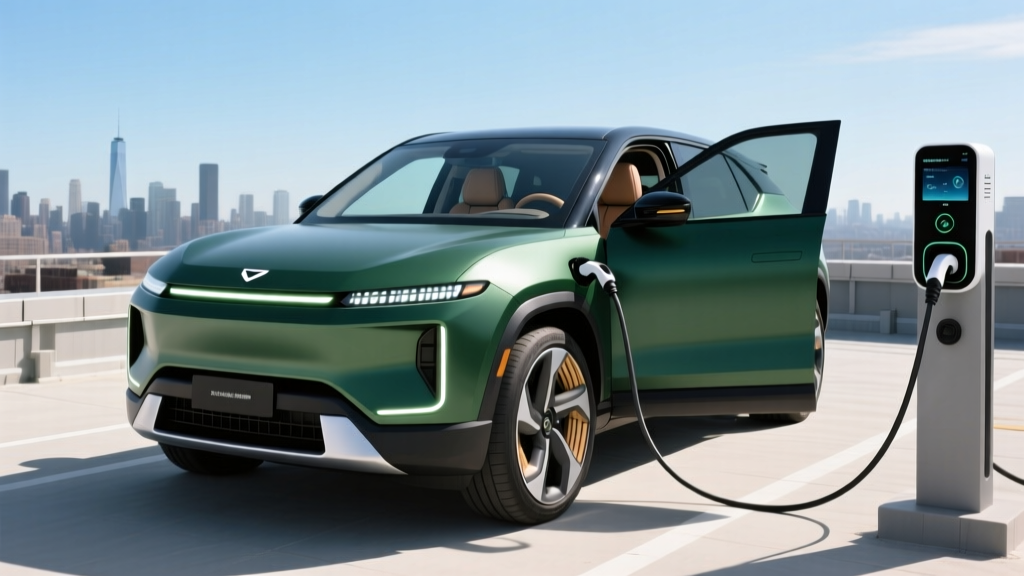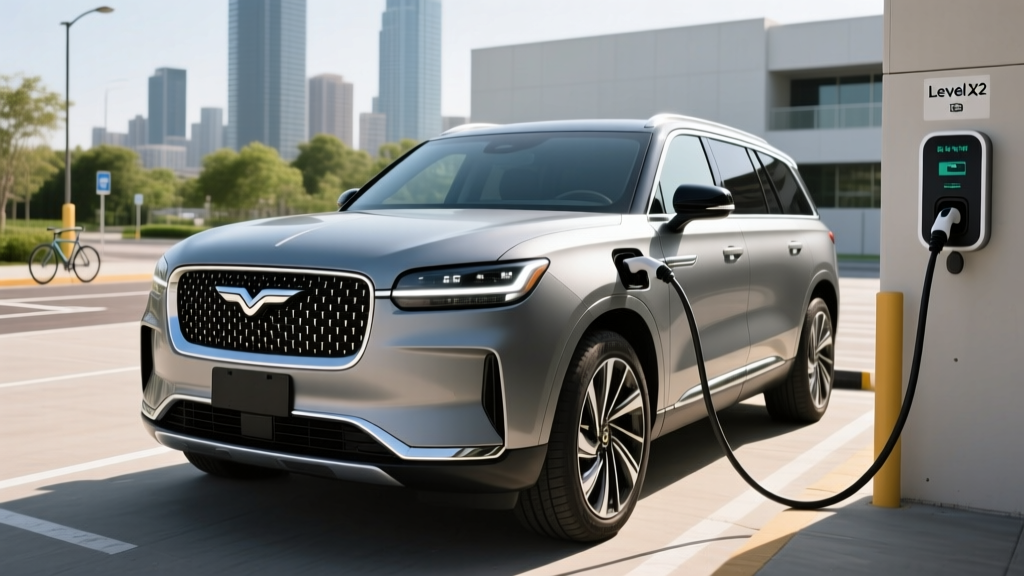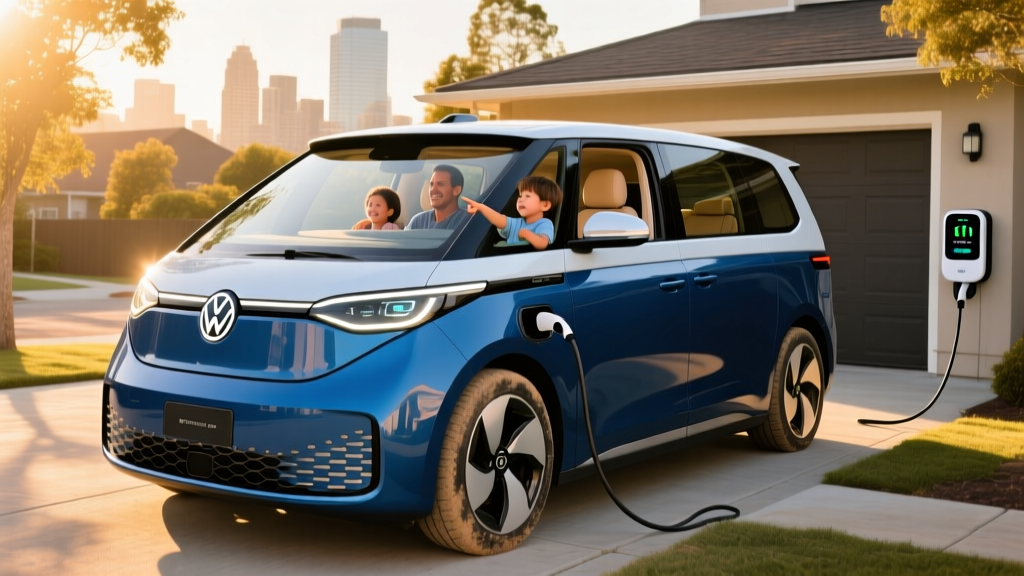
The Volkswagen ID. Buzz doesn't just trade on nostalgia — it attempts something the U.S. market hasn't seen in years: a spacious, three-row electric passenger van built for families who refuse to default to a crossover. After spending time with the 2026 model year, the Buzz delivers on interior volume and ride comfort but asks buyers to accept trade-offs in range and fast-charging speed that matter for road-tripping households.
This review breaks down every number that matters — EPA range versus what you'll actually see on the highway, the realities of its 170 kW charge curve, tax-credit eligibility under current IRS §30D rules, and how it stacks up against the Kia EV9 and other three-row electric alternatives.
2026 ID. Buzz: Quick Specs at a Glance
| Spec | RWD Standard | AWD (4MOTION) |
|---|---|---|
| EPA Range | 234 miles | 231 miles |
| Battery (usable) | 91 kWh (NMC) | |
| Peak DC Fast Charge | 170 kW (CCS1) | |
| 10–80% DCFC Time | ~26 minutes | |
| Level 2 Home Charging | 11 kW (~32 mi/hr) | |
| Horsepower | 282 hp | 335 hp |
| 0–60 mph | 7.9 sec (est.) | 5.7 sec |
| Drivetrain | Rear-Wheel Drive | Dual-Motor AWD |
| MPGe (combined) | 87 MPGe | 85 MPGe |
| Efficiency | ~39 kWh/100 mi | ~40 kWh/100 mi |
| Seating | 6 or 7 passengers | |
| Cargo (behind 3rd row) | 18.5 cu ft | |
| Cargo (max, seats folded) | ~134 cu ft | |
| Base MSRP | ~$59,995 | ~$64,495 |
| Battery Warranty | 8 years / 100,000 miles (70% capacity) | |
Range Reality: What the EPA Sticker Doesn't Tell You
Real-World Expectation: 200–215 miles on mixed highway driving; 170–190 miles in sub-40°F weather or sustained 75+ mph Interstate runs.
The ID. Buzz carries a 91 kWh usable battery pack using NMC (nickel manganese cobalt) chemistry — chosen for its higher energy density, which matters in a vehicle this size. The EPA rates the RWD model at 234 miles and the AWD at 231 miles. Those numbers are competitive for a 6,000-pound box on wheels but trail the Kia EV9 Long Range (304 miles EPA) significantly.
In real-world driving, the Buzz's aerodynamics work against it. At highway speeds above 70 mph, the flat windshield and upright stance push consumption closer to 42–45 kWh/100 mi, dropping effective range to roughly 200 miles. In cold weather — say, a Minnesota January at 20°F — expect an additional 15–25% loss depending on cabin heat usage. The Buzz uses a heat pump (standard on U.S. trims), which mitigates cold-weather losses compared to resistive heating, but the laws of physics still apply to a vehicle with the frontal area of a small building.
For daily commuting and school runs under 80 miles round-trip, the Buzz's range is a non-issue — you'll charge at home and rarely think about it. For road trips exceeding 200 miles, route planning around DC fast chargers becomes mandatory.
Charging Speed: DC Fast, Level 2, and the Curve
| Charging Level | Power (kW) | Speed (mi/hr added) | Notes |
|---|---|---|---|
| Level 1 (120V) | ~1.4 kW | ~3–4 mi/hr | Emergency/trickle only |
| Level 2 (240V, 48A) | 11 kW | ~32 mi/hr | Full charge in ~9.5 hours |
| DC Fast (peak) | 170 kW | — | 10–80% in ~26 min |
| DC Fast (sustained avg.) | ~120–130 kW | — | Curve tapers sharply above 80% |
The ID. Buzz peaks at 170 kW on a DC fast charger using its CCS1 connector. That's respectable but not class-leading — the Hyundai Ioniq 5 and Kia EV9 both hit 235–240 kW on 800V architectures, making their 10–80% sprints closer to 18 minutes.
Here's what the spec sheet doesn't show: the charge curve. The Buzz hits its 170 kW peak around 20–30% State of Charge (SoC) and sustains strong speeds through roughly 55%, after which the rate begins tapering. By 80%, you're looking at roughly 60–70 kW. The 10–80% time of approximately 26 minutes is based on VW's testing at optimal battery temperature with preconditioning active.
Preconditioning matters. The Buzz will warm its battery pack when you navigate to a DC fast charger in the infotainment system, bringing the pack to the ideal temperature window for maximum charge acceptance. Skip this step on a cold morning and your peak rate may drop to 120 kW or lower until the pack warms up.
At home on a Level 2 charger (240V, 48 amps), the 11 kW onboard charger adds roughly 32 miles of range per hour — meaning a full 0–100% charge takes about 9.5 hours. Plan on plugging in overnight, and you'll wake up full every morning. A Level 2 home charger installation typically costs $500–$2,000 depending on your electrical panel's capacity and distance from the panel to your parking spot.
VW has not yet adopted the NACS (Tesla) connector for the ID. Buzz in North America, meaning you'll need a CCS-to-NACS adapter to access Tesla Superchargers. VW has confirmed NACS adoption for future model years, but 2026 models ship with CCS1.
Performance and Driving Impressions
The RWD ID. Buzz puts 282 horsepower to the rear wheels via a single APP550 electric motor mounted on the rear axle. The 0–60 mph time lands around 7.9 seconds — adequate for merging and passing, but this is a vehicle that rewards calm inputs over aggressive ones. The steering is light, the turning circle is surprisingly tight for its length, and regenerative braking offers adjustable levels (though not true one-pedal driving to a full stop in all conditions).
The AWD 4MOTION variant adds a front motor for a combined 335 hp and drops the 0–60 time to approximately 5.7 seconds. That's genuinely quick for a three-row van and makes highway overtaking effortless. The dual-motor setup also provides meaningful traction improvement in rain and snow, which matters if you live above the 38th parallel.
Ride quality is where the Buzz shines. The long wheelbase (117.5 inches for the U.S. long-wheelbase version) absorbs highway imperfections with a composed, planted feel that most three-row crossovers can't match. Body roll is well-controlled for a tall vehicle, and the low center of gravity from the floor-mounted battery pack keeps things stable through curves.
Interior Space, Tech, and Daily Livability
The ID. Buzz's interior is its strongest selling point. The U.S.-spec long-wheelbase model offers seating for up to seven passengers (2+3+2 layout) or six with second-row captain's chairs. Third-row legroom is genuinely adult-friendly at approximately 36 inches — a claim most three-row crossovers, including the Tesla Model X, struggle to make.
Cargo volume behind the third row sits at 18.5 cubic feet — enough for a week's groceries or a couple of carry-on bags. Fold the third row and you unlock roughly 75 cubic feet; fold both rear rows and the Buzz opens up to approximately 134 cubic feet of flat-load space. That minivan-like utility is exactly what many EV families have been missing.
The infotainment system runs VW's ID. Software 4.0 on a 12.9-inch central touchscreen. It's a significant improvement over the ID.4's original software — faster, more responsive, with wireless Apple CarPlay and Android Auto standard. However, VW's reliance on touch-sensitive sliders for volume and temperature remains a frustration; they lack backlighting and are easy to miss while driving.
Driver-assistance technology includes VW's IQ.DRIVE suite: adaptive cruise control with stop-and-go, lane-centering assist, front and rear automatic emergency braking, and Park Assist. This is SAE Level 2 driver assistance — you must keep your hands on the wheel and eyes on the road. It works well on Interstate highways but is not a substitute for an attentive driver.
Pricing, Trims, and Federal Tax Credit Eligibility
| Trim | Drivetrain | MSRP | §30D Credit Eligible? | Effective Price (est.) |
|---|---|---|---|---|
| Pro S (RWD) | RWD | ~$59,995 | Check sourcing rules | ~$52,495–$59,995 |
| Pro S (AWD) | AWD | ~$64,495 | Check sourcing rules | ~$56,995–$64,495 |
| Pro S Plus (RWD) | RWD | ~$65,495 | Check sourcing rules | ~$57,995–$65,495 |
| 1st Edition (AWD) | AWD | ~$69,995 | Check sourcing rules | ~$62,495–$69,995 |
The ID. Buzz qualifies as a van/SUV under IRS classifications, meaning the $80,000 MSRP cap for the §30D federal tax credit applies — all trims clear that threshold comfortably. However, eligibility for the full $7,500 credit depends on two factors that shift frequently:
- Battery sourcing and critical minerals: The battery pack must meet escalating percentages of U.S.-sourced or FTA-partner-sourced critical minerals and battery components. VW manufactures the ID. Buzz in Hannover, Germany, and battery cell sourcing has been a moving target for imported EVs. Check the current fueleconomy.gov eligibility list before purchasing.
- Buyer income caps: Modified adjusted gross income cannot exceed $300,000 (joint filers), $225,000 (head of household), or $150,000 (single). This applies to all §30D claims.
If eligible, the $7,500 credit can now be transferred to the dealer at the point of sale under current IRS rules, reducing your purchase price on the spot rather than waiting until tax filing. Always confirm eligibility with your dealer and cross-reference with the IRS clean vehicle credit page, as sourcing requirements tighten annually.
How It Compares: ID. Buzz vs. the Three-Row EV Field
The ID. Buzz occupies a unique position — it's the only electric van in the U.S. market. But buyers cross-shop it against three-row electric SUVs:
- Kia EV9: Starts lower (~$54,900), offers up to 304 miles EPA range, charges at 235 kW (800V architecture), and qualifies for the full $7,500 credit (U.S.-assembled in Georgia). The EV9 is the pragmatic choice if range and charging speed top your list.
- Tesla Model X: Starts around $79,990, offers 311–348 miles EPA range, and accesses the Supercharger network natively. But it's far more expensive, and third-row space is cramped compared to the Buzz.
- Rivian R1S: Premium off-road-capable three-row SUV starting around $79,900. Superior in performance and adventure capability, but at a much higher price point.
The Buzz wins on interior volume, ride comfort, and the simple joy of its design. It loses on range, charging speed, and price-per-mile of range. If you need a road-trip warrior, the EV9 or Model X is the better tool. If you need a spacious daily family hauler with personality and can charge at home, the Buzz makes a compelling case.
Battery Warranty and Long-Term Ownership
Volkswagen covers the ID. Buzz battery pack for 8 years or 100,000 miles, whichever comes first, against defects and capacity loss below 70% of original capacity. This is industry-standard and matches most competitors. The powertrain (motors, reduction gear, power electronics) carries the same 8-year/100,000-mile coverage.
The vehicle limited warranty is 4 years / 50,000 miles. VW also includes 3 years / 36,000 miles of scheduled maintenance and 3 years of roadside assistance.
NMC battery chemistry typically shows 8–12% degradation over the first 100,000 miles based on industry data from similar packs. To maximize longevity, avoid routinely charging to 100% or depleting below 10% — keeping the pack in the 20–80% SoC window for daily use reduces stress on the cells. The built-in battery management system and liquid thermal management help mitigate degradation, but owner habits still matter.
Pros
- Class-leading interior volume and genuine adult-friendly third row
- Smooth, composed ride quality unmatched by crossover competitors
- Distinctive design with strong curb appeal and heritage connection
- AWD option with 335 hp and 5.7-sec 0–60 is genuinely quick
- Heat pump standard for better cold-weather efficiency
- Up to ~134 cu ft cargo with seats folded — minivan utility
Cons
- 234-mile EPA range trails competitors (Kia EV9: 304 mi)
- 170 kW peak DC charging is slower than 800V rivals (235+ kW)
- Starting price near $60K is steep for the range offered
- Touch-sensitive volume/temp sliders are a usability frustration
- CCS1 connector requires adapter for Tesla Supercharger access
- No frunk (front trunk) — charge cables and accessories eat cargo space
Who Should Buy the 2026 ID. Buzz?
Buy the ID. Buzz if: You need genuine three-row seating for adults, value interior volume and ride comfort over maximum range, can charge at home most nights, and want a vehicle with personality that stands apart from the crossover crowd. It's ideal as a family daily driver, school-run hauler, and weekend cargo mover.
Look elsewhere if: You regularly road-trip more than 200 miles between stops, need the fastest possible DC charging, want to minimize cost-per-mile-of-range, or require native Supercharger access without adapters. The Kia EV9 or Tesla Model X better serves the long-distance family.
Frequently Asked Questions
What is the real-world range of the VW ID. Buzz?
The EPA rates the RWD ID. Buzz at 234 miles and the AWD at 231 miles. In real-world mixed highway driving at 70–75 mph, expect roughly 200–215 miles. In cold weather below 40°F, plan for 170–190 miles due to battery chemistry limitations and cabin heating demand, even with the standard heat pump.
How fast does the ID. Buzz charge at home and on the road?
At home on a 240V Level 2 charger, the Buzz charges at up to 11 kW, adding about 32 miles of range per hour for a full charge in roughly 9.5 hours. On a DC fast charger, it peaks at 170 kW, achieving a 10–80% charge in approximately 26 minutes under optimal conditions. Charging slows significantly above 80% SoC.
How much does the ID. Buzz cost after the federal tax credit?
The base RWD Pro S starts at approximately $59,995. If you qualify for the full $7,500 §30D federal tax credit (subject to income caps, MSRP caps, and battery-sourcing requirements), the effective price drops to roughly $52,495. Eligibility depends on current IRS sourcing rules — always verify on fueleconomy.gov before purchasing, as imported vehicles face stricter sourcing scrutiny.
Does the ID. Buzz qualify for the $7,500 federal EV tax credit?
It may, but eligibility is not guaranteed. The ID. Buzz is assembled in Germany, and the §30D credit requires specific percentages of battery components and critical minerals to be sourced from the U.S. or FTA-partner countries. These thresholds increase annually. Check the current eligibility list and consult a tax professional for your specific situation.
Is the ID. Buzz worth buying over the Kia EV9?
It depends on your priorities. The EV9 offers more range (304 vs. 234 miles), faster DC charging (235 vs. 170 kW), a lower starting price, and currently stronger tax-credit eligibility (U.S. assembly). The ID. Buzz offers more interior volume, a more comfortable ride, a usable third row for adults, and a design with genuine character. For daily family use with home charging, the Buzz is excellent. For road-trip-heavy households, the EV9 is the pragmatic pick.
Can the ID. Buzz tow?
The AWD ID. Buzz has a towing capacity of approximately 2,500 pounds — enough for a small utility trailer or a pair of jet skis, but not suitable for most travel trailers or boats. The RWD model has a lower tow rating. If towing is a priority, look at the Rivian R1S (7,700 lb) or Tesla Model X (5,000 lb).
Is the ID. Buzz self-driving?
No. The ID. Buzz's IQ.DRIVE system is SAE Level 2 driver assistance — it can manage steering, acceleration, and braking on highways, but the driver must remain fully engaged with hands on the wheel and eyes on the road. It is not an autonomous vehicle.