Why the VW ID Buzz Production Halt Matters Now
If you've been tracking the VW ID Buzz — Volkswagen's retro-styled electric microbus revived for the modern era — you've likely seen the headlines about the VW ID Buzz production halt affecting European and U.S. delivery timelines. The pause, tied to software validation and supply-chain recalibration at VW's Hanover plant, has pushed many 2026 model-year orders into uncertain territory. But for buyers who can still secure a unit from dealer inventory or who are weighing whether to hold their reservation, the fundamental question remains: is the ID Buzz the right electric family hauler?
This review covers everything you need to know about the U.S.-spec long-wheelbase ID Buzz, from its real-world range and charging behavior to pricing, tax credit eligibility, and how it stacks up against three-row EV rivals like the Kia EV9 and Rivian R1S.
Specs at a Glance: 2025–2026 VW ID Buzz (U.S. LWB)
| Attribute | Specification |
|---|---|
| EPA Estimated Range | 234 miles (RWD), 231 miles (AWD) |
| Battery Capacity | 91 kWh usable (NMC chemistry) |
| Drivetrain | RWD (single motor) or AWD (dual motor) |
| Horsepower | 282 hp (RWD) / 335 hp (AWD) |
| 0–60 mph | 7.9 sec (RWD) / 5.9 sec (AWD) |
| Max DC Fast Charge | 175 kW peak |
| 10–80% DC Charge Time | ~26 minutes (under ideal conditions) |
| Level 2 Home Charge Rate | 11 kW AC (~27 miles/hr) |
| Efficiency | 89 MPGe combined / 34 kWh/100 mi (RWD est.) |
| Seating | 7 passengers (3 rows) |
| Cargo (behind 3rd row) | 18.5 cu ft |
| Cargo (3rd row folded) | 75.4 cu ft |
| Base MSRP | $59,995 (Pro S RWD) |
| Battery/Powertrain Warranty | 8 years / 100,000 miles |
Real-World Range: What to Actually Expect
EPA Sticker: 234 miles (RWD) / 231 miles (AWD)
Real-World Expectation: Plan for 190–210 miles on highway road trips at 70+ mph. In cold weather (below 35°F), expect a further 15–25% reduction, bringing effective range to roughly 155–180 miles. City driving with regenerative braking recovers more energy, often yielding 220+ miles in mild conditions.
The ID Buzz's boxy aerodynamics work against it at highway speeds. Its frontal area and upright windshield create substantially more drag than a sleeker crossover like the Kia EV9 (which achieves 279 miles EPA from a similarly sized battery). Around town, where speeds are lower and regen braking recaptures energy effectively, the gap narrows. But if your use case involves regular 200-mile interstate drives, you'll be stopping to charge more often than the EPA number suggests.
According to fueleconomy.gov, the ID Buzz RWD posts 89 MPGe combined. That translates to roughly 34 kWh consumed per 100 miles of mixed driving — on the thirstier side for a modern EV, again a consequence of its van proportions.
Charging Speed and Home Setup
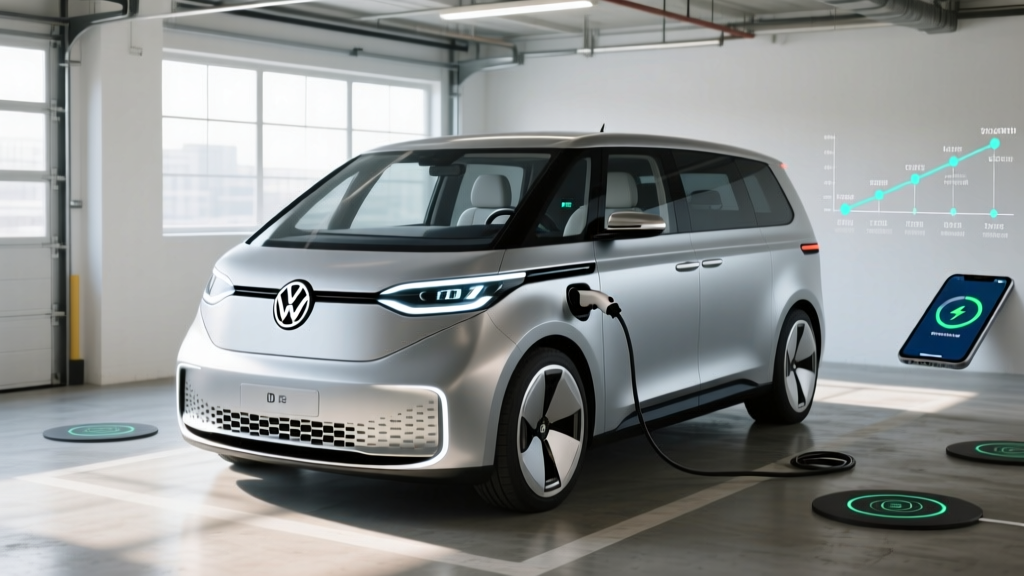
The ID Buzz supports a peak DC fast-charge rate of 175 kW via its CCS connector (NACS adapter availability through Volkswagen's charging partnerships is expanding for the 2026 model year). Under optimal battery preconditioning — which the ID Buzz initiates when you navigate to a charger via the built-in route planner — a 10–80% session takes approximately 26 minutes.
However, real-world charging curves tell a more nuanced story. The 175 kW peak is sustained only briefly between roughly 15–35% state of charge. Above 60%, the rate tapers significantly, dropping below 80 kW by 70% SoC and slowing further past 80%. If you arrive at a charger with a very low battery (under 10%), the initial ramp-up may also take a minute or two before hitting peak rate.
| Charging Level | Power | Speed (Approx.) | Use Case |
|---|---|---|---|
| Level 1 (120V) | 1.4 kW | ~3–4 miles/hr | Emergency / overnight trickle |
| Level 2 (240V, 48A) | 11 kW | ~27 miles/hr | Home daily charging |
| DC Fast Charge | 175 kW peak | 10–80% in ~26 min | Road trips, rapid top-ups |
For home charging, the ID Buzz's 11 kW onboard AC charger is competitive. On a properly installed 240V / 48-amp Level 2 circuit (such as a ChargePoint Home Flex or Wallbox Pulsar Plus), you'll recover roughly 27 miles of range per hour, meaning a full overnight session (8–10 hours) easily replenishes the entire battery. Installation costs for a Level 2 home setup typically range from $500 to $2,000 depending on panel proximity and whether your electrical panel requires an upgrade to 200 amps.
Pricing, Trims, and Federal Tax Credit Eligibility
The U.S.-spec ID Buzz launched in three trim levels:
- Pro S (RWD): $59,995 MSRP
- Pro S Plus (RWD): $63,495 MSRP
- 1st Edition (AWD): $69,995 MSRP
Destination charges add approximately $1,395. Fully optioned, a 1st Edition can approach $73,000 out the door before incentives.
| Trim | MSRP | Est. After §30D Credit* | Eligible? |
|---|---|---|---|
| Pro S RWD | $59,995 | $52,495 | See caveats below |
| Pro S Plus RWD | $63,495 | $55,995 | See caveats below |
| 1st Edition AWD | $69,995 | $62,495 | See caveats below |
*Federal tax credit eligibility under IRS §30D is not guaranteed and depends on multiple factors:
- MSRP Cap: Vans and SUVs must be under $80,000 MSRP. All current ID Buzz trims clear this threshold.
- Buyer Income Cap: Adjusted gross income must not exceed $150,000 (single), $225,000 (head of household), or $300,000 (joint filing).
- Battery Sourcing: Critical minerals and battery components must meet escalating percentage thresholds from qualifying trade partners. Volkswagen has indicated compliance for U.S.-delivered units, but buyers should verify VIN eligibility via the IRS's official tool or their dealer at point of sale.
- Point-of-Sale Transfer: As of 2024, qualifying buyers can transfer the credit to the dealer at purchase, reducing the purchase price directly rather than waiting for a tax refund.
Given the production halt, buyers securing a 2025 or early 2026 unit from existing inventory should confirm credit eligibility before signing — VIN-specific verification is the only reliable method.
Driving, Performance, and Technology
The ID Buzz is not a performance vehicle, and it doesn't pretend to be. The RWD model's 282 hp and 7.9-second 0–60 time are adequate for merging and passing but won't win drag races. The AWD variant's 335 hp and 5.9-second sprint feel noticeably more confident, especially when the van is loaded with passengers and cargo.
Ride quality is a genuine strength. The long wheelbase (127.5 inches on the U.S. LWB) and soft suspension tuning absorb highway imperfections well, and the turning circle — while not tight — is manageable for a vehicle of this size. The rear-wheel-drive architecture gives it a tighter turning radius than many three-row SUVs.
Tech highlights include:
- 12.9-inch central infotainment display with wireless Apple CarPlay and Android Auto
- Digital cockpit with customizable instrument cluster
- IQ.DRIVE suite: adaptive cruise control, lane centering, automatic emergency braking, blind-spot monitoring
- Available head-up display and Harman Kardon premium audio
- Power sliding doors with hands-free opening
- Available panoramic glass roof with electrochromic dimming
Notable drawbacks:
- Infotainment software has drawn criticism for sluggish response times and unintuitive menu nesting — VW has issued OTA updates to address some complaints, but the system still trails competitors like Hyundai/Kia in usability.
- Touch-capacitive sliders for volume and climate have proven divisive; many owners prefer physical controls.
- Third-row legroom (33.5 inches) is tight for adults on longer trips. This is a 5-adults-plus-2-kids vehicle, not a true 7-adult hauler.
- No frunk (front trunk). All cargo space is in the rear.
Pros, Cons, and the Production Halt Context
Pros
- Iconic retro design with genuine road presence and conversation-starting appeal
- Spacious, versatile cabin with configurable seating and excellent outward visibility
- Smooth, quiet ride quality ideal for family duty
- Competitive Level 2 home charging speed (11 kW)
- AWD available with respectable 5.9-sec 0–60
- Power sliding doors are a game-changer for tight parking spots with kids
Cons
- Range is modest for the battery size — 234 mi EPA trails rivals
- Highway efficiency suffers due to aerodynamic drag
- 175 kW peak DC charge rate is outpaced by Hyundai/Kia's 800V architecture (240+ kW)
- Infotainment software still lags behind class leaders
- Pricing pushes into luxury territory without luxury badge cachet
- Third row is cramped for adults
- Production halt introduces delivery uncertainty and potential wait times of 6+ months
The VW ID Buzz production halt compounds the pricing concern. With limited units reaching U.S. shores, dealer markups have been reported in several markets. If you're committed to the ID Buzz, locking in a price via a reservation with a transparent dealer — and getting MSRP or close to it in writing — is essential. Don't pay over sticker for a vehicle whose range and charging specs, while good, aren't class-leading.
How It Compares: ID Buzz vs. Key Rivals
The ID Buzz occupies a unique niche. No other EV on the U.S. market offers this exact combination of minivan practicality, retro character, and electric drivetrain. But buyers cross-shopping it will likely encounter these alternatives:
- Kia EV9 (3-row SUV): 279 mi EPA range, 240 kW DC charging, starting ~$54,900. More efficient, charges faster, less cargo volume but more car-like dynamics.
- Rivian R1S (3-row SUV): Up to 410 mi EPA (Max Pack), 200+ kW charging, starting ~$79,900. Far more range and off-road capability, but significantly more expensive.
- Chrysler Pacifica PHEV (minivan): 32 mi electric-only range, then hybrid. Not a BEV, but the only plug-in minivan alternative with established availability and no range anxiety for road trips.
If the ID Buzz's charm, sliding doors, and van-format cargo area resonate with your family's needs, it has no direct equivalent. If you prioritize range and charging speed above all else, the EV9 is the more rational choice.
Who Should Buy the VW ID Buzz?
The ID Buzz is best suited for:
- Suburban families who need three rows, value easy kid-loading via power sliding doors, and can charge at home nightly.
- Lifestyle buyers who want something distinctive and are willing to accept range trade-offs for character.
- Urban and suburban commuters whose daily drives fall well within the 190–210 mile real-world envelope and who rarely road-trip beyond 150 miles one-way.
It is not ideal for:
- Frequent long-distance road trippers (the 234-mile EPA range and 175 kW charge rate mean more stops and longer waits than rivals).
- Buyers in extreme cold climates where winter range loss could push effective range below 160 miles.
- Those who need to tow — the ID Buzz is not rated for significant towing (est. 2,500 lbs max, well behind the Rivian R1S or EV9).
Frequently Asked Questions
What is the real-world range of the VW ID Buzz?
The EPA rates the ID Buzz RWD at 234 miles and AWD at 231 miles. In real-world highway driving at 70+ mph, expect 190–210 miles. In cold weather below 35°F, plan for 155–180 miles.
How fast does the ID Buzz charge?
On DC fast charging, it peaks at 175 kW, achieving a 10–80% charge in roughly 26 minutes under ideal conditions. At home on a Level 2 (240V, 48A) charger, it adds about 27 miles of range per hour, fully charging overnight in 8–10 hours.
Does the VW ID Buzz qualify for the federal EV tax credit?
It may qualify for up to $7,500 under IRS §30D, but eligibility depends on your income, the vehicle's MSRP (all trims are under the $80,000 van cap), and battery sourcing compliance. Verify your specific VIN's eligibility via the IRS tool or your dealer before purchase.
How much does the ID Buzz cost after incentives?
The base Pro S RWD starts at $59,995. With the full $7,500 federal credit, that drops to $52,495. State and local incentives may reduce the cost further — check your jurisdiction's programs via afdc.energy.gov.
Is the VW ID Buzz worth buying vs. the Kia EV9?
If you prioritize character, sliding doors, and van-format cargo flexibility, the ID Buzz is unique. If range (279 mi EPA), faster charging (240 kW), and lower starting price matter more, the EV9 is the more practical choice.
What impact does the production halt have on availability?
The VW ID Buzz production halt has delayed deliveries and constrained U.S. inventory. Some buyers face 4–8 month waits. If you can secure a unit at or near MSRP from existing stock, it may be worth acting; otherwise, monitor Volkswagen's production updates and consider rival vehicles in the interim.
What is the battery warranty on the ID Buzz?
Volkswagen covers the high-voltage battery and electric powertrain for 8 years or 100,000 miles, whichever comes first. The warranty guarantees the battery will retain at least 70% of its original capacity during that period.