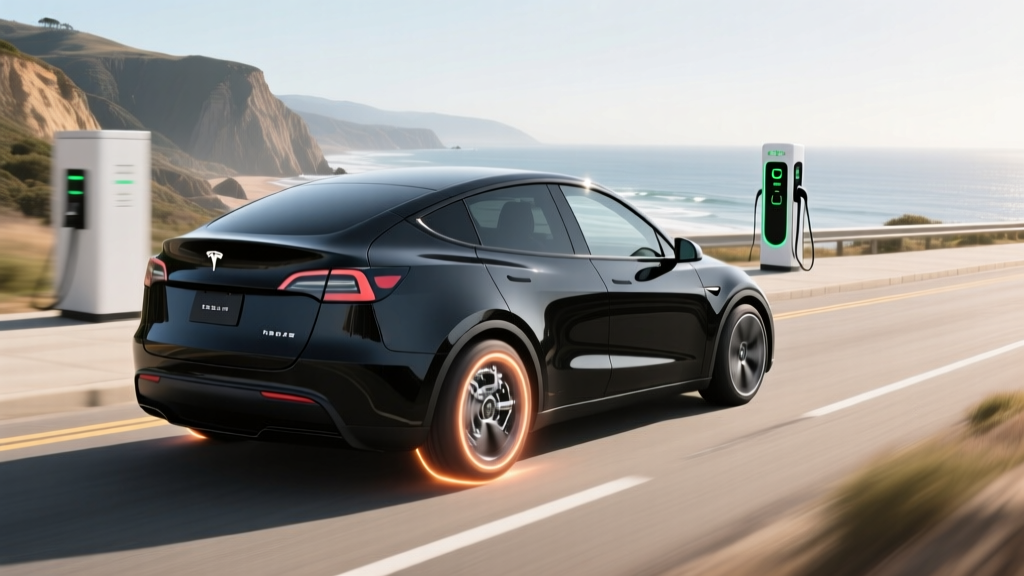
The phrase "Tesla one wheel" might sound like a futuristic concept, but for thousands of buyers searching for the most affordable Tesla, it points to something very real: a single-motor, rear-wheel-drive Tesla that sends power to just one axle. In 2026, that entry point is the Tesla Model Y Rear-Wheel Drive — the base trim that strips away the dual-motor complexity and delivers a compelling, if slightly compromised, electric crossover.
This review covers the single-motor Model Y RWD in detail: its real-world range, LFP battery behavior, charging speeds, pricing after federal tax credits, and whether saving $4,000–$5,000 over the Long Range AWD is worth the trade-offs.
Quick Verdict: Who Should Consider the Single-Motor Model Y?
The Model Y RWD exists for a specific buyer: someone who wants Tesla's Supercharger network, software ecosystem, and crossover utility at the lowest possible price. If you live in a mild climate, commute under 50 miles round-trip, and rarely road-trip in winter, the single-motor variant makes strong financial sense. If you need all-wheel drive for snow, tow regularly, or want maximum range for cross-country drives, the Long Range or Performance trims are worth the premium.
- You want the lowest MSRP in the Tesla lineup
- You live in a region with mild winters (rare snow/ice)
- Your daily commute is under 60 miles
- You value LFP battery longevity and 100% daily charging
- You regularly drive in snow or heavy rain
- You need 300+ miles of EPA range for road trips
- You tow (3,500 lb vs. no official tow rating on RWD)
- You want sub-5-second 0–60 acceleration
Range, Battery, and Efficiency: The LFP Advantage
| Spec | Model Y RWD (2026) |
|---|---|
| EPA Range | 260 miles |
| Battery Capacity (usable) | ~60 kWh |
| Battery Chemistry | LFP (Lithium Iron Phosphate) |
| Efficiency | 125 MPGe / 27 kWh/100 mi |
| Drivetrain | Rear-Wheel Drive (single motor) |
| 0–60 mph | 6.6 seconds |
| Horsepower | 295 hp |
| Battery Warranty | 8 years / 100,000 miles |
| Base MSRP | $39,990 |
Real-world expectation: In mixed suburban/highway driving at 65–70 mph, expect roughly 230–245 miles on a full charge. In cold weather (below 32°F), range drops to approximately 185–210 miles due to cabin heating demands and battery resistance. City driving with regen braking can push closer to the 260-mile sticker, and occasionally beyond in stop-and-go traffic.
Source: EPA Fuel Economy Guide
The Model Y RWD uses an LFP (lithium iron phosphate) battery pack, a chemistry that trades energy density for longevity and safety. Unlike NMC (nickel manganese cobalt) packs in the Long Range, LFP cells tolerate daily charging to 100% without accelerated degradation. Tesla explicitly recommends setting the charge limit to 100% at least once per week on LFP vehicles to keep the battery management system calibrated.
The trade-off: LFP batteries are heavier per kWh and lose more range in cold weather compared to NMC. On a 15°F morning, you might see 30–35% range reduction versus 20–25% on the NMC Long Range. If you garage your car and precondition before departure, this penalty shrinks considerably.
Charging Speed: DC Fast, Level 2, and the Supercharger Network
| Charging Method | Power (kW) | Speed | Notes |
|---|---|---|---|
| DC Fast Charge (peak) | 170 kW | 10–80% in ~25 minutes | Sustains ~100 kW above 50% SoC |
| Tesla Supercharger V3 | 170 kW max | ~165 miles in 15 min | Preconditioning required for peak |
| Level 2 (240V, 48A) | 11.5 kW | ~44 miles per hour | Full charge in ~5.5 hours |
| Level 2 (240V, 32A) | 7.7 kW | ~30 miles per hour | Common with Mobile Connector |
| Level 1 (120V) | ~1.4 kW | ~5 miles per hour | Overnight trickle only |
The single-motor Model Y peaks at 170 kW on DC fast chargers — a meaningful step below the Long Range's 250 kW capability. In practice, the charge curve holds above 120 kW until roughly 40% state of charge, then tapers through the 50–80% window. A 10–80% session takes approximately 25 minutes at a V3 Supercharger, versus 18–20 minutes for the Long Range.
For home charging, the onboard charger accepts up to 11.5 kW (48 amps) on a 60-amp circuit. Most owners install a Tesla Wall Connector ($475 for hardware) on a NEMA 14-60 or hardwired 60A circuit. Expect $800–$1,500 for a professional installation depending on panel proximity and local permit fees. If your electrical panel is at capacity, a 200-amp service upgrade can add $1,500–$3,000.
One practical note: preconditioning matters. If you navigate to a Supercharger using the Tesla app or in-car nav, the battery thermal management system warms the pack en route, enabling faster charging on arrival. Without preconditioning — say, plugging into a third-party Electrify America station cold — peak rates may be limited to 80–100 kW for the first several minutes.
Performance and Driving Dynamics
The single rear-mounted motor produces 295 horsepower and launches the Model Y RWD to 60 mph in 6.6 seconds. That's brisk by any crossover standard — quicker than a base Toyota RAV4 or Honda CR-V — but noticeably softer than the Long Range AWD's 4.8-second sprint.
On the road, the RWD model feels balanced and predictable. The low center of gravity (battery pack under the floor) keeps body roll minimal through corners. Regenerative braking is strong enough for one-pedal driving in most conditions, though Tesla no longer offers a low-regen toggle on new vehicles.
The limitation: traction in wet and snowy conditions. With power sent only to the rear wheels and instant electric torque, the RWD Model Y can break traction more easily than AWD variants on slick surfaces. Winter tires help significantly, but if you live in Minnesota, Colorado, or anywhere with sustained winter precipitation, AWD is a practical necessity, not a luxury.
Interior, Cargo, and Technology
The 2026 Model Y "Juniper" refresh brought meaningful interior upgrades: ventilated front seats, ambient lighting, a rear touchscreen for passengers, power-folding second-row seats, and improved acoustic glass. These updates apply across all trims, including the RWD.
| Dimension | Model Y RWD |
|---|---|
| Cargo (behind 2nd row) | 30.2 cu ft |
| Cargo (2nd row folded) | 72.1 cu ft |
| Front Legroom | 41.8 in |
| Rear Legroom | 37.5 in |
| Seating | 5 passengers |
The 15.4-inch center touchscreen handles infotainment, climate, and vehicle settings. Wireless Apple CarPlay is not supported — Tesla uses its own interface with Spotify, Apple Music, and Tidal built in. The Tesla mobile app provides remote climate control, charging status, location tracking, and Summon (low-speed parking lot maneuvering).
On the driver-assistance front, every Model Y ships with Tesla Autopilot, which includes Traffic-Aware Cruise Control and Autosteer (lane centering). This is an SAE Level 2 system: it assists with steering and speed, but you must keep your hands on the wheel and eyes on the road at all times. Full Self-Driving (Supervised) remains an $8,000 option or $99/month subscription and is still Level 2 — it does not make the car autonomous.
Pricing, Tax Credits, and Total Cost
| Item | Amount |
|---|---|
| Base MSRP (Model Y RWD) | $39,990 |
| Destination Fee | $1,390 |
| Federal Tax Credit (§30D) | Up to $7,500 (eligibility varies) |
| Estimated Price After Credit | ~$33,880 (if fully eligible) |
| As-Tested (with FSD, Red Paint, 20" Wheels) | ~$51,880 |
The federal EV tax credit under IRS §30D can reduce your effective cost by up to $7,500, but eligibility depends on several factors that change annually:
- MSRP Cap: SUVs/crossovers must be under $80,000 — the Model Y qualifies at all trims.
- Income Cap: Modified AGI must not exceed $150,000 (single), $225,000 (head of household), or $300,000 (joint). Exceed these, and the credit phases to zero.
- Battery Sourcing: The $7,500 credit splits into two halves — $3,750 for critical-mineral sourcing and $3,750 for battery-component manufacturing. As of 2026, vehicles with any battery components from a "foreign entity of concern" (FEOC, primarily Chinese suppliers) lose the component half. Check Tesla's current sourcing disclosures.
- Point-of-Sale Transfer: Since 2024, you can transfer the credit to the dealer at purchase, reducing the sticker price directly rather than waiting for a tax refund.
For a buyer in the 22% federal tax bracket who qualifies fully, the effective purchase price drops below $34,000 — competitive with a well-equipped RAV4 Hybrid when you factor in fuel savings and lower maintenance. However, verify your eligibility with a tax professional before relying on the credit in your budget.
Model Y RWD vs. Key Competitors
| Spec | Tesla Model Y RWD | Hyundai Ioniq 5 SE (RWD) | Ford Mustang Mach-E Select (RWD) |
|---|---|---|---|
| EPA Range | 260 mi | 290 mi | 250 mi |
| Battery | 60 kWh LFP | 77.4 kWh NMC | 75.7 kWh NMC |
| DC Fast Charge | 170 kW | 240 kW | 150 kW |
| 10–80% Time | ~25 min | ~18 min | ~30 min |
| 0–60 mph | 6.6 sec | 7.2 sec | 6.3 sec |
| Base MSRP | $39,990 | $42,600 | $42,995 |
| Charging Network | Tesla Supercharger (native) | NACS adapter / Supercharger access | NACS adapter / Supercharger access |
| Battery Warranty | 8 yr / 100k mi | 10 yr / 100k mi | 8 yr / 100k mi |
The Model Y RWD undercuts competitors on price but sacrifices range and peak charging speed. The Ioniq 5 charges faster and goes farther, but costs $2,600 more and uses an NMC pack that shouldn't be charged to 100% daily. The Mach-E offers a sportier drive but trails on charging speed and software integration.
Tesla's Supercharger network remains the strongest advantage for road-trip charging reliability, though Hyundai, Ford, and others now have NACS adapters granting Supercharger access. The gap is narrowing, but Tesla's native integration (plug-and-charge without adapters or third-party apps) still offers the lowest-friction experience.
- Lowest MSRP in Tesla's lineup
- LFP battery supports daily 100% charging with minimal degradation
- Access to 20,000+ Tesla Superchargers natively
- Strong software/OTA update ecosystem
- Spacious cargo area (72.1 cu ft folded)
- Juniper interior refresh is a meaningful upgrade
- 260-mile EPA range limits road-trip flexibility
- 170 kW peak DC charging is slower than rivals
- No AWD option — poor snow/ice traction
- Cold-weather range loss is significant on LFP
- No Apple CarPlay or Android Auto
- FSD remains Level 2 despite the "Self-Driving" name
Ownership Costs and Long-Term Value
Over five years, the Model Y RWD benefits from lower fuel and maintenance costs compared to gas crossovers. At 27 kWh/100 mi and a national average electricity rate of $0.16/kWh, you'll spend roughly $4.32 per 100 miles driven at home. Compare that to a 28-MPG gas crossover at $3.40/gallon: $12.14 per 100 miles. Over 60,000 miles, that's a $4,700 fuel savings.
Maintenance is minimal: no oil changes, no transmission fluid, brake pads last 80,000+ miles thanks to regen braking. The main recurring cost is cabin air filter replacement (~$60 DIY) and tire rotation.
Depreciation has been a sore spot for Tesla owners in 2024–2025 due to aggressive price cuts. If you plan to hold the vehicle 5+ years, this matters less. If you trade in frequently, be aware that resale values have been volatile.
Insurance premiums for the Model Y tend to run 15–25% higher than comparable gas crossovers due to repair costs and parts pricing. Get a quote before purchasing to avoid surprises.
Frequently Asked Questions
What is the real-world range of the Tesla Model Y RWD?
The EPA rates it at 260 miles, but real-world highway driving at 70 mph yields roughly 230–245 miles. In winter cold (below freezing), expect 185–210 miles. City driving with frequent regenerative braking can match or slightly exceed the EPA estimate.
How fast does the Model Y RWD charge at home and on the road?
At home on a 48-amp Level 2 charger, it adds about 44 miles of range per hour (11.5 kW), reaching a full charge in roughly 5.5 hours. On a DC fast charger, it peaks at 170 kW and charges from 10–80% in approximately 25 minutes.
Does the Model Y RWD qualify for the $7,500 federal EV tax credit?
It can, but eligibility depends on your income (must be under $150K single / $300K joint), the vehicle's battery sourcing compliance with FEOC rules, and MSRP (under $80K for SUVs, which the Model Y meets). The credit can be transferred at point of sale since 2024. Consult the IRS clean vehicle credit page and a tax professional for your specific situation.
Is the single-motor Model Y worth buying over the Long Range?
If you live in a mild climate, commute locally, and want the lowest price, yes — the $5,000+ savings is significant. If you need AWD for snow, tow anything, or road-trip frequently and want fewer charging stops, the Long Range's 320-mile range and dual motors justify the premium.
Can I charge a Tesla Model Y RWD on non-Tesla chargers?
Yes. The Model Y uses the NACS (North American Charging Standard) connector natively, which is the Tesla plug. For CCS-based networks like Electrify America, you'll need a NACS-to-CCS adapter (sold separately, ~$250). Most public Level 2 chargers use J1772, and Tesla includes a J1772 adapter in the vehicle.
How long will the LFP battery last?
LFP chemistry is rated for 3,000+ charge cycles before significant degradation, which translates to well over 300,000 miles in theory. Tesla warrants the battery for 8 years or 100,000 miles, whichever comes first, with a minimum 70% capacity retention threshold. Real-world data from high-mileage Teslas suggests 10–15% degradation over 100,000 miles is typical.
The "Tesla one wheel" — the single-motor Model Y RWD — is the gateway to Tesla ownership at a price that finally competes with mainstream crossovers once incentives are factored in. It's not the longest-range, fastest-charging, or most capable variant, but for the right buyer, it's the smartest financial move in the lineup. Know its cold-weather limits, install a proper Level 2 charger at home, and it will deliver reliable, low-cost daily transportation for years.