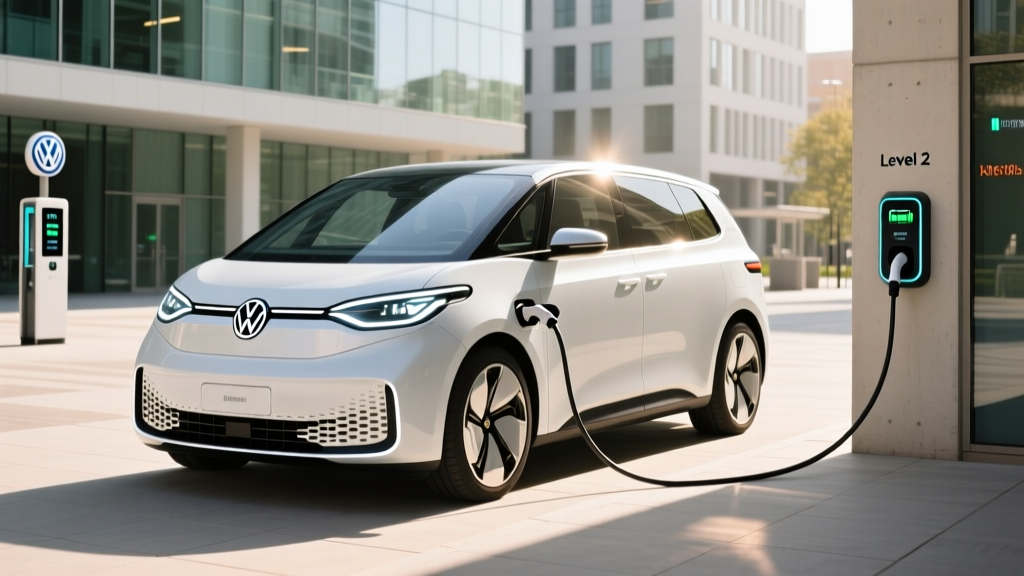
The Volkswagen ID. Buzz arrived in the U.S. market as the first mainstream electric minivan since the Chrysler Pacifica hybrid blazed a different trail. Retro-styled, three-row, and fully electric, the ID. Buzz targets families who want van-life versatility without tailpipe emissions. But nostalgia alone doesn't pay the bills — or charge the battery. Below, we break down every spec that matters: the VW ID. Buzz MSRP by trim, real-world range expectations, charging speed realities, and whether this electric microbus actually qualifies for the federal EV tax credit.
Real-World Range Reality Check
EPA Estimated Range: 234 miles (Standard Wheelbase, RWD) / 231 miles (AWD)
What to Expect in Practice: On highway road trips at 70+ mph, expect approximately 195–210 miles before needing to plug in. In cold weather (below 30°F), that figure can drop to 170–185 miles due to cabin heating demands and increased battery resistance. City driving with frequent regenerative braking opportunities will get you closest to the 234-mile EPA sticker. Plan charging stops around 180 miles for a comfortable buffer.
2026 VW ID. Buzz MSRP and Trim Breakdown
Volkswagen prices the ID. Buzz across three trims in the U.S. market. The base MSRP includes destination charges. Here is the complete pricing ladder:
| Trim | Drivetrain | Base MSRP (incl. destination) | Federal Tax Credit Potential | Effective Price After Credit |
|---|---|---|---|---|
| Pro S (Standard Wheelbase) | RWD | $59,995 | Up to $7,500 (§30D) | ~$52,495* |
| Pro S Plus (Standard Wheelbase) | RWD or AWD | $63,495 (RWD) / $65,495 (AWD) | Up to $7,500 (§30D) | ~$55,995–$57,995* |
| 1st Edition (Standard Wheelbase) | AWD | $69,995 | Up to $7,500 (§30D) | ~$62,495* |
*Effective price assumes full §30D credit eligibility. Federal tax credit availability depends on battery component sourcing, critical mineral requirements, buyer income limits ($150K single / $300K joint MAGI), and MSRP caps. The ID. Buzz falls under the van/SUV MSRP cap of $80,000. Always verify current eligibility on IRS.gov and consult a tax professional. Point-of-sale transfer is available through participating dealers.
Battery, Chemistry, and Efficiency
The U.S.-spec ID. Buzz uses a 91 kWh net usable lithium-ion battery pack (gross capacity approximately 100 kWh). Volkswagen sources NMC (nickel-manganese-cobalt) cells for the North American market, prioritizing energy density to maximize range in this large, heavy vehicle. This contrasts with the LFP (lithium iron phosphate) chemistry found in some Tesla and Ford models — NMC offers higher energy density but requires more careful state-of-charge management for long-term longevity.
EPA efficiency ratings land at 87 MPGe combined for the RWD model, which translates to roughly 38 kWh per 100 miles. That's thirstier than a Tesla Model Y Long Range (~28 kWh/100mi) but competitive with other three-row electric vehicles given the ID. Buzz's boxy aerodynamics and 5,600+ pound curb weight.
| Specification | Value |
|---|---|
| Battery Usable Capacity | 91 kWh (NMC chemistry) |
| EPA Range (RWD) | 234 miles |
| EPA Range (AWD) | 231 miles |
| MPGe Combined (RWD) | 87 MPGe |
| Energy Consumption | ~38 kWh/100 mi |
| Drivetrain | RWD (single motor) or AWD (dual motor) |
| Horsepower | 286 hp (RWD) / 335 hp (AWD) |
| Torque | 413 lb-ft (RWD) / 516 lb-ft (AWD) |
| 0–60 mph | 7.9 sec (RWD) / 5.9 sec (AWD) |
| Curb Weight | ~5,644 lbs (RWD) |
| Towing Capacity | Not rated for towing in U.S. |
Charging Speed: DC Fast Charge and Home Level 2
Charging is where the ID. Buzz shows both its strengths and its generational limitations. The 400-volt architecture caps DC fast charging at 170 kW peak, which is respectable but falls short of the 250–350 kW peaks offered by Hyundai/Kia's E-GMP platform or Tesla's latest vehicles on V3/V4 Superchargers.
| Charging Level | Power / Rate | Speed | Notes |
|---|---|---|---|
| Level 1 (120V household) | ~1.4 kW | ~3–4 miles/hour | Emergency/top-up only; full charge takes days |
| Level 2 (240V home, 40A circuit) | ~9.6 kW | ~22 miles/hour | Full 10–100% in ~10 hours; ideal overnight |
| Level 2 (240V, 48A circuit) | ~11.5 kW | ~26 miles/hour | Requires 60A breaker; faster overnight fill |
| DC Fast Charge (peak) | 170 kW | 10–80% in ~26 minutes | Peak rate sustained to ~40% SoC, then tapers |
Charging curve reality: The 170 kW peak is achievable only when the battery is preconditioned and between roughly 10–40% state of charge. From 40–80%, the rate tapers progressively — expect an average of around 120–130 kW across the full 10–80% session, which is why Volkswagen quotes approximately 26 minutes for that window. Above 80%, charging slows dramatically to protect the NMC cells, so plan to unplug at 80% during road trips unless you need the extra range to reach your next stop.
The ID. Buzz uses the CCS1 connector in North America. Volkswagen has announced future NACS adapter compatibility, but as of the current model year, CCS1 is the native port. This means access to Electrify America, EVgo, and ChargePoint DC networks natively, with Tesla Supercharger access via adapter (check VW's latest adapter availability).
Interior Space, Cargo, and Passenger Comfort
The ID. Buzz's party trick is interior volume. The standard-wheelbase U.S. model seats up to seven passengers across three rows, and the boxy shape maximizes usable space:
- Cargo behind 3rd row: 18.7 cu ft
- Cargo behind 2nd row (3rd row folded): 55.0 cu ft
- Maximum cargo (2nd and 3rd rows folded): 107.4 cu ft
- Front headroom: 41.3 inches
- 2nd-row legroom: 37.6 inches
- 3rd-row legroom: 32.5 inches (tight for adults on long trips)
The third row is best suited for children or occasional adult use on short trips. For families regularly hauling six or seven, the second-row captain's chairs (available on Pro S Plus and 1st Edition) offer superior comfort and easier third-row access. The flat floor — a benefit of the dedicated MEB EV platform — means no transmission tunnel hump, improving footroom across all rows.
Notable interior drawbacks: the glossy plastic lower dash panels attract fingerprints, and the capacitive-touch steering wheel controls (a VW ID-family hallmark) draw consistent criticism for accidental inputs and lack of tactile feedback.
Tech, Driver Assistance, and Safety
The ID. Buzz comes equipped with VW's latest ID. Software 4.0 infotainment system on a 12.9-inch central touchscreen, a meaningful upgrade from the sluggish software that plagued early ID.4 models. Wireless Apple CarPlay and Android Auto are standard, along with a 5.3-inch digital instrument cluster.
Driver assistance falls under VW's IQ.DRIVE suite, which includes:
- Adaptive cruise control with stop-and-go
- Lane-keeping assist with lane centering
- Front and rear automatic emergency braking
- Blind-spot monitoring with rear cross-traffic alert
- Travel Assist (combined lane centering + adaptive cruise up to highway speeds)
SAE Automation Level: Level 2
VW IQ.DRIVE and Travel Assist are SAE Level 2 driver-assistance systems. The driver must remain fully engaged, hands on or near the wheel, and eyes on the road at all times. This is not autonomous or "self-driving" capability. Level 4 fully driverless operation is currently limited to geofenced robotaxi services like Waymo.
Warranty Coverage
Volkswagen backs the ID. Buzz with competitive warranty terms:
- Limited vehicle warranty: 4 years / 50,000 miles
- Battery and powertrain warranty: 8 years / 100,000 miles (covers battery capacity retention below 70% of original)
- Roadside assistance: 4 years / 50,000 miles
The 70% capacity retention threshold over 8 years is industry-standard and aligns with the federal mandate for battery warranty. Real-world degradation data from European ID. Buzz owners (on sale since 2022) suggests NMC packs in the MEB platform lose approximately 5–8% capacity over the first 60,000 miles, well within warranty limits.
Pros, Cons, and Who Should Buy the ID. Buzz
Pros
- Unique retro styling that draws attention everywhere
- Spacious three-row seating with flat floor
- 107 cu ft max cargo volume rivals dedicated cargo vans
- Smooth, quiet ride quality with compliant suspension
- 234-mile EPA range adequate for daily driving and moderate road trips
- AWD available with a respectable 5.9-second 0–60 time
- Improved ID. Software 4.0 infotainment over prior VW EVs
Cons
- MSRP starts near $60K — expensive for a minivan alternative
- 170 kW DC charging peak is slower than Hyundai/Kia/Tesla competitors
- Real-world highway range closer to 195–210 miles
- Third-row legroom tight for adults (32.5 inches)
- Capacitive-touch steering wheel controls frustrate many drivers
- No towing rating in the U.S. market
- Federal tax credit eligibility uncertain due to battery sourcing rules
Who the ID. Buzz Suits Best
Ideal buyer: A family of four to six who prioritizes interior space, unique styling, and daily electric commuting under 150 miles round-trip, with occasional 200-mile road trips. The ID. Buzz excels as a school-run, grocery-hauling, weekend-adventure vehicle with enough range for regional travel.
Look elsewhere if: You regularly drive 300+ miles between charging stops, need towing capability, or want the fastest possible DC charging for frequent road trips. The Kia EV9 (300-mile range, 210+ kW charging) or Tesla Model X (335-mile range, 250 kW Supercharging) may serve those needs better, though neither matches the Buzz's character.
Frequently Asked Questions
What is the real-world range of the VW ID. Buzz?
The EPA rates the RWD ID. Buzz at 234 miles and the AWD at 231 miles. In mixed real-world driving, most owners report 200–215 miles in moderate temperatures. Highway driving at 75+ mph reduces range to roughly 195–210 miles, and cold weather below 30°F can push it down to 170–185 miles. Battery preconditioning before DC fast charging helps recover some efficiency.
How fast does the ID. Buzz charge at home and on the road?
On a 48-amp Level 2 home charger (240V), the ID. Buzz adds approximately 26 miles of range per hour, fully recharging overnight in about 10 hours. On DC fast chargers, it peaks at 170 kW and charges from 10–80% in approximately 26 minutes. The charge rate tapers significantly above 80%, so plan to disconnect at 80% during road trips for time efficiency.
Does the VW ID. Buzz qualify for the $7,500 federal EV tax credit?
Eligibility for the full §30D federal tax credit depends on several factors that change periodically: battery component and critical mineral sourcing requirements, buyer adjusted gross income limits ($150,000 single / $225,000 head of household / $300,000 joint), and the vehicle MSRP cap ($80,000 for vans/SUVs — the ID. Buzz qualifies here). As of 2026, battery sourcing rules have tightened significantly, and many EVs that previously qualified no longer do. Check the current eligible vehicle list on fueleconomy.gov and the IRS clean vehicle credit page before purchasing. Point-of-sale transfer is available through enrolled dealers.
How does the ID. Buzz compare to the Kia EV9 and Tesla Model X?
The Kia EV9 offers up to 300 miles of EPA range, faster 210+ kW DC charging, and starts around $54,900 — undercutting the Buzz on price and range, though it sacrifices the retro character. The Tesla Model X delivers 335 miles of range and 250 kW Supercharging but starts above $80,000 and has a less practical interior layout for cargo. The ID. Buzz wins on style, ride comfort, and cargo versatility; it loses on range, charging speed, and price-to-range ratio. Source: fueleconomy.gov.
Is the ID. Buzz available with all-wheel drive?
Yes. AWD is available on the Pro S Plus trim and standard on the 1st Edition. The dual-motor AWD system produces 335 horsepower and 516 lb-ft of torque, dropping the 0–60 mph time to 5.9 seconds. AWD costs approximately $2,000 extra and reduces EPA range by just 3 miles (231 vs. 234).
Can I tow with the VW ID. Buzz?
Volkswagen has not rated the U.S.-spec ID. Buzz for towing. European models carry a tow rating of approximately 2,200 lbs (braked), but this has not been certified for the North American market. If towing is a priority, consider the Kia EV9 (up to 5,000 lbs rated) or the Rivian R1S.