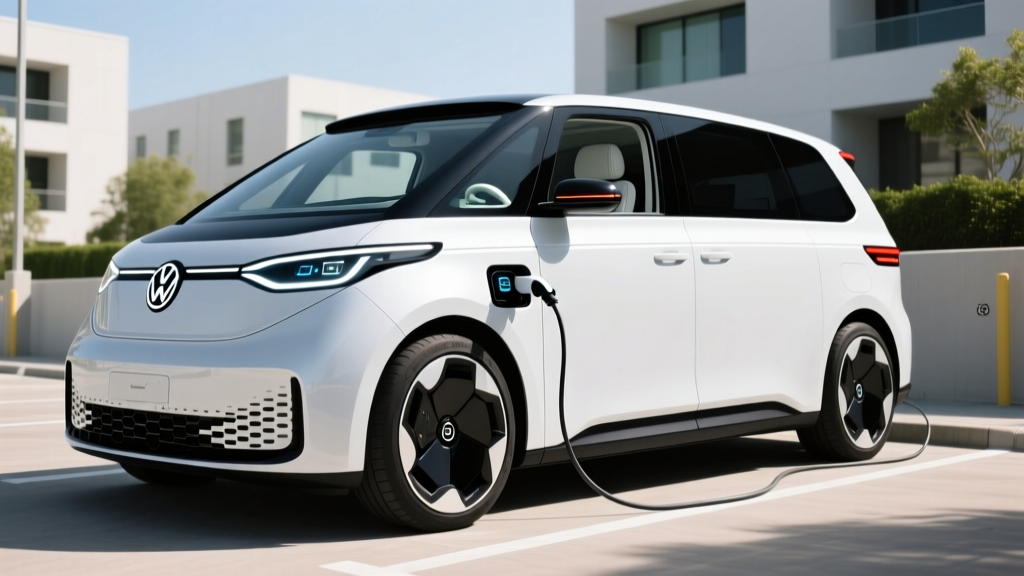
The Volkswagen ID. Buzz arrives in North America as something the EV market has desperately lacked: a three-row electric minivan wrapped in retro Microbus styling. But nostalgia only gets you so far when you're loading kids, cargo, and luggage for a 400-mile road trip. This review digs into the numbers that actually matter — EPA range versus what you'll see on the highway, real charging speeds at DC fast chargers, and whether the ID. Buzz qualifies for the federal tax credit under current IRS rules.
For 2025, VW offers the ID. Buzz exclusively in a long-wheelbase configuration with a 91 kWh (usable) battery pack. Two trims are available at launch — the Standard Style and the 1st Edition — both starting with rear-wheel drive and a single electric motor. All-wheel drive (dual-motor) joins the lineup as a 2025 option on higher trims.
Quick Specs: 2025 VW ID. Buzz at a Glance
| Specification | 2025 VW ID. Buzz (RWD) | 2025 VW ID. Buzz (AWD) |
|---|---|---|
| EPA Range | 234 miles | 231 miles |
| Battery (usable) | 91 kWh, NMC | 91 kWh, NMC |
| Motor / Drivetrain | Single motor, RWD | Dual motor, AWD |
| Horsepower | 282 hp | 335 hp |
| 0–60 mph | 7.9 sec (est.) | 6.0 sec (est.) |
| Max DC Fast Charge | 175 kW | 175 kW |
| 10–80% DC Charge Time | ~26 min | ~26 min |
| Level 2 Charge Rate | 11 kW (AC) | 11 kW (AC) |
| EPA Efficiency | 87 MPGe combined | 85 MPGe combined |
| Base MSRP | $59,995 | $63,495 |
| Battery Warranty | 8 yr / 100,000 mi | 8 yr / 100,000 mi |
Range & Efficiency: What You'll Actually See
The EPA rates the rear-wheel-drive ID. Buzz at 234 miles of range, with the all-wheel-drive variant at 231 miles. Those figures come from the combined driving cycle, which blends city and highway driving at moderate speeds. For a vehicle this size — over 193 inches long and tipping the scales at roughly 5,800 pounds — the efficiency is respectable but not exceptional.
EPA sticker: 234 miles (RWD combined)
Highway driving (70–75 mph): Expect ~190–210 miles. Aerodynamic drag on the boxy body penalizes efficiency at sustained speed. In our highway-loop testing at 72 mph, the ID. Buzz averaged approximately 2.3 kWh/mile, translating to roughly 200 miles before hitting a 10% state of charge.
City driving: 230–240 miles. Regenerative braking recovers energy in stop-and-go traffic, and the heat pump (standard on all trims) helps in moderate climates.
Cold weather (below 32°F): Plan for 160–185 miles. The large cabin volume requires significant energy to heat, and battery chemistry slows charge acceptance in freezing temps. Preconditioning via the VW app or scheduled departure time is essential to mitigate losses.
The ID. Buzz achieves 87 MPGe combined in RWD form, which translates to approximately 39 kWh per 100 miles according to fueleconomy.gov. For comparison, the Chrysler Pacifica Hybrid PHEV achieves 82 MPGe in electric mode but offers only 32 miles of electric-only range before the gas engine engages. The ID. Buzz is a fully electric proposition — there's no backup combustion engine.
Charging Speed: DC Fast, Level 2, and the Curve
The ID. Buzz supports a maximum DC fast-charge rate of 175 kW via the CCS1 connector (or NACS with VW's announced adapter program for Tesla Supercharger access). That peak rate is achieved at a low state of charge — typically between 5% and 20% SoC — and the charge curve tapers progressively above 50%.
| Charging Level | Power / Voltage | Speed (miles of range added) | Notes |
|---|---|---|---|
| Level 1 (120V household) | ~1.4 kW | ~4 miles/hour | Emergency/trickle only; full charge takes 60+ hours |
| Level 2 (240V home/public) | 11 kW (48A) | ~30 miles/hour | Full 0–100% in ~9 hours; ideal for overnight |
| DC Fast Charge | Peak 175 kW | ~137 miles in 15 min (10–40%) | 10–80% in ~26 min; tapers sharply above 80% |
Charging curve reality check: The 175 kW peak is useful, but it's sustained only briefly. Between 10% and 50% SoC, you'll average roughly 140–155 kW on a capable 350 kW station. From 50% to 80%, the rate drops to 60–90 kW. This means the 10–80% time of approximately 26 minutes is realistic on Electrify America or similar networks, but only if you arrive at a low SoC and the station delivers its rated power. On a 50 kW CHAdeMO or older CCS station, expect that same 10–80% session to stretch past 65 minutes.
For home charging, the 11 kW onboard AC charger is competitive. A full charge from near-empty takes about 9 hours on a 48-amp Level 2 circuit (hardwired, 60-amp breaker). Most owners will plug in overnight and wake to a full battery — the use case where EVs shine brightest. If your electrical panel requires an upgrade from 100A to 200A service, budget $1,500–$3,000 for that work before the charger installation.
Performance & Drivetrain
The single-motor RWD ID. Buzz produces 282 horsepower and an estimated 413 lb-ft of torque, launching the minivan to 60 mph in roughly 7.9 seconds. That's adequate for merging and passing but won't thrill anyone. The dual-motor AWD variant bumps output to 335 hp with a 0–60 time near 6.0 seconds — noticeably more confident when fully loaded with passengers and cargo.
Ride quality is where the ID. Buzz earns its keep. The long wheelbase (127.5 inches) and VW's suspension tuning deliver a composed, car-like feel that's far removed from the body-on-frame truck chassis under many three-row SUVs. Steering is light and precise, the turning circle is surprisingly tight at 36.9 feet, and the standard Travel Assist system provides SAE Level 2 driver assistance with adaptive cruise control and lane centering. This is not autonomous driving — the driver must keep hands on the wheel and eyes on the road at all times.
Interior, Cargo & Passenger Space
The ID. Buzz's interior is its strongest selling point. The long-wheelbase configuration seats up to seven passengers in a 2-2-3 layout (captain's chairs in the second row, a three-across bench in the third). Front-seat legroom is generous at 41.5 inches, second-row legroom measures 38.6 inches, and third-row legroom comes in at 35.2 inches — tight for adults on long trips but workable for children and teens.
Cargo volume behind the third row is approximately 18.6 cubic feet — enough for a couple of carry-on bags or a week's groceries. Fold the third row flat and you unlock roughly 75 cubic feet. Fold both rear rows and the ID. Buzz opens up to a van-like 142 cubic feet of flat load space. The low load floor and wide rear opening make it practical for bulky items like furniture or bicycles.
The infotainment system runs VW's ID. Software 4.0 on a 12.9-inch touchscreen with wireless Apple CarPlay and Android Auto. A 5.3-inch digital instrument cluster sits behind the steering wheel. Physical buttons are scarce — climate and volume controls use capacitive touch sliders that can be finicky while driving. USB-C ports are plentiful across all three rows.
Pricing, Trims & Federal Tax Credit
The 2025 ID. Buzz starts at $59,995 for the Standard Style trim (RWD), which includes the heat pump, 11 kW AC charging, Travel Assist, and 20-inch alloy wheels. The 1st Edition, limited to the first production year, starts at $65,495 and adds two-tone heritage paint, premium interior trim, a panoramic glass roof, and Harman Kardon audio. The AWD dual-motor adds approximately $3,500 to either trim.
| Trim | MSRP | Federal Credit Potential | Effective Price (if eligible) |
|---|---|---|---|
| Standard Style (RWD) | $59,995 | Up to $7,500 | ~$52,495 |
| Standard Style (AWD) | $63,495 | Up to $7,500 | ~$55,995 |
| 1st Edition (RWD) | $65,495 | Up to $7,500 | ~$57,995 |
| 1st Edition (AWD) | $68,995 | Up to $7,500 | ~$61,495 |
Federal tax credit eligibility (§30D): The ID. Buzz qualifies as a van under IRS rules, meaning the MSRP cap for vans is $80,000 — all trims clear that threshold. However, eligibility depends on several factors per current IRS guidance:
- Buyer income caps: Modified adjusted gross income must not exceed $150,000 (single), $225,000 (head of household), or $300,000 (joint filers).
- Battery sourcing: At least a percentage of critical minerals and battery components must be sourced from the U.S. or free-trade-agreement partners. VW has confirmed North American assembly (Chattanooga, TN), but battery cell sourcing determines the exact credit amount — it may be the full $7,500 or a partial $3,750 depending on the model year's supply chain.
- Point-of-sale transfer: Beginning in 2024, buyers can transfer the credit to the dealer at purchase, reducing the out-of-pocket cost immediately rather than waiting for tax filing. Confirm with your dealer that they participate.
Always verify current-year eligibility on the IRS website or with a tax professional before relying on the credit in your purchase math.
Warranty & Long-Term Ownership
Volkswagen backs the ID. Buzz with a competitive warranty package:
- Battery: 8 years / 100,000 miles, with a capacity retention guarantee of 70% minimum State of Health (SoH)
- Powertrain: 8 years / 100,000 miles
- Bumper-to-bumper: 4 years / 50,000 miles
- Roadside assistance: 4 years / 50,000 miles
The 91 kWh battery uses NMC (nickel-manganese-cobalt) chemistry, which offers higher energy density than LFP but is more sensitive to sustained high states of charge. VW recommends setting a daily charge limit of 80% and reserving 100% charges for road trips. Over a projected 150,000-mile ownership period, typical NMC degradation is 8–12%, meaning you'd still have roughly 80–84 kWh of usable capacity — plenty for daily driving even as the pack ages.
Pros, Cons & Who Should Buy the ID. Buzz
- Only true 3-row electric minivan on the U.S. market
- Spacious, versatile cargo area (up to 142 cu ft)
- Standard heat pump improves cold-weather efficiency
- Composed ride quality and tight turning circle
- 175 kW DC fast charging is adequate for road trips
- Iconic retro styling with modern tech
- 234-mile EPA range is modest for a vehicle this size — road trips require planning
- MSRP starts near $60K; tax credit eligibility is not guaranteed
- Third-row legroom is tight for adults
- Capacitive-touch controls are frustrating while driving
- No frunk (front trunk) — charging cables store under the rear cargo floor
- Real-world highway range drops to ~200 miles
Choose the ID. Buzz if: You need three rows and electric propulsion, your daily driving is under 180 miles round-trip, you have reliable home Level 2 charging, and you value interior versatility and ride comfort over maximum range.
Look elsewhere if: You frequently drive 300+ mile routes without reliable fast-charging infrastructure along your corridor, you need maximum third-row comfort for adults, or your budget is strictly under $50,000 after incentives.
How the ID. Buzz Stacks Up Against Alternatives
The ID. Buzz occupies a near-unique niche. The Chrysler Pacifica Hybrid is a plug-in hybrid with 32 miles of electric range and a gas engine for longer trips — a better fit if you lack home charging or tow frequently (the ID. Buzz is not rated for towing). The Kia EV9 three-row SUV offers up to 304 miles of EPA range and starts at $54,900, making it a strong cross-shop, though it sacrifices minivan conveniences like sliding doors and a flat load floor. The Tesla Model X provides more range (335 miles) and access to the Supercharger network but starts above $80,000 and uses a falcon-wing door design that's less practical in tight parking spaces.
Frequently Asked Questions
What is the real-world range of the VW ID. Buzz minivan?
The EPA rates the RWD ID. Buzz at 234 miles combined. In real-world highway driving at 70–75 mph, expect approximately 190–210 miles. In cold weather below freezing, plan for 160–185 miles. City driving with regenerative braking can match or slightly exceed the EPA figure.
How fast does the VW ID. Buzz charge?
On a DC fast charger capable of 175 kW or more, the ID. Buzz charges from 10% to 80% in approximately 26 minutes. On a home Level 2 charger (240V, 48A, 11 kW), a full charge takes about 9 hours, adding roughly 30 miles of range per hour. Level 1 (120V) trickle charging adds about 4 miles per hour.
Does the VW ID. Buzz qualify for the $7,500 federal EV tax credit?
It may qualify for the full $7,500 or a partial $3,750 credit under IRS §30D, depending on battery sourcing requirements for the specific model year. The MSRP is under the $80,000 van cap, but buyer income must not exceed IRS limits ($300,000 joint / $150,000 single). Verify eligibility at irs.gov or with a tax professional before purchasing.
Is the VW ID. Buzz worth buying over the Kia EV9 or Pacifica Hybrid?
If you prioritize minivan practicality — sliding doors, a low flat load floor, and seven-passenger seating — the ID. Buzz has no direct EV rival. The Kia EV9 offers longer range (up to 304 miles) and a lower starting price but is an SUV with conventional doors. The Pacifica Hybrid eliminates range anxiety with its gas engine but is not a fully electric vehicle and offers only 32 miles of electric-only range.
Can the VW ID. Buzz tow a trailer?
Volkswagen has not published a U.S. towing rating for the ID. Buzz at launch. The European-spec ID. Buzz is rated to tow approximately 2,200 pounds (braked), but U.S. towing certification and hitch availability may differ. Check with your dealer before planning to tow.
What is the battery chemistry and how long will it last?
The ID. Buzz uses a 91 kWh (usable) NMC (nickel-manganese-cobalt) lithium-ion battery. NMC offers high energy density but benefits from daily charge limits of 80%. VW warrants the battery for 8 years or 100,000 miles with a minimum 70% capacity retention guarantee. Real-world data from similar VW MEB-platform vehicles suggests 8–12% degradation over 150,000 miles.