The Volkswagen ID. Buzz arrives in the U.S. for the 2025 model year as the first mainstream electric minivan since the Chrysler Pacifica concept never materialized. Built on VW's MEB platform and assembled in Hanover, Germany, it trades retro styling for genuine three-row utility. But nostalgia only gets you so far when the starting price is $59,995. This review breaks down the ID. Buzz interior layout, real-world range, charging behavior, and whether the numbers justify the premium.
Quick Verdict: Who Should Consider the ID. Buzz?
The ID. Buzz targets families who need three rows and cargo volume that midsize electric SUVs can't deliver, but who also want something more distinctive than a Tesla Model X. It works best as a daily driver with home Level 2 charging and occasional road trips under 200 miles between stops. If your commute is short, you have garage charging, and you prioritize passenger space over long-range highway cruising, the Buzz delivers. If you regularly tow, drive 400-mile stretches in winter, or need the absolute lowest cost-per-mile, look elsewhere.
2025 VW ID. Buzz: Core Specifications at a Glance
| Specification | Value |
|---|---|
| EPA Range | 234 miles (1-Style RWD); 231 miles (Pro S AWD) |
| Battery (Usable / Gross) | 86 kWh usable / 91 kWh gross, NMC chemistry |
| Powertrain | RWD single-motor (282 hp) or AWD dual-motor (335 hp) |
| 0–60 mph | 7.9 sec (RWD est.); 6.5 sec (AWD est.) |
| DC Fast Charge Peak | 170 kW (CCS1) |
| 10–80% DC Charge Time | ~26 minutes (VW est.) |
| Level 2 Home Charge | 11 kW onboard; ~27 miles per hour of charging |
| Efficiency (MPGe) | 87 MPGe combined (RWD, EPA est.) |
| Cargo (behind 3rd row / max) | 18.0 cu ft / 137.0 cu ft (seats folded) |
| Seating | 7 passengers (2+3+2 layout) |
| Base MSRP | $59,995 (1-Style RWD) / $63,495 (Pro S AWD) |
| Battery / Powertrain Warranty | 8 years / 100,000 miles |
The VW ID. Buzz Interior: Three Rows, Real Dimensions
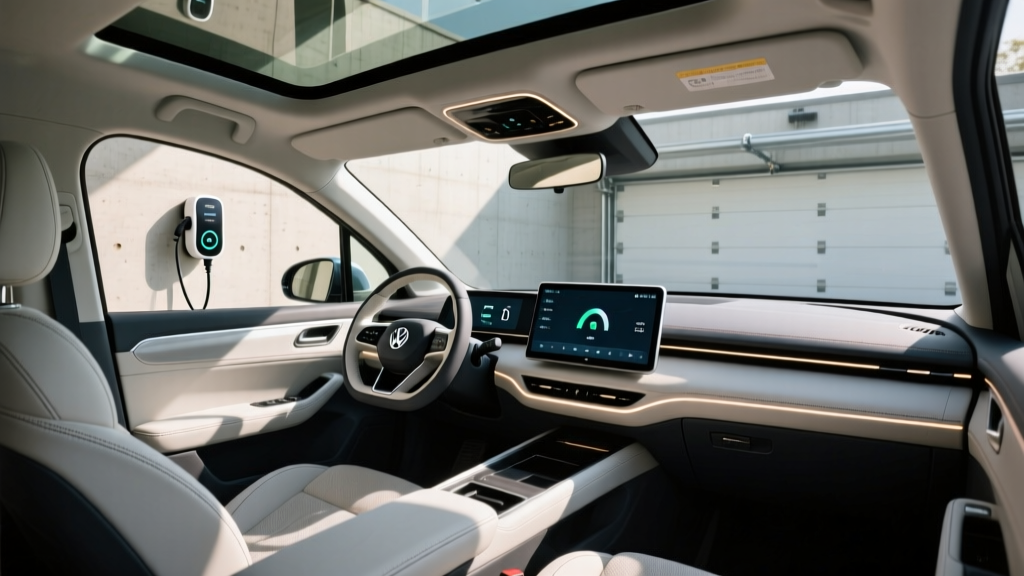
The headline feature is the VW ID. Buzz interior packaging. Unlike the European short-wheelbase model (which seats five), the U.S. version stretches the wheelbase to 127.5 inches and adds a third row, creating a legitimate seven-passenger cabin. Here's how the space breaks down:
- First-row legroom: 42.1 inches — generous, with a flat floor and no transmission tunnel
- Second-row legroom: 38.4 inches — three-across bench with sliding fore/aft adjustment
- Third-row legroom: 33.5 inches — usable for children or short-trip adults; tight for long highway drives
- Cargo behind 3rd row: 18.0 cu ft — fits roughly four carry-on bags or a week of groceries for a family
- Cargo with 3rd row folded: 75.5 cu ft — competitive with a midsize SUV
- Maximum cargo (all rear seats folded): 137.0 cu ft — approaches full-size van territory
The flat floor is a direct benefit of the MEB skateboard architecture. The battery sits beneath the cabin, lowering the center of gravity and eliminating the driveshaft hump. Materials are a mixed bag: the dashboard uses a soft-touch recycled fabric that feels premium, but lower door panels and the third-row trim are hard plastics typical of VW's volume-oriented approach. The available two-tone interior (cream and copper) is the strongest design choice VW has made in a decade, but it adds cost and limits color availability.
Infotainment and Driver Assistance
A 12.9-inch touchscreen runs VW's ID.Software 4.0, which is a meaningful step up from the laggy 3.x system that plagued early ID.4 owners. Response times are acceptable, wireless Apple CarPlay and Android Auto are standard, and the voice assistant handles navigation and climate commands reliably. Physical climate controls remain absent — temperature and fan speed are buried in the touchscreen or the capacitive slider beneath it, which is still frustrating to use while driving.
Standard driver assistance includes Travel Assist (adaptive cruise + lane centering), which is SAE Level 2 — meaning the driver must keep hands on the wheel and eyes on the road at all times. It is not self-driving. The system performs competently on divided highways but requires frequent steering-wheel torque input to confirm attention. Park Assist Plus with memory parking is available on Pro S trims and works well for repeating tight garage maneuvers.
Real-World Range: What the EPA Sticker Doesn't Tell You
EPA Estimated Range: 234 miles (RWD) / 231 miles (AWD)
Real-World Expectation: Plan for 185–210 miles on highway road trips at 70+ mph. In cold weather (below 30°F), expect 160–185 miles before needing to charge. City and suburban driving at moderate speeds can approach or slightly exceed the EPA figure thanks to regenerative braking.
The ID. Buzz is a tall, boxy vehicle with a frontal area that punishes it at highway speeds. Aerodynamic drag is the dominant energy consumer above 65 mph, and no amount of battery capacity overcomes physics. On a 75°F day at 65 mph on flat terrain, you'll see roughly 2.4–2.6 miles per kWh, which translates to about 205–225 miles from a full charge. Push to 75 mph, and efficiency drops to 2.0–2.2 mi/kWh, yielding 175–195 miles.
Cold weather compounds the problem. The ID. Buzz uses a heat pump (standard on U.S. models) to warm the cabin more efficiently than resistive heating, but battery chemistry still slows in low temperatures. At 20°F with cabin heat active, expect 25–35% range loss versus the EPA sticker. Preconditioning the battery while plugged in — using the VW app to set a departure time — recovers some of this loss by warming the pack before you drive.
For context, the Kia EV9 (the closest electric three-row competitor) achieves 270–304 miles EPA depending on trim, with a larger 100 kWh battery and slightly more aerodynamic shaping. The Rivian R1S (Gen 2, Max Pack) reaches 350+ miles but costs significantly more. The ID. Buzz trades range for interior volume and price positioning.
Charging Speed: DC Fast, Level 2, and the Curve Reality
| Charging Level | Power (kW) | Miles Added per Hour | Notes |
|---|---|---|---|
| Level 1 (120V household) | ~1.4 kW | ~3–4 mi/hr | Emergency only; 60+ hours for full charge |
| Level 2 (240V, 48A home charger) | 11 kW (onboard max) | ~27 mi/hr | Full charge in ~8 hours; ideal overnight |
| DC Fast Charge (CCS1) | 170 kW peak | ~150+ mi in 10 min (at peak) | 10–80% in ~26 min; tapers sharply above 80% |
The ID. Buzz charges at a peak of 170 kW on DC fast chargers, which is adequate but not class-leading. The Kia EV9 peaks at 236 kW (on 800V architecture), and the Hyundai Ioniq 5 hits 240 kW. VW's 400V MEB platform limits peak rate, and the charge curve tells the real story:
- 10–50% SoC: Sustains close to 170 kW — this is where the Buzz charges fastest
- 50–80% SoC: Tapers to roughly 100–120 kW as the battery management system protects cell health
- Above 80% SoC: Drops below 50 kW; charging from 80–100% adds another 25–30 minutes
On a road trip, this means you should plan stops around 10–80% charging sessions of roughly 25–30 minutes. Arriving at a charger at 5% SoC and leaving at 80% gives you about 185 miles of real-world highway range (in moderate weather), which translates to roughly 2.5 hours of driving between stops. It's workable, but not effortless for 500-mile days.
For home charging, an 11 kW Level 2 setup (48 amps on a 60-amp circuit) adds about 27 miles of range per hour. An overnight charge from 20% to 100% takes roughly 7–8 hours. Installation costs for a dedicated 240V/60A circuit typically run $800–$2,500 depending on panel proximity and local permitting; if your electrical panel needs an upgrade to 200A service, add $1,500–$3,500. The ID. Buzz uses the CCS1 connector (not NACS), but VW has confirmed that future MEB models will adopt NACS, and CCS-to-NACS adapters are available for Tesla Supercharger access.
Pricing, Trims, and Federal Tax Credit Eligibility
| Trim | Drivetrain | Base MSRP | Est. Federal Credit (§30D) | Effective Price (if eligible) |
|---|---|---|---|---|
| 1-Style | RWD | $59,995 | $0–$7,500* | $52,495–$59,995 |
| Pro S | RWD | $63,495 | $0–$7,500* | $55,995–$63,495 |
| Pro S Plus | AWD | $69,995 | $0–$7,500* | $62,495–$69,995 |
* Federal tax credit eligibility under IRS §30D depends on multiple factors that change frequently. As of 2025, the ID. Buzz is assembled in Germany, which affects the final-assembly requirement. Buyers must also meet adjusted gross income caps ($150,000 single / $300,000 joint for new vehicles), and the vehicle must satisfy critical-mineral and battery-component sourcing thresholds that phase in annually. The MSRP cap for vans/SUVs is $80,000, which the ID. Buzz clears. Consult a tax professional and check fueleconomy.gov for current eligibility before relying on the credit. Point-of-sale transfer is available if you qualify, reducing the purchase price at the dealer.
The ID. Buzz is positioned as a premium electric van, and pricing reflects that. The 1-Style RWD at $59,995 includes the 12.9-inch infotainment, Travel Assist, heated front seats, and the two-tone paint scheme. The Pro S adds a panoramic sunroof, power-sliding rear doors, and a 360-degree camera. The AWD Pro S Plus tops out near $70,000 with Nappa leather, a head-up display, and the most powerful dual-motor setup. For comparison, the Kia EV9 GT-Line AWD starts around $73,000, while the Rivian R1S Adventure starts at $79,900 before credits.
Performance and Efficiency: Adequate, Not Sporty
The rear-wheel-drive ID. Buzz produces 282 horsepower and 406 lb-ft of torque from a single permanent-magnet motor on the rear axle. The 0–60 mph time of roughly 7.9 seconds is leisurely by EV standards but perfectly adequate for a family van. The dual-motor AWD version adds a front induction motor for 335 hp combined and drops the 0–60 to approximately 6.5 seconds, which feels brisk in a vehicle this size.
Ride quality is a strength. The long wheelbase and 4,700-pound curb weight (RWD) give the Buzz a planted, composed feel over highway expansion joints and rough pavement. The turning circle is surprisingly tight (36.7 feet) thanks to the rear-drive layout and front wheels that can turn sharply without accommodating a driveshaft. This makes parking-lot maneuverability better than most three-row SUVs.
Efficiency lands at an EPA-estimated 87 MPGe combined for the RWD model, which translates to roughly 39 kWh per 100 miles. That's less efficient than the Tesla Model X (102 MPGe) but expected for a boxy van shape. At the national average electricity price of $0.17/kWh, fueling the ID. Buzz costs approximately $6.63 per 100 miles — roughly half the cost of a gas minivan averaging 22 mpg at $3.50/gallon.
Battery Longevity, Warranty, and Ownership Costs
VW equips the ID. Buzz with a 91 kWh gross (86 kWh usable) NMC (nickel-manganese-cobalt) battery pack. The chemistry prioritizes energy density over the extreme cycle life of LFP, which is typical for vehicles needing 230+ miles of range in a single pack. VW's battery management system maintains a buffer at the top and bottom of the state-of-charge range to reduce degradation stress.
The high-voltage battery warranty covers 8 years or 100,000 miles, whichever comes first, against capacity loss below 70% of original capacity. This is industry-standard and matches Hyundai, Kia, and Ford. Real-world degradation data on MEB-platform vehicles (ID.4, Audi Q4 e-tron) suggests roughly 5–8% capacity loss over the first 100,000 miles under normal use, which would leave the pack above the warranty threshold. Avoiding repeated 100% charges and frequent DC fast charging in extreme heat will extend longevity.
The limited vehicle warranty is 4 years / 50,000 miles. Insurance costs for the ID. Buzz are expected to run 15–25% higher than a comparable gas minivan, based on early quotes for MEB-platform vehicles. Depreciation is harder to predict for a niche vehicle, but VW's recent EV resale values have lagged Tesla and Hyundai, partly due to brand perception and software-issue history.
Pros, Cons, and the Competition
Pros
- Genuine 7-passenger seating with usable third row
- 137 cu ft max cargo — minivan-class volume
- Distinctive design; stands out in any parking lot
- Composed ride quality and tight turning circle
- Heat pump standard (improves cold-weather range)
- Improved ID.Software 4.0 over prior MEB vehicles
Cons
- 234-mile EPA range is modest for the price
- 170 kW peak DC charge rate trails 800V competitors
- No NACS port (CCS1 only; adapter needed for Tesla Superchargers)
- Capacitive climate controls are distracting while driving
- German assembly may limit §30D tax credit eligibility
- $60K+ starting price before options
Key Competitors
- Kia EV9 (270–304 mi EPA, $54,900+): More range, faster 800V charging, lower starting price, but less cargo volume and a more conventional SUV shape.
- Rivian R1S (350+ mi Max Pack, $79,900+): Superior range, off-road capability, and NACS charging, but significantly more expensive and smaller third row.
- Tesla Model X (320+ mi EPA, $79,990+): Best-in-class range and Supercharger network access, but higher price, controversial styling, and panel-gap history.
- Chrysler Pacifica Hybrid (PHEV, 32 mi electric, $51,000+): Plug-in hybrid flexibility for long trips, but only 32 miles of electric range and no DC fast charging.
Frequently Asked Questions
What is the real-world range of the VW ID. Buzz?
The EPA rates the RWD ID. Buzz at 234 miles and the AWD at 231 miles. In real-world highway driving at 70–75 mph, expect 185–210 miles. In cold weather below 30°F, plan for 160–185 miles. City driving with regenerative braking can approach or exceed the EPA estimate.
How fast does the ID. Buzz charge at home and on the road?
At home on a 240V Level 2 charger, the ID. Buzz accepts up to 11 kW, adding about 27 miles of range per hour (full charge in ~8 hours). On DC fast chargers, it peaks at 170 kW and charges from 10–80% in approximately 26 minutes. Above 80%, charging slows significantly to protect battery health.
Does the VW ID. Buzz qualify for the federal EV tax credit?
Eligibility under IRS §30D is uncertain for the ID. Buzz because it is assembled in Germany, which may not satisfy the final-assembly requirement. Additionally, buyers must meet income caps ($150K single / $300K joint), and the battery must meet critical-mineral and component-sourcing thresholds. Check fueleconomy.gov and consult a tax professional before assuming the $7,500 credit applies.
Is the VW ID. Buzz worth buying versus the Kia EV9?
If you prioritize maximum interior volume, distinctive styling, and a true van layout, the ID. Buzz is the only electric option. If range, charging speed, and lower price matter more, the Kia EV9 is the more pragmatic choice — it offers up to 304 miles EPA, 800V fast charging, and starts $5,000+ lower. Test-drive both and measure your garage.
Can the ID. Buzz tow?
The U.S.-spec ID. Buzz has a braked towing capacity of 2,500 pounds (RWD) and 3,500 pounds (AWD). This is sufficient for a small utility trailer or a pair of jet skis but not a camper or boat. Towing will reduce range by 30–50%.
Does the ID. Buzz have a frunk (front trunk)?
No. The ID. Buzz does not include a front trunk. The front hood houses the HVAC system and power electronics, and VW has not designed a cargo compartment in that space. All cargo goes in the rear.