The Short Answer on the EV Volkswagen Bus
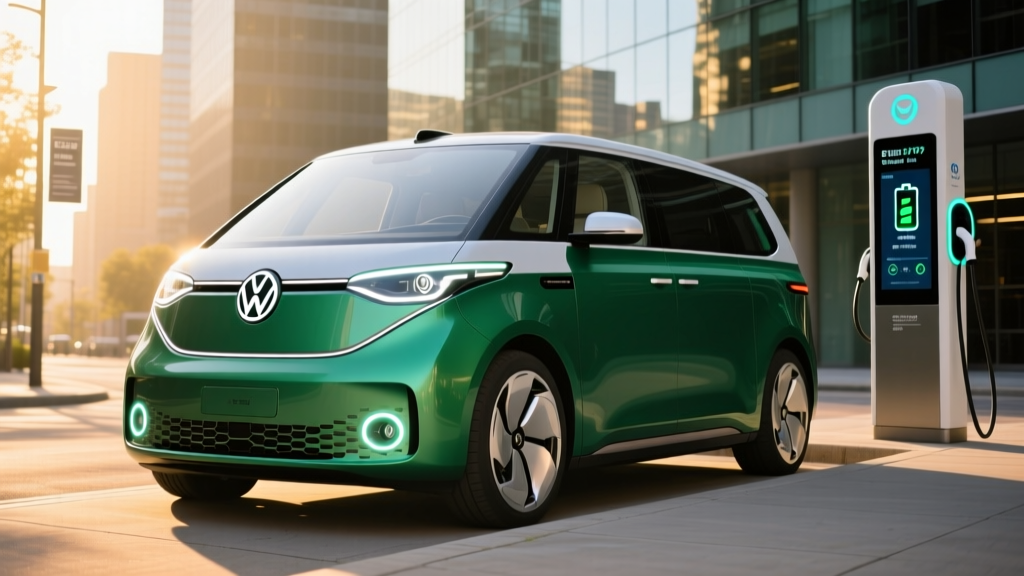
The 2026 Volkswagen ID. Buzz is the production realization of the classic VW microbus, now fully electric. It offers an EPA-estimated 231 miles of range (RWD) or 234 miles (AWD), DC fast charging up to 200 kW (10–80% in roughly 26 minutes), and a starting MSRP around $59,995. It qualifies for a $7,500 federal tax credit under IRS §30D (subject to income and sourcing rules), bringing the effective starting price closer to $52,495. If you want a three-row, retro-styled people hauler with zero tailpipe emissions, the ID. Buzz is currently the only dedicated electric minivan on the U.S. market — but it trades maximum range and cargo flexibility for its iconic design.
Range, Battery, and Real-World Efficiency
The U.S.-spec ID. Buzz rides on VW's MEB platform with a 91 kWh usable battery pack (NMC chemistry). The rear-wheel-drive model produces 282 horsepower, while the 4Motion AWD variant bumps output to 335 hp and drops the 0–60 mph time from roughly 7.9 seconds to about 6.5 seconds.
EPA Range vs. Real-World Expectations
| Configuration | EPA Range | Real-World Highway (70 mph) | Cold Weather (20°F) |
|---|---|---|---|
| RWD Pro S | 231 mi | ~195–210 mi | ~160–185 mi |
| AWD Pro S 4Motion | 234 mi | ~200–215 mi | ~165–190 mi |
Source: fueleconomy.gov
The ID. Buzz's boxy aerodynamic profile (Cd ~0.29) works against highway efficiency. Expect roughly 2.0–2.2 kWh/mile at sustained interstate speeds, which translates to about 87–95 MPGe combined. Around town, regenerative braking recovers more energy, and you'll see closer to the EPA sticker figure.
The heat pump comes standard on U.S. models, which helps mitigate cold-weather range loss during cabin heating. VW's thermal management system also includes battery preconditioning — activate it via the navigation system when routing to a DC fast charger, and the pack will warm to optimal temperature for faster charging speeds.
Charging Speed: Home and DC Fast Charging
Understanding the distinction between kW (power, or charge rate) and kWh (energy, or battery capacity) is essential here. The ID. Buzz's 91 kWh battery is the "tank size," while the charge rate in kW determines how quickly that tank fills.
| Charging Level | Power | Miles Added per Hour | Use Case |
|---|---|---|---|
| Level 1 (120V) | ~1.4 kW | ~4–5 mi/hr | Emergency / overnight trickle |
| Level 2 (240V, 48A) | ~11 kW | ~33–37 mi/hr | Home daily charging |
| DC Fast Charge | Up to 200 kW peak | ~160 mi in 26 min (10–80%) | Road trips |
On a DC fast charger, the ID. Buzz peaks around 200 kW but sustains that rate only briefly. The charge curve tapers significantly above 50% state of charge (SoC), and charging from 80–100% can take nearly as long as the 10–80% session. For road-trip planning, plan stops around the 10–80% window for the fastest turnaround.
For home charging, VW recommends a 48-amp Level 2 wallbox on a dedicated 60-amp circuit. A full 0–100% charge takes approximately 9 hours. Most owners who drive 30–50 miles daily will only need to top up overnight and never charge to 100% — which also benefits long-term battery health.
Pricing, Tax Credits, and Trim Breakdown
| Spec | RWD Pro S | AWD Pro S 4Motion | AWD 1st Edition |
|---|---|---|---|
| MSRP | $59,995 | $64,995 | $69,995 |
| After $7,500 Credit* | $52,495 | $57,495 | $62,495 |
| HP | 282 | 335 | 335 |
| 0–60 mph | ~7.9 sec | ~6.5 sec | ~6.5 sec |
| EPA Range | 231 mi | 234 mi | 234 mi |
| Towing Capacity | 2,500 lbs | 3,500 lbs | 3,500 lbs |
*Federal §30D tax credit eligibility depends on buyer income (≤$150K single / $300K joint), vehicle MSRP caps (vans/SUVs ≤$80,000), and battery sourcing requirements. The credit can be transferred to the dealer as a point-of-sale discount. Verify current-year rules at IRS.gov.
The ID. Buzz is classified as a van for §30D purposes, meaning the $80,000 MSRP cap applies (not the $55,000 sedan cap). All current trims fall under that threshold. Battery sourcing and critical-mineral requirements may affect eligibility — VW has confirmed the ID. Buzz's battery assembly qualifies, but always cross-check with your tax professional before purchase.
ID. Buzz vs. Gas Minivans: Cost and Ownership Comparison
The closest gas competitors are the Toyota Sienna (hybrid, 36 MPG combined) and the Chrysler Pacifica (PHEV option available). Here's how the numbers stack up over five years of ownership at 15,000 miles/year:
| Cost Factor | VW ID. Buzz AWD | Toyota Sienna Hybrid | Chrysler Pacifica PHEV |
|---|---|---|---|
| Purchase Price (after credit) | $57,495 | $40,000 | $52,000 |
| Fuel/Energy (5 yr) | $3,900 | $7,200 | $5,100 |
| Maintenance (5 yr) | $1,800 | $3,500 | $3,200 |
| Insurance (5 yr est.) | $11,500 | $8,500 | $9,800 |
| Estimated Depreciation | $22,000 | $14,000 | $19,000 |
| 5-Year Total Cost | $96,695 | $73,200 | $89,100 |
Assumptions: electricity at $0.14/kWh, gas at $3.40/gal, home charging 80% of the time. Insurance estimates vary significantly by driver profile and state. Depreciation is an estimate based on current EV resale trends.
The ID. Buzz saves roughly $3,300 on energy and $1,400 on maintenance over five years compared to the Sienna, but the higher purchase price, steeper depreciation, and pricier insurance premiums erase those savings. The total cost of ownership favors the Sienna by a wide margin — unless you place a premium on the EV driving experience, zero tailpipe emissions, and the ID. Buzz's unique design and packaging.
Real-World Ownership: What First-Time EV Buyers Must Know
Home Charging Access Is Non-Negotiable for Most Owners
Without reliable Level 2 home charging, owning an electric minivan becomes a logistical challenge. The ID. Buzz's 91 kWh battery takes too long on Level 1 for daily use, and relying on public DC fast charging is both more expensive ($0.35–$0.50/kWh vs. $0.14 at home) and less convenient. Budget $500–$1,500 for a Level 2 wallbox installation (equipment plus licensed electrician), and potentially $1,500–$3,500 more if your electrical panel needs a 200-amp upgrade.
Cargo Space: The Design Trade-Off
The ID. Buzz's retro styling means a shorter overall length than a Sienna or Odyssey. Behind the third row, you get approximately 18.2 cubic feet — enough for a few grocery runs but tight for family road-trip luggage. Fold the third row and you unlock roughly 75 cu ft, but unlike competitors, the second-row seats don't stow into the floor. They slide and fold but must be physically removed for maximum cargo, and each seat weighs roughly 50 pounds.
Driving Dynamics and Tech
The ID. Buzz rides comfortably and quietly, with the low center of gravity typical of MEB-platform EVs. VW's IQ.DRIVE suite includes adaptive cruise control, lane-keeping assist, and automated emergency braking — this is SAE Level 2 driver assistance, meaning you must keep your hands on the wheel and eyes on the road at all times. The infotainment system uses a 12.9-inch touchscreen, though some owners report that the capacitive touch sliders for volume and climate can be finicky.
Battery Longevity and Warranty Coverage
VW covers the ID. Buzz battery with an 8-year/100,000-mile warranty against degradation below 70% of original capacity. The NMC chemistry provides strong energy density but is more sensitive to sustained high-SoC storage than LFP packs. Best practices for longevity:
- Set the daily charge limit to 80% and only charge to 100% before long trips
- Use DC fast charging sparingly — it's fine for road trips, but daily Level 2 is gentler on the cells
- Avoid leaving the vehicle parked at very low or very high SoC in extreme temperatures
- Monitor State of Health (SoH) via the vehicle's battery management display
A full battery replacement outside warranty is estimated at $15,000–$22,000 based on current MEB-platform pricing — a figure worth factoring into long-term ownership plans if you intend to keep the vehicle beyond 150,000 miles.
Decision Framework: Is the EV Volkswagen Bus Right for You?
Choose the VW ID. Buzz if:
- You have Level 2 home charging and drive under 200 miles most days
- You want a three-row EV with distinctive styling and a comfortable ride
- You qualify for the $7,500 federal tax credit, making the price more palatable
- You value quiet, smooth electric driving and want to eliminate gas station visits
- You're willing to accept a range and cargo trade-off for the microbus experience
Look elsewhere if:
- You regularly drive 300+ miles between charges (consider a Tesla Model X or Rivian R1S)
- You need maximum cargo versatility with stow-and-go seating (Sienna or Pacifica)
- You don't have access to home or workplace charging
- Minimizing total cost of ownership is your top priority (Sienna Hybrid wins decisively)
- You need to tow more than 3,500 lbs
Common Misconceptions About the ID. Buzz
| Myth | Fact |
|---|---|
| "It's basically a converted gas van." | The ID. Buzz is built on VW's dedicated MEB electric platform — it was never an ICE vehicle. |
| "231 miles of range isn't enough for a family vehicle." | The average American drives 37 miles/day. For 95% of daily driving, 231 miles is more than sufficient. Road trips require planning but are manageable with the 200 kW charge rate. |
| "EV batteries need replacing every few years." | Modern NMC packs like the ID. Buzz's are designed for 150,000–200,000+ miles with gradual degradation. VW warranties 70% capacity retention for 8 years/100,000 miles. |
| "The tax credit is guaranteed." | §30D eligibility depends on your income, the vehicle's battery sourcing, and MSRP caps. Rules can change. Always verify at IRS.gov and consult a tax professional. |
| "It can use Tesla Superchargers." | The U.S. ID. Buzz uses the CCS1 connector. As of 2026, VW has not equipped it with NACS. Adapters may become available, but native Supercharger access is not currently supported. |
Frequently Asked Questions
Does the VW ID. Buzz qualify for the full $7,500 federal tax credit?
As of 2026, VW has structured the ID. Buzz's battery sourcing to meet §30D critical-mineral and battery-component requirements. The MSRP falls under the $80,000 van cap. However, your personal eligibility depends on adjusted gross income limits ($150,000 single / $300,000 joint filer). The credit can be applied as a point-of-sale reduction through the dealer. Confirm current-year eligibility on IRS.gov.
How long does it take to charge the ID. Buzz at home?
On a 48-amp Level 2 charger (240V), a full 0–100% charge takes approximately 9 hours. Most daily driving of 30–50 miles requires only 1–2 hours of Level 2 charging to replenish. Level 1 (120V) adds only about 4–5 miles per hour and is impractical as a primary charging method for a vehicle with a 91 kWh battery.
Can the ID. Buzz handle winter driving?
The AWD 4Motion variant provides strong traction in snow and ice, and the standard heat pump preserves range better than resistive heating. Expect 25–30% range reduction in sustained sub-freezing temperatures (roughly 160–185 real-world miles from a full charge). Preconditioning the cabin and battery while still plugged in at home minimizes this loss.
How does the ID. Buzz compare to the Kia EV9?
The Kia EV9 offers more range (up to 304 miles EPA), faster DC charging (up to 350 kW on 800V architecture), and a lower starting price (~$54,900). However, the EV9 has a more conventional SUV design and a less distinctive interior. The ID. Buzz wins on character, sliding second-row captain's chairs, and the microbus lifestyle appeal. If specs-per-dollar matter most, the EV9 is the more pragmatic three-row EV.
What is the ID. Buzz's safety rating?
The ID. Buzz earned a 5-star overall rating from NHTSA and top marks from IIHS in crashworthiness testing. Standard safety features include automatic emergency braking with pedestrian detection, blind-spot monitoring, rear cross-traffic alert, and VW's IQ.DRIVE Level 2 driver-assistance suite.
Is the ID. Buzz a good road-trip vehicle?
It can be, with planning. The 200 kW peak DC charge rate adds roughly 160 miles in 26 minutes (10–80%), which is adequate for highway rest stops. The boxy shape creates wind noise at speed and reduces highway efficiency, so you'll stop slightly more often than in a more aerodynamic EV like the Tesla Model X or Hyundai Ioniq 9. The trade-off is a more enjoyable, spacious cabin experience at each stop.