Quick Answer: The 2026 VW ID. Buzz is a three-row, retro-styled electric van built on VW's MEB platform. It offers an EPA-estimated 231–234 miles of range (depending on trim and drivetrain), a 91 kWh usable battery, and 200 kW peak DC fast charging (10–80% in approximately 26 minutes). Pricing starts at $59,995 for the Pro S (RWD) before destination. It does not currently qualify for the federal §30D tax credit due to overseas battery sourcing, though state incentives and the commercial §45W credit (for fleet buyers) may apply. Real-world highway range drops to roughly 190–210 miles, and cold weather can shave another 15–25% off that figure.
What the VW ID. Buzz Electric Van Actually Offers
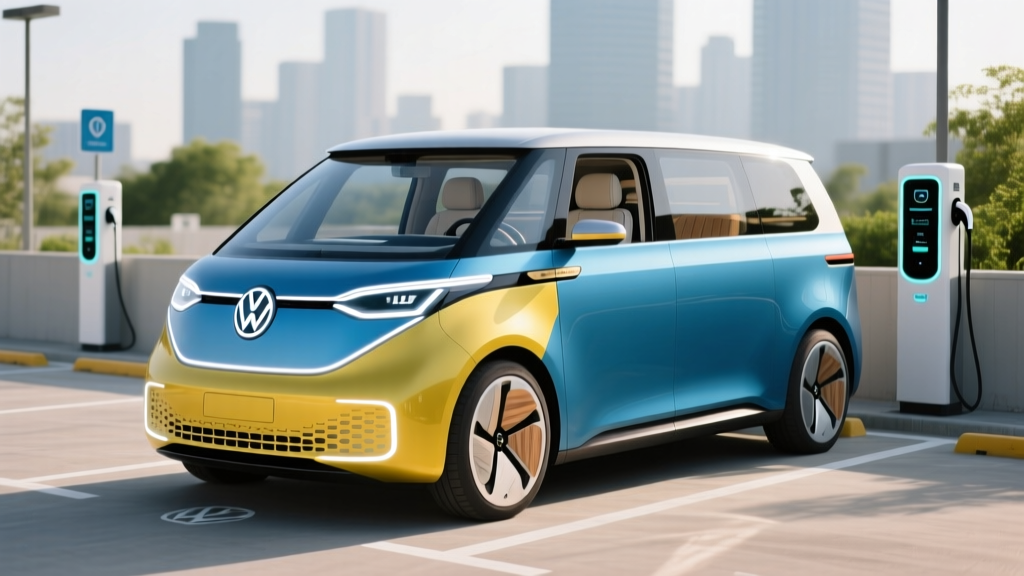
The ID. Buzz marks Volkswagen's return to the microbus segment — but this time with a fully electric powertrain. Available in the US as a long-wheelbase model, it seats up to seven across three rows and targets families, adventure-seekers, and commercial fleets who want zero tailpipe emissions without sacrificing passenger or cargo space.
Under the sheet metal, the ID. Buzz rides on VW's MEB architecture — the same platform underpinning the ID.4 crossover. The rear-wheel-drive Pro S sends 282 horsepower to the rear axle, while the available 4Motion all-wheel-drive variant bumps output to 335 hp via a second front motor. Both use a 91 kWh (usable) lithium-ion battery pack with NMC (nickel manganese cobalt) chemistry, providing a balance of energy density and thermal stability suited to a vehicle of this size and weight.
| Spec | Pro S (RWD) | Pro S Plus (AWD) |
|---|---|---|
| EPA Range | 234 miles | 231 miles |
| Battery (usable) | 91 kWh, NMC | 91 kWh, NMC |
| Horsepower | 282 hp | 335 hp |
| 0–60 mph | ~7.9 sec | ~5.9 sec |
| Peak DC Charge Rate | 200 kW | 200 kW |
| 10–80% DC Charge Time | ~26 min | ~26 min |
| Level 2 Charge Rate | 11 kW (AC) | 11 kW (AC) |
| MPGe (combined) | 87 MPGe | 84 MPGe |
| Starting MSRP | $59,995 | $65,495 |
| Battery Warranty | 8 yr / 100,000 mi | 8 yr / 100,000 mi |
Sources: fueleconomy.gov, VW USA ID. Buzz
Real-World Range: What the EPA Sticker Doesn't Tell You
The EPA combined range of 234 miles (RWD) looks adequate for most daily driving, but a three-row van rarely lives a purely "combined" life. Highway cruising at 70–75 mph with a full load of passengers and cargo will push consumption higher than the EPA's blended test cycle suggests.
Real-World Range Expectations:
- Mild weather, mixed driving: 210–225 miles
- Highway (70 mph, loaded): 190–210 miles
- Cold weather (below 32°F): 160–190 miles (NMC chemistry loses 15–25% in freezing temps)
- Mountain/towing: Expect further reduction; the ID. Buzz has a 3,500-lb tow rating on AWD trims
The 91 kWh pack provides a reasonable buffer, but the van's 5,800+ lb curb weight and boxy aerodynamic profile work against efficiency at sustained highway speeds. Plan charging stops conservatively on road trips — aim to arrive at chargers at 15–20% SoC rather than running the pack to single digits.
On DC fast charging, the 200 kW peak rate is competitive but not class-leading. The charge curve tapers significantly above 80% SoC, which is standard behavior for NMC packs protecting long-term cell health. For road trips, the practical sweet spot is charging from 10–80% in roughly 26 minutes at a properly rated 200+ kW station (such as Electrify America's newest stalls). If you're relying on 50–150 kW public chargers, expect 40–60 minutes for the same session.
ID. Buzz vs. Gas Minivans: The Ownership Cost Reality
The most direct competitors to the ID. Buzz aren't other electric vans — there simply aren't many. The Chrysler Pacifica PHEV is the closest electrified alternative, while the Toyota Sienna (hybrid only) and Honda Odyssey (gas) represent the conventional minivan segment. Here's how the math works over five years and 75,000 miles of driving:
| Cost Category | VW ID. Buzz Pro S (RWD) | Toyota Sienna XLE (HEV) | Honda Odyssey EX-L (Gas) |
|---|---|---|---|
| Purchase Price (MSRP) | $59,995 | $43,995 | $43,300 |
| Federal Tax Credit | $0* | $0 | $0 |
| Estimated State Incentives | $0–$2,000† | $0 | $0 |
| Fuel / Electricity (75k mi) | $3,375‡ | $6,250§ | $9,375¶ |
| Maintenance (5 yr) | $1,200 | $3,500 | $4,200 |
| Insurance (5 yr est.) | $9,500 | $7,800 | $7,500 |
| Estimated Depreciation | $24,000 | $15,000 | $16,500 |
| Total 5-Year Cost | ~$99,070 | ~$76,545 | ~$80,875 |
* The ID. Buzz does not currently qualify for the §30D clean vehicle credit due to battery component and critical mineral sourcing requirements. Fleet buyers may qualify for the §45W commercial credit. † Varies by state; check AFDC state incentive database. ‡ Assumes $0.15/kWh home charging average at 2.5 mi/kWh. § Sienna at 36 MPG combined, $3.00/gal. ¶ Odyssey at 22 MPG combined, $3.00/gal.
The numbers are stark: the ID. Buzz costs substantially more to own over five years, driven primarily by its higher purchase price, steeper depreciation curve, and elevated insurance premiums. Where it wins is fuel cost — home charging at national-average electricity rates delivers a per-mile energy cost roughly 60–65% lower than a gas minivan and 45–50% lower than the Sienna hybrid.
For fleet operators and commercial buyers, the calculus shifts. The §45W commercial clean vehicle credit can provide up to $7,500 per vehicle, and fleet electricity rates are often lower than residential. Maintenance savings also compound at higher mileage. But for a private family buyer paying MSRP, the ID. Buzz is a premium-priced lifestyle choice, not a budget play.
Tax Credits and Incentives: What Actually Applies
§30D Federal Tax Credit Eligibility for the 2026 ID. Buzz:
- MSRP cap (vans): $80,000 — ✅ ID. Buzz qualifies on price
- Buyer income cap: $150K single / $300K joint — varies by buyer
- Battery component sourcing (North America): ❌ Not met — battery cells manufactured overseas
- Critical minerals sourcing (FTA countries): ❌ Not fully met
- Final assembly (North America): ✅ Assembled in Hanover, Germany — wait, this does NOT meet North America requirement
Result: The 2026 VW ID. Buzz does not qualify for the $7,500 §30D consumer credit. Final assembly occurs in Germany, and battery sourcing does not satisfy current-year requirements. Always verify current eligibility at fueleconomy.gov and consult a tax professional, as IRS guidance and manufacturer sourcing can change.
State-level incentives may partially offset the price gap. California's CVRP program, Colorado's state credit, and various utility rebates for home charger installation can collectively reduce net cost by $2,000–$5,000 depending on your jurisdiction. Check the Alternative Fuels Data Center for your state's current programs.
Home Charging: What You Need Before You Buy
The ID. Buzz's 91 kWh battery demands a serious home charging setup. On a standard 120V outlet (Level 1), you'll recover roughly 3–4 miles of range per hour — meaning a full charge from empty takes over 24 hours. That's impractical for a daily-driver family van.
| Charging Level | Power (kW) | Miles of Range per Hour | Full Charge Time (est.) |
|---|---|---|---|
| Level 1 (120V / 12A) | 1.4 kW | ~3–4 mi/hr | 24–30+ hours |
| Level 2 (240V / 48A) | 11.5 kW | ~30–33 mi/hr | ~8–9 hours |
| DC Fast (200 kW peak) | Up to 200 kW | ~180 mi in 26 min (10–80%) | N/A (partial charges) |
A Level 2 home charger on a 240V / 48-amp circuit is essentially mandatory. Here's what installation typically costs:
| Component | Low Estimate | High Estimate |
|---|---|---|
| Level 2 Charger (48A, hardwired) | $400 | $750 |
| Electrical Permit | $50 | $250 |
| Electrician Labor (standard install, <50 ft run) | $600 | $1,500 |
| Panel Upgrade (if needed — 200A service) | $1,500 | $4,000 |
| Total (no panel upgrade) | $1,050 | $2,500 |
| Total (with panel upgrade) | $2,550 | $6,500 |
Have a licensed electrician evaluate your panel before committing to the purchase. A 48-amp charger requires a 60-amp dedicated circuit, and older homes with 100-amp service will almost certainly need an upgrade. The ID. Buzz's 11 kW onboard charger means you won't benefit from higher-amperage chargers (e.g., 80A units) — the van caps intake at 11 kW regardless.
If you lack home charging access (apartment dwellers, street parkers), the ID. Buzz becomes significantly less practical. Public DC fast charging is viable for road trips, but relying on it daily means 30–45 minute sessions several times a week at $0.30–$0.50/kWh — erasing much of the fuel-cost advantage.
Common Misconceptions About the ID. Buzz
| Myth | Fact |
|---|---|
| "It qualifies for the $7,500 federal tax credit" | It does not. Assembly in Germany and overseas battery sourcing disqualify it under current §30D rules. |
| "It's basically an electric minivan" | Cargo volume behind the third row (approx. 18 cu ft) is significantly less than a Sienna or Odyssey (~33 cu ft). It's more of a lifestyle passenger van than a cargo-hauling minivan. |
| "200 kW charging means it always charges that fast" | 200 kW is the peak rate, sustained only between roughly 10–35% SoC at optimal battery temperature. Above 50%, the curve tapers; above 80%, it slows dramatically. Average session rate is closer to 120–140 kW. |
| "The range is fine for road trips" | 234 EPA miles means real-world highway range of ~190–210 miles. Plan stops every 160–180 miles to maintain a safety buffer, especially in cold weather or mountainous terrain. |
| "EV maintenance is basically zero" | You still need tire rotations (heavy EVs wear tires faster), cabin air filter replacements, brake fluid checks, and wiper/washer service. Budget $800–$1,500 over 5 years — not zero. |
Who Should Buy the VW ID. Buzz — and Who Shouldn't
Buy the ID. Buzz if:
- You want a distinctive, head-turning three-row EV and are willing to pay a premium for design and character
- You have reliable home Level 2 charging and most daily driving is under 150 miles round-trip
- You value a smooth, quiet, torque-rich driving experience over maximum cargo utility
- You're a fleet/commercial buyer who can leverage the §45W credit and lower operating costs
- You live in a state with additional EV incentives that narrow the price gap
Look elsewhere if:
- You need maximum cargo space — the Sienna, Odyssey, or Pacifica all offer more behind the third row
- You regularly drive 300+ mile highway trips and live in an area with sparse DC fast-charging infrastructure
- You lack home charging access and would rely on public chargers daily
- You're budget-conscious — the Sienna HEV delivers 36 MPG combined at $16,000 less in purchase price
- You need a federal tax credit to make the numbers work — the ID. Buzz doesn't qualify
The VW ID. Buzz electric van occupies a unique niche: it's the only retro-styled, three-row EV on the US market, and it delivers genuine passenger comfort and a refined ride. But its 231–234 mile real-world range, $60,000+ entry price, and tax-credit ineligibility mean it works best as a second vehicle or a deliberate lifestyle purchase — not as the sole family hauler for long-distance road trippers. If the math and the mission match, it's a genuinely compelling EV. If you need utility-per-dollar, a hybrid minivan still wins on paper.
Frequently Asked Questions
Does the 2026 VW ID. Buzz qualify for the federal EV tax credit?
No. The ID. Buzz is assembled in Hanover, Germany, and its battery components and critical minerals do not meet the North American sourcing requirements of the §30D credit as of the 2026 model year. Commercial/fleet buyers may qualify for the separate §45W credit (up to $7,500). Always verify current rules at IRS.gov.
How much does it cost to charge the ID. Buzz at home?
At the national average residential electricity rate of ~$0.16/kWh, a full 91 kWh charge costs approximately $14.56 and provides roughly 210–225 real-world miles. That works out to about $0.065–$0.07 per mile — compared to $0.13–$0.15/mile for a gas minivan at $3.00/gallon.
What is the real-world range of the VW ID. Buzz?
The EPA rates the RWD Pro S at 234 miles combined. In real-world driving, expect 210–225 miles in mild conditions, 190–210 miles on the highway at 70+ mph, and 160–190 miles in freezing temperatures. Cold weather significantly impacts NMC battery performance due to increased internal resistance and cabin heating demands.
Can the ID. Buzz tow?
Yes. The AWD Pro S Plus is rated for up to 3,500 lbs (braked trailer). The RWD model is rated lower. Keep in mind that towing will substantially reduce range — expect a 30–50% reduction depending on trailer weight and terrain.
How does the ID. Buzz compare to the Chrysler Pacifica PHEV?
The Pacifica PHEV offers 32 miles of electric-only range before the gas engine engages, making it more practical for long road trips without charging stops. However, its all-electric range is far shorter, and it requires both gas and electric maintenance. The ID. Buzz offers a fully electric experience with lower per-mile energy costs but less total range flexibility for cross-country travel.
What is the battery warranty on the ID. Buzz?
VW covers the high-voltage battery for 8 years or 100,000 miles (whichever comes first), guaranteeing a minimum of 70% capacity retention over that period. This is consistent with industry norms for NMC packs and provides reasonable long-term protection against accelerated degradation.