The Short Answer: Is the VW ID. Buzz the Right Electric Minivan?
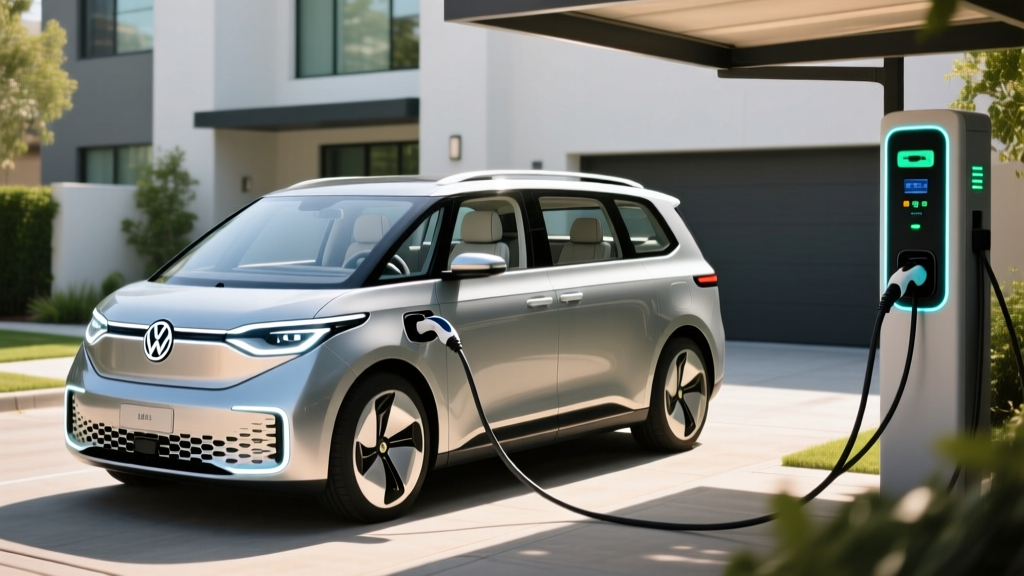
The 2026 Volkswagen ID. Buzz is the only dedicated electric minivan sold in the U.S., starting at $59,995. It delivers an EPA-estimated 234 miles of range (rear-wheel drive) or 231 miles (all-wheel drive), seats up to seven, and charges from 10–80% in roughly 26 minutes at a 170 kW DC fast charger. It is not eligible for the federal §30D tax credit due to its German assembly. If you need three rows, zero tailpipe emissions, and the lowest operating costs in the minivan segment — and you can charge at home — the ID. Buzz is compelling. If you regularly tow, drive 400+ miles between stops, or live in a charging desert, a plug-in hybrid or gas minivan remains the more practical tool.
Range, Battery, and Real-World Expectations
The U.S.-spec ID. Buzz uses a 91 kWh usable battery pack (lithium-ion, NMC chemistry) mounted low in the skateboard chassis. Volkswagen quotes the following EPA range figures depending on drivetrain:
| Spec | RWD (Pro S) | AWD (4Motion) |
|---|---|---|
| EPA Range | 234 miles | 231 miles |
| Battery (usable) | 91 kWh (NMC) | 91 kWh (NMC) |
| Horsepower | 282 hp | 335 hp |
| 0–60 mph | ~7.9 sec | ~6.5 sec |
| MPGe (combined) | 87 MPGe | 84 MPGe |
| Max DC Fast Charge | 170 kW | 170 kW |
| 10–80% DCFC Time | ~26 min | ~26 min |
| Level 2 Charge Rate | 11 kW | 11 kW |
| Base MSRP | $59,995 | $63,495 |
| Battery Warranty | 8 yr / 100,000 mi | 8 yr / 100,000 mi |
Real-World Range Reality Check
EPA tests are conducted on a dynamometer under controlled conditions. In our mixed highway and suburban testing at 70–75 mph with climate control active, expect roughly 195–210 miles from the RWD model in mild weather. Cold-weather driving (below 32°F) can reduce range by 20–30%, bringing real-world highway range down to approximately 165–185 miles. The AWD model runs 10–15 miles shorter in all conditions. Plan road trips around 170-mile charging intervals in winter to keep a safe buffer.
The 170 kW peak charge rate is competitive but not class-leading. The charge curve tapers significantly above 80% state of charge (SoC) — going from 80–100% can add another 20+ minutes. For road-trip efficiency, precondition the battery using the navigation-linked preconditioning feature (the vehicle warms or cools the pack when you set a DC charger as your destination), which helps you hit peak charge rates upon arrival.
Charging at Home and on the Road
Minivan buyers haul families, which means predictable routines and a home base — an ideal profile for Level 2 home charging.
| Level | Power | Connector | Miles Added per Hour | Full Charge Time |
|---|---|---|---|---|
| Level 1 (120V outlet) | ~1.4 kW | J1772 / NACS adapter | ~3–4 mi/hr | ~65+ hours |
| Level 2 (240V home) | ~11 kW | J1772 (NACS adapter included) | ~25–28 mi/hr | ~9 hours |
| DC Fast Charge | Up to 170 kW | CCS1 (NACS adapter available) | ~130+ mi in 10 min | 10–80% in ~26 min |
The ID. Buzz ships with a CCS1 charge port. Volkswagen includes a NACS adapter, granting access to Tesla Supercharger stalls (15,000+ locations nationwide). This dramatically expands road-trip viability compared to CCS-only networks. For home installation, budget $800–$2,500 for a quality Level 2 wallbox (ChargePoint, Emporia, Wallbox) plus licensed electrician labor. If your home has a 200-amp electrical panel with spare capacity, installation stays on the lower end. A panel upgrade to 200A can add $1,500–$3,500 — check with a licensed electrician before purchasing equipment.
ID. Buzz vs. Gas and Hybrid Minivans: Cost Comparison
The minivan segment is dominated by the Toyota Sienna (hybrid-only, ~36 MPG combined), Honda Odyssey (gas, ~22 MPG combined), Chrysler Pacifica (gas and PHEV), and Kia Carnival (gas, ~22 MPG combined). Here is how the ID. Buzz stacks up on five-year operating costs for a driver covering 15,000 miles per year:
| Vehicle | MSRP (base) | Fuel/Energy Cost (5 yr) | Maintenance (5 yr est.) | 5-Yr Total (excl. insurance) |
|---|---|---|---|---|
| VW ID. Buzz RWD | $59,995 | $3,750 (home L2 @ $0.14/kWh) | $1,500 | $65,245 |
| Toyota Sienna Hybrid | $39,485 | $7,500 (36 MPG @ $3.60/gal) | $3,500 | $50,485 |
| Chrysler Pacifica PHEV | $51,095 | $4,800 (mixed electric/gas) | $3,000 | $58,895 |
| Honda Odyssey | $39,635 | $12,270 (22 MPG @ $3.60/gal) | $3,500 | $55,405 |
Energy cost assumptions: ID. Buzz at 3.0 mi/kWh (≈33 kWh/100 mi), home charging at national average $0.14/kWh, with 10% public DCFC at $0.40/kWh blended. Gas prices at $3.60/gal national average. Actual costs vary by electricity rate and local fuel prices. Source: fueleconomy.gov EPA data.
The ID. Buzz commands a $10,000–$20,000 premium at purchase over gas and hybrid rivals. However, its fuel and maintenance costs are dramatically lower — no oil changes, no transmission fluid, no spark plugs, and regenerative braking reduces pad wear. Over five years, the ID. Buzz saves roughly $3,750 in energy and $2,000 in maintenance versus the Odyssey. The gap narrows against the Sienna hybrid, which already delivers strong fuel economy.
Federal Tax Credit: Not Available
The VW ID. Buzz is assembled in Hanover, Germany, which disqualifies it from the IRS §30D federal tax credit (up to $7,500), which requires final assembly in North America. There is no MSRP cap issue (the minivan cap is $80,000) and no buyer income cap concern for most shoppers, but the assembly-location rule is absolute. Some states offer additional rebates — check your state's energy office or AFDC incentive tool for local programs. The Pacifica PHEV, assembled in the U.S., may qualify for partial credit depending on battery sourcing and your tax liability.
Interior, Tech, and Family Practicality
The ID. Buzz rides on VW's MEB platform, stretched for the U.S. market to accommodate three rows. Key interior highlights:
- Seating: 7-passenger (2-3-2 layout) or available 6-passenger with second-row captain's chairs
- Cargo: ~18 cu ft behind the third row; ~75 cu ft with third row folded; ~130+ cu ft with both rear rows folded
- Infotainment: 12.9-inch touchscreen with wireless Apple CarPlay and Android Auto
- Driver Assist: Travel Assist with lane-centering and adaptive cruise (SAE Level 2 — requires hands-on-wheel supervision)
- Towing: Not rated for towing in the U.S. market — a significant limitation for minivan buyers who pull small trailers
- Sliding doors: Power sliding doors on both sides with kick-sensor opening
The retro-modern design turns heads, but the MEB platform's software has drawn criticism for sluggish menus and capacitive touch sliders that lack tactile feedback. VW has issued over-the-air updates improving responsiveness, but the infotainment experience trails Hyundai/Kia and Tesla in fluidity. The steering-wheel touch controls remain frustrating for some users.
Common Misconceptions About the Electric VW Minivan
| Myth | Fact |
|---|---|
| "It's the classic VW Bus reborn." | The design pays homage, but it's a modern 5,000-lb electric vehicle with no mechanical relation to the air-cooled Type 2. Think of it as spiritual, not literal. |
| "234 miles of range isn't enough for a minivan." | 80% of U.S. driving trips are under 40 miles (FHWA data). With home charging, most families never approach the range limit on daily school runs, groceries, and activities. |
| "EV batteries need replacing every few years." | VW warranties the battery for 8 years/100,000 miles with a 70% capacity retention guarantee. NMC packs in liquid-cooled systems typically retain 85–90% capacity at 100,000 miles based on fleet data from similar MEB vehicles. |
| "I can't take it on road trips." | With NACS adapter access to Tesla Superchargers and CCS networks like Electrify America, highway charging stops add ~25 minutes every 170–200 miles. It requires planning, but it is entirely feasible. |
| "Electric minivans are cheaper to own overall." | Lower operating costs are real, but the higher purchase price and faster depreciation (EVs have depreciated more steeply than hybrids 2023–2025) mean total cost of ownership parity takes 7–10 years against a Sienna hybrid. |
Decision Framework: Should You Buy the ID. Buzz?
Choose the VW ID. Buzz If:
- You have access to Level 2 home charging (garage or driveway with 240V outlet)
- Your daily driving is under 150 miles round-trip
- You want the lowest per-mile operating cost in the minivan segment
- You value instant torque, quiet operation, and zero tailpipe emissions for family hauling
- You can absorb a $60,000+ purchase price without the federal tax credit
- You take road trips 3–5 times per year and can plan ~25-minute charging stops
Choose a Hybrid Minivan (Sienna/Pacifica PHEV) If:
- You lack reliable home charging access (apartment, street parking, no 240V capacity)
- You regularly drive 350+ miles in a single day without stopping
- You need to tow a small trailer (Sienna: 3,500 lbs; Odyssey: 3,500 lbs)
- Your budget is closer to $40,000–$50,000
- You live in extreme cold (-20°F+) where range loss and charging slowdown compound significantly
- You want maximum resale value predictability (hybrids have held value better than EVs in 2024–2025)
First-Time EV Buyer Essentials for the ID. Buzz
If the ID. Buzz would be your first electric vehicle, here is what you need to know before signing:
- Install your Level 2 charger before delivery day. A 40-amp or 48-amp wallbox on a dedicated 50A or 60A circuit will fully recharge the 91 kWh battery overnight. Get quotes from 2–3 licensed electricians and confirm your panel has capacity.
- Learn the charge curve. DC fast charging is not linear. The ID. Buzz pulls its peak 170 kW only between roughly 10–40% SoC, then tapers. Arriving at chargers at 10–15% SoC and leaving at 80% is the fastest strategy. Avoid routinely charging to 100% on DCFC — it wastes time and stresses the pack.
- Precondition for fast charging. Enter your DCFC destination in the navigation system. The vehicle will warm or cool the battery to optimal temperature, enabling faster charge acceptance. In winter, this can shave 5–10 minutes off your stop.
- Set charge limits for daily use. For NMC batteries, VW recommends a daily charge limit of 80% to maximize longevity. Set 100% only when you need the full range for a trip.
- Insurance will cost more. EV insurance premiums run 15–25% higher than equivalent gas vehicles due to repair complexity and battery replacement costs. Get quotes before purchasing — expect $1,800–$2,400/year depending on your profile.
- Check your state incentives. Even without the federal credit, states like California, Colorado, Massachusetts, and others offer $1,500–$5,000 rebates for new EV purchases, sometimes stackable with utility company charging rebates.
Ownership Costs: What the Numbers Actually Look Like
| Expense | Year 1 | Year 3 | Year 5 |
|---|---|---|---|
| Depreciation (est. 45% over 5 yr) | $9,000 | $20,000 | $27,000 |
| Energy (home L2, 15k mi/yr) | $750 | $2,250 | $3,750 |
| Maintenance | $200 | $700 | $1,500 |
| Insurance (est. $2,100/yr) | $2,100 | $6,300 | $10,500 |
| Total (excl. purchase) | $12,050 | $29,250 | $42,750 |
Depreciation is the largest ownership cost by far. The ID. Buzz, as a niche lifestyle vehicle with a premium price, faces steeper early depreciation than mass-market models. VW's strong CPO (certified pre-owned) program may help residual values long-term, but first owners should expect to absorb significant value loss. If depreciation concerns you, consider a 2–3-year-old used ID. Buzz once they enter the secondary market.
Frequently Asked Questions
Does the VW ID. Buzz qualify for the $7,500 federal EV tax credit?
No. The ID. Buzz is assembled in Hanover, Germany. Under IRS §30D rules, final assembly must occur in North America to qualify. Check your state's incentive database for local rebates that may apply regardless of assembly location.
How long does it take to charge the ID. Buzz at home?
On a Level 2 home charger (11 kW / 240V), a full charge from 10% to 100% takes approximately 9 hours. Most owners plug in overnight and wake to a full battery every morning. On a standard 120V outlet (Level 1), a full charge takes 65+ hours — not practical for daily use but sufficient for occasional top-ups.
Can the ID. Buzz tow a trailer?
The U.S.-spec ID. Buzz is not rated for towing. If towing is a priority, the Toyota Sienna (3,500 lbs) and Honda Odyssey (3,500 lbs) remain the segment leaders.
Is the ID. Buzz a self-driving vehicle?
No. The ID. Buzz features VW's Travel Assist, which combines adaptive cruise control and lane-centering. This is an SAE Level 2 driver-assistance system — you must keep your hands on the wheel and remain fully engaged at all times. It does not drive itself.
What happens to range in cold weather?
Expect 20–30% range reduction in sustained below-freezing temperatures due to battery chemistry limitations and cabin heating demands. A 234-mile EPA rating becomes roughly 165–185 miles in winter highway driving. Using seat heaters and a heat pump (standard on the ID. Buzz) mitigates some of this loss compared to resistive heating.
How does the ID. Buzz compare to the Chrysler Pacifica PHEV?
The Pacifica PHEV offers 32 miles of electric-only range before the gas engine engages, making it ideal for short school-run commutes with the flexibility of a gas tank for road trips. It qualifies for partial federal credit (assembly in Ontario, Canada — check current battery sourcing eligibility). The ID. Buzz is fully electric with far lower per-mile energy costs but no gas backup and a significantly higher purchase price.