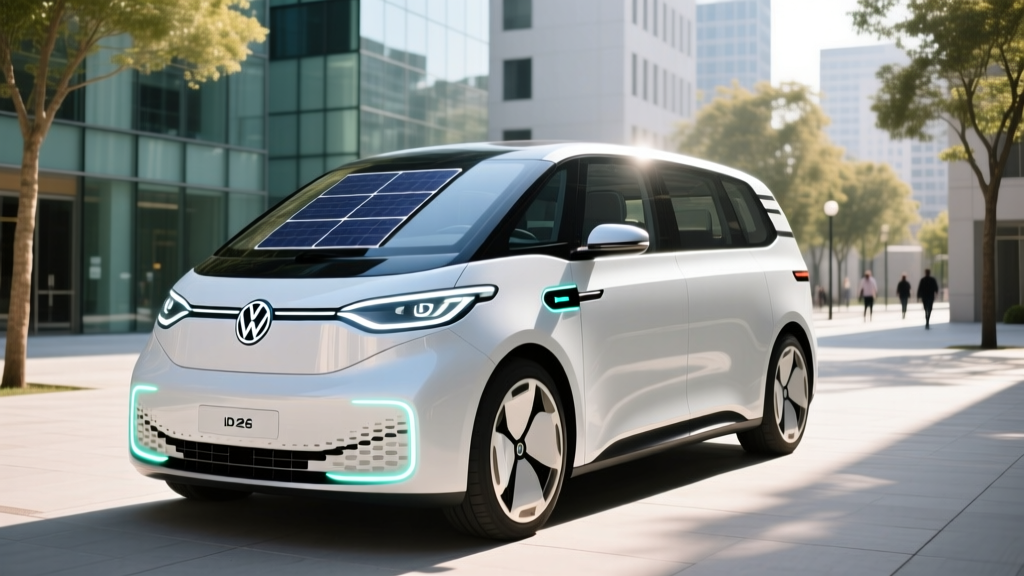
Is the VW ID. Buzz electric bus worth it? The 2026 VW ID. Buzz delivers 234 miles of EPA-estimated range, 170 kW DC fast charging (10–80% in ~26 minutes), and a starting MSRP of $59,995. It's the only all-electric three-row minivan on the U.S. market. Buyers who need seven seats, want lower per-mile fuel costs than a gas minivan, and have access to Level 2 home charging will find it compelling. Those who regularly tow, drive 300+ miles in cold weather without charging stops, or lack home charging should weigh a plug-in hybrid minivan or a larger EV SUV instead.
VW ID. Buzz Specs at a Glance
| Spec | Value |
|---|---|
| EPA Range | 234 mi (RWD) / 231 mi (AWD) |
| Battery (usable) | 86 kWh, NMC chemistry |
| DC Fast Charge (peak) | 170 kW (10–80% in ~26 min) |
| Level 2 AC Charge | 11 kW (~9 hrs for full charge) |
| Connector | CCS1 (NACS adapter available) |
| 0–60 mph | 7.9 sec (RWD) / 5.7 sec (AWD) |
| Horsepower | 282 hp (RWD) / 335 hp (AWD) |
| Cargo (behind 3rd row) | 18.2 cu ft |
| Cargo (max, seats folded) | 132.4 cu ft |
| Seating | 7 passengers |
| Base MSRP | $59,995 (RWD Pro S) |
| Battery Warranty | 8 yr / 100,000 mi |
Real-World Range vs. EPA Sticker
EPA Estimate: 234 miles (RWD Pro S)
Real-World Expectation: 185–210 miles on the highway at 70+ mph; 150–175 miles in sub-30°F winter conditions; 200–225 miles in mixed suburban driving at moderate temperatures.
The ID. Buzz is a tall, boxy vehicle with the aerodynamic profile of, well, a bus. That shape creates drag that hits efficiency hard at highway speeds. According to fueleconomy.gov, the RWD model returns 87 MPGe combined. That translates to roughly 3.1 miles per kWh — respectable around town, but expect closer to 2.6–2.8 mi/kWh at sustained 75 mph.
In cold weather, the large cabin volume demands significant heating energy. The ID. Buzz uses a heat pump (standard on U.S. models), which reduces but does not eliminate cold-weather range loss. Plan for a 25–35% reduction when temperatures drop below freezing, especially on longer trips where the cabin must stay warm for hours.
For a family that drives 40–60 miles round-trip daily with home charging, 234 miles of EPA range is more than adequate. For 250+ mile road trips, you'll need at least one DC fast-charge stop.
Charging: Home and on the Road
| Level | Power | Miles Added per Hour | Full Charge Time |
|---|---|---|---|
| Level 1 (120V) | ~1.4 kW | ~4 mi/hr | ~62 hours |
| Level 2 (240V, 48A) | 11 kW | ~34 mi/hr | ~9 hours |
| DC Fast Charge | 170 kW (peak) | ~150 mi in 15 min | 10–80% in ~26 min |
The ID. Buzz ships with a CCS1 connector. Volkswagen has confirmed NACS adapter compatibility, which unlocks access to Tesla Supercharger stations — a significant advantage for road-trip charging in areas where Electrify America or other CCS networks are sparse.
At a DC fast charger, the ID. Buzz peaks at 170 kW but, like all EVs, follows a tapering charge curve. You'll see the fastest rates between 10–50% state of charge. Above 80%, charging slows dramatically to protect the battery — a 10–80% session takes about 26 minutes, but pushing from 80–100% can add another 25–30 minutes. On road trips, plan your stops around 10–80% sessions for the best time efficiency.
For home charging, a Level 2 wallbox (240V, 48A) will fully replenish the 86 kWh battery overnight in roughly 9 hours. Installation costs typically run $800–$2,500 depending on your electrical panel capacity and the distance from panel to charger. Homes with older 100A panels may need a $1,500–$3,000 panel upgrade to support a 48A circuit.
Electric Bus vs. Gas Minivan: The Cost Comparison
The ID. Buzz's most direct competitor is the gas-powered minivan segment: the Toyota Sienna (hybrid), Honda Odyssey, and Chrysler Pacifica. Here's how the numbers stack up.
| Metric | VW ID. Buzz (RWD) | Toyota Sienna (HEV) | Honda Odyssey |
|---|---|---|---|
| Base MSRP | $59,995 | $38,085 | $39,635 |
| Fuel/Energy Cost per Mile | $0.04–$0.06 (home L2) | $0.10 (36 MPG) | $0.13 (22 MPG) |
| Annual Fuel (15,000 mi) | $600–$900 | $1,500 | $1,950 |
| Maintenance (annual avg) | ~$300 | ~$600 | ~$650 |
| 5-Year Fuel Cost | $3,000–$4,500 | $7,500 | $9,750 |
| 5-Year Maintenance | ~$1,500 | ~$3,000 | ~$3,250 |
| EPA Range / MPG | 234 mi / 87 MPGe | 610 mi / 36 MPG | 470 mi / 22 MPG |
The upfront gap is stark: the ID. Buzz starts roughly $21,000 above a Sienna. However, the per-mile energy cost is 50–70% lower when charging at home on a standard utility rate (~$0.13/kWh). Over five years and 75,000 miles, the fuel and maintenance savings total approximately $6,000–$8,000 — narrowing but not eliminating the price gap.
EV insurance premiums also tend to run 15–25% higher than equivalent gas vehicles due to repair costs and parts pricing. Budget an extra $200–$400 annually for insurance on the ID. Buzz compared to a Sienna.
5-Year Total Cost of Ownership Estimate (75,000 miles):
| Category | VW ID. Buzz | Toyota Sienna HEV |
|---|---|---|
| Purchase Price | $59,995 | $38,085 |
| Federal Tax Credit (§30D) | Up to $7,500* | $0 |
| Home Charger Install | $1,500 | $0 |
| Fuel/Energy (5 yr) | $3,750 | $7,500 |
| Maintenance (5 yr) | $1,500 | $3,000 |
| Insurance Premium (5 yr est.) | $9,000 | $7,200 |
| Estimated Depreciation | $22,000 | $14,000 |
| Net 5-Year Cost | ~$51,245 | ~$41,785 |
*§30D credit eligibility depends on MSRP caps, buyer income limits, and battery critical-mineral sourcing requirements. Verify current rules at IRS.gov and consult a tax professional.
Federal Tax Credit and Incentives
Under current IRS §30D rules, the ID. Buzz may qualify for up to $7,500 in federal tax credits, but eligibility is not guaranteed for every buyer. Key requirements include:
- MSRP Cap: Vans/minivans must have an MSRP at or below $80,000 (the ID. Buzz qualifies across all trims).
- Buyer Income Cap: Modified AGI must not exceed $150,000 (single), $225,000 (head of household), or $300,000 (joint).
- Battery Sourcing: Critical minerals and battery components must meet escalating domestic-sourcing percentages that tighten annually. Check the specific VIN on fueleconomy.gov for current eligibility.
- Point-of-Sale Transfer: Qualified buyers can transfer the credit to the dealer at purchase, reducing the out-of-pocket price immediately rather than waiting for a tax refund.
Some states and utilities also offer rebates for EV purchases and home charger installation. These vary widely by jurisdiction — check your state energy office and local utility for current programs.
Common Misconceptions About the ID. Buzz
| Myth | Fact |
|---|---|
| "It's a camper van you can live in." | The U.S. ID. Buzz is a 7-passenger minivan. There is no built-in bed, kitchen, or pop-top. Aftermarket camper conversions exist but are third-party and void portions of the warranty. |
| "234 miles of range isn't enough for a family vehicle." | The average American drives 37 miles per day (FHWA data). For daily use, 234 miles provides a 6x buffer. Road trips require planning, just as gas minivans require gas stops. |
| "The battery will need replacing in 5 years." | VW warrants the battery for 8 years/100,000 miles with a minimum 70% capacity retention threshold. NMC batteries in modern thermal-managed packs typically retain 85–90% capacity after 100,000 miles based on industry degradation data. |
| "You can't take it on road trips." | With DC fast charging at 170 kW and NACS adapter compatibility for Superchargers, the ID. Buzz can add ~150 miles in 15 minutes. A 500-mile trip requires two 25-minute stops — comparable to rest stops and meal breaks on a family drive. |
| "It qualifies for the full $7,500 tax credit automatically." | Credit eligibility depends on buyer income, battery sourcing, and MSRP. Not all buyers qualify for the full amount, and sourcing rules tighten annually. Always verify before purchasing. |
What First-Time EV Buyers Should Know
Home charging is essential. The ID. Buzz's 86 kWh battery takes over 60 hours on a standard 120V outlet. Without Level 2 home charging (240V), ownership becomes logistically difficult. If you can't install a Level 2 charger at home or at work, a plug-in hybrid like the Chrysler Pacifica PHEV (32 miles electric-only, then gas) is a more practical bridge.
Understand kW vs. kWh. kW (kilowatts) measures power — how fast you charge. kWh (kilowatt-hours) measures energy — how much the battery holds. The ID. Buzz has an 86 kWh battery and charges at up to 170 kW. Think of it like a gas tank: kWh is the tank size, kW is the pump speed.
Preconditioning matters. The ID. Buzz can precondition its battery before a DC fast-charge session, warming the cells to optimal temperature for faster charging. Use the navigation system to route to a charger, and the car will precondition automatically. Skipping this step in cold weather can slow your charge rate by 30–50%.
Towing is limited. The ID. Buzz is rated for 2,000 lbs towing capacity — enough for a small utility trailer or a pair of jet skis, but not a travel trailer or boat. If towing is a priority, consider a larger EV SUV or a gas/hybrid minivan.
Decision Framework: Is the ID. Buzz Right for You?
Choose the VW ID. Buzz if:
- You need 7 seats and want the only all-electric minivan available.
- Your daily driving is under 150 miles and you have Level 2 home charging.
- You value low per-mile energy costs and minimal maintenance over lowest purchase price.
- You want a distinctive, retro-styled vehicle that stands out from crossover SUVs.
- You qualify for the §30D tax credit and can reduce the effective purchase price.
Choose a gas or hybrid minivan (Sienna, Odyssey, Pacifica) if:
- You regularly drive 250+ miles in a single day, especially in cold climates.
- You need to tow more than 2,000 lbs.
- Your budget caps below $45,000 and you cannot absorb the upfront premium.
- You lack access to Level 2 home or workplace charging.
- You prefer the proven long-term resale value track record of established minivans.
Choose a 3-row EV SUV (Rivian R1S, Kia EV9, Tesla Model X) if:
- You want more range (270–350+ miles), faster charging, or more towing capacity.
- You need AWD for snow/terrain and the ID. Buzz AWD's 231-mile range is too tight for your needs.
- You prefer SUV driving dynamics and don't need minivan-style sliding doors.
Frequently Asked Questions
Does the VW ID. Buzz have a frunk (front trunk)?
No. The ID. Buzz does not have a front trunk. All cargo space is in the rear — 18.2 cu ft behind the third row, expanding to 132.4 cu ft with seats folded. The lack of a frunk is partly due to the HVAC and power electronics occupying the front compartment.
Can the ID. Buzz use Tesla Superchargers?
Yes, with a VW-approved NACS adapter. The ID. Buzz ships with CCS1, but Volkswagen has confirmed NACS compatibility. This opens access to the Tesla Supercharger network, which has the largest and most reliable DC fast-charging footprint in the U.S.
What happens if the battery degrades significantly?
VW's battery warranty guarantees at least 70% capacity retention for 8 years or 100,000 miles. If the battery falls below this threshold, VW will repair or replace it under warranty. Out-of-warranty battery replacement for a pack this size currently costs $12,000–$20,000, though prices are declining as the supply chain matures.
Is the ID. Buzz available with all-wheel drive?
Yes. The ID. Buzz AWD adds a front motor for a combined 335 hp and a 5.7-second 0–60 time. AWD range drops slightly to 231 miles EPA. AWD is available on the Pro S Plus and 1st Edition trims.
How does the ID. Buzz handle in snow?
The AWD model provides solid traction in snow and light off-pavement conditions, aided by the low center of gravity from the floor-mounted battery pack. The RWD model is rear-wheel drive with significant weight over the drive axle (the motor is in the rear), which helps, but winter tires are recommended for either drivetrain in sustained snow conditions.
What ADAS features does the ID. Buzz include?
The ID. Buzz comes standard with VW's IQ.DRIVE suite, which includes adaptive cruise control, lane-keeping assist, automatic emergency braking, and blind-spot monitoring. This is an SAE Level 2 driver-assistance system — the driver must remain attentive and keep hands on the wheel at all times. It is not a self-driving system.
The Bottom Line
The VW ID. Buzz occupies a unique niche: the only electric minivan in America, wrapped in heritage styling that turns heads at every school drop-off. At $59,995, it's a premium-priced vehicle that saves money on fuel and maintenance but doesn't fully close the cost gap with a Toyota Sienna over five years unless you factor in the federal tax credit and place high value on zero tailpipe emissions and a quiet, smooth ride.
For families with predictable daily routes, home charging access, and road-trip habits that accommodate a 20–25 minute charging stop every 180–200 miles, the ID. Buzz is a practical and genuinely enjoyable electric family hauler. For those who regularly push beyond 300 miles in cold weather, tow heavy loads, or lack home charging, a hybrid minivan remains the more pragmatic choice in 2026.