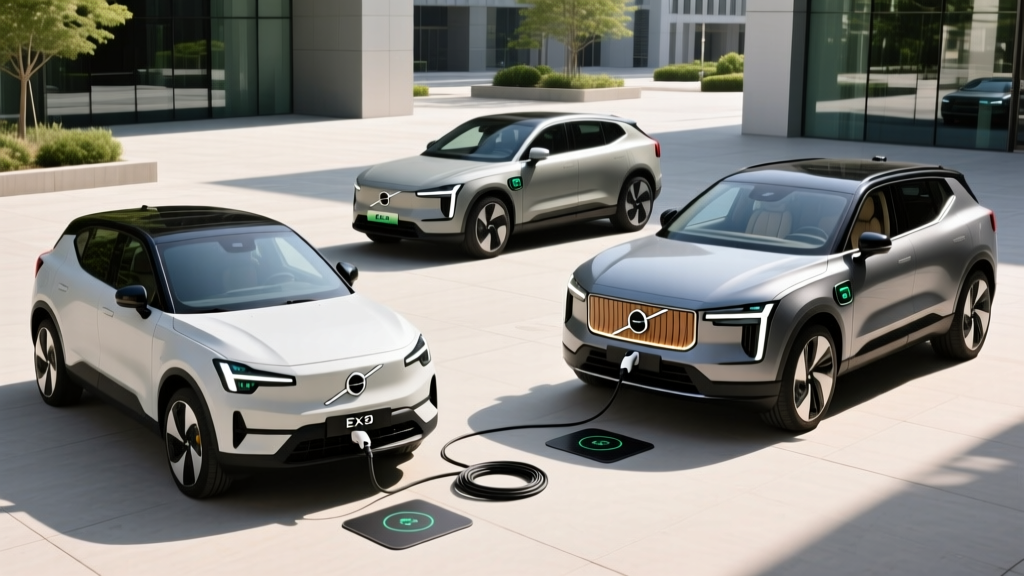
Quick Answer: Volvo's 2026 electric lineup spans three core models: the compact EX30 (EPA-estimated 265 miles, starting ~$36,345), the midsize XC40 Recharge / EX40 (EPA 293 miles, ~$53,550), and the flagship three-row EX90 (EPA ~300 miles, ~$79,990). All use Google built-in infotainment, support DC fast charging up to 200 kW, and come with an 8-year/100,000-mile battery warranty. Federal §30D tax credit eligibility varies by model, trim, and your income — the EX30 may qualify for up to $3,750 depending on battery sourcing, while the EX90 currently does not qualify due to its MSRP exceeding the $80,000 SUV cap. If you want an affordable premium compact EV, the EX30 is the value pick; if you need three rows, the EX90 is one of few electric options in its class.
Volvo's 2026 Electric Lineup at a Glance
Volvo has committed to becoming a fully electric brand by 2030, and its 2026 lineup reflects that trajectory. The current battery-electric offerings cover distinct buyer needs — from urban commuting to family hauling. Here's how they stack up on paper:
| Spec | EX30 (Single Motor) | EX30 (Twin Motor) | EX40 / XC40 Recharge | EX90 (Twin Motor) |
|---|---|---|---|---|
| EPA Range | ~265 mi | ~245 mi | ~293 mi | ~300 mi |
| Battery (usable) | 64 kWh (NMC) | 64 kWh (NMC) | 78 kWh (NMC) | 107 kWh (NMC) |
| Peak DC Charge | 153 kW | 153 kW | 200 kW | 250 kW |
| 10–80% DC Time | ~26 min | ~26 min | ~28 min | ~30 min |
| Level 2 Rate | 11 kW | 11 kW | 11 kW | 11 kW |
| 0–60 mph | 5.1 sec | 3.4 sec | 4.5 sec | 4.7 sec |
| Horsepower | 272 hp | 422 hp | 402 hp | 496 hp |
| Starting MSRP | $36,345 | $46,195 | $53,550 | $79,990 |
| §30D Credit Eligibility | Up to $3,750* | Up to $3,750* | Up to $3,750* | Not eligible (MSRP cap) |
*Federal §30D credit eligibility depends on battery component and critical-mineral sourcing requirements, buyer income caps ($150K single / $300K joint), and MSRP limits ($55K cars / $80K SUVs/vans/trucks). Confirm current rules at IRS.gov.
Real-World Range Reality Check: EPA estimates are measured under controlled conditions. In real-world highway driving at 70–75 mph, expect roughly 10–15% less range than the sticker. In freezing temperatures (below 32°F), range can drop 20–30% due to battery chemistry and cabin heating demands. The EX30's 265-mile EPA figure might deliver ~210–225 miles on a cold-weather road trip. The EX90's larger 107 kWh pack gives it more buffer, but its heavier mass (5,900+ lbs) works against efficiency — plan for ~240–260 real-world highway miles.
How Volvo EVs Compare to Gas and Hybrid Alternatives
Volvo buyers often cross-shop against the brand's own mild-hybrid models (B5 powertrain) and competitors like the BMW iX, Audi Q8 e-tron, and Genesis Electrified GV70. Here's how the economics and specs compare when you put a Volvo EV against a similarly priced gas Volvo:
| Factor | EX40 (Electric) | XC60 B5 (Mild Hybrid Gas) |
|---|---|---|
| Starting MSRP | $53,550 | $48,350 |
| Federal Tax Credit | Up to $3,750 (if eligible) | $0 |
| Effective Starting Price | ~$49,800 | $48,350 |
| Fuel/Energy Cost (15K mi/yr) | ~$580/yr (home charging, $0.13/kWh) | ~$1,875/yr (28 MPG, $3.50/gal) |
| Annual Maintenance | ~$300–$400 | ~$700–$900 |
| 5-Year Fuel/Energy Savings | EV saves ~$6,475 in energy alone | |
| EPA Efficiency | 92 MPGe combined | 28 MPG combined |
The upfront price gap narrows significantly after factoring in the federal credit (if you qualify) and state incentives. The ongoing energy savings are where EVs pull ahead — home charging at national-average residential rates ($0.13/kWh per EIA data) costs roughly $0.04 per mile versus $0.125 per mile for a 28 MPG gas vehicle at $3.50/gallon. Over five years and 75,000 miles, that's over $6,000 in energy savings alone, not counting reduced maintenance (no oil changes, fewer brake replacements due to regenerative braking).
However, if you lack home charging access — living in an apartment without a garage, for example — reliance on public DC fast charging at $0.35–$0.50/kWh erases much of that advantage, pushing per-mile costs to $0.10–$0.14. This is where a plug-in hybrid like the XC60 Recharge (35 miles electric-only, then 28 MPG gas) might make more sense for your situation.
Real Ownership Costs: The Full Picture
Sticker price is just the starting point. Here's a five-year total cost of ownership (TCO) breakdown for the EX30 Single Motor versus a comparable gas compact luxury crossover, assuming 15,000 miles per year, home Level 2 charging, and national averages:
| Cost Category (5 Years) | Volvo EX30 Single Motor | Gas Compact Luxury Crossover (e.g., Audi Q3) |
|---|---|---|
| Purchase Price (after credit) | ~$32,595 | $38,500 |
| Fuel / Energy | $2,900 | $9,375 |
| Maintenance | $1,750 | $3,750 |
| Insurance (avg) | $7,500 | $6,250 |
| Depreciation (est.) | $14,000 | $16,500 |
| 5-Year TCO Estimate | ~$58,745 | ~$74,375 |
Key takeaways from this breakdown:
- Insurance is typically 15–25% higher for EVs due to repair costs, battery replacement exposure, and higher initial vehicle values. Get quotes before purchasing.
- Depreciation on EVs remains volatile. Tesla's 2023–2024 price cuts hammered used EV values industry-wide. Volvo EVs have held more steadily, but long-term residual values are still establishing.
- Home charger installation adds $500–$2,000 upfront (Level 2, 240V, 40-amp circuit) but pays back within 1–2 years versus public charging costs.
- Maintenance savings are real. No engine oil, transmission fluid, spark plugs, or exhaust system. Brake pads last significantly longer thanks to regenerative braking recapturing kinetic energy.
Charging the Volvo EV Fleet: What You Need to Know
Volvo EVs use the CCS1 connector for DC fast charging on current models, though Volvo has announced a transition to the NACS (Tesla) connector for future vehicles. Here's what that means practically:
| Charging Level | Power (kW) | Miles Added per Hour | Best For |
|---|---|---|---|
| Level 1 (120V outlet) | 1.4 kW | ~4–5 mi/hr | Overnight top-ups, emergencies |
| Level 2 (240V home) | 11 kW | ~30–37 mi/hr | Daily home charging (full overnight) |
| DC Fast (153–250 kW) | Peak rate | ~150–200 mi in 30 min | Road trips, quick stops |
A critical concept here is the charging curve. When Volvo says the EX90 charges at up to 250 kW, that's the peak rate — not the sustained average. Lithium-ion batteries accept charge fastest between 10–50% state of charge (SoC), then taper significantly above 80% to protect cell health. A typical DC fast-charging session (10–80%) on the EX40 averages around 130–150 kW sustained, delivering roughly 200 miles of range in 28 minutes. The last 20% (80–100%) can take as long as the first 80% — which is why road-trip strategy involves charging to 80% and moving on.
Volvo's Google built-in navigation includes route planning with automatic battery preconditioning — the car warms the battery pack as you approach a DC fast charger, enabling faster charge acceptance. This is essential in cold weather, where an un-preconditioned battery might accept only 40–50 kW instead of its rated peak.
Public Charging Network Access
With the CCS1 connector, current Volvo EVs access Electrify America, EVgo, ChargePoint, and other major networks. Through Ford and GM's adoption of NACS, adapters are increasingly available, and Volvo owners can use a CCS-to-NACS adapter (approximately $150–$200) to access Tesla Superchargers where permitted. Volvo's partnership with ChargePoint includes complimentary charging credits on some models — check current offers at purchase.
Battery Longevity and Warranty Coverage
Volvo equips its EVs with NMC (nickel manganese cobalt) lithium-ion battery packs. NMC offers higher energy density than LFP (lithium iron phosphate), giving more range per kilogram — important in vehicles like the EX30 where packaging space is tight. The trade-off is that NMC cells degrade slightly faster than LFP over thousands of charge cycles, though modern thermal management systems have narrowed this gap substantially.
| Attribute | NMC (Volvo's Choice) | LFP (Tesla Model 3 RWD, etc.) |
|---|---|---|
| Energy Density | Higher (~250 Wh/kg cell) | Lower (~170 Wh/kg cell) |
| Cycle Life | ~1,000–2,000 cycles | ~3,000–5,000 cycles |
| Cold Performance | Better | Reduced in extreme cold |
| Recommended Daily Charge | 80% (for longevity) | 100% OK |
| Cost | Higher | Lower |
Volvo's battery warranty covers 8 years or 100,000 miles, guaranteeing a minimum of 70% capacity retention. Industry data from Recurrent shows that modern liquid-cooled EV batteries typically retain 85–92% capacity at 100,000 miles — well above warranty thresholds. Real-world degradation is rarely the crisis that early EV skeptics predicted, but it's not zero: expect to lose roughly 1–2% of range per year under normal use patterns.
Battery care tips for NMC packs:
- Set your daily charge limit to 80% — only charge to 100% before long trips
- Avoid leaving the car at 100% SoC for extended periods (days)
- Use preconditioning when navigating to DC fast chargers
- In extreme heat, park in shade or a garage when possible
Decision Framework: Which Volvo EV Is Right for You?
Choose the EX30 if: You want a premium compact EV under $40K, commute under 50 miles daily, and prioritize urban maneuverability over cargo space. The single-motor version's 265-mile range handles most weekly driving on a single home charge. It's the most affordable entry into Volvo's electric lineup and the likeliest to qualify for at least partial federal tax credits.
Choose the EX40 (XC40 Recharge) if: You need more interior space, all-weather AWD confidence, and 290+ miles of range. The 78 kWh battery and 200 kW DC charging make it a capable road-trip vehicle. At ~$53,550, it sits below the $55,000 car MSRP cap for §30D eligibility, though sourcing rules may limit the credit to $3,750.
Choose the EX90 if: You need three rows of seating and are willing to pay premium pricing. With 496 hp, a 107 kWh battery, and advanced LiDAR-equipped safety systems, it's Volvo's technology flagship. However, its ~$80,000 MSRP puts it at or above the $80,000 SUV cap for federal tax credit eligibility — expect to pay full price unless you find a negotiated deal below the cap.
Consider a Volvo plug-in hybrid (Recharge T8) instead if: You lack reliable home charging, regularly drive 400+ miles between stops in charging-desert regions, or want electric-only commuting (35 miles) without full EV commitment. The XC60 Recharge and XC90 Recharge offer a pragmatic bridge.
Common Misconceptions About Volvo EVs
| Myth | Fact |
|---|---|
| "Volvo EVs have poor range compared to Tesla" | The EX40's 293-mile EPA range is competitive with the Model Y Long Range (310 mi). The EX90's 300 miles matches the BMW iX xDrive50. Range gaps have largely closed across the industry. |
| "The battery will need replacing and cost $20,000" | Modern NMC packs with active thermal management are designed to outlast the vehicle's economic life. Out-of-warranty replacements run $12,000–$18,000 but are rarely needed — degradation data shows 85%+ retention at 100K miles. |
| "You can't road-trip in a Volvo EV" | With 153–250 kW DC fast charging and 10–80% times under 30 minutes, road trips require 20–30 minute stops every 2–2.5 hours. The CCS network covers all major US highways, and NACS adapter access to Superchargers is expanding. |
| "Volvo's EV software is buggy" | Early XC40 Recharge models had Google Automotive OS teething issues. 2024–2026 OTA updates have substantially improved stability, navigation accuracy, and charging reliability. Current builds are competitive with any premium EV OS. |
| "All Volvo EVs get the $7,500 tax credit" | Federal §30D credit depends on MSRP caps, buyer income limits, and battery sourcing requirements. Most Volvo EVs currently qualify for $0–$3,750, not the full $7,500, due to critical-mineral sourcing rules. Always verify at IRS.gov before purchasing. |
What First-Time Volvo EV Buyers Should Know
If this is your first electric vehicle, here are the practical ownership realities that brochures don't emphasize:
- Home charging is non-negotiable for convenience. A Level 2 home charger (240V, 40A circuit, ~$500–$800 for the unit plus $500–$2,000 for electrician installation) transforms EV ownership. You wake up every morning with a "full tank." Without it, you're dependent on public infrastructure that varies wildly in reliability.
- Your electrical panel may need an upgrade. Adding a 40A circuit requires available panel capacity. Older homes with 100A service may need a $1,500–$3,000 panel upgrade to 200A. Get an electrician assessment before purchasing.
- Cold weather changes everything. If you live in northern climates, expect 20–30% range loss below freezing. The EX30's 265 EPA miles becomes ~185–210 real-world miles in a Minnesota January. A heat pump (standard on most Volvo EVs) mitigates this somewhat but doesn't eliminate it.
- Tire costs are higher. EVs are heavier (the EX90 weighs over 5,900 lbs) and deliver instant torque. Expect tire replacement every 25,000–35,000 miles versus 40,000–50,000 on a comparable gas vehicle. Budget $800–$1,200 per set.
- Plan road trips around chargers, not gas stations. Apps like A Better Routeplanner and PlugShare are essential. Volvo's built-in Google Maps handles this natively, but have a backup plan — especially in rural areas where CCS chargers are sparse.
- One-pedal driving takes a week to learn. Volvo's regenerative braking setting lets you slow the car by lifting the accelerator, recovering energy back into the battery. Most owners prefer it within a week and find it reduces brake wear dramatically.
Frequently Asked Questions
Are Volvo electric cars reliable?
Volvo's EV powertrains have proven mechanically reliable — electric motors have far fewer moving parts than internal combustion engines. The main reported issues in early XC40 Recharge models centered on software (Google Automotive OS) and 12V auxiliary battery drain, both largely addressed through over-the-air updates. Volvo's IIHS safety ratings remain top-tier across the EV lineup.
How long does it take to charge a Volvo EV at home?
With a Level 2 home charger (11 kW), the EX30's 64 kWh battery charges from empty to full in approximately 6.5 hours. The EX40's 78 kWh pack takes about 8 hours. The EX90's 107 kWh battery requires roughly 10 hours. Most owners plug in overnight and wake up fully charged — daily driving of 30–50 miles only requires 2–4 hours of Level 2 charging to replenish.
Can I use a Tesla Supercharger with my Volvo EV?
Current Volvo EVs use the CCS1 connector. Tesla has opened portions of its Supercharger network to non-Tesla vehicles, and CCS-to-NACS adapters are available for approximately $150–$200. Volvo has confirmed it will adopt the NACS connector on future models. Check the Tesla app for compatible Supercharger locations near you.
What happens if the battery degrades significantly?
Volvo's battery warranty guarantees at least 70% capacity retention for 8 years or 100,000 miles. If your battery falls below this threshold within the warranty period, Volvo will repair or replace it at no cost. Industry data shows most modern EV batteries retain 85–92% capacity at 100,000 miles, making warranty claims uncommon.
Is the Volvo EX90 worth $80,000?
The EX90 competes with the BMW iX, Mercedes EQS SUV, and Rivian R1S in the premium electric three-row segment. Its LiDAR-equipped safety suite, 496 hp dual-motor powertrain, and 300-mile range are compelling. However, it does not qualify for the federal tax credit due to the $80,000 SUV MSRP cap, making the effective price significantly higher than credit-eligible competitors. If three electric rows are a priority and budget allows, it's a strong choice — but test-drive against the Rivian R1S and Kia EV9 before committing.