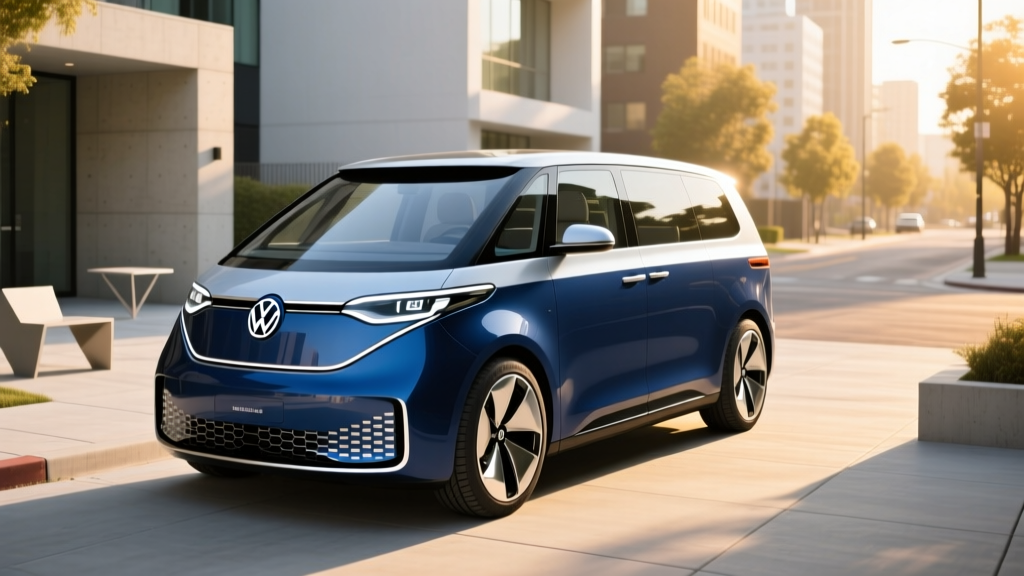
The Volkswagen ID. Buzz arrived in the U.S. with a mission: channel the microbus nostalgia of the 1960s into a modern, three-row electric van that families can actually live with. But nostalgia doesn't pay the bills. The real question buyers are asking is whether the numbers — the ID. Buzz cost, its range, and its charging speed — add up to a smart purchase in a crowded EV market.
We've spent time with the 2026 model year ID. Buzz to give you the unvarnished numbers: what it costs out the door, how far it really goes on a charge, how fast it fills up, and whether the federal tax credit actually applies. No marketing fluff — just the data you need to decide.
2026 VW ID. Buzz at a Glance: Full Spec Sheet
| Specification | Standard Range (RWD) | Pro S (RWD) | Pro S Plus (AWD) |
|---|---|---|---|
| Base MSRP | $59,995 | $65,495 | $69,995 |
| EPA Range | 234 mi | 231 mi | 217 mi |
| Battery (Usable) | 91 kWh (NMC) | 91 kWh (NMC) | 91 kWh (NMC) |
| Motor Config | Rear single motor | Rear single motor | Dual-motor AWD |
| Horsepower | 282 hp | 282 hp | 335 hp |
| 0–60 mph | ~7.9 sec | ~7.9 sec | ~5.9 sec |
| Max DC Fast Charge | 200 kW | 200 kW | 200 kW |
| 10–80% DC Time | ~26 min | ~26 min | ~26 min |
| Level 2 Charge Rate | 11 kW (~30 mi/hr) | 11 kW (~30 mi/hr) | 11 kW (~30 mi/hr) |
| MPGe (Combined) | 87 MPGe | 85 MPGe | 80 MPGe |
| Efficiency (kWh/100 mi) | 39 kWh | 40 kWh | 42 kWh |
| Seats | 7 | 7 | 7 |
| Cargo (Behind 3rd Row) | 18.7 cu ft | 18.7 cu ft | 18.7 cu ft |
| Cargo (3rd Row Folded) | 75.5 cu ft | 75.5 cu ft | 75.5 cu ft |
| Battery Warranty | 8 yr / 100,000 mi | 8 yr / 100,000 mi | 8 yr / 100,000 mi |
| Vehicle Warranty | 4 yr / 50,000 mi | 4 yr / 50,000 mi | 4 yr / 50,000 mi |
Source: fueleconomy.gov, Volkswagen of America press materials. Specs reflect 2025–2026 model year data; confirm with your dealer for final MY2026 adjustments.
The Real ID. Buzz Cost: Trim Pricing and Tax Credit Math
Let's cut straight to the bottom line. The 2026 ID. Buzz starts at $59,995 for the Standard Range RWD trim — already a premium price for an electric minivan. The better-equipped Pro S RWD sits at $65,495, and the dual-motor AWD Pro S Plus tops the lineup at $69,995. Add destination charges (~$1,395), paint options, and dealer-installed accessories, and a fully loaded AWD model can push past $73,000 before incentives.
| Trim | MSRP + Dest. | Federal Credit (§30D) | Est. Net Cost |
|---|---|---|---|
| Standard Range RWD | $61,390 | Up to $7,500* | ~$53,890 |
| Pro S RWD | $66,890 | Up to $7,500* | ~$59,390 |
| Pro S Plus AWD | $71,390 | Up to $7,500* | ~$63,890 |
*Critical tax credit caveats: The IRS §30D Clean Vehicle Credit has strict eligibility requirements. To claim the full $7,500:
- MSRP cap: Vans qualify under the $80,000 cap for SUVs/vans (the ID. Buzz is classified as a light truck/van) — all trims clear this.
- Buyer income cap: AGI must not exceed $150,000 (single), $225,000 (head of household), or $300,000 (joint filers).
- Battery sourcing: The vehicle must meet critical mineral and battery component requirements that phase in stricter thresholds each year. VW has sourced components to qualify, but verify the specific VIN's eligibility on fueleconomy.gov before purchase.
- Point-of-sale transfer: You can transfer the credit to the dealer at purchase for an immediate price reduction — no waiting until tax filing.
Always confirm your personal eligibility with a tax professional. Incentive rules evolve annually, and battery sourcing compliance can change by model year and production batch.
Real-World Range: What the EPA Number Doesn't Tell You
Real-World Expectation: Plan for ~185–210 miles on the highway at 70–75 mph. In cold weather (below 35°F), expect a further 20–30% reduction, dropping effective range to ~150–175 miles for the AWD model. City driving with regenerative braking recovers some efficiency, often exceeding EPA estimates in stop-and-go traffic.
The ID. Buzz's boxy, upright shape is its charm and its Achilles' heel. That flat front end and vertical windshield create aerodynamic drag that punishes efficiency at highway speeds. The 91 kWh usable battery is substantial, but the vehicle's ~5,800-pound curb weight and roughly 0.35 Cd drag coefficient mean it burns through electrons faster than sleeker EVs like the Hyundai Ioniq 5 or Tesla Model Y.
At 39–42 kWh per 100 miles depending on trim, the ID. Buzz is one of the least efficient EVs in its price range. For context, the Model Y Long Range achieves roughly 28 kWh/100 mi. That translates to higher electricity costs per mile and more frequent charging stops on road trips — a factor worth modeling if you plan regular long-distance travel.
The ID. Buzz does use NMC (nickel manganese cobalt) battery chemistry, which offers higher energy density than LFP alternatives. This helps pack 91 kWh into the floor without sacrificing ground clearance. However, NMC batteries benefit from daily charging limits around 80% for longevity, unlike LFP packs that tolerate regular 100% charges. VW's 8-year/100,000-mile battery warranty covers capacity below 70% of original — a fairly standard threshold.
Charging Speed: DC Fast Charge and Home Level 2 Breakdown
| Charging Method | Max Power | Speed / Time | Connector |
|---|---|---|---|
| DC Fast Charge (10–80%) | 200 kW peak | ~26 minutes | CCS1 (NACS adapter available) |
| DC Fast Charge (80–100%) | Tapers to ~50 kW | ~30+ additional minutes | CCS1 |
| Level 2 Home/Public (240V) | 11 kW (48A) | ~30 miles per hour of charging | J1772 / NACS (with adapter) |
| Level 1 (120V Standard Outlet) | ~1.4 kW | ~3–4 miles per hour | Standard household plug |
The ID. Buzz peaks at 200 kW on DC fast charging, which is respectable but not class-leading. Rivals like the Hyundai Ioniq 5 and Kia EV9 accept 250+ kW. More importantly, the ID. Buzz's charging curve tapers noticeably after 80% state of charge — that last 20% can take as long as the first 80%. On road trips, the practical strategy is to charge from 10–80% and move on, adding roughly 160–170 real-world miles in 26 minutes.
For home Level 2 charging, the onboard 11 kW charger is a strong point. With a 48-amp Level 2 wallbox (like a ChargePoint Home Flex or Emporia Level 2), you'll add about 30 miles of range per hour. A full overnight charge from 10% takes roughly 8.5 hours — feasible for most schedules. Budget $500–$1,500 for a quality Level 2 home charger and $800–$2,500 for electrician installation (more if your panel needs a 200-amp upgrade).
VW ships the ID. Buzz with a CCS1 charge port. As the industry shifts to NACS (Tesla's connector), VW has confirmed NACS adapter compatibility, and future production may include a native NACS port. If you rely on the Tesla Supercharger network, confirm adapter availability and compatibility with your model year.
Driving Impressions: Performance, Ride Quality, and Tech
The rear-wheel-drive ID. Buzz delivers 282 horsepower through a single rear motor — adequate for a vehicle this size, with a 0–60 mph time around 7.9 seconds. The dual-motor AWD variant bumps output to 335 hp and drops 0–60 to approximately 5.9 seconds, which makes merging and passing genuinely confident even when loaded with passengers and cargo.
Ride quality is a highlight. The long 127.5-inch wheelbase and independent suspension smooth out highway expansion joints and city potholes effectively. The steering is light and predictable, though the 20.3-foot overall length demands attention in tight parking lots. A 37.1-foot turning circle is tighter than many SUVs, which helps in urban environments.
Tech and driver assistance: The ID. Buzz runs VW's ID. Software 4.0 on a 12.9-inch infotainment touchscreen. Wireless Apple CarPlay and Android Auto are standard. The IQ.DRIVE suite includes adaptive cruise control, lane centering, automatic emergency braking, and blind-spot monitoring. This is an SAE Level 2 driver-assistance system — it does not drive itself. You must keep your hands on the wheel and eyes on the road at all times.
One notable omission: the ID. Buzz does not offer GM's Super Cruise or Ford's BlueCruise-style hands-free highway driving. If you want eyes-off-capable Level 2+ assistance, you'll need to look elsewhere.
Interior Space: Passenger and Cargo Dimensions
The ID. Buzz's three-row cabin is its strongest selling point for families:
- Front headroom: 41.5 inches — massive, thanks to the tall roofline
- Second-row legroom: 37.6 inches — comfortable for adults
- Third-row legroom: 33.5 inches — usable for adults on shorter trips, tight for long hauls
- Cargo behind 3rd row: 18.7 cu ft — enough for a few grocery bags or a compact stroller
- Cargo with 3rd row folded: 75.5 cu ft — competitive with midsize SUVs
- Max cargo (all rear seats folded): ~125 cu ft
The second-row bench splits and slides fore/aft for legroom flexibility. The third row folds flat but doesn't tumble or remove easily — if you need maximum cargo space frequently, compare this against the Kia EV9, which offers a more flexible seating configuration. The ID. Buzz also lacks a frunk (front trunk); the motor and electronics fill that space.
ID. Buzz vs. the Competition: Is It Worth the Cost?
Pros
- Distinctive retro styling with genuine road presence
- Standard 3-row, 7-passenger seating with adult-usable rear rows
- Spacious cabin with excellent headroom and visibility
- Competitive 200 kW DC fast charging
- 11 kW Level 2 onboard charger (faster than many rivals)
- AWD option available for all-weather confidence
- Eligible for up to $7,500 federal tax credit
- Strong 8-year/100,000-mile battery warranty
Cons
- Premium pricing — starts near $60K before options
- Mediocre efficiency (39–42 kWh/100 mi) means higher charging costs
- Real-world highway range falls well below EPA estimate
- No frunk for additional storage
- No hands-free driving mode (IQ.DRIVE is standard Level 2 only)
- CCS1 port requires adapter for NACS/Tesla Supercharger access
- Third-row cargo space tight with all seats in use
Who Should Buy the ID. Buzz?
Choose the ID. Buzz if: You want a distinctive, head-turning three-row EV for family duty and suburban commuting; you value style, cabin space, and ride comfort over maximum range; you primarily charge at home and take road trips of 200 miles or less between stops.
Consider the Kia EV9 or Tesla Model X instead if: You need maximum range (EV9 offers up to 304 mi EPA), faster DC charging (EV9: 250 kW), hands-free driving tech, or a lower starting price for a 3-row EV. The EV9 starts around $54,900 and delivers better efficiency.
Consider the Chrysler Pacifica PHEV if: You lack reliable home charging, frequently drive 300+ miles between stops, or need sliding doors and a minivan-specific layout at a lower price point.
5-Year Ownership Cost Snapshot
The ID. Buzz's premium MSRP is only part of the financial picture. Here's what five years of ownership looks like at 15,000 miles per year, assuming $0.14/kWh home electricity and 80% home / 20% public charging:
| Cost Category | ID. Buzz Pro S RWD (Est.) | Kia EV9 GT-Line AWD (Est.) |
|---|---|---|
| Purchase Price (after $7,500 credit) | $59,390 | $58,890 |
| 5-Year Fuel/Energy Cost | $5,460 | $4,620 |
| Estimated Insurance (5 yr) | $9,500 | $8,200 |
| Maintenance (5 yr) | $1,800 | $1,800 |
| Estimated Depreciation | $22,000 | $20,500 |
| 5-Year Total | ~$98,150 | ~$94,010 |
Estimates based on fueleconomy.gov efficiency data, industry-average depreciation curves, and national insurance averages. Your actual costs will vary by state, driving habits, and electricity rates.
The ID. Buzz costs roughly $4,000 more over five years than the EV9, driven by higher energy consumption, steeper insurance premiums (insurers price the ID. Buzz higher due to repair cost uncertainty and parts availability), and potentially faster depreciation. These are estimates — get personalized insurance quotes before committing.
Frequently Asked Questions
Does the VW ID. Buzz qualify for the $7,500 federal EV tax credit?
The ID. Buzz is eligible for up to $7,500 under IRS §30D, provided you meet income caps ($300K joint / $150K single), the vehicle meets battery sourcing requirements for the model year, and you take delivery as a new vehicle. The credit can be transferred to the dealer at point of sale for an immediate price reduction. Always verify your specific VIN's eligibility on fueleconomy.gov before signing.
What is the real-world highway range of the ID. Buzz?
Expect roughly 185–210 miles at sustained highway speeds (70–75 mph) for the RWD models, and 175–195 miles for the AWD Pro S Plus. Cold weather (below 35°F) can reduce this by an additional 20–30%. The EPA sticker says 234 miles, but plan your road trips around 180-mile segments to maintain a comfort buffer.
How fast does the ID. Buzz charge at home?
On a 48-amp Level 2 home charger (240V), the ID. Buzz accepts up to 11 kW and gains approximately 30 miles of range per hour. A full charge from 10% to 100% takes about 8.5 hours. On a standard 120V outlet (Level 1), expect only 3–4 miles per hour — adequate for topping off but not for daily use if you drive more than 30 miles per day.
Is the ID. Buzz a good road-trip vehicle?
It's workable but not ideal. With ~185 miles of real-world highway range and 200 kW DC charging, you'll stop every 2.5–3 hours to charge for 25–30 minutes. That's manageable on well-served corridors (I-5, I-95, I-70 through Colorado) but can be stressful in charging deserts. The cabin comfort is excellent for long hauls, but the range limitation is real.
How does the ID. Buzz compare to the Kia EV9?
The EV9 offers more EPA range (up to 304 mi), faster 250 kW charging, a lower starting price (~$54,900), and available hands-free highway driving. The ID. Buzz counters with more character, a roomier-feeling cabin (especially headroom), and a standard 11 kW onboard charger vs. the EV9's 10.9 kW. If efficiency and range are your priorities, the EV9 wins on paper. If style and cabin experience matter more, the ID. Buzz is compelling.
What is the ID. Buzz battery warranty?
Volkswagen covers the high-voltage battery for 8 years or 100,000 miles, whichever comes first. The warranty guarantees the battery will retain at least 70% of its original capacity during that period. The general vehicle warranty is 4 years / 50,000 miles.