The Retro Van Goes Electric — But Does the ID. Buzz Work as a Campervan?
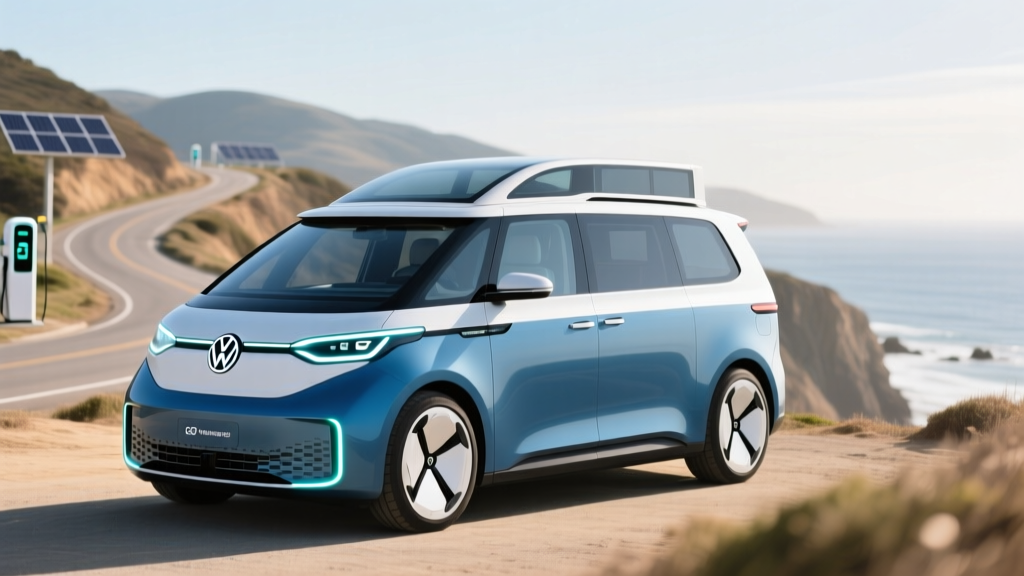
Volkswagen's ID. Buzz arrived in the US for the 2025 model year as a three-row, long-wheelbase electric van with unmistakable retro styling. But a growing segment of buyers isn't interested in school runs — they want the VW ID. Buzz campervan. Whether through VW's own California variant (available in Europe, not yet confirmed for the US) or through third-party upfitters converting standard ID. Buzz LWB models, the electric microvan is being pressed into overlanding and car-camping duty. This review examines the US-spec 2025 ID. Buzz through that lens: what its range, charging, cargo dimensions, and pricing actually mean for campervan life, and where the compromises bite.
The short version: the ID. Buzz offers more interior volume than any other mainstream EV on the market, decent (not exceptional) range, acceptable fast-charging speeds, and a starting price that positions it firmly in premium territory. As a campervan platform, it's compelling for weekend warriors who can charge at home — but its 234-mile EPA range and front-heavy weight distribution demand realistic expectations for off-grid touring.
Spec Snapshot: 2025 VW ID. Buzz LWB (US Spec)
| Spec | Value |
|---|---|
| EPA Range | 234 miles (LWB AWD); 231 miles (LWB RWD) |
| Battery (usable) | 86 kWh (NMC lithium-ion) |
| Drivetrain | RWD (single motor) or AWD (dual motor, GTX) |
| Horsepower | 282 hp (RWD) / 339 hp (AWD GTX) |
| 0–60 mph | ~7.9 sec (RWD) / ~6.5 sec (AWD GTX) |
| Max DC Fast Charge | 170 kW (10–80% in ~26 min) |
| Level 2 AC Charging | 11 kW onboard (~33 mi/hr) |
| Efficiency | 87 MPGe combined (AWD) / 90 MPGe (RWD) |
| Cargo (behind 3rd row) | 18.2 cu ft |
| Cargo (3rd row folded) | 75.5 cu ft |
| Cargo (all rear seats out) | 131.3 cu ft |
| Base MSRP (RWD Standard) | $59,995 |
| AWD GTX MSRP | $69,995 |
| Battery/Powertrain Warranty | 8 years / 100,000 miles |
| Basic Warranty | 4 years / 50,000 miles |
Real-World Range: What 234 EPA Miles Actually Means on a Camping Trip
Real-World Highway (70 mph, 75°F): ~190–210 miles
Cold Weather Highway (30°F, heater on): ~155–175 miles
Fully Loaded + Roof Box + Headwind: ~165–185 miles
The EPA figure is measured under controlled lab conditions. On an actual road trip — which is the entire point of a campervan — you'll see less. The ID. Buzz is a large, heavy, boxy vehicle with the aerodynamic profile of, well, a van. At highway speeds above 65 mph, aerodynamic drag dominates energy consumption, and the Buzz's flat front end and upright greenhouse don't help.
In independent real-world testing by multiple outlets, the AWD LWB ID. Buzz has delivered between 190 and 210 miles at sustained highway speeds in moderate temperatures. That's roughly a 10–19% reduction from the EPA sticker, which is typical for a vehicle with this shape. Cold weather compounds the problem: the NMC battery loses efficiency below 40°F, and running the cabin heater (the ID. Buzz does include a heat pump on most trims, which helps) still draws significant energy. Expect 155–175 miles of usable range on a 30°F winter highway drive.
For campervan use, there's another factor: weight and accessories. A loaded conversion with a bed platform, kitchen module, water tanks, and gear can easily add 500–800 lbs over the stock curb weight of ~5,800 lbs. A roof box or cargo carrier worsens aerodynamics further. Plan for 165–185 real-world miles in a fully-equipped camping configuration and you won't be stranded.
That range is workable for most weekend camping loops in the western US or Northeast corridor where DC fast chargers are increasingly available along interstates. It's less ideal for remote BLM land boondocking or long stretches of US-50 in Nevada. Route planning with apps like A Better Routeplanner is essential.
Charging Speed: 170 kW Peak, but Watch the Curve
| Charging Level | Power | Time / Rate |
|---|---|---|
| Level 1 (120V household) | ~1.4 kW | ~4 mi/hr — ~60+ hours for full charge |
| Level 2 (240V home, 48A) | 11 kW (onboard max) | ~33 mi/hr — ~9 hours 10–100% |
| DC Fast Charge (peak) | 170 kW | 10–80% in ~26 minutes |
| DC Fast Charge (sustained avg) | ~110–120 kW avg | 10–80% realistic session |
The ID. Buzz supports up to 170 kW DC fast charging via its CCS1 connector (a NACS adapter will be available for Tesla Supercharger access). VW quotes a 10–80% charge time of approximately 26 minutes at an appropriate 175+ kW station. That's a reasonable number for a vehicle in this class — comparable to the Ford E-Transit and faster than the older Chevy Bolt's CCS architecture, though notably slower than Hyundai-Kia's 800V E-GMP platform (which peaks at 240+ kW).
Here's the nuance that matters for road trips: peak kW is not sustained kW. The 170 kW figure is achieved only in a narrow state-of-charge window (roughly 10–30% SoC at optimal battery temperature). Above 50%, the charge rate tapers significantly, dropping below 100 kW. Above 80%, it slows to under 50 kW as the battery management system protects cell longevity. On a typical road-trip stop where you arrive at 15% and charge to 80%, expect an average rate closer to 110–120 kW, making the 26-minute claim achievable under good conditions but not guaranteed at every station.
Preconditioning matters. The ID. Buzz can precondition its battery when you navigate to a DC fast charger via the built-in navigation system. This warms the NMC cells to optimal charging temperature, which is especially important in cold weather. If you pull into a fast charger cold-soaked without preconditioning, your peak rate may be limited to 100–120 kW, extending your stop significantly. Always navigate to your charger when possible.
For home charging, the 11 kW onboard charger is solid. On a 48-amp Level 2 circuit (the most common home installation for EV owners), you'll add roughly 33 miles of range per hour, or fully replenish the 86 kWh battery in about 9 hours. For campervan use, this means you can leave home every morning with a full "tank" if you have Level 2 installed — which is the single biggest advantage EV campervans have over gas conversions on multi-day trips with home-base stops.
Interior Space and Campervan Conversion Potential
The ID. Buzz's party trick is interior volume. At 131.3 cubic feet with all rear seats removed, it offers more enclosed cargo space than a Tesla Model Y (76 cu ft max), Rivian R1S (85 cu ft), or Ford Mustang Mach-E (60 cu ft). The box-shaped interior with near-vertical walls and a flat floor is inherently easier to build out than the tapered cargo areas of SUVs.
Key dimensions for campervan planning:
- Cargo floor length (behind front seats): ~68 inches — enough for a full-length bed platform for most adults
- Cargo floor width (between wheel wells): ~48 inches — fits a standard sleeping pad
- Interior height (floor to ceiling): ~53 inches — sufficient to sit upright on a low bed platform, but not stand
- Cargo opening width: ~47 inches — accommodates bike loading
- Sliding door opening: Power sliding doors on both sides with wide apertures for easy gear loading
The US-market LWB (long wheelbase) model stretches 195.4 inches overall — about 10 inches longer than the European short-wheelbase version — and rides on a 121.8-inch wheelbase. That length puts it between a Honda Odyssey and a Ford Transit Connect in footprint, making it manageable in parking lots while offering legitimate build-out room inside.
Third-party conversion companies are beginning to offer campervan modules for the ID. Buzz, including slide-in kitchen galleys, bed platforms, and auxiliary battery systems. VW has not announced a US version of the ID. Buzz California (the factory campervan sold in Europe), and given VW's cautious US product strategy, a factory conversion seems unlikely before 2027 at the earliest. For now, the standard LWB model is your canvas.
One practical note: the ID. Buzz does not offer vehicle-to-load (V2L) capability in the US market as of the 2025 model year. You cannot power camp appliances directly from the traction battery. This is a meaningful omission compared to the Hyundai Ioniq 5 and Ford F-150 Lightning, both of which offer V2L or Pro Power Onboard for running induction cooktops, lights, and devices off-grid. You'll need a separate portable power station (EcoFlow, Jackery, etc.) for campsite electricity.
Performance, Ride Quality, and Drivetrain
The ID. Buzz is not fast by EV standards, but it doesn't need to be. The rear-wheel-drive model's single motor produces 282 horsepower and gets the van to 60 mph in roughly 7.9 seconds — perfectly adequate for highway merging and mountain passes. The dual-motor GTX trim bumps output to 339 hp and drops the 0–60 to about 6.5 seconds, which feels genuinely quick in a vehicle this size.
For campervan use, the AWD GTX is the more practical choice despite its higher price and slightly lower EPA range (234 vs. 231 miles — the difference is marginal). All-wheel drive provides traction on forest service roads, gravel campground approaches, and snowy mountain passes where a rear-drive van carrying 800 lbs of conversion gear might struggle. The dual-motor setup also handles the added weight of a build-out more gracefully.
Ride quality is a genuine strength. The ID. Buzz rides on VW's MEB platform with a long wheelbase that smooths out highway expansion joints and dirt washboards better than shorter EVs. The suspension tuning leans comfort-oriented, which suits the campervan use case. Body roll is noticeable in corners (tall vehicle, heavy battery) but not alarming.
Towing is not a strong suit. The US-spec ID. Buzz is rated for 2,000 lbs of towing capacity — enough for a small teardrop trailer or utility trailer, but not a full camp trailer. If your camping setup depends on towing, the Rivian R1T (11,000 lbs) or F-150 Lightning (7,700+ lbs) are far more capable. The ID. Buzz is an interior-volume play, not a towing platform.
Pricing, Trims, and Federal Tax Credit Eligibility
| Trim | MSRP | Est. After §30D Credit* | Notes |
|---|---|---|---|
| ID. Buzz LWB Standard Style (RWD) | $59,995 | $52,495 | Base trim, well-equipped |
| ID. Buzz LWB Pro S (RWD) | $63,495 | $55,995 | Added tech and comfort features |
| ID. Buzz LWB Pro S Plus (RWD) | $66,495 | $58,995 | Premium trim, Harman Kardon audio |
| ID. Buzz GTX (AWD) | $69,995 | $62,495 | Dual-motor, sport-tuned |
*Tax credit estimates assume full $7,500 eligibility under IRS §30D rules. Eligibility depends on buyer income limits ($150K single / $300K joint AGI), vehicle MSRP caps ($80,000 for vans/SUVs — the ID. Buzz qualifies), and critical-mineral/battery-component sourcing requirements that change annually. As of the 2025 tax year, the ID. Buzz's battery sourcing compliance is confirmed for the full credit, but always verify current-year rules at irs.gov or with a tax professional before purchasing. The credit can be transferred to the dealer at point of sale as a purchase-price reduction.
At roughly $60,000 before incentives, the ID. Buzz is a premium-priced vehicle. For context, a used T4 or T3 VW camper conversion can be had for $25,000–$45,000 (with all the reliability caveats of a 25-year-old van), and a Ford Transit Connect starts around $35,000 (gas, not electric). The ID. Buzz's value proposition rests on its electric powertrain savings (lower fuel and maintenance costs), modern safety tech, and the novelty factor of its design.
For campervan conversion, budget an additional $5,000–$20,000 for a professional build-out depending on complexity (basic bed platform and storage vs. full galley with plumbing and electrical). That puts a fully converted ID. Buzz campervan in the $65,000–$85,000 range — competitive with a Winnebago e-RV concept or a custom Sprinter conversion, but significantly more than a DIY Subaru Outback camping setup.
Tech, Driver Assistance, and Notable Drawbacks
The ID. Buzz comes equipped with VW's IQ.DRIVE suite, which includes adaptive cruise control with stop-and-go, lane-keeping assist, automatic emergency braking, and Travel Assist (a combined lane-centering and adaptive cruise system). This is SAE Level 2 driver assistance — it can reduce fatigue on long highway stretches to a campsite, but the driver must remain fully engaged with hands on the wheel and eyes on the road. It is not self-driving, and VW's lane-centering implementation is competent but not class-leading compared to GM's Super Cruise or Ford's BlueCruise on mapped highways.
The infotainment system runs on VW's ID.Software 4.0 with a 12.9-inch touchscreen on higher trims. The interface has improved markedly over earlier ID.4 implementations, with faster response times and more logical menus. Wireless Apple CarPlay and Android Auto are standard. A head-up display with augmented-reality navigation is available on Pro S Plus trims — genuinely useful for following directions on unfamiliar back roads to a trailhead.
Notable drawbacks for campervan buyers:
- No V2L: Cannot power camp appliances from the traction battery. A significant miss for off-grid use.
- No roof rack from factory: The panoramic glass roof (standard on most trims) precludes traditional crossbar mounting. Aftermarket solutions for roof boxes are limited as of early 2025.
- Ground clearance: At approximately 6.8 inches, this is a pavement-oriented vehicle. Deep ruts and rocky forest roads are a risk to the underbody battery pack.
- Software quirks: VW's touch-capacitive steering wheel controls and slider-based climate controls are fiddly and draw consistent criticism. Not a dealbreaker, but annoying on a long trip.
- No spare tire: The ID. Buzz uses a tire repair kit. For remote camping, carrying a full-size spare (which takes cargo space) or at minimum a quality plug kit and compressor is advisable.
Pros
- Class-leading interior volume (131 cu ft) ideal for build-outs
- Flat floor and boxy walls simplify campervan conversions
- Comfortable ride quality on long highway drives
- AWD available for campground access roads
- Heat pump standard — better cold-weather efficiency
- Full $7,500 federal tax credit eligibility (verify sourcing rules annually)
- Modern safety suite standard across all trims
Cons
- 234-mi EPA range is modest for a road-trip vehicle
- No V2L for off-grid campsite power
- Low ground clearance limits off-pavement use
- No factory roof rack with panoramic roof
- 170 kW peak charge rate trails Hyundai/Kia 800V rivals
- Premium pricing ($60K+) before conversion costs
- 2,000-lb towing capacity is minimal
Who Should Buy the VW ID. Buzz as a Campervan?
- You want a dedicated, comfortable EV sleep-in vehicle for weekend trips within 200 miles of home
- You have Level 2 home charging and can start every trip fully charged
- Interior volume and a flat sleeping platform matter more than off-road capability
- You value low running costs (electricity vs. gas, no oil changes) over many years of ownership
- You want a daily-driver EV that doubles as a campervan — not a dedicated rig
- You need 300+ miles of range for remote touring (consider Rivian R1S or Tesla Model X)
- Off-grid V2L power is essential (Hyundai Ioniq 5, Ford F-150 Lightning)
- You tow a camp trailer over 2,000 lbs
- You regularly drive rough forest roads requiring 8+ inches of ground clearance
- Budget is tight — a used gas van conversion costs 40–60% less upfront
The ID. Buzz campervan occupies a specific niche: the weekend-warrior daily driver. It's an excellent commuter vehicle Monday through Friday with three rows of seating for families, then transforms into a comfortable two-person sleeping platform on Friday evenings. Its range is adequate for the I-5 corridor, the Blue Ridge Parkway, or the Pacific Coast Highway with planned charging stops. It's not the right tool for the Dalton Highway or the Rubicon Trail — and it doesn't pretend to be.
Frequently Asked Questions
What is the real-world range of the VW ID. Buzz campervan?
The EPA rates the AWD LWB ID. Buzz at 234 miles and the RWD at 231 miles. In real-world highway driving at 70 mph in moderate temperatures, expect 190–210 miles. With a full campervan conversion adding 500–800 lbs plus a roof box, plan for 165–185 miles per charge. In cold weather (below 30°F), highway range drops to approximately 155–175 miles.
How fast does the ID. Buzz charge on a road trip?
The ID. Buzz peaks at 170 kW on DC fast chargers, achieving a 10–80% charge in approximately 26 minutes under optimal conditions. The sustained average rate over a typical session is closer to 110–120 kW due to charge-curve tapering above 50% state of charge. At home on a 48-amp Level 2 charger, it adds about 33 miles of range per hour, with a full charge taking roughly 9 hours.
Does the VW ID. Buzz qualify for the $7,500 federal EV tax credit?
Yes, the ID. Buzz qualifies for the full $7,500 §30D federal tax credit as of the 2025 tax year, provided the buyer meets income limits ($150,000 single / $300,000 joint modified AGI). The MSRP cap for vans is $80,000, which all ID. Buzz trims fall under. Battery critical-mineral and component sourcing requirements must also be met — VW has confirmed compliance, but verify current-year rules at irs.gov before purchase, as requirements tighten annually. The credit can be applied as a point-of-sale price reduction through the dealer.
Is the ID. Buzz worth buying vs. other electric campervan options?
It depends on your priorities. The ID. Buzz offers more interior volume than any other mainstream EV SUV (131 cu ft), making it the best pure interior space for conversions. However, the Rivian R1S offers 316 miles of range, air suspension for variable ground clearance, and V2L capability — at a higher price ($80K+). The Hyundai Ioniq 5 offers V2L and faster 800V charging but far less cargo space. For dedicated campervan duty with daily-driver practicality, the ID. Buzz is a strong option if its range and ground-clearance limits fit your trip profile.
Can I install a pop-top roof on the ID. Buzz for standing room?
As of early 2025, no major aftermarket company offers a certified pop-top roof for the US-spec LWB ID. Buzz, largely due to the standard panoramic glass roof and the vehicle's recency in the market. European conversion companies offer pop-tops for the short-wheelbase European model, but US-market fitment is unconfirmed. Expect aftermarket options to emerge by 2026–2027 as the vehicle's installed base grows. For now, interior height is limited to ~53 inches — enough to sit up in a sleeping bag but not stand.
How much does a full campervan conversion cost for the ID. Buzz?
Professional conversions range from approximately $5,000 for a basic bed platform with storage drawers to $20,000+ for a full build with galley kitchen, auxiliary electrical system, insulation, and custom cabinetry. DIY conversions can be completed for $1,500–$5,000 in materials. Factor conversion costs on top of the vehicle's $60,000–$70,000 MSRP for total budget planning.
What is the battery warranty on the ID. Buzz?
VW covers the high-voltage battery and electric powertrain for 8 years or 100,000 miles (whichever comes first), with a capacity retention guarantee of 70% over that period. The basic vehicle warranty is 4 years / 50,000 miles. For campervan use, the battery warranty provides meaningful long-term protection, though note that aftermarket conversion work that modifies the vehicle's electrical system could potentially affect warranty coverage — consult your VW dealer before any conversion that taps into high-voltage or 12V systems.