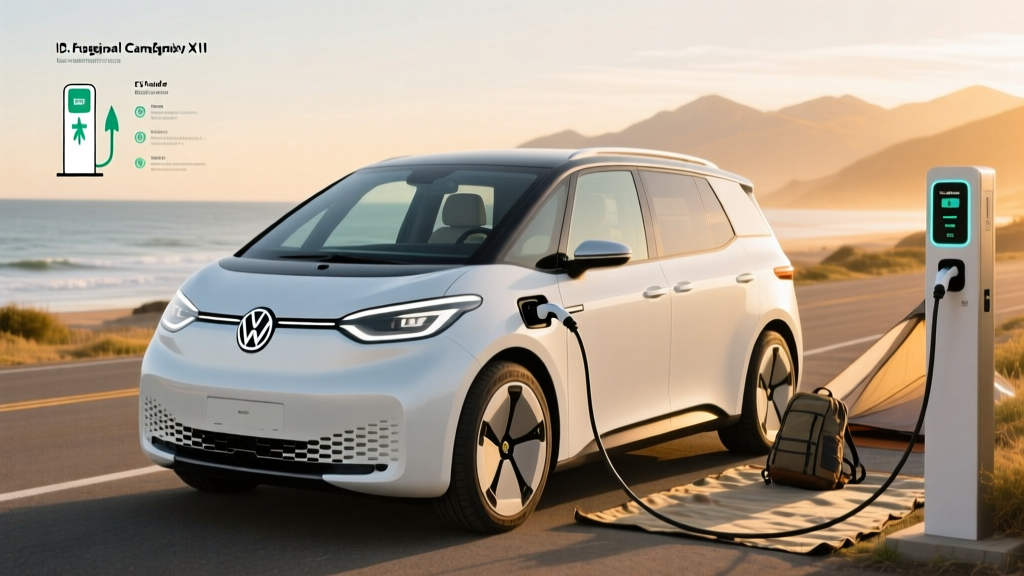
The Volkswagen ID. Buzz is the electric microbus revival that turned heads with its retro styling, and the camper variant takes that appeal further by adding a pop-top roof and integrated camping amenities. But nostalgia alone doesn't make a great road-trip EV. In this review, we break down the VW ID. Buzz camper's range, charging capabilities, pricing, and daily-driver practicality to determine whether this electric van can genuinely replace a gas-powered camper on your next adventure — or whether its limitations outweigh the charm.
Range and Efficiency: EPA Numbers vs. Reality
Real-World Expectation: ~185–210 miles on the highway at 70 mph; ~160–180 miles in cold weather (below 35°F) with cabin heating. The camper variant's pop-top adds drag and weight, potentially shaving 10–20 miles off these figures when deployed or loaded with gear.
The ID. Buzz uses a 91 kWh usable battery pack (gross capacity ~95 kWh) with NMC (nickel-manganese-cobalt) chemistry, chosen for its higher energy density — critical in a large van. For context, the standard-wheelbase rear-wheel-drive model carries an EPA range of 234 miles, while the available 4MOTION all-wheel-drive version drops to approximately 220 miles due to the added front motor weight and drivetrain losses.
Efficiency lands around 84 MPGe combined, or roughly 40 kWh per 100 miles. That's thirsty by EV standards — for comparison, a Hyundai Ioniq 5 achieves about 114 MPGe. The ID. Buzz's brick-like aerodynamics and 5,500+ lb curb weight are the culprits. On a 300-mile road trip, plan for at least one DC fast-charge stop, and in cold weather or mountainous terrain, two stops is prudent.
| Spec | RWD Standard WB | AWD 4MOTION |
|---|---|---|
| EPA Range | 234 mi | ~220 mi |
| Battery (Usable/Gross) | 91 kWh / ~95 kWh, NMC | |
| Horsepower | 282 hp | 330 hp |
| 0–60 mph | ~7.9 sec | ~6.5 sec |
| Drivetrain | Rear-Wheel Drive | Dual-Motor AWD |
| MPGe (Combined) | ~84 MPGe | ~80 MPGe |
| kWh / 100 mi | ~40 | ~42 |
| Base MSRP (Standard WB) | $59,995 | $69,995 |
Charging Speed: DC Fast Charge and Home Level 2
Charging speed is where the ID. Buzz's large battery presents both an advantage and a liability. More kWh means longer range, but it also means longer fill-up times if the charge rate doesn't scale accordingly.
| Charging Level | Power (kW) | Speed / Time |
|---|---|---|
| Level 1 (120V household) | ~1.4 kW | ~3–4 mi/hr — full charge in 60+ hours |
| Level 2 (240V, 40A home charger) | ~9.6 kW | ~23 mi/hr — full charge in ~10 hours |
| Level 2 (240V, 48A charger) | ~11.5 kW | ~28 mi/hr — full charge in ~8 hours |
| DC Fast Charge (peak) | 200 kW (peak) | 10–80% in ~26 minutes |
The ID. Buzz supports up to 200 kW peak DC fast charging via its CCS connector (note: Volkswagen has not adopted the NACS/Tesla connector for the ID. Buzz in North America as of the 2025–2026 model years). At a 350 kW Electrify America station, you'll see peak speeds around 175–200 kW between roughly 10–30% state of charge, after which the charge curve tapers significantly. By 60% SoC, expect rates to drop to ~120 kW, and above 80%, charging slows dramatically to protect battery health — dropping below 50 kW.
Real-world charging insight: The 10–80% time of approximately 26 minutes is competitive for a 91 kWh pack, but remember that 10–80% only adds about 160 miles of range in this van. For a full road-trip recharge to 90%+, plan on 40–45 minutes at the charger. Preconditioning the battery (via the vehicle's navigation-routed preconditioning system) is essential for achieving peak charge rates — arriving at a DC fast charger without preconditioning can add 10+ minutes to your stop, particularly in cold weather.
At home, a Level 2 charger at 48 amps (the typical maximum for a NEMA 14-50 or hardwired setup) will fully replenish the battery overnight in about 8 hours. Installation costs for a home Level 2 charger typically range from $500 to $2,500 depending on your electrical panel capacity and wiring distance — budget toward the higher end if your home has a 100-amp panel that needs upgrading to 200 amps.
Performance and Drivetrain
The rear-wheel-drive ID. Buzz produces 282 horsepower and 339 lb-ft of torque from its single rear-mounted permanent-magnet synchronous motor. That delivers a 0–60 mph time of approximately 7.9 seconds — adequate for merging and passing but hardly quick for a vehicle this heavy. The dual-motor 4MOTION AWD variant bumps output to 330 horsepower and 413 lb-ft, dropping the 0–60 time to roughly 6.5 seconds.
Ride quality is a highlight. The long wheelbase and soft suspension tuning absorb highway imperfections effectively, and the turning radius is surprisingly tight at 36.3 feet — a legacy of the original Microbus's urban-friendly design philosophy. The available IQ.DRIVE suite includes Travel Assist (adaptive cruise + lane centering, SAE Level 2), Front Assist with autonomous emergency braking, and Park Assist. Make no mistake: Travel Assist requires hands on the wheel and eyes on the road at all times. This is driver assistance, not self-driving.
Interior, Cargo, and Camper Amenities
The standard-wheelbase ID. Buzz seats up to seven across three rows, with the second row offering captain's chairs that slide, recline, and fold. Cargo space behind the third row is approximately 18.2 cubic feet — modest for a vehicle this size — but folding the third row opens up roughly 75.5 cubic feet. Behind the front seats, maximum cargo volume reaches approximately 130 cubic feet.
The camper variant (marketed in some regions as the ID. Buzz California or with dealer-installed pop-top packages from partners like Brabus or Westfalia) typically adds:
- A pop-top roof with an upper sleeping berth (roughly 78" x 47" bed)
- An integrated kitchenette module with a single-burner induction cooktop, small sink, and pull-out fridge drawer
- Rear seat conversion to a lower bed (~72" x 45")
- Privacy curtains and auxiliary 12V/USB-C outlets in the rear cabin
- Available auxiliary house battery to power camper amenities without drawing from the traction battery
Legroom is generous across all rows: approximately 42 inches in the front, 38 inches in the second row, and 34 inches in the third. The flat floor (thanks to the skateboard-style EV platform) makes moving between rows easy — a real advantage for families wrangling kids and gear.
Pricing, Trims, and Federal Tax Credit
| Trim / Config | Base MSRP | Federal §30D Credit | Effective Price |
|---|---|---|---|
| Pro S (RWD, Standard WB) | $59,995 | $0 (MSRP cap exceeded*) | $59,995 |
| Pro S Plus (RWD, Standard WB) | $64,995 | $0 (MSRP cap exceeded*) | $64,995 |
| 1st Edition (AWD) | $69,995 | $0 (MSRP cap exceeded*) | $69,995 |
| Camper conversion (dealer-installed) | +$8,000–$18,000 | N/A on upfit | $68,000–$88,000+ |
*Critical tax credit detail: Under IRS §30D rules, the federal EV tax credit for vans, SUVs, and trucks has an MSRP cap of $80,000. The base ID. Buzz trims fall under that cap, but the credit also requires meeting critical mineral and battery component sourcing thresholds that shift annually. As of 2025–2026, Volkswagen's battery supply chain for the ID. Buzz has not consistently met the full $7,500 threshold requirements. Additionally, buyer income caps apply: modified adjusted gross income (MAGI) must not exceed $150,000 (single), $225,000 (head of household), or $300,000 (married filing jointly). Always verify current eligibility on IRS.gov before purchase. The credit can now be transferred to the dealer at point of sale as an instant discount, if eligible.
Camper conversion packages are typically dealer-installed aftermarket upfits and do not factor into the MSRP cap calculation for the federal credit. State-level incentives vary widely — check your local DMV or energy office for regional rebates.
Battery Longevity and Warranty
Volkswagen backs the ID. Buzz battery pack with an 8-year / 100,000-mile warranty against defects and excessive capacity loss (below 70% state of health). The powertrain carries the same 8-year / 100,000-mile coverage, while the basic vehicle warranty is 4 years / 50,000 miles.
NMC chemistry in the ID. Buzz offers higher energy density than LFP (lithium iron phosphate) alternatives, but it is more sensitive to sustained high state-of-charge and extreme heat. For maximum longevity:
- Set your daily charge limit to 80% unless you need full range for a trip
- Avoid frequent DC fast charging when Level 2 is available
- Use the vehicle's battery preconditioning when navigating to a charger
- Minimize prolonged storage above 90% SoC or below 10% SoC
Real-world NMC degradation data from ID.4 owners (which shares the MEB platform) suggests approximately 5–8% capacity loss over the first 60,000 miles, with degradation slowing significantly thereafter. A full battery replacement out of warranty would likely cost $15,000–$22,000 based on current MEB platform pricing, though this figure should decrease as the supply chain matures.
Pros, Cons, and Verdict
Pros
- Iconic retro design with genuine road presence
- Spacious, configurable interior with flat floor
- Tight turning radius for a large van (36.3 ft)
- Pop-top camper variant enables legitimate overnight camping
- Comfortable ride quality on long highway stretches
- Available AWD for traction in rain and light snow
Cons
- Low efficiency (~84 MPGe) means frequent charging stops
- 234-mile EPA range is marginal for road-trip duty
- Peak 200 kW DC charging is slower than competitors like the Hyundai Ioniq 5 (240 kW) or Kia EV9 (236 kW in ~25 min)
- CCS-only — no NACS adapter included; Supercharger access requires a third-party adapter
- Camper conversion adds $8K–$18K on top of an already expensive base price
- Likely does not qualify for the $7,500 federal tax credit due to battery sourcing rules
- Infotainment software (VW ID.Software) has been a consistent criticism across the ID. family for lag and menu complexity
Verdict: The VW ID. Buzz camper is a compelling lifestyle vehicle for weekend warriors who prioritize style, space, and short-to-medium-distance camping trips within ~180 miles of home. It is not the most efficient or fastest-charging EV on the market, and its range limitations mean you'll plan your road trips around charging infrastructure more carefully than you would in a Kia EV9 or Rivian R1S. If your camping trips routinely exceed 300 miles one-way, a PHEV or extended-range EV may serve you better. But for the right use case — coastal weekends, festival camping, family car-camping within a regional radius — the ID. Buzz camper delivers an experience no competitor matches.
Who Is the ID. Buzz Camper For?
This EV suits best as a:
- Weekend camper: 100–200 mile round trips to campgrounds with Level 2 charging at your destination
- Family adventure vehicle: Daily driver that transforms for Saturday sleepovers and tailgating
- Urban/suburban commuter with a hobby: Decent daily range with the fun factor of a camper-ready van
It is less suited for:
- Long-distance road trippers who regularly drive 400+ miles between destinations
- Off-grid boondockers who need days of self-sufficient power (the traction battery is not designed for V2L camping loads without an auxiliary house battery)
- Budget-conscious buyers — total cost with camper conversion easily reaches $75,000–$88,000
Frequently Asked Questions
What is the real-world range of the VW ID. Buzz camper?
The EPA rates the RWD standard-wheelbase ID. Buzz at 234 miles. In real-world highway driving at 70 mph, expect 185–210 miles. In cold weather below 35°F, range drops to approximately 160–180 miles. Camper conversions with pop-tops add aerodynamic drag and weight, which may reduce these figures by an additional 5–10%.
How fast does the ID. Buzz charge at home and on the road?
At home on a Level 2 charger (48A, 240V), the ID. Buzz adds roughly 28 miles of range per hour and fully charges in about 8 hours. On a DC fast charger, it peaks at 200 kW and charges from 10–80% in approximately 26 minutes, though the charge curve tapers significantly above 60% SoC.
Does the VW ID. Buzz qualify for the $7,500 federal EV tax credit?
It depends. The base MSRP falls under the $80,000 van/SUV cap, but the critical mineral and battery component sourcing requirements under IRS §30D are stringent and change annually. As of the 2025–2026 tax year, the ID. Buzz has not consistently qualified for the full $7,500 credit. Buyer income limits also apply ($300,000 MAGI for joint filers). Verify on fueleconomy.gov and irs.gov before purchasing.
How does the ID. Buzz compare to the Kia EV9 or Rivian R1S for camping?
The Kia EV9 offers up to 304 miles of EPA range, faster 236 kW peak charging, and qualifies more readily for tax incentives — but lacks the camper-conversion ecosystem and retro charm. The Rivian R1S provides 352–410 miles of range (depending on battery pack), genuine off-road capability, and a built-in camp kitchen option, but starts above $80,000. The ID. Buzz wins on character and interior flexibility, but loses on range and charging speed.
Can I power my camping appliances from the ID. Buzz battery?
The ID. Buzz does not natively offer vehicle-to-load (V2L) capability in the North American market as of 2025–2026. Most camper conversions include an auxiliary 12V house battery specifically to power kitchenettes, lights, and devices without draining the main traction battery. If V2L is a priority, the Hyundai Ioniq 5 or Ford F-150 Lightning offer this feature natively.
What is the battery warranty on the ID. Buzz?
Volkswagen provides an 8-year / 100,000-mile warranty on the high-voltage battery, covering defects and capacity loss below 70% state of health. The powertrain carries the same coverage, while the basic bumper-to-bumper warranty is 4 years / 50,000 miles.