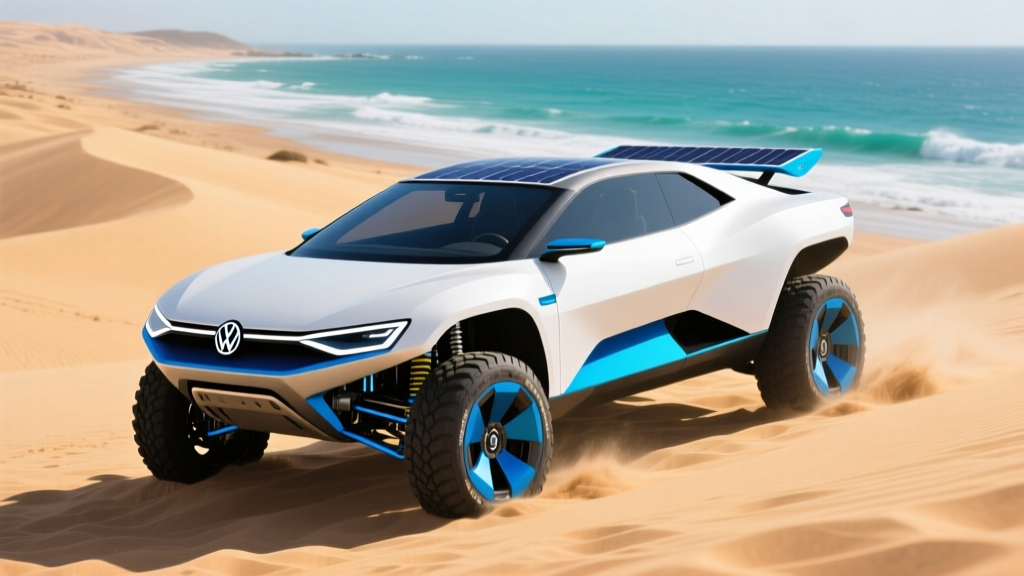
When Volkswagen unveiled the ID Buggy concept at the Geneva Motor Show, it captured something the EV market desperately lacks: pure, unadulterated fun. Built on the same MEB platform that underpins the ID.4 and ID. Buzz, this retro-futuristic dune machine promised open-air electric driving with zero emissions and a healthy dose of nostalgia. But years later, the question remains: is the VW ID Buggy actually coming to production, and should you hold out hope or look elsewhere?
As of early 2026, the VW ID Buggy remains a concept vehicle with no confirmed US production timeline. Volkswagen has not announced pricing, EPA certification, or dealer availability. What follows is a comprehensive analysis of the concept's published specifications, engineering feasibility, market positioning, and what a production version would realistically look like — so you can make an informed decision about your next EV purchase today, not someday.
What Is the VW ID Buggy, Exactly?
The VW ID Buggy is a fully electric, two-seat, open-top concept vehicle designed as a modern homage to the classic Meyers Manx dune buggies built on the original Beetle platform. Revealed in 2019, it was engineered on Volkswagen's Modular Electric Drive Matrix (MEB) — the same skateboard architecture used in the ID.4 crossover, ID. Buzz microbus, and European ID.3 hatchback.
The concept was designed with a critical engineering feature: a modular body structure. Volkswagen explicitly stated the upper body could be detached from the MEB chassis, theoretically allowing third-party coachbuilders to create custom bodies — much like the original dune buggy ecosystem of the 1960s. This "skateboard-plus" philosophy was central to VW's pitch to specialty manufacturers.
However, Volkswagen's subsequent strategic pivot — including the cancellation of the ID. Buzz for the US market (later reversed for limited import), the restructuring of its EV timeline under CEO Oliver Blume, and the prioritization of higher-volume models — has left the ID Buggy in limbo. No production confirmation has been issued as of 2026.
Projected Specs: Battery, Range, and Efficiency
While the ID Buggy concept was displayed without a fully finalized production powertrain, Volkswagen confirmed it was built around a 62 kWh (gross) battery pack positioned in the floor of the MEB platform. Some later reports from European automotive press referenced an uprated 82 kWh pack option using the longer MEB wheelbase variant.
| Specification | Concept / Projected | MEB Reference (ID.4 Pro S) |
|---|---|---|
| Battery Capacity (usable) | ~77 kWh (est. 82 kWh gross) | 77 kWh (82 kWh gross) |
| Battery Chemistry | NMC (Nickel Manganese Cobalt) | NMC |
| Drivetrain | RWD (single motor); AWD concept shown | RWD or AWD |
| Horsepower | 201 hp (RWD) / 295 hp (AWD concept) | 282 hp (RWD) / 335 hp (AWD) |
| 0-60 mph (projected) | ~7.0 sec (RWD) / ~5.5 sec (AWD) | 7.3 sec (RWD) / 5.4 sec (AWD) |
| EPA Range (projected) | ~220-250 mi (est.) | 275 mi (EPA certified) |
| Efficiency (projected) | ~2.8-3.2 kWh/mi | 2.9 kWh/mi (104 MPGe combined) |
Real-world range expectations: The open-air design, lack of aerodynamic optimization (flat windshield, no roof), and likely off-road-oriented tires would penalize efficiency significantly compared to the ID.4. Where the ID.4 achieves 275 miles EPA, a production ID Buggy would likely see 220-250 miles EPA at best — and highway driving at 70+ mph could reduce that to 180-200 miles. Cold-weather operation (below 40°F) would further reduce usable range by 20-30%, a well-documented characteristic of NMC chemistry without the thermal advantages of a sealed cabin.
The NMC (Nickel Manganese Cobalt) chemistry used across the MEB platform offers higher energy density than LFP (Lithium Iron Phosphate), which is critical in a lightweight, compact vehicle where battery volume is constrained. However, NMC cells degrade slightly faster over time and are more sensitive to sustained high-state-of-charge storage — owners should target 80% daily charge and avoid leaving the vehicle at 100% for extended periods.
Charging Performance: DC Fast and Home Level 2
Based on the MEB platform's established charging architecture, a production ID Buggy would share the following charging capabilities with the ID.4 and ID. Buzz:
| Charging Level | Power / Rate | Speed | Notes |
|---|---|---|---|
| Level 1 (120V household) | 1.4 kW | ~3-4 mi/hr | Emergency/trickle only |
| Level 2 (240V home) | 7.2-11 kW | ~22-32 mi/hr | Full charge overnight (~8-10 hrs) |
| DC Fast Charge | Peak 170 kW | 10-80% in ~30 min | CCS connector; tapers above 80% |
Charging curve reality check: The MEB platform's 170 kW peak rate is only sustained between approximately 10-30% state of charge. From 30-60%, the rate drops to roughly 120-130 kW, and above 80% it falls below 50 kW to protect cell longevity. This means a "10-80% in 30 minutes" claim is accurate, but a full 10-100% session will take closer to 55-60 minutes. For a vehicle with ~220-250 miles of projected range, road-trip charging stops would need to be planned every 150-180 miles under real highway conditions.
Home Level 2 charging at 11 kW (48A circuit, requiring a 60A breaker) would replenish the battery from empty to full in roughly 7-8 hours — adequate for overnight charging. Installation costs for a Level 2 home charger typically range from $800-$2,500 depending on panel capacity and conduit run length, according to the U.S. Department of Energy.
Design, Practicality, and the Open-Air Tradeoff
The ID Buggy concept measures approximately 161 inches long, 74 inches wide, and 57 inches tall — roughly the footprint of a Volkswagen Golf but significantly wider and lower. It features:
- 2 seats with waterproof, salt-resistant upholstery designed for beach and trail use
- No doors, no roof — a reinforced roll hoop provides structural rigidity and rollover protection
- Flat-load rear deck with estimated 15-20 cubic feet of open cargo space (no enclosed trunk)
- 22-inch wheels with all-terrain tires and increased ground clearance (~8.5 inches projected)
- Removable upper body for third-party customization (concept feature)
The absence of doors and a roof creates obvious practical limitations. There is no climate-controlled cabin, meaning the heat pump that Volkswagen includes on cold-climate MEB vehicles would be largely irrelevant. Rain, dust, and temperature extremes are fully exposed. This is a fair-weather, adventure-oriented vehicle — not a daily commuter or family hauler.
Cargo capacity is constrained to the rear deck and whatever aftermarket storage solutions an owner installs. There is no frunk (front trunk) in the concept due to the compact MEB front subframe housing the steering and suspension components.
Pricing, Tax Credits, and Market Positioning
Volkswagen has never announced pricing for the ID Buggy because it has never confirmed production. However, we can project pricing based on MEB platform economics and comparable niche vehicles:
| Scenario | Estimated MSRP | After §30D Credit | Notes |
|---|---|---|---|
| Base RWD (if produced) | $35,000-$40,000 | $27,500-$32,500 | Assumes US assembly for credit eligibility |
| AWD / Off-Road Trim | $42,000-$48,000 | $34,500-$40,500 | Dual-motor, upgraded suspension |
| Third-Party Coachbuild | $55,000-$75,000+ | Varies | Limited production, specialty pricing |
Federal tax credit eligibility (§30D) would depend entirely on production decisions VW has not yet made. Under current IRS rules, the vehicle must meet:
- MSRP cap: Under $55,000 for cars / $80,000 for SUVs/trucks (classification of a dune buggy is uncertain)
- Buyer income cap: AGI below $150,000 (single) / $300,000 (joint)
- Battery sourcing: Critical minerals and battery components must meet escalating domestic/free-trade-agreement thresholds — increasing annually through 2029
- North American assembly: Final assembly must occur in the US, Canada, or Mexico
If Volkswagen were to produce the ID Buggy exclusively in its Zwickau, Germany plant (where other MEB vehicles are built), it would not qualify for the §30D credit regardless of price. VW would need to shift production to its Chattanooga, Tennessee facility — a significant investment for a low-volume niche vehicle.
Does the VW ID Buggy qualify for the $7,500 federal EV tax credit?
Not currently, because the vehicle is not in production. If a production version were launched, eligibility would depend on where it's assembled (must be North America), its MSRP (must be under $55K for a car classification), and whether its battery meets 2026 critical-mineral sourcing thresholds. Buyers should consult a tax professional and verify current-year rules at IRS.gov.
What is the real-world range of the VW ID Buggy?
Since no EPA testing has been conducted, we project approximately 220-250 miles EPA based on the 77-82 kWh MEB battery and the vehicle's poor aerodynamics. Real-world highway driving at 70+ mph would likely yield 180-200 miles, and cold weather (below 40°F) could drop that to 150-170 miles. The open design means no cabin preconditioning benefit.
How fast does the VW ID Buggy charge?
Based on the MEB platform: peak 170 kW DC fast charging, achieving 10-80% in approximately 30 minutes. Home Level 2 at 11 kW adds roughly 30 miles per hour of charging, or a full charge in 7-8 hours. Note that charging speed tapers significantly above 80% to protect battery health.
Is the VW ID Buggy worth waiting for vs. buying now?
Unless Volkswagen makes a surprise production announcement, no — there is nothing to wait for. The concept has been dormant since 2019. Buyers seeking a fun, open-air EV should consider currently available alternatives (see below) rather than delay a purchase on an unconfirmed concept.
Competitor Comparison: What Can You Actually Buy Today?
The ID Buggy occupies a segment with almost no direct electric competitors. But several available vehicles deliver on adjacent use cases:
| Vehicle | Type | EPA Range | Open Air? | Starting MSRP |
|---|---|---|---|---|
| Tesla Cybertruck | Electric truck | 318-340 mi | No (bed open) | $79,990 |
| Ford Bronco (convertible top) | Gas/Hybrid SUV | N/A (gas) | Yes (removable roof/doors) | $39,995 |
| Jeep Wrangler 4xe | PHEV SUV | 22 mi electric / 370 mi total | Yes (removable roof/doors) | $51,790 |
| Meyers Manx 2.0 (EV) | Electric dune buggy | ~150 mi (est.) | Yes (fully open) | ~$45,000 (limited) |
| VW ID.4 AWD | Electric SUV | 263 mi | No (panoramic roof avail.) | $43,990 |
The Meyers Manx 2.0 is the closest spiritual and functional equivalent — an actual production electric dune buggy from the company that invented the genre. However, it's built in extremely limited numbers, has a shorter estimated range (~150 miles), and carries a premium price. The Jeep Wrangler 4xe offers removable doors and roof with plug-in hybrid efficiency, making it the most practical open-air electrified option available today.
Warranty and Ownership Considerations
If produced, the ID Buggy would inherit Volkswagen's MEB platform warranty structure:
- Battery warranty: 8 years / 100,000 miles (whichever comes first), covering capacity retention below 70% of original
- Powertrain warranty: 8 years / 100,000 miles (electric motor, power electronics, reduction gear)
- Bumper-to-bumper: 4 years / 50,000 miles
- Corrosion perforation: 7 years / 100,000 miles
A unique ownership concern for the ID Buggy would be weather exposure. Without doors or a roof, interior components — seats, infotainment screen, wiring harnesses — would face UV degradation, moisture intrusion, and dust accumulation far beyond what sealed EVs experience. Insurance premiums would likely be elevated due to the vehicle's specialty classification, limited production volume, and higher repair complexity for exposed components.
The Verdict: Fun Fantasy, Uncertain Future
✓ Pros (If Produced)
- Unique open-air EV experience with zero direct competitors at scale
- MEB platform reliability — proven battery and motor technology
- Modular body allows third-party customization
- Instant electric torque ideal for sand and trail use
- Retro design with strong enthusiast appeal
- Projected 170 kW DC fast charging adequate for road trips
✗ Cons (Current Reality)
- Not in production — no purchase option exists
- No confirmed timeline or pricing from Volkswagen
- Open design limits daily usability and all-weather capability
- Likely poor real-world range (~180-200 mi highway) due to aerodynamics
- Tax credit eligibility uncertain (German assembly likely disqualifies)
- Two-seat layout limits passenger and cargo utility
- Insurance and maintenance costs likely elevated for specialty vehicle
Who this EV suits best: The ID Buggy — if it ever reaches production — is ideal for a second or third vehicle in a household that already has a practical daily driver. It targets weekend warriors, beach-community residents, off-road enthusiasts, and collectors who value uniqueness over utility. It is not a commuter car, family vehicle, or road-trip machine.
Who should look elsewhere: Anyone needing a primary vehicle, daily commuting capability, all-weather driving, passenger space for more than one companion, or cargo versatility. The open design and projected range limitations make it impractical as a sole vehicle for virtually any buyer.
The honest assessment: the VW ID Buggy remains one of the most exciting EV concepts of the past decade, but excitement doesn't charge batteries or sign purchase agreements. Volkswagen's strategic focus has shifted toward volume sellers and profitability over niche halo vehicles. If you want an open-air electrified adventure vehicle today, the Jeep Wrangler 4xe or the limited-production Meyers Manx 2.0 are your actual options. Keep watching Volkswagen's announcements — but don't delay your EV purchase waiting for a dune buggy that may never arrive.
Sources: fueleconomy.gov (EPA efficiency data for MEB platform vehicles), IRS.gov (§30D clean vehicle credit rules), Volkswagen Group press archives (ID Buggy concept disclosure, 2019 Geneva Motor Show).