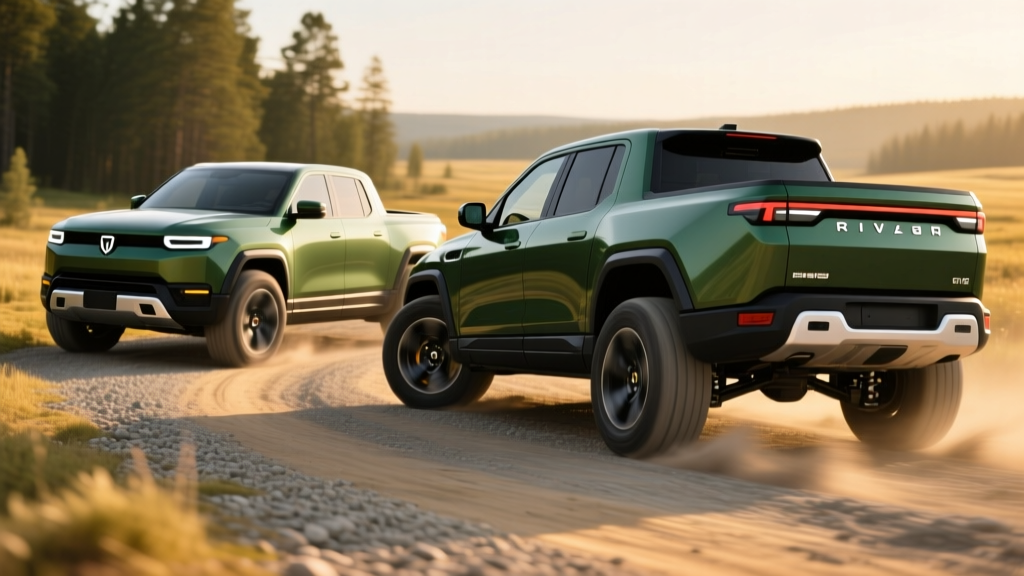
The Rivian kick turn — officially called a tank turn — is one of the most talked-about maneuverability features in the electric truck and SUV segment. By spinning the left and right wheel pairs in opposite directions, a quad-motor Rivian R1T or R1S can pivot nearly 360 degrees in place. It's a party trick, a trail tool, and a tight-parking-lot escape hatch all rolled into one. But how does it actually work, which trims get it, and does the rest of the vehicle hold up beyond the gimmick?
This guide breaks down the tank turn feature in detail, then covers what matters just as much to real buyers: EPA range, charging speeds, battery chemistry, pricing after federal tax credits, and how the R1T and R1S stack up against the Ford F-150 Lightning, Chevrolet Silverado EV, and Tesla Cybertruck.
What Is the Rivian Kick Turn (Tank Turn)?
The Rivian kick turn uses the independent quad-motor drivetrain to rotate the vehicle around its vertical axis. The left-side wheels spin forward while the right-side wheels spin in reverse (or vice versa), allowing the truck or SUV to pivot in place on low-traction surfaces like dirt, sand, snow, or gravel.
Rivian introduced the feature as part of its software-defined vehicle platform. It is not available on dual-motor trims — you need the Quad-Motor configuration, which pairs four independent permanent-magnet motors (one per wheel) with Rivian's hydraulic roll-control suspension and advanced torque-vectoring software.
How It Works in Practice
Activate the tank turn from the center touchscreen. The vehicle's stability system checks surface conditions, steering angle, and surroundings. Once engaged, the driver uses a virtual joystick on-screen to control rotation direction and speed. The turn is slow and deliberate — roughly 10-15 degrees per second — giving the driver time to stop if an obstacle appears.
- Tank turns are designed for off-road and low-traction surfaces only. Performing them on dry pavement can cause excessive tire wear and drivetrain stress.
- The feature requires the Quad-Motor drivetrain — dual-motor R1T/R1S models do not support it.
- Rivian recommends using the feature at low speeds in open areas; it is not a substitute for careful trail navigation.
Practical Use Cases
- Trail turnarounds: When a narrow forest road dead-ends and there's no room for a three-point turn.
- Boat ramp positioning: Fine-tuning the truck's angle when hooking up a trailer on a tight ramp.
- Snow and sand recovery: Rotating out of a stuck position without digging deeper ruts.
- Campsite maneuvering: Pointing the truck toward a view or away from wind without multiple back-and-forth moves.
2026 Rivian R1T & R1S: Core Specifications
Before diving deeper into the kick turn, here are the numbers that define daily ownership. The table below reflects the 2026 model-year Quad-Motor and Max Pack configurations most relevant to buyers seeking the tank turn feature.
| Specification | R1T Quad-Motor (Large Pack) | R1T Quad-Motor (Max Pack) |
|---|---|---|
| EPA Range | 328 miles | 420 miles |
| Battery Capacity (usable) | ~128 kWh | ~149 kWh |
| Battery Chemistry | NMC (Nickel Manganese Cobalt) | NMC |
| Horsepower | 1,025 hp | 1,025 hp |
| Torque | 1,198 lb-ft | 1,198 lb-ft |
| 0-60 mph | ~3.0 seconds | ~3.0 seconds |
| Max DC Fast Charge | ~200 kW | ~200 kW |
| 10-80% DC Charge Time | ~30 minutes | ~40 minutes |
| Level 2 Home Charging | 11.5 kW (~25 mi/hr) | 11.5 kW (~25 mi/hr) |
| MPGe (combined) | ~70 MPGe | ~68 MPGe |
| Efficiency | ~48 kWh/100 mi | ~49 kWh/100 mi |
| Max Towing Capacity | 11,000 lbs | 11,000 lbs |
| Drivetrain | AWD (Quad-Motor) | AWD (Quad-Motor) |
Sources: EPA / fueleconomy.gov, Rivian R1T specifications.
Real-World Range: What to Actually Expect
EPA Sticker: 328 mi (Large Pack) / 420 mi (Max Pack)
Highway (70-80 mph, fair weather): Expect ~260-280 mi (Large Pack) / ~340-360 mi (Max Pack)
Cold Weather (below 32°F): Expect ~220-250 mi (Large Pack) / ~290-320 mi (Max Pack)
Towing (5,000+ lb trailer): Range can drop 40-50% — plan for ~150-190 mi between charges (Large Pack)
The R1T's boxy shape and 6,800+ lb curb weight work against highway efficiency. At 75 mph, aerodynamic drag increases significantly compared to a sedan-shaped EV. In EPA testing, the combined cycle blends city and highway driving, which favors the R1T's strong regenerative braking in stop-and-go traffic.
Cold weather compounds the issue. The NMC battery chemistry in the R1T is energy-dense but more sensitive to low temperatures than LFP. Rivian's heat pump and battery preconditioning help — always precondition before DC fast charging in cold weather to avoid painfully slow charge rates. Without preconditioning, a cold-soaked battery may accept only 30-50 kW at a 200 kW-capable charger.
Charging Speeds: DC Fast, Level 2, and the Charge Curve
Charging speed is where many R1T owners report their biggest real-world surprise — and not always in a good way. Here's the breakdown:
| Charge Level | Power (kW) | Miles Added per Hour | Notes |
|---|---|---|---|
| Level 1 (120V household) | ~1.4 kW | ~3 mi/hr | Emergency/trickle only — full charge takes days |
| Level 2 (240V, 48A) | 11.5 kW | ~25 mi/hr | Full charge overnight (~12-14 hours for Large Pack) |
| DC Fast Charge (peak) | ~200 kW | ~300+ mi/hr (at peak) | Peak rate sustained only from ~10-40% SoC |
| DC Fast Charge (10-80%) | Avg ~130 kW | — | ~30 min (Large Pack), ~40 min (Max Pack) |
The Charge Curve Reality
Rivian's peak ~200 kW rate is a headline number, but like all EVs, the R1T's charge curve tapers significantly as the battery fills. Expect peak rates between 10-40% State of Charge (SoC). From 40-60%, rates typically drop to 130-150 kW. Above 80%, charging slows to 50 kW or less as the battery management system protects cell longevity.
For road trips, the practical strategy is to charge from 10-80% (about 30 minutes at a capable station) and move on. Charging from 80-100% at a DC fast charger can take as long as the 10-80% session — it's only worth it if you're parked overnight.
The R1T uses the NACS (Tesla) connector as of the 2025 model year, giving access to Tesla Superchargers with a Rivian-provided adapter as well as the growing NACS-native Electrify America and ChargePoint networks. This is a significant advantage over CCS-only vehicles as the industry consolidates around NACS.
Pricing, Trims, and Federal Tax Credit Eligibility
The Quad-Motor configuration required for the kick turn/tank turn sits at the top of the R1T and R1S lineup. Here's what pricing looks like for 2026:
| Trim / Configuration | Base MSRP | Est. §30D Credit | Effective Price |
|---|---|---|---|
| R1T Dual-Motor (Large Pack) | ~$71,700 | Up to $7,500* | ~$64,200 |
| R1T Quad-Motor (Large Pack) | ~$89,000 | Up to $7,500* | ~$81,500 |
| R1T Quad-Motor (Max Pack) | ~$99,000 | Up to $7,500* | ~$91,500 |
| R1S Quad-Motor (Large Pack) | ~$91,000 | Up to $7,500* | ~$83,500 |
*Federal tax credit eligibility is not guaranteed. Verify current rules at IRS.gov §30D.
Federal Tax Credit (§30D) Checklist
- MSRP Cap: Trucks/vans/SUVs must have an MSRP at or below $80,000. The R1T Dual-Motor qualifies; Quad-Motor trims exceed the cap and are ineligible for the new-vehicle credit.
- Buyer Income Cap: Modified AGI must not exceed $150,000 (single), $225,000 (head of household), or $300,000 (joint).
- Battery Sourcing: Critical minerals and battery components must meet phased-in domestic-sourcing thresholds. Rivian has worked to qualify, but eligibility can shift annually — always confirm at the point of sale.
- Point-of-Sale Transfer: As of 2024, buyers can transfer the credit to the dealer for an immediate price reduction rather than waiting to claim it on their tax return.
- Assembly: Vehicle must undergo final assembly in North America. The R1T and R1S are built in Normal, Illinois — this requirement is met.
Cargo, Passenger Space, and Daily Practicality
The R1T is a midsize pickup — smaller than an F-150 but larger than a Tacoma. Here's how the space breaks down:
- Bed length: 4'6" (54 inches) — shorter than most body-on-frame trucks, but the gear tunnel (lockable, pass-through storage behind the cab) adds ~11 cu ft of enclosed cargo space.
- Bed payload: ~1,760 lbs
- Frunk (front trunk): ~11 cu ft, drainable — useful as a cooler or secure storage
- Cab seating: 5 passengers, 4 full doors
- Rear legroom: ~37 inches — adequate for adults on shorter trips, tight for tall passengers on long hauls
- R1S cargo (SUV): Up to ~105 cu ft with second and third rows folded; third row is best for children
The gear tunnel is the R1T's secret weapon for adventure use. It spans the full width of the vehicle behind the rear seats, accessible from both sides and the bed. Rivian offers a slide-out camp kitchen accessory that fits inside — a thoughtful integration you won't find on the F-150 Lightning or Cybertruck.
Warranty Coverage
| Coverage | Term |
|---|---|
| Battery Pack | 8 years / 175,000 miles (retains ≥70% capacity) |
| Drivetrain / Powertrain | 8 years / 175,000 miles |
| Bumper-to-Bumper | 5 years / 60,000 miles |
| Roadside Assistance | 5 years / 60,000 miles |
Rivian's 175,000-mile battery warranty is among the most generous in the segment — Tesla covers 8 years / 120,000 miles on the Model S/X and 8 years / 100,000 miles on the Model 3/Y. The 70% capacity retention threshold is industry standard. Real-world data from early R1T owners (2022-2024 models) shows degradation in the 3-6% range after 40,000-60,000 miles, which is consistent with NMC chemistry expectations.
Standout Tech and Notable Drawbacks
Tech Highlights
- Rivian Driver+ (SAE Level 2): Adaptive cruise + lane centering on highways. Competent but not class-leading — IIHS has not rated it as highly as GM's Super Cruise or Ford's BlueCruise in usability studies. The driver must remain engaged at all times.
- 15.6-inch center touchscreen: Responsive, well-organized interface with native navigation, campsite/trail databases, and over-the-air (OTA) software updates.
- Powered tonneau cover: Available on the R1T — integrates with the gear tunnel for secure, weather-sealed bed storage.
- OTA updates: Rivian regularly ships feature updates (the tank turn itself was added via OTA to existing Quad-Motor vehicles).
- Native NACS port: Access to Tesla Superchargers and the expanding NACS public network without a permanent adapter.
Drawbacks Worth Knowing
- Highway efficiency: At ~48 kWh/100 mi, the R1T is thirsty for an EV. Long road trips mean more frequent charging stops than a Hyundai Ioniq 5 or Tesla Model Y.
- DC charge speed: The ~200 kW peak is respectable but trails the Hyundai/Kia E-GMP platform (~240 kW on 800V architecture) and the Tesla Cybertruck (~250 kW).
- Rear seat space: Midsize truck reality — not as roomy as a full-size F-150 Lightning for tall rear passengers.
- Service network: Rivian's service center footprint is growing but still sparse in rural and Mountain West regions. Mobile service vans cover some gaps.
- Insurance costs: Quad-Motor R1T premiums run 15-30% higher than comparable gas trucks due to repair costs and parts availability.
Pros and Cons at a Glance
✓ Pros
- Tank turn/kick turn is genuinely useful off-road
- 1,025 hp quad-motor performance (0-60 in ~3.0 sec)
- Class-leading gear tunnel storage
- 175,000-mile battery warranty
- Native NACS charging connector
- Strong OTA update track record
- 420-mile Max Pack range (class-leading for trucks)
✗ Cons
- Quad-Motor trims exceed $80K tax credit MSRP cap
- Highway range drops significantly at 75+ mph
- DC fast charge peak (~200 kW) trails 800V competitors
- Rear seat legroom is midsize-truck tight
- Service center availability still limited in some regions
- Premium insurance costs
- Tank turn limited to low-traction surfaces
Rivian R1T vs. Key Competitors
| Attribute | Rivian R1T Quad-Motor | Ford F-150 Lightning (Ext. Range) | Tesla Cybertruck AWD |
|---|---|---|---|
| EPA Range | 328-420 mi | 320 mi | 340 mi |
| Horsepower | 1,025 hp | 580 hp | 600 hp |
| 0-60 mph | ~3.0 sec | ~3.8 sec | ~4.1 sec |
| Max DC Charge | ~200 kW | ~150 kW | ~250 kW |
| Tank Turn Feature | ✓ Yes (Quad-Motor) | ✗ No | ✗ No |
| Towing Capacity | 11,000 lbs | 10,000 lbs | 11,000 lbs |
| Base MSRP (comparable) | ~$89,000 | ~$72,000 | ~$81,000 |
| §30D Tax Credit | Likely ineligible (MSRP cap) | Eligible (select trims) | Eligible (under $80K cap) |
| Battery Warranty | 8 yr / 175,000 mi | 8 yr / 100,000 mi | 8 yr / 120,000 mi |
Decision Framework
Choose the Rivian R1T Quad-Motor if: You need genuine off-road capability with the tank turn, value adventure-oriented design (gear tunnel, camp kitchen), want the strongest battery warranty in the segment, and budget is secondary to capability.
Choose the Ford F-150 Lightning if: You need full-size truck space, want the lowest entry price with tax credit eligibility, and primarily drive on-road with occasional light towing.
Choose the Tesla Cybertruck if: You want the fastest DC charging in a truck, prefer the Supercharger network natively, and can accept the polarizing design and build-quality variability.
Who Is the Rivian R1T (with Kick Turn) Best For?
The R1T Quad-Motor with the tank turn feature is a niche within a niche — and that's exactly the point. This vehicle is purpose-built for:
- Overland and off-road enthusiasts who regularly navigate tight trails, forest roads, and backcountry campsites where maneuverability matters.
- Adventure-oriented families who tow boats or campers on weekends and want a daily-drivable truck during the week.
- Tech-forward buyers who value OTA updates, software-defined features, and a startup mentality over legacy dealer networks.
- Second-vehicle households where the R1T is the adventure/truck and a more efficient EV handles the daily commute.
If your truck needs are primarily highway commuting and Home Depot runs, the F-150 Lightning or even a dual-motor R1T (without the tank turn) makes more financial sense. The Quad-Motor premium buys capability you may never fully use — unless you regularly find yourself on trails where a 360-degree pivot is the difference between pressing forward and backing out for a mile.
Frequently Asked Questions
What is the real-world range of the Rivian R1T Quad-Motor?
The EPA rates the R1T Quad-Motor Large Pack at 328 miles and the Max Pack at 420 miles. In real-world highway driving at 70-80 mph, expect 260-280 miles (Large Pack) or 340-360 miles (Max Pack). Cold weather below freezing can reduce range by an additional 15-25%. Towing cuts range roughly in half.
How fast does the R1T charge at home and on the road?
At home on a Level 2 (240V, 48A) charger, the R1T adds about 25 miles of range per hour — a full Large Pack charge takes roughly 12-14 hours overnight. On DC fast chargers, it peaks at ~200 kW and charges from 10-80% in about 30 minutes (Large Pack) or 40 minutes (Max Pack). Peak rates are sustained only in the lower portion of the battery; expect tapering above 60% SoC.
Does the Rivian R1T qualify for the $7,500 federal EV tax credit?
It depends on the trim. The Dual-Motor R1T (starting around $71,700) is under the $80,000 MSRP cap for trucks and may qualify, subject to buyer income limits and battery-sourcing requirements. The Quad-Motor trims (starting ~$89,000) exceed the MSRP cap and are not eligible for the new-vehicle §30D credit. Always verify current eligibility at IRS.gov and consult a tax professional.
Can I do a tank turn on pavement?
Rivian strongly discourages it. Tank turns are designed for low-traction surfaces (dirt, sand, gravel, snow). Performing them on dry asphalt causes rapid tire scrubbing, excessive wear, and potential drivetrain stress. The software may limit or warn against use on high-friction surfaces.
Is the Rivian R1T worth buying over the F-150 Lightning or Cybertruck?
It depends on your priorities. The R1T Quad-Motor offers the most off-road capability, the unique tank turn feature, the longest battery warranty (175,000 miles), and the best adventure-specific design (gear tunnel). The F-150 Lightning wins on price, full-size interior space, and tax credit eligibility. The Cybertruck leads in DC charging speed and has Supercharger-native access. If off-road maneuverability and adventure design are your top criteria, the R1T is the strongest choice — but you'll pay a significant premium and likely forgo the federal tax credit.
What are the biggest pros and cons of the Rivian R1T?
Pros: Tank turn capability, 1,025 hp performance, 420-mile Max Pack range, gear tunnel storage, 175K-mile battery warranty, NACS connector, strong OTA updates. Cons: Quad-Motor exceeds tax credit MSRP cap, highway efficiency is poor (~48 kWh/100 mi), DC charge speed trails 800V competitors, midsize rear seat, limited service centers in some areas, high insurance premiums.
Does the dual-motor R1T have the kick turn / tank turn?
No. The tank turn requires independent control of all four wheels, which is only available on the Quad-Motor drivetrain. The dual-motor R1T uses one motor per axle and cannot perform tank turns. If the kick turn is a must-have feature, you'll need to step up to the Quad-Motor configuration.