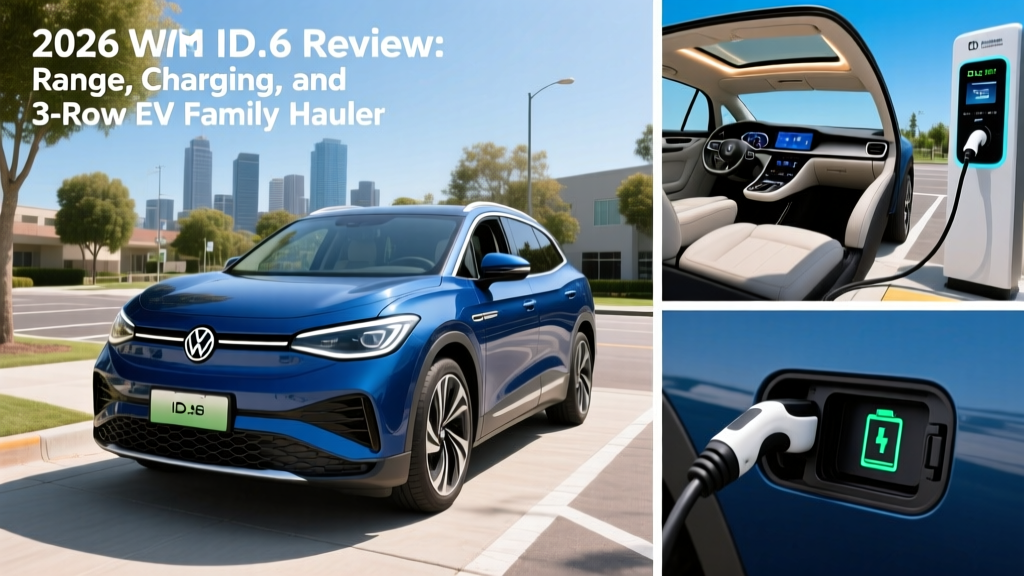
The Volkswagen ID.6 has been a staple in China's electric-vehicle market since 2021, sold through the SAIC-VW and FAW-VW joint ventures as a three-row, six- or seven-seat electric SUV. As of early 2026, Volkswagen has not officially launched the ID.6 in the United States, and there is no confirmed timeline for a North American release. This profile examines the ID.6's known specifications, real-world performance data from international markets, and what U.S. buyers should understand before hoping for—or importing—this model.
If you're researching the VW ID.6 because you've seen it in international coverage, spotted one while traveling, or are simply tracking Volkswagen's global EV lineup, this guide gives you the exact numbers, honest limitations, and competitive context you need.
VW ID.6 Specifications at a Glance
| Specification | ID.6 X (RWD) | ID.6 Crozz AWD |
|---|---|---|
| Battery Capacity (usable) | 84.8 kWh (NMC) | 84.8 kWh (NMC) |
| CLTC Range (China) | ~600 km (373 mi) | ~550 km (342 mi) |
| EPA-Estimated Range | Not rated (not sold in U.S.) | Not rated |
| Motor Output | 201 hp (150 kW) rear | 308 hp (230 kW) dual-motor |
| 0-100 km/h (0-62 mph) | ~9.1 sec | ~6.6 sec |
| Max DC Fast Charge | ~175 kW (peak) | ~175 kW (peak) |
| 10-80% DCFC Time | ~30 minutes (est.) | ~30 minutes (est.) |
| Level 2 AC Charge Rate | 11 kW (~37 mi/hr) | 11 kW (~37 mi/hr) |
| Drivetrain | Rear-wheel drive | Dual-motor AWD |
| Seating | 6 or 7 passengers | 6 or 7 passengers |
| Cargo (behind 3rd row) | ~10.6 cu ft | ~10.6 cu ft |
| Cargo (3rd row folded) | ~37 cu ft | ~37 cu ft |
| Wheelbase | 115.7 in (2,965 mm) | 115.7 in (2,965 mm) |
| Base Price (China, approx.) | ~¥250,000 (~$35,000 USD) | ~¥280,000 (~$39,000 USD) |
| U.S. MSRP | Not available — not sold in the U.S. | |
| U.S. Federal Tax Credit (§30D) | Not eligible (not sold/certified in U.S.) | |
Sources: Volkswagen China official specifications; international automotive testing data. CLTC range figures are from the China Light-Duty Vehicle Test Cycle, which tends to produce higher numbers than the U.S. EPA cycle. If the ID.6 were EPA-rated, expect figures roughly 15-20% lower than CLTC equivalents.
Battery, Range, and Real-World Expectations
The ID.6 uses an NMC lithium-ion battery, which offers higher energy density than LFP (lithium iron phosphate) chemistry but is more sensitive to sustained high states of charge. VW recommends daily charging to 80% for longevity, reserving 100% for long trips. The battery management system includes active liquid cooling and a thermal preconditioning feature that warms the pack before DC fast charging—critical for maintaining charge speed in cold conditions.
Volkswagen provides an 8-year / 160,000 km (roughly 100,000-mile) battery warranty in the Chinese market, guaranteeing at least 70% capacity retention over that period. Should the ID.6 eventually reach the U.S., expect VW to align its warranty with the standard 8-year/100,000-mile battery and powertrain coverage offered on the ID.4.
Charging Speed: DC Fast and Home Level 2
| Charging Level | Power / Rate | Time or Speed | Notes |
|---|---|---|---|
| Level 1 (120V household) | ~1.4 kW | ~5 mi/hr | Emergency/trickle only |
| Level 2 (240V home/public) | 11 kW (max) | ~37 mi/hr; 0-100% in ~8.5 hrs | Requires 48A circuit (60A breaker) |
| DC Fast Charge (CCS) | Peak ~175 kW | 10-80% in ~30 min | Peak rate only sustained to ~35-40%; tapers significantly above 80% |
The ID.6's peak DC fast-charge rate of approximately 175 kW is competitive with other MEB-platform vehicles like the ID.4, but it falls short of the 200-350 kW peaks offered by Hyundai/Kia's E-GMP platform (Ioniq 5, EV6) and Tesla's latest architecture. On a 150 kW Electrify America or CCS-compatible charger, the ID.6 will charge near its ceiling. On a 350 kW station, it won't take advantage of the extra headroom.
The charge curve is the critical detail: the 175 kW peak is typically sustained only from roughly 10% to 35-40% state of charge. From 40-60%, expect around 120-130 kW, and from 60-80%, roughly 80-90 kW. The 10-80% time of approximately 30 minutes assumes ideal battery temperature and a charger capable of sustaining the curve. In cold weather without preconditioning, that time can stretch to 40+ minutes.
For home charging, the 11 kW onboard AC charger means you'll need a hardwired Level 2 station on a 60-amp breaker to achieve the full rate. On a standard 40-amp (32A) circuit, charge speed drops to about 7.7 kW (~26 mi/hr), still adequate for overnight replenishment of 200+ miles.
Performance and Driving Dynamics
The RWD ID.6 X produces 201 horsepower from its rear-mounted permanent-magnet synchronous motor, delivering a 0-62 mph (0-100 km/h) time of roughly 9.1 seconds. That's adequate for a family hauler but unexciting—think of it as a composed, quiet cruiser rather than a performance EV.
The dual-motor AWD variant (sold as the ID.6 Crozz or ID.6 X AWD depending on the JV partner) bumps output to 308 horsepower and drops the 0-62 time to approximately 6.6 seconds. The extra traction is valuable in rain and snow, and the torque-vectoring rear motor gives the AWD model noticeably better cornering confidence for a vehicle of this size.
Driving dynamics follow the MEB-platform formula: a low center of gravity thanks to the underfloor battery, well-tuned suspension for comfort over sportiness, and a tight turning radius (the rear-wheel steering available on some trims helps in urban environments). Regenerative braking offers multiple levels selectable via steering-wheel paddles, but the ID.6 does not offer true one-pedal driving with a full stop—VW's philosophy has been to let the vehicle coast rather than aggressively regen to a halt.
Interior, Technology, and Practical Space
The ID.6 rides on VW's MEB platform stretched to a 115.7-inch wheelbase—significantly longer than the ID.4's 108.9 inches. That extra length translates directly to third-row usability. Unlike many compact three-row SUVs where the third row is token seating, the ID.6's third row can accommodate adults on shorter trips, though it's best suited for children or teens on longer journeys.
Cargo space behind the third row is approximately 10.6 cubic feet—enough for a few grocery bags or a couple of carry-on suitcases. Fold the third row and you get roughly 37 cubic feet, competitive with midsize SUVs. Fold both rear rows and maximum cargo volume reaches approximately 70 cubic feet.
The infotainment system uses VW's ID. Software platform with a 12-inch central touchscreen (upgraded from earlier 10-inch units), wireless Apple CarPlay and Android Auto, and an augmented-reality head-up display on higher trims. The digital instrument cluster is a compact 5.3-inch display mounted behind the steering wheel, supplemented by the head-up display for navigation and speed.
Driver-assistance features include adaptive cruise control with stop-and-go, lane-keeping assist, automatic emergency braking, and a semi-automated lane-change feature on equipped models. These systems are SAE Level 2—the driver must remain engaged and hands on or near the wheel at all times. This is not autonomous driving.
Pricing, Availability, and Tax Credit Status
In China, the ID.6 starts at approximately ¥250,000 (roughly $35,000 USD at current exchange rates) for the base RWD model and climbs to approximately ¥330,000 (~$46,000) for a fully equipped AWD variant. These prices reflect the intensely competitive Chinese EV market and local production through VW's joint ventures.
U.S. availability: As of 2026, Volkswagen has not announced plans to sell the ID.6 in the United States. VW's North American EV strategy currently centers on the ID.4 (assembled in Chattanooga, Tennessee), the ID. Buzz microbus, and the upcoming ID.7 sedan. The ID.6, produced exclusively in China, does not meet U.S. homologation requirements and would require significant modification for NHTSA certification, different crash-structure standards, and CCS/NACS charging compatibility.
- The ID.6 is not sold in the U.S. and is not eligible for the §30D credit.
- Even if imported, it would fail the North American final-assembly requirement.
- The §30D credit requires the vehicle to be assembled in North America, meet battery-component and critical-mineral sourcing thresholds, and fall under MSRP caps ($80,000 for SUVs/vans/pickups; $55,000 for sedans).
- Buyer income caps also apply: $300,000 joint / $225,000 head of household / $150,000 individual MAGI.
- Always verify current rules at IRS.gov before making purchase decisions.
VW ID.6 vs. U.S. Competitors: What You Can Actually Buy
Since the ID.6 isn't available stateside, here's how its specs compare to three-row electric SUVs you can purchase in the U.S. today:
| Attribute | VW ID.6 (China) | Kia EV9 | VW ID.4 | Tesla Model Y (3-row) |
|---|---|---|---|---|
| U.S. Availability | Not available | Yes | Yes | Yes (optional 3rd row) |
| EPA Range | N/A (est. 280-310 mi) | 279-304 mi | 245-291 mi | 295-310 mi |
| Battery | 84.8 kWh NMC | 100 kWh NMC | 82 kWh NMC | ~75 kWh NMC |
| Max DCFC | ~175 kW | 236 kW | 175 kW | ~250 kW |
| 10-80% DCFC | ~30 min | ~24 min | ~28 min | ~22 min |
| Seating Rows | 3 | 3 | 2 | 2 (optional 3) |
| Starting MSRP (U.S.) | N/A | ~$54,900 | ~$39,735 | ~$44,990 |
| Federal Credit Eligible | No | Partial (§30D varies by trim) | Yes (if income/MSRP qualify) | Yes (if income/MSRP qualify) |
The Kia EV9 is the closest U.S.-market rival to the ID.6 in concept: a dedicated three-row electric SUV with genuine adult-capable third-row seating. It's larger, faster-charging, and more expensive. The VW ID.4 is a two-row compact SUV—smaller but more affordable. The Tesla Model Y's optional third row is best suited for small children only.
Pros and Cons
Pros
- Genuine three-row seating with usable adult space in the third row
- Competitive pricing in China (~$35,000 base) undercuts U.S. rivals significantly
- Comfortable ride quality tuned for family use over sportiness
- MEB platform's low center of gravity gives confident handling for its size
- 84.8 kWh battery provides solid range for daily commuting and moderate road trips
- Augmented-reality head-up display and modern ID. Software infotainment
Cons
- Not available in the United States — no confirmed plans for U.S. launch
- 175 kW peak DC charge rate trails competitors like EV9 (236 kW) and Tesla (250 kW)
- Charge curve tapers early — peak rate sustained only to ~35-40% SoC
- 9.1-second 0-62 mph time (RWD) feels sluggish for a modern EV
- Capacitive touch controls on steering wheel and climate panel draw criticism for usability
- No NACS connector — CCS-only in current form (irrelevant for U.S. but limits global charging flexibility)
- Third-row cargo space (10.6 cu ft) is tight when all seats are in use
Who the VW ID.6 Suits — and Who Should Look Elsewhere
- You live in a market where it's sold (China, select international markets) and need a three-row electric SUV on a moderate budget.
- Your daily driving is under 200 miles and you prioritize comfort and space over performance.
- You have reliable home Level 2 charging and rarely need DC fast charging.
- You need a three-row EV in the United States — the Kia EV9 is the most direct competitor.
- Fast DC charging is important for your road-trip habits — the EV9, Tesla Model Y/X, and Hyundai Ioniq 5 all charge faster.
- You want federal tax credit eligibility — the ID.6 does not qualify under §30D.
- You value sporty acceleration — the RWD ID.6's 9.1-second 0-62 is leisurely by EV standards.
Frequently Asked Questions
What is the real-world range of the VW ID.6?
The ID.6 carries a CLTC rating of up to 600 km (373 miles) for the RWD model, but CLTC is optimistic. A realistic EPA-equivalent estimate is 280-310 miles. In real-world highway driving at 70+ mph, expect 240-270 miles. In freezing temperatures, range can drop to 200 miles or below without battery preconditioning.
How fast does the VW ID.6 charge?
On a DC fast charger, the ID.6 peaks at approximately 175 kW, achieving a 10-80% charge in roughly 30 minutes under ideal conditions. The peak rate is only sustained to about 35-40% state of charge, then tapers progressively. At home on a Level 2 charger (11 kW / 48A), a full charge takes approximately 8.5 hours.
How much does the VW ID.6 cost after tax credits?
The ID.6 is not sold in the United States and is not eligible for the federal §30D EV tax credit. In China, it starts at approximately ¥250,000 (~$35,000 USD). There is no U.S. MSRP, and importing one individually would not qualify for incentives due to the North American assembly requirement.
Is the VW ID.6 worth buying vs. competitors?
In markets where it's available, the ID.6 offers strong value as an affordable three-row electric SUV. However, in the U.S., the Kia EV9 is the closest alternative and offers faster charging (236 kW peak), more cargo space, U.S. warranty support, and partial federal tax credit eligibility. The ID.6's 175 kW charge rate and 9.1-second 0-62 time (RWD) are notable weaknesses against newer competitors.
What are the biggest pros and cons of the ID.6?
Pros: genuine three-row seating, competitive pricing, comfortable ride, large battery, modern tech. Cons: not available in the U.S., slower DC charging than rivals, early charge-curve taper, modest RWD acceleration, capacitive touch controls that frustrate some drivers.
Does the VW ID.6 qualify for the federal EV tax credit?
No. The §30D credit requires final assembly in North America, compliance with battery-component and critical-mineral sourcing rules, MSRP under $80,000 (SUVs), and buyer income within caps ($300,000 joint / $150,000 individual). The ID.6 is assembled in China and not sold or certified in the U.S., making it ineligible. Always check current rules at IRS.gov.
Will Volkswagen bring the ID.6 to the United States?
As of 2026, VW has not announced U.S. plans for the ID.6. Volkswagen of America's EV roadmap focuses on the ID.4 (built in Tennessee), the ID. Buzz, and the ID.7 sedan. The ID.6 would require significant re-engineering for U.S. safety standards and charging infrastructure compatibility. If VW does pursue a U.S. three-row EV, it may arrive as a different model or a next-generation vehicle rather than a direct ID.6 import.