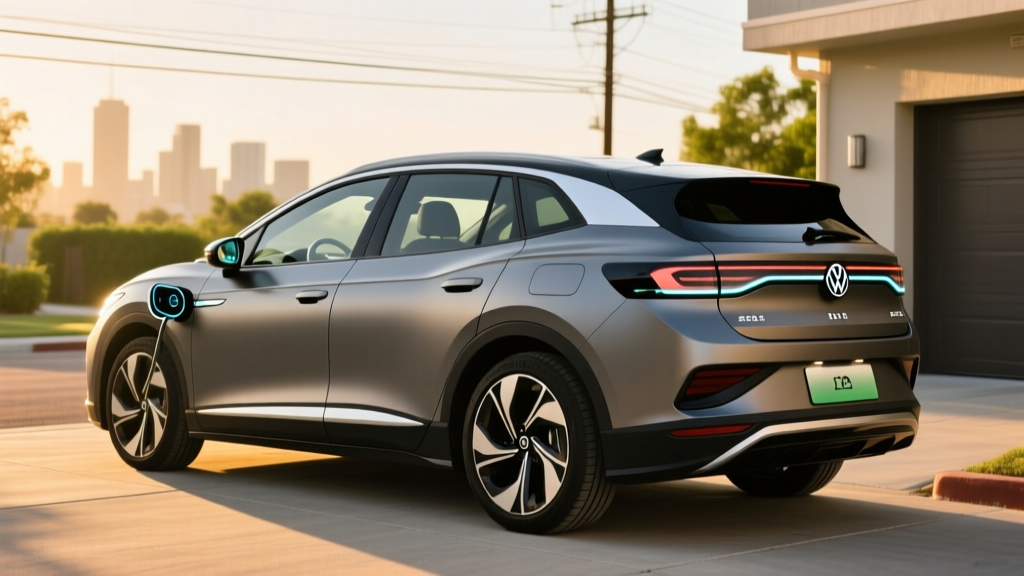
The 2026 Volkswagen ID.5 is the sloped-roof sibling of the ID.4, trading a few cubic feet of cargo space for a more aerodynamic profile and slightly longer EPA range. As VW's MEB-platform coupe SUV enters its third full model year in the US market, it faces stiff competition from the Tesla Model Y, Hyundai Ioniq 5, and Ford Mustang Mach-E. This review breaks down the ID.5's real-world range, charging behavior, ownership costs, and whether it still earns a spot on your shortlist.
Quick Verdict: Who the ID.5 Is For
The ID.5 targets style-conscious EV buyers who want a premium cabin and comfortable ride without the polarizing design of some rivals. It's best suited for daily commuters and small families who prioritize a quiet, refined interior over maximum cargo volume or blistering acceleration. If you need a third row, maximum towing, or the longest possible range, look elsewhere. If you want a well-built, comfortable two-row electric crossover with solid — if not class-leading — charging speed, the ID.5 delivers.
Range, Battery, and Real-World Efficiency
| Specification | ID.5 Pro S (RWD) | ID.5 Pro S Plus AWD |
|---|---|---|
| EPA Range | 291 miles | 263 miles |
| Battery (Usable) | 82 kWh (NMC) | 82 kWh (NMC) |
| Efficiency (Combined) | 104 MPGe (32 kWh/100mi) | 95 MPGe (35 kWh/100mi) |
| Drivetrain | Rear-Wheel Drive | Dual-Motor AWD |
| Horsepower | 282 hp | 335 hp |
| 0-60 mph | 6.7 sec | 5.1 sec |
The 82 kWh usable battery uses nickel-manganese-cobalt (NMC) chemistry, which offers higher energy density than LFP but requires more careful charge management for long-term health. VW recommends setting a daily charge limit of 80% for routine use and charging to 100% only before long trips. The vehicle's thermal management system actively conditions the battery, helping preserve capacity and optimize charging speed.
Charging Speed: DC Fast, Level 2, and Level 1
| Charging Level | Power / Rate | Time or Miles Added |
|---|---|---|
| DC Fast Charge (Peak) | 175 kW | 10-80% in ~29 minutes |
| DC Fast Charge (Sustained avg.) | ~120-130 kW | ~180 miles added in 25 min |
| Level 2 (240V, 48A) | 11.5 kW | ~33 miles per hour of charging |
| Level 2 (240V, 32A) | 7.7 kW | ~22 miles per hour of charging |
| Level 1 (120V, 12A) | 1.4 kW | ~4 miles per hour of charging |
The ID.5's 175 kW peak DC fast-charge rate is adequate but no longer class-leading in 2026. Competitors like the Hyundai Ioniq 5 (peak 240 kW on 800V architecture) and the Tesla Model Y (peak ~250 kW at V3 Superchargers) charge noticeably faster. The ID.5's charge curve holds near peak rate from roughly 10-40% SoC, then tapers progressively. From 80-100%, charging slows dramatically — expect the final 20% to add another 25-30 minutes.
For home charging, the ID.5 accepts up to 11.5 kW on a 48-amp Level 2 circuit (requires a 60-amp breaker). A full overnight charge from 10% to 80% takes roughly 5.5 hours. VW includes a mobile charge cord capable of Level 1 (120V) and Level 2 (240V with adapter), though most buyers will install a dedicated wall connector. Home installation typically costs $800-$2,500 depending on panel capacity and run length — factor in a potential panel upgrade ($1,500-$3,000) if your home has a 100-amp service.
The ID.5 uses the CCS1 connector for DC fast charging. With VW's adoption of the North American Charging Standard (NACS) for future models, current ID.5 owners can access Tesla Supercharger networks using a VW-approved CCS-to-NACS adapter, though maximum charge rates may be limited by the adapter's throughput.
Pricing, Trims, and Federal Tax Credit Eligibility
| Trim | Base MSRP | Est. After §30D Credit | Destination |
|---|---|---|---|
| ID.5 Pro S (RWD) | $44,990 | $37,490* | $1,395 |
| ID.5 Pro S Plus (RWD) | $48,490 | $40,990* | $1,395 |
| ID.5 Pro S Plus AWD | $51,990 | $44,490* | $1,395 |
*Tax credit estimates assume full eligibility. Verify current rules at IRS.gov.
The 2026 ID.5 qualifies for the federal EV tax credit under IRS §30D, but eligibility depends on several factors that buyers must verify:
- MSRP Cap: The ID.5 (classified as an SUV) must have an MSRP at or below $80,000. All current trims clear this threshold.
- Buyer Income Cap: Modified adjusted gross income must not exceed $150,000 (single), $225,000 (head of household), or $300,000 (married filing jointly).
- Battery Sourcing: Critical minerals and battery components must meet phased-in domestic content requirements. VW has worked to restructure supply chains, but exact compliance varies by build date — confirm with your dealer and cross-reference the DOE's eligible vehicle list.
- Point-of-Sale Transfer: As of 2024, buyers can transfer the credit to the dealer at purchase, reducing the upfront cost rather than waiting for a tax refund. This requires dealer participation and IRS registration.
State and local incentives may stack on top of the federal credit. California's CVRP, Colorado's innovative motor vehicle credit, and various utility rebates can reduce the effective price further — but these vary by jurisdiction and funding availability.
Interior, Cargo, and Daily Livability
The ID.5's coupe roofline sacrifices some practicality for aesthetics. Behind the rear seats, cargo volume measures 30.3 cubic feet — down from the ID.4's 30.3 cu ft (the two are nearly identical to the window line, but the ID.5's sloped roof reduces usable height for taller items). Folding the rear seats opens up 64.2 cubic feet, compared to the ID.4's 64.2 cu ft. In practice, the ID.5 handles groceries, luggage, and strollers fine, but bulky items like tall boxes or large dog crates may not fit as easily.
Passenger space remains generous: front legroom is 41.1 inches, rear legroom is 37.6 inches. Headroom in the rear is tighter than the ID.4 due to the roofline — taller passengers (6'2"+) may notice the difference. The cabin materials are a step above many competitors, with soft-touch surfaces, ambient lighting, and available heated/ventilated seats. VW's ID. Software 4.0 infotainment system is more responsive than earlier versions, with a 12.9-inch touchscreen, wireless Apple CarPlay/Android Auto, and improved voice recognition.
Notable tech features include:
- Travel Assist with swarm data (adaptive cruise + lane centering, SAE Level 2 — driver must remain engaged)
- Park Assist Plus with memory parking (learns and repeats parking maneuvers)
- Augmented-reality head-up display (available on Pro S Plus)
- Heat pump (standard on AWD, available on RWD) — critical for cold-weather range preservation
- V2L capability via accessory adapter (powers small devices/appliances from the traction battery)
Warranty and Long-Term Ownership
VW provides a competitive warranty package for the 2026 ID.5:
- Basic Vehicle: 4 years / 50,000 miles
- Powertrain: 4 years / 50,000 miles
- Battery: 8 years / 100,000 miles (capacity retention guaranteed above 70% of original)
- Roadside Assistance: 4 years / 50,000 miles
- Corrosion Perforation: 12 years / unlimited miles
The 8-year/100,000-mile battery warranty is industry-standard. VW guarantees the battery will retain at least 70% of its original usable capacity during the warranty period. Real-world degradation data from European ID.4/ID.5 fleets (which have been on the road since 2021) suggests typical capacity loss of 5-8% over the first 60,000 miles, well within the warranty threshold. NMC chemistry generally degrades faster than LFP in high-temperature and high-charge-state conditions, so following VW's 80% daily charge recommendation is prudent for longevity.
Insurance costs for the ID.5 run 10-20% higher than comparable gas-powered crossovers, consistent with industry-wide EV insurance premiums. Average annual premiums range from $1,800-$2,600 depending on location, driving record, and coverage level.
How the ID.5 Stacks Up Against Competitors
| Spec | 2026 VW ID.5 Pro S | 2026 Tesla Model Y LR | 2026 Hyundai Ioniq 5 SEL |
|---|---|---|---|
| EPA Range | 291 mi | 330 mi | 303 mi |
| Battery | 82 kWh (NMC) | ~78 kWh (NMC) | 77.4 kWh (NMC) |
| Peak DC Charge | 175 kW | ~250 kW | 240 kW |
| 10-80% DC Time | ~29 min | ~22 min | ~18 min |
| 0-60 mph | 6.7 sec | 5.0 sec | 7.2 sec |
| Cargo (rear seats up) | 30.3 cu ft | 30.2 cu ft | 27.2 cu ft |
| Base MSRP | $44,990 | $44,990 | $43,500 |
Pros
- Refined, quiet cabin with premium materials
- Comfortable ride quality over rough pavement
- Strong real-world efficiency (32 kWh/100mi)
- Generous rear-seat legroom
- Heat pump availability preserves cold-weather range
- Intuitive physical controls alongside touchscreen
Cons
- DC charging speed trails Hyundai/Tesla rivals
- Coupe roofline limits tall-item cargo versatility
- Infotainment still occasionally laggy despite updates
- No front trunk (frunk) — charge cable storage only
- Rear headroom tight for tall passengers
- Dealer network EV expertise varies widely
Should You Buy the VW ID.5?
- You value cabin refinement and ride comfort over maximum range or charging speed
- Your daily commute is under 100 miles round-trip and you charge at home
- You want a distinctive coupe-SUV design without paying luxury-brand premiums
- You live in a moderate climate or spec the heat pump for cold weather
- You regularly road-trip 300+ miles and need the fastest possible DC charging (consider Ioniq 5 or Model Y)
- You need maximum cargo height for bulky items (the ID.4 or Mach-E offer more vertical space)
- You want the longest EPA range in the segment (Model Y Long Range leads at 330 miles)
- You need a third row (consider the Kia EV9 or Rivian R1S)
Frequently Asked Questions
What is the real-world range of the 2026 VW ID.5?
The EPA rates the RWD ID.5 Pro S at 291 miles and the AWD at 263 miles. In real-world highway driving at 70-75 mph in moderate temperatures, expect 250-265 miles (RWD) or 225-240 miles (AWD). Cold weather below 30°F reduces range to roughly 200-220 miles for the RWD model.
How fast does the ID.5 charge at home and on the road?
On a DC fast charger, the ID.5 peaks at 175 kW and charges from 10-80% in approximately 29 minutes. At home on a 48-amp Level 2 charger (11.5 kW), it adds about 33 miles of range per hour, reaching a full charge overnight in roughly 7-8 hours from near-empty.
Does the 2026 VW ID.5 qualify for the federal EV tax credit?
The ID.5 is eligible for up to $7,500 under IRS §30D, subject to buyer income caps ($150K single / $300K married), the $80,000 MSRP cap for SUVs (all trims qualify), and battery critical-mineral/component sourcing requirements. The credit can be transferred to the dealer at point of sale. Always verify current eligibility at IRS.gov and with your dealer before purchasing.
Is the VW ID.5 worth buying over the Tesla Model Y or Hyundai Ioniq 5?
It depends on priorities. The Model Y offers more range (330 mi) and faster Supercharger access. The Ioniq 5 charges faster (18 min 10-80%). The ID.5 wins on cabin refinement, ride comfort, and a less polarizing design. For buyers who charge mostly at home and prioritize daily comfort over road-trip charging speed, the ID.5 is a strong choice.
What is the battery warranty on the ID.5?
VW covers the ID.5's battery for 8 years or 100,000 miles, guaranteeing it will retain at least 70% of its original usable capacity. Real-world data from European fleets shows typical degradation of 5-8% over the first 60,000 miles.
Does the ID.5 have a frunk (front trunk)?
No. The ID.5 does not have a usable front trunk. There is a small compartment under the hood for storing the mobile charge cable and accessories, but it is not suitable for cargo.