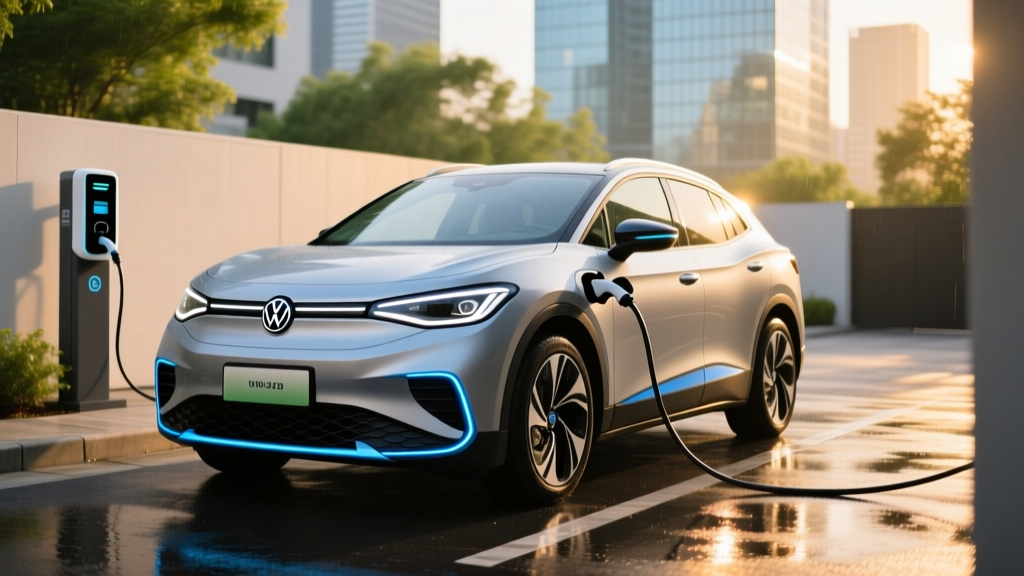
The Volkswagen ID.4 occupies a distinct space in the compact electric crossover segment: it is deliberately engineered to feel substantial, planted, and quiet rather than aggressively sporty. For 2026, the ID.4 continues to refine a formula that prioritizes ride comfort, interior volume, and practical daily driving over headline-grabbing acceleration. But that engineering philosophy has a direct consequence on the spec sheet — the VW ID.4 weight is notably higher than several of its rivals, and that mass influences everything from energy consumption to tire wear to how the vehicle behaves on a twisty back road.
In this review, we examine the 2026 Volkswagen ID.4 across every metric that matters to a real EV buyer: real-world range versus EPA estimates, DC fast-charging curves, home charging practicality, cabin space, and the federal tax credit landscape under current IRS §30D rules. We also address the weight question head-on — why it matters, how VW manages it, and whether it should influence your purchase decision.
2026 VW ID.4 Specifications at a Glance
| Specification | RWD Pro (Standard Range) | RWD Pro S (Larger Battery) | AWD Pro S |
|---|---|---|---|
| EPA Range | 206 miles | 291 miles | 263 miles |
| Battery (Usable / Gross) | 62 kWh / 64 kWh | 82 kWh / 86 kWh | 82 kWh / 86 kWh |
| Battery Chemistry | NMC (Nickel Manganese Cobalt) | NMC | NMC |
| Horsepower | 201 hp | 282 hp | 335 hp (dual-motor) |
| 0–60 mph | 7.7 sec | 7.2 sec | 5.4 sec |
| Drivetrain | Rear-Wheel Drive | Rear-Wheel Drive | All-Wheel Drive |
| Curb Weight (approx.) | 4,682 lbs | 4,929 lbs | 5,148 lbs |
| Max DC Fast Charge | 135 kW | 175 kW | 175 kW |
| 10–80% DC Charge Time | ~30 min | ~28 min | ~28 min |
| Level 2 Home Charge Rate | 11 kW (AC) | 11 kW (AC) | 11 kW (AC) |
| EPA Efficiency (Combined) | 104 MPGe | 107 MPGe | 98 MPGe |
| Base MSRP | $39,735 | $44,735 | $48,735 |
| Battery/Powertrain Warranty | 8 years / 100,000 miles | ||
Note: MSRP figures exclude destination charges (~$1,395). Specifications reflect the 2026 model year as published by Volkswagen. Always confirm with your dealer, as mid-year running changes can occur.
Why the VW ID.4 Weight Matters for EV Buyers
At roughly 4,682 to 5,148 pounds depending on trim and drivetrain, the VW ID.4 weight sits on the heavier end of the compact electric SUV class. For comparison, the Hyundai Ioniq 5 (AWD, long-range) weighs approximately 4,868 lbs, while the Tesla Model Y Long Range AWD comes in around 4,363 lbs. The Ford Mustang Mach-E Extended Range AWD tips the scales near 4,898 lbs.
Why does the ID.4 carry more mass than some competitors? Several engineering decisions contribute:
- Steel-intensive body structure: Unlike the Tesla Model Y, which uses a mix of aluminum and high-strength steel with gigacastings, the ID.4 relies more heavily on conventional steel construction. This keeps production costs manageable but adds weight.
- Sound insulation and comfort engineering: VW loads the ID.4 with acoustic dampening material, thicker glass, and a multi-link rear suspension designed for ride quality over weight savings. The result is a remarkably quiet cabin but a heavier vehicle.
- Battery pack housing: The MEB platform's battery enclosure is robust but not the lightest in the segment. The 86 kWh gross pack in the Pro S and AWD models adds significant mass low in the chassis.
The practical implications of the VW ID.4 weight include:
- Energy consumption: Heavier vehicles require more energy to accelerate and maintain speed. The AWD Pro S at 5,148 lbs returns 98 MPGe combined, while the lighter RWD Pro S achieves 107 MPGe — a meaningful difference over a year of driving.
- Tire wear: Heavier EVs with instant torque tend to wear tires faster. Budget for replacement tires every 30,000–40,000 miles rather than the 50,000+ miles typical of lighter ICE vehicles.
- Braking feel: The ID.4's weight is well-managed by its regenerative braking system, but you will notice the mass during hard braking from highway speeds. Stopping distances are competitive but not class-leading.
- Ride quality (the upside): That mass, combined with VW's suspension tuning, gives the ID.4 a planted, composed ride that absorbs road imperfections better than lighter competitors. This is the trade-off many buyers willingly accept.
Real-World Range vs. EPA Estimates
EPA Combined Range: 291 miles (RWD Pro S) / 263 miles (AWD Pro S) / 206 miles (RWD Pro)
Real-World Highway (70 mph, 75°F): Expect ~240–260 miles (Pro S RWD) / ~215–235 miles (Pro S AWD)
Cold-Weather Highway (30°F): Expect ~195–220 miles (Pro S RWD) / ~175–200 miles (Pro S AWD)
Key Variable: The ID.4's heat pump (standard on Pro S trims) reduces winter range loss compared to EVs without one, but battery chemistry and the vehicle's weight still cause noticeable cold-weather reduction.
The EPA range figures for the 2026 ID.4 are achievable in mixed city/suburban driving at moderate speeds and temperatures. However, the vehicle's weight and aerodynamic profile (a 0.28 Cd drag coefficient — respectable but not exceptional) mean highway efficiency drops more noticeably than in lighter, sleeker EVs.
In real-world testing conditions, the RWD Pro S with its 82 kWh usable battery delivers approximately 3.3–3.5 miles per kWh on the highway at 70 mph. That translates to roughly 250 miles before you'd want to stop and charge. In cold weather, lithium-ion internal resistance increases and cabin heating demands energy — even with the heat pump, expect a 15–25% range reduction depending on severity.
For the Standard Range (Pro) trim with 62 kWh usable, the 206-mile EPA rating is honest for daily commuting but limits road-trip utility. You'll be stopping every 150–170 highway miles in real conditions. This trim is best suited for buyers with reliable home charging and a commute under 80 miles round-trip.
Charging Speed and Infrastructure
Charging is where the 2026 ID.4 shows both competence and a clear gap versus the segment leaders. The RWD Pro S and AWD models accept up to 175 kW on a DC fast charger, while the Standard Range Pro caps at 135 kW. These are usable numbers, but they trail the Hyundai Ioniq 5 (240 kW peak), Kia EV6 (240 kW), and the Tesla Model Y (250 kW on V3 Superchargers).
| Charging Level | Power / Rate | Miles of Range Added | Notes |
|---|---|---|---|
| Level 1 (120V household) | ~1.2 kW | ~3–4 miles per hour | Emergency/trickle only; a full charge takes 3+ days |
| Level 2 (240V, 48A home charger) | 11 kW (max onboard) | ~33–37 miles per hour | Full charge in ~7.5–8 hours (Pro S); ideal overnight |
| DC Fast Charge (Pro S / AWD) | 175 kW peak | ~70 miles in 10 minutes (at peak) | 10–80% in ~28 min; tapers significantly above 80% |
| DC Fast Charge (Pro Standard) | 135 kW peak | ~55 miles in 10 minutes (at peak) | 10–80% in ~30 min; smaller battery fills faster overall |
Understanding the charge curve: The ID.4 does not sustain its peak 175 kW rate for the entire session. Like all EVs, charge speed is highest at a low state of charge (SoC) and tapers as the battery fills to protect cell longevity. Expect peak speeds between 10–40% SoC, with a gradual taper to ~100 kW by 60% and further reduction to ~50 kW by 80%. This is why manufacturers quote 10–80% times rather than 0–100% — charging above 80% on DC is painfully slow and best avoided on road trips.
For home Level 2 charging, the ID.4's 11 kW onboard charger is a strong point. With a 48-amp, 240-volt home charger (such as a ChargePoint Home Flex or Emporia Vue), you'll add roughly 35 miles of range per hour of charging. An overnight session from 10 PM to 6 AM easily replenishes a full day of driving for most owners. Installation costs for a Level 2 home charger typically range from $500–$1,500 depending on your electrical panel capacity and run distance — consult a licensed electrician for a site-specific quote.
The ID.4 uses the CCS1 connector for DC fast charging on non-Tesla networks (Electrify America, EVgo, ChargePoint). Volkswagen includes three years of complimentary Electrify America charging (with a kWh cap) on new ID.4 purchases, which significantly offsets early ownership costs. VW has not yet adopted the NACS (Tesla) connector natively for the 2026 model year, though an adapter solution may become available.
Performance and Driving Dynamics
The 2026 ID.4 is not a performance EV, and VW doesn't pretend otherwise. The RWD models deliver adequate acceleration for merging and passing, while the AWD Pro S with its dual-motor, 335-horsepower setup provides genuinely quick 5.4-second 0–60 mph sprints. But the headline here isn't straight-line speed — it's the quality of the driving experience.
The ID.4's weight, which we discussed earlier, contributes to a sense of solidity that many buyers find reassuring. The steering is light but precise, the turning radius is remarkably tight (31.5 feet — better than many compact crossovers), and the rear-wheel-drive architecture gives the RWD models a natural balance that front-wheel-drive EVs lack.
Regenerative braking in the ID.4 is intentionally mild. Unlike the Nissan LEAF or Chevrolet Bolt's aggressive one-pedal driving modes, VW lets the ID.4 coast freely when you lift off the accelerator, with a steering-wheel-mounted paddle to engage regen on demand. This approach feels more natural to drivers transitioning from gas vehicles but frustrates EV veterans who prefer strong regen. The ID.4 does not offer true one-pedal driving that brings the vehicle to a complete stop without touching the brake pedal.
Interior Space, Cargo, and Technology
Where the ID.4 genuinely excels is interior packaging. The MEB platform's flat floor and short overhangs create a cabin that feels a class above its exterior dimensions:
- Rear legroom: 37.6 inches — more than the Tesla Model Y (35.2 in) and competitive with the Hyundai Ioniq 5 (39.4 in)
- Cargo volume (behind rear seats): 30.3 cubic feet
- Cargo volume (rear seats folded): 64.2 cubic feet
- Front trunk (frunk): None on AWD models; a small storage compartment on RWD (not a true frunk)
The infotainment system remains the ID.4's most common criticism. The 12.9-inch touchscreen (Pro S and above) runs VW's ID. Software 4.0, which is faster and more responsive than earlier versions but still relies on capacitive touch sliders for volume and temperature that lack backlighting and tactile feedback. Wireless Apple CarPlay and Android Auto are standard. The available augmented-reality head-up display (Pro S Plus trim) is genuinely impressive, projecting navigation arrows onto the windshield in a way that appears to overlay the road ahead.
Driver assistance comes via VW's IQ.DRIVE suite, which includes adaptive cruise control with stop-and-go, lane centering, automatic emergency braking, and blind-spot monitoring. This is a SAE Level 2 driver-assist system — the driver must remain fully engaged with hands on the wheel and eyes on the road at all times. It is not autonomous driving and does not replace an attentive operator.
Pricing, Trims, and Federal Tax Credit Eligibility
| Trim | Base MSRP | With Destination | Est. §30D Credit | Effective Price (if eligible) |
|---|---|---|---|---|
| Pro (Standard Range, RWD) | $39,735 | $41,130 | Up to $7,500 | ~$33,630 |
| Pro S (RWD) | $44,735 | $46,130 | Up to $7,500 | ~$38,630 |
| AWD Pro S | $48,735 | $50,130 | Up to $7,500 | ~$42,630 |
| AWD Pro S Plus | $53,235 | $54,630 | Up to $7,500 | ~$47,130 |
IRS §30D Federal Tax Credit — Key Eligibility Rules (2026):
- MSRP cap: SUVs must have an MSRP at or below $80,000. All ID.4 trims qualify.
- Buyer income cap: Adjusted gross income must not exceed $150,000 (single), $225,000 (head of household), or $300,000 (married filing jointly).
- Battery sourcing requirements: The credit is split into two halves — $3,750 for critical minerals sourcing and $3,750 for battery component manufacturing. Sourcing rules tighten annually. The ID.4's battery supply chain has historically qualified for at least a portion of the credit, but exact eligibility can shift based on mineral provenance and assembly location. Always verify current eligibility on IRS.gov or with a tax professional before purchasing.
- Point-of-sale transfer: As of 2024, buyers can transfer the credit to the dealer at purchase, reducing the upfront cost rather than waiting to claim it on their tax return. This is available for the ID.4 at participating dealers.
The ID.4 is assembled at Volkswagen's Chattanooga, Tennessee plant, which supports its domestic content profile and contributes to its tax credit eligibility. However, battery cell sourcing — primarily from suppliers in South Korea and China — remains the variable that determines whether buyers receive the full $7,500 or a partial credit. Check the latest fueleconomy.gov listings for the most current credit amounts by trim.
How the ID.4 Compares to Key Competitors
The compact electric SUV segment in 2026 is crowded and competitive. Here's how the ID.4 stacks up on the metrics that matter:
| Metric | VW ID.4 AWD Pro S | Hyundai Ioniq 5 (AWD LR) | Tesla Model Y (LR AWD) | Ford Mustang Mach-E (ER AWD) |
|---|---|---|---|---|
| EPA Range | 263 mi | 290 mi | 311 mi | 290 mi |
| Battery (usable) | 82 kWh | 77.4 kWh | 75 kWh | 88 kWh |
| Max DC Charge | 175 kW | 240 kW | 250 kW | 150 kW |
| 0–60 mph | 5.4 sec | 5.1 sec | 4.8 sec | 5.1 sec |
| Curb Weight | 5,148 lbs | 4,868 lbs | 4,363 lbs | 4,898 lbs |
| Cargo (rear seats up) | 30.3 cu ft | 27.2 cu ft | 30.2 cu ft | 29.7 cu ft |
| Base MSRP (AWD) | $48,735 | $51,100 | $48,990 | $51,975 |
Where the ID.4 wins: Turning radius, ride comfort, cabin noise levels, and value (especially after tax credits). The ID.4 AWD Pro S undercuts the Ioniq 5 and Mach-E on price while offering competitive cargo space and a more comfortable ride.
Where the ID.4 falls short: DC fast-charging speed (175 kW vs. 240–250 kW for Hyundai/Kia/Tesla), EPA range (263 vs. 290–311 miles), and infotainment usability. If you road-trip frequently and prioritize minimizing charging stops, the Model Y or Ioniq 5 are stronger choices.
Who Should Buy the 2026 VW ID.4?
- Suburban families who prioritize ride comfort and cabin quietness over sporty dynamics
- Commuters with home Level 2 charging and a daily round-trip under 80 miles
- Buyers transitioning from a gas vehicle who want a familiar, unintimidating EV experience
- Value-conscious shoppers who want a practical AWD electric SUV under $45,000 after incentives
- You road-trip more than 6 times per year and need maximum range + fastest charging
- You want cutting-edge infotainment and over-the-air feature updates
- You prefer strong regenerative braking and one-pedal driving
- Vehicle weight is a primary concern (e.g., garage floor limits, efficiency maximization)
Frequently Asked Questions
What is the real-world range of the 2026 VW ID.4?
The EPA rates the RWD Pro S at 291 miles combined and the AWD Pro S at 263 miles. In real-world highway driving at 70 mph in moderate temperatures, expect approximately 240–260 miles (RWD) or 215–235 miles (AWD). Cold weather at 30°F reduces these figures by 15–25%, yielding roughly 195–220 miles for the RWD Pro S. The ID.4's heat pump helps mitigate winter losses compared to EVs without one.
How fast does the VW ID.4 charge at home and on the road?
On a Level 2 home charger (240V, 48A), the ID.4 charges at up to 11 kW, adding roughly 35 miles of range per hour — a full overnight charge covers most daily needs. On a DC fast charger, the Pro S and AWD models peak at 175 kW, achieving a 10–80% charge in approximately 28 minutes. The Standard Range Pro peaks at 135 kW with a similar 10–80% time due to its smaller battery. Charging above 80% on DC slows dramatically — plan to unplug at 80% during road trips.
How much does the 2026 ID.4 cost after federal tax credits?
The ID.4 Pro starts at $41,130 with destination, potentially dropping to ~$33,630 with the full $7,500 federal credit. The popular AWD Pro S starts at $50,130 and could reach ~$42,630 after incentives. However, the §30D credit is subject to buyer income limits, battery sourcing rules, and MSRP caps. Verify your eligibility on IRS.gov before committing to a purchase. Point-of-sale transfer is available at participating dealers.
Does the VW ID.4 qualify for the full $7,500 federal EV tax credit?
The ID.4 qualifies for at least a portion of the §30D credit, and potentially the full $7,500 depending on current battery sourcing compliance. The vehicle is assembled in Chattanooga, TN, which helps its domestic content profile. However, critical mineral and battery component sourcing rules tighten each year, and the exact credit amount can change. Always check fueleconomy.gov for the latest per-trim eligibility before purchasing.
Is the VW ID.4 worth buying versus the Tesla Model Y or Hyundai Ioniq 5?
It depends on your priorities. The ID.4 offers superior ride comfort, a tighter turning radius, and strong value after tax credits. The Model Y wins on range (311 mi), charging speed (250 kW), and Supercharger network access. The Ioniq 5 leads in DC charging speed (240 kW) and interior design. If comfort and value matter most, the ID.4 is a strong pick. If road-trip efficiency and fast charging are paramount, look to Tesla or Hyundai.
What are the biggest pros and cons of the 2026 VW ID.4?
- Comfortable, quiet ride quality
- Generous rear legroom (37.6 in)
- Competitive pricing after tax credits
- Tight turning radius (31.5 ft)
- Standard heat pump on Pro S trims
- 3 years complimentary Electrify America charging
- DC charging slower than rivals (175 kW peak)
- Infotainment touch sliders lack tactile feedback
- Heavier than competitors (5,148 lbs AWD)
- No true one-pedal driving mode
- EPA range trails Model Y and Ioniq 5
- No front trunk (frunk) on AWD models
What is the battery warranty on the 2026 VW ID.4?
Volkswagen covers the ID.4's high-voltage battery and electric powertrain for 8 years or 100,000 miles, whichever comes first. The warranty guarantees the battery will retain at least 70% of its original capacity during the coverage period. If degradation exceeds 30% within the warranty window, VW will repair or replace the battery pack at no cost. This is consistent with industry standards (most competitors offer 8 years/100,000 miles) and provides meaningful long-term protection.