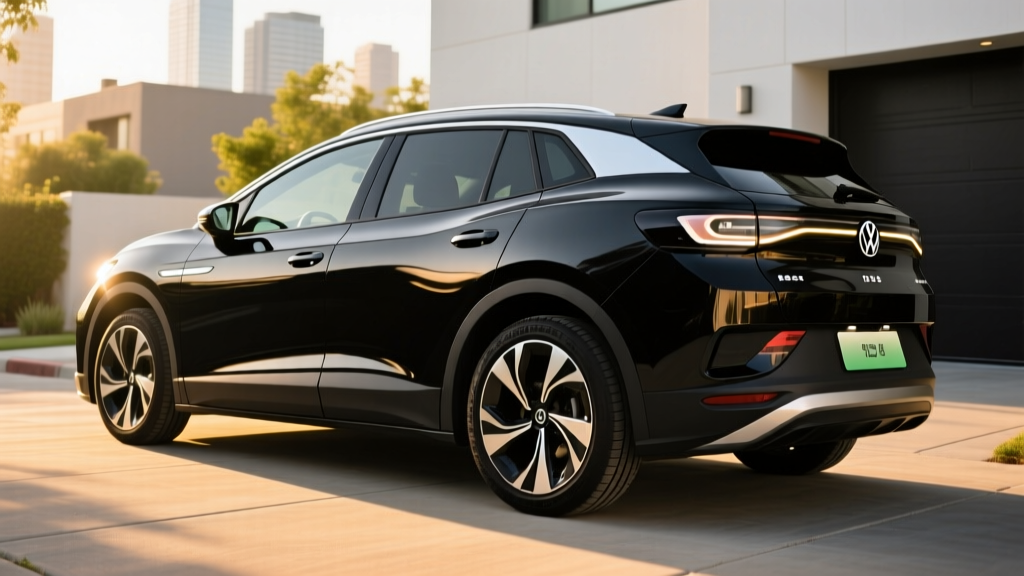
The Volkswagen ID.4 has been the brand's electric anchor in the US market since its 2021 debut, and for 2026, VW continues to offer the ID.4 Black — a darkened, appearance-focused trim that bundles blacked-out wheels, roof, and trim accents on top of the well-equipped Pro S platform. But beneath the stealthy aesthetic lies the same 82 kWh (usable) NMC battery pack and rear- or all-wheel-drive powertrain that define the ID.4's value proposition: a mainstream, family-sized electric crossover with competitive range and DC fast-charging at a price that undercuts many rivals.
This review covers everything a buyer needs to know about the 2026 VW ID.4 Black — from real-world range expectations and charging-curve behavior to federal tax credit eligibility under current IRS §30D rules. Whether you're cross-shopping the Tesla Model Y, Hyundai Ioniq 5, or Ford Mustang Mach-E, the data below will help you decide if the ID.4 Black earns a spot on your shortlist.
2026 VW ID.4 Black: Key Specifications at a Glance
| Spec | ID.4 Black (RWD) | ID.4 Black (AWD) |
|---|---|---|
| EPA Range | 275 miles | 254 miles |
| Battery (Usable) | 82 kWh, NMC | 82 kWh, NMC |
| Horsepower | 282 hp | 335 hp |
| 0–60 mph | 7.7 sec | 5.4 sec |
| Drivetrain | Rear-Wheel Drive | Dual-Motor AWD |
| Max DC Fast Charge | 175 kW | 175 kW |
| 10–80% DC Time | ~30 min | ~30 min |
| Level 2 Home Charge | 11 kW (~37 mi/hr) | 11 kW (~37 mi/hr) |
| MPGe (Combined) | 107 MPGe | 98 MPGe |
| Efficiency | 31 kWh/100 mi | 34 kWh/100 mi |
| Cargo (behind rear seats) | 30.3 cu ft | 30.3 cu ft |
| Cargo (seats folded) | 64.2 cu ft | 64.2 cu ft |
| Rear Legroom | 37.6 in | 37.6 in |
| Base MSRP | $46,090 | $49,490 |
| Battery/Powertrain Warranty | 8 yr / 100,000 mi | 8 yr / 100,000 mi |
Sources: EPA / fueleconomy.gov, Volkswagen USA. Specs reflect 2026 model year.
Real-World Range: What the EPA Sticker Doesn't Tell You
Real-World Expectation: 230–260 miles in mixed driving; 200–220 miles sustained highway at 75+ mph; 180–210 miles in freezing temperatures with cabin heat.
The ID.4 Black RWD carries an EPA-estimated 275 miles of range, which is respectable for a two-row electric crossover in this price bracket. The AWD variant drops to 254 miles due to the added weight and drag of the front motor.
In real-world testing, the ID.4's efficiency hovers around 31 kWh/100 miles in mixed city-suburban driving, closely matching the EPA figure. However, at sustained highway speeds above 70 mph, aerodynamic drag pushes consumption closer to 36–38 kWh/100 miles, reducing effective range to roughly 215–230 miles. This is typical for a bluff-bodied crossover — the Hyundai Ioniq 5 and Tesla Model Y exhibit similar highway penalties.
Cold weather is the bigger range variable. In temperatures below 32°F, the NMC pack loses 20–30% of its usable capacity to internal resistance and cabin heating demands. The ID.4 does offer a heat pump (standard on Pro S trims and above, which the Black is based on), which mitigates some of this loss compared to resistive heating. Expect 190–215 miles of real range on a cold winter day in the RWD model. Preconditioning the battery while plugged in — a feature accessible through the VW Car-Net app — helps preserve range and improves DC charging speeds in cold weather.
Charging Speed: DC Fast Charging and Home Level 2
The ID.4 Black accepts a peak DC fast-charge rate of 175 kW via its CCS1 connector (an adapter is available for NACS/Tesla Supercharger access, as VW has committed to NACS adoption). On a 350 kW Electrify America station, the ID.4 can add approximately 70% of its battery (10–80%) in about 30 minutes under ideal thermal conditions.
| Charging Level | Power | Miles Added Per Hour | Notes |
|---|---|---|---|
| Level 1 (120V) | ~1.4 kW | ~4–5 mi/hr | Emergency/trickle only |
| Level 2 (240V, 48A) | 11 kW | ~37 mi/hr | Full charge in ~8.5 hours |
| DC Fast (peak) | 175 kW | ~650 mi/hr (peak) | 10–80% in ~30 min; tapers above 80% |
A critical nuance: the 175 kW figure is a peak, not a sustained rate. The ID.4's charging curve ramps quickly to ~170 kW between 10–30% State of Charge, then begins a gradual taper. By 60% SoC, you're typically seeing 120–130 kW, and above 80%, the rate drops sharply to protect battery longevity — often below 50 kW. This is why the industry standard metric is 10–80% time rather than 0–100%. Plan road-trip stops around the 10–80% window for maximum efficiency.
At home, the ID.4 Black's onboard charger supports up to 11 kW on a 240V Level 2 circuit (48 amps). That translates to roughly 37 miles of range per hour of charging, meaning a depleted battery reaches full overnight in about 8.5 hours. For most owners who plug in nightly and rarely drain below 30%, a Level 2 home charger refills the daily driving deficit in 2–4 hours. Installation costs for a Level 2 home station typically range from $500–$2,500 depending on panel capacity and wiring distance — budget for a licensed electrician to assess your 200-amp panel headroom.
Performance and Driving Dynamics
The RWD ID.4 Black delivers 282 horsepower from its single rear-mounted permanent-magnet synchronous motor. The 0–60 mph sprint takes 7.7 seconds — adequate for merging and passing but not thrilling. Where the RWD model shines is in low-speed responsiveness: electric torque delivery is instant, making the ID.4 feel quicker around town than the stopwatch suggests.
The AWD variant adds a front induction motor for a combined 335 hp and a 5.4-second 0–60 time. The dual-motor setup also provides genuine all-weather traction, which matters if you live in snow-belt states. The AWD system is torque-biased rearward under normal conditions, preserving the RWD character, but can send up to 100% of torque to the front axle when slip is detected.
Ride quality is a strong point. The ID.4's MEB platform places the heavy battery pack low, yielding a planted, composed feel over rough pavement. Steering is light and precise, though feedback is minimal — this is a comfort-oriented cruiser, not a sport handler. Regenerative braking offers multiple levels adjustable via steering-wheel paddles, but the ID.4 does not offer true one-pedal driving to a full stop in all modes; you'll still use the brake pedal in most scenarios.
Pricing, Trims, and Federal Tax Credit Eligibility
The 2026 VW ID.4 Black starts at $46,090 (RWD) and $49,490 (AWD), including destination. The Black trim is based on the Pro S level, adding 20-inch black alloy wheels, a black-painted roof, black mirror caps, darkened LED taillights, and "Black" badging. Interior upgrades include black V-Tex leatherette seats and a panoramic fixed glass roof.
| Trim | MSRP | Est. Federal Credit (§30D) | Effective Price |
|---|---|---|---|
| ID.4 Black RWD | $46,090 | Up to $7,500* | ~$38,590* |
| ID.4 Black AWD | $49,490 | Up to $7,500* | ~$41,990* |
*Federal tax credit eligibility under IRS §30D depends on multiple criteria:
- MSRP Cap: SUVs must be priced at or below $80,000 — the ID.4 Black qualifies.
- Buyer Income Cap: Modified AGI must not exceed $150,000 (single), $225,000 (head of household), or $300,000 (joint).
- Battery Sourcing: The full $7,500 requires meeting both critical-mineral and battery-component sourcing thresholds, which tighten annually. The ID.4's Chattanooga, TN assembly and evolving supply chain have generally qualified it for the full credit, but verify current-year status at the IRS Clean Vehicle Provisions page or with your tax professional.
- Point-of-Sale Transfer: As of 2024, buyers can transfer the credit to the dealer at purchase, reducing the out-of-pocket price immediately rather than waiting for a tax refund.
The ID.4 Black also qualifies for various state-level incentives (e.g., California's CVRP, Colorado's innovative motor vehicle credit), but amounts vary by jurisdiction. Check your state energy office or the AFDC state law database for current programs.
Interior, Tech, and Cargo Practicality
The ID.4 Black's cabin is spacious and modern, if slightly minimalist. A 12.9-inch infotainment touchscreen dominates the dash, running VW's latest ID. Software 4.0 interface. Wireless Apple CarPlay and Android Auto are standard, along with wireless phone charging. The digital instrument cluster is a compact 5.3-inch display mounted behind the steering wheel, supplemented by an augmented-reality head-up display that overlays navigation prompts onto the windshield — a genuinely useful feature on highway road trips.
Driver-assistance tech includes VW's IQ.DRIVE suite: adaptive cruise control with stop-and-go, lane-centering assist (Travel Assist), automatic emergency braking with pedestrian detection, and blind-spot monitoring. This is an SAE Level 2 system — the driver must keep hands on the wheel and eyes on the road at all times. It is not autonomous driving.
Cargo volume is competitive: 30.3 cubic feet behind the rear seats (comparable to the Model Y's rear cargo area) and 64.2 cubic feet with the 60/40 split rear seats folded. There is no front trunk (frunk) on the ID.4 — the space under the hood houses power electronics. Rear-seat legroom of 37.6 inches comfortably fits adults on longer trips.
Pros, Cons, and the Competition
Pros
- 275-mile EPA range is solid for the segment
- 175 kW DC fast charging with 10–80% in ~30 min
- Spacious cabin with 30.3 cu ft cargo and adult-friendly rear seats
- Heat pump included (Pro S-based trims) for cold-weather efficiency
- Eligible for full $7,500 federal tax credit (verify sourcing annually)
- Composed ride quality; low center of gravity from MEB platform
- Strong 8-year/100,000-mile battery warranty
Cons
- Infotainment software can be laggy; capacitive touch sliders frustrate some users
- No frunk — missed opportunity for additional storage
- RWD 0–60 of 7.7 sec feels leisurely vs. Model Y Long Range (5.0 sec)
- CCS1 connector requires adapter for Tesla Supercharger network access
- Regen braking doesn't achieve full one-pedal stop in all modes
- Highway range drops noticeably above 70 mph
Key competitors: The Tesla Model Y Long Range ($47,990, 310 mi EPA) offers more range, faster acceleration, and native Supercharger access but lacks the ID.4's ride comfort and physical control ergonomics. The Hyundai Ioniq 5 ($45,500, 303 mi EPA, 800V architecture enabling 350 kW peak charging) charges faster but has slightly less cargo room. The Ford Mustang Mach-E ($42,995, 250 mi EPA Extended Range RWD) is sportier to drive but trails on range. The ID.4 Black occupies a comfort-and-value middle ground that suits buyers who prioritize ride refinement and cabin space over outright performance.
Who Should Buy the VW ID.4 Black?
Choose the ID.4 Black if: You want a comfortable, family-friendly electric crossover with strong range, decent fast-charging, and eligibility for the full federal tax credit — and you value ride quality and cabin quietness over sporty acceleration.
Look elsewhere if: You need maximum fast-charge speed (Ioniq 5's 800V architecture wins), you rely heavily on the Tesla Supercharger network without adapters (Model Y), or you want three-row seating (Kia EV9).
The ID.4 Black is best suited for suburban families and commuters who can charge at home nightly and take occasional road trips of 200–300 miles. Its heat pump and AWD option make it a credible choice in northern climates. If your daily commute is under 60 miles and you have reliable Level 2 home charging, the ID.4 Black will rarely require a public charging stop in normal use.
Frequently Asked Questions
What is the real-world range of the 2026 VW ID.4 Black?
The EPA rates the RWD ID.4 Black at 275 miles and the AWD at 254 miles. In mixed real-world driving, expect 230–260 miles. Sustained highway driving at 75+ mph reduces this to roughly 215–230 miles, and freezing winter temperatures can drop range to 190–215 miles despite the standard heat pump.
How fast does the ID.4 Black charge at home and on the road?
At home on a 240V Level 2 charger, the ID.4 Black charges at up to 11 kW, adding about 37 miles of range per hour for a full charge in ~8.5 hours. On a DC fast charger, it peaks at 175 kW and can go from 10–80% in approximately 30 minutes under ideal conditions.
Does the VW ID.4 Black qualify for the $7,500 federal EV tax credit?
The ID.4 Black is assembled in Chattanooga, TN, and has historically qualified for the full $7,500 under IRS §30D. However, eligibility depends on your income (AGI caps apply), the vehicle's MSRP (must be under $80,000 for SUVs — the ID.4 qualifies), and annual battery-sourcing requirements that tighten each year. Verify current-year eligibility on IRS.gov or consult a tax professional before purchasing.
Is the VW ID.4 Black worth buying vs. the Tesla Model Y or Hyundai Ioniq 5?
The ID.4 Black is worth considering if ride comfort, cabin quietness, and value (especially after the federal credit) are your priorities. The Model Y wins on range (310 mi) and Supercharger convenience; the Ioniq 5 wins on peak charging speed (up to 350 kW on 800V infrastructure). The ID.4 Black sits between them as a comfort-oriented, well-rounded choice.
What is the ID.4's battery warranty?
Volkswagen covers the ID.4's high-voltage battery for 8 years or 100,000 miles, whichever comes first. The warranty guarantees the battery will retain at least 70% of its original usable capacity during that period. VW's limited vehicle warranty is 4 years / 50,000 miles.
Does the ID.4 Black have a front trunk (frunk)?
No. The ID.4 does not offer a front trunk. The space under the hood is occupied by power electronics and the HVAC system. All cargo must go in the rear compartment (30.3 cu ft behind rear seats, 64.2 cu ft with seats folded).