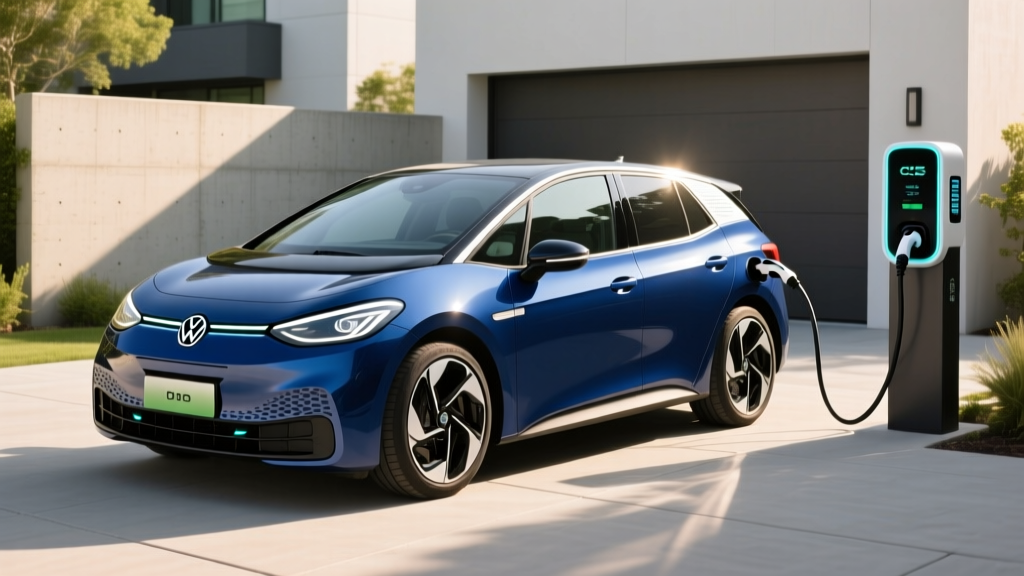
The Volkswagen ID.2 has been one of the most anticipated entries in the affordable EV segment. Announced as VW's entry-level electric hatchback, the ID.2 targets a price point below $30,000 (European pricing) and promises to bring the MEB platform to a new audience. However, as of early 2026, the ID.2 remains announced for the European market with no confirmed US launch date. This profile covers what we know from VW's official previews, concept reveals, and European-market specifications — and what US buyers should realistically expect if and when this model arrives stateside.
Because the ID.2 is not yet on sale in the United States, all specs below are preliminary and based on VW's announced data and the ID.2all concept. EPA estimates, US pricing, and federal tax credit eligibility cannot be confirmed until the vehicle is officially certified for the US market. We will update this profile when definitive US-market information becomes available.
What Is the VW ID.2?
The VW ID.2 is a B-segment electric hatchback positioned below the ID.3 and ID.4 in Volkswagen's electric lineup. It rides on a shortened version of VW's MEB (Modular Electric Drive) platform and is designed to compete with affordable EVs like the upcoming next-gen Chevrolet Bolt, the BYD Dolphin, and the Renault 5 E-Tech in global markets. The production version was previewed by the ID.2all concept, which VW unveiled to signal a return to more traditional, Golf-like hatchback styling after the polarizing ID.3 design.
VW has confirmed the ID.2 will launch in Europe first, with deliveries expected to begin in 2026. A US-market version has not been officially announced, though VW of America has acknowledged interest in bringing a more affordable EV to its lineup. If it arrives in the US, it would likely be for the 2027 model year at the earliest.
Projected Range, Battery, and Efficiency
VW has announced that the ID.2 will offer a WLTP range of up to 450 km (approximately 280 miles) in its longest-range variant. For US buyers, WLTP figures typically overstate range compared to EPA testing — expect an EPA estimate in the 230–250 mile range if the same battery pack is certified stateside.
Real-World Expectation: ~190–220 miles at sustained highway speeds (70+ mph); expect 15–25% range loss in freezing temperatures (below 32°F). City driving with regen braking will yield results closer to the EPA sticker.
The ID.2 is expected to use a ~58 kWh (usable) lithium-ion battery pack. VW has not confirmed the exact chemistry for the ID.2, but industry reporting suggests the base model may use LFP (lithium iron phosphate) cells for cost reduction, with an NMC option for the longer-range variant. LFP offers slower degradation and tolerance for 100% daily charging, but lower energy density and reduced cold-weather performance compared to NMC.
| Spec | Projected / Announced |
|---|---|
| WLTP Range | Up to 450 km (~280 mi) |
| EPA Range (est.) | ~230–250 mi (unconfirmed) |
| Battery Capacity (usable) | ~58 kWh |
| Battery Chemistry | LFP (base) / NMC (long-range) — unconfirmed |
| Max DC Fast Charge | ~100–125 kW (projected) |
| 10–80% DC Charge Time | ~25–30 minutes (projected) |
| Level 2 Home Charge Rate | ~7.2–11 kW |
| 0–60 mph | ~8.0 seconds (est., base RWD) |
| Horsepower | ~150–200 hp (depending on variant) |
| Drivetrain | RWD (rear motor) |
| MPGe (est.) | ~110–120 MPGe combined (projected) |
Charging Speed: DC Fast and Level 2 Home Charging
Based on the MEB platform's capabilities in the ID.3 and ID.4, the ID.2 is projected to support DC fast charging at a peak rate of approximately 100–125 kW. This would allow a 10–80% charge in roughly 25–30 minutes at a compatible station. While not class-leading (the Hyundai Ioniq 5 peaks at 240 kW on its 800V architecture), this is adequate for a subcompact hatchback and comparable to the Chevrolet Bolt EUV's 55 kW peak — meaning the ID.2 would represent a meaningful improvement over that outgoing model.
For home Level 2 charging, VW is expected to equip the ID.2 with an onboard charger rated at 7.2 kW (single-phase) or 11 kW (three-phase, common in Europe). US models would likely get the 7.2 kW or possibly an 11.5 kW onboard charger. At 7.2 kW, a full 0–100% charge would take approximately 8–9 hours — easily completed overnight on a standard 240V home circuit.
| Level | Power (kW) | Miles of Range Added per Hour | Full Charge Time (0–100%) |
|---|---|---|---|
| Level 1 (120V) | ~1.4 kW | ~4–5 mi/hr | ~40+ hours |
| Level 2 (240V) | 7.2–11 kW | ~22–34 mi/hr | ~6–9 hours |
| DC Fast Charge | ~100–125 kW peak | ~150+ mi in 15 min (at peak) | 10–80% in ~25–30 min |
Charging curve reality check: Peak kW is only sustained at lower states of charge (typically 10–40% SoC). Expect the charge rate to taper significantly above 80% SoC — a 10–80% session will be noticeably faster than an 80–100% top-off. VW's MEB platform vehicles have historically shown moderate taper curves, not the aggressive taper seen in some older architectures.
Performance and Drivetrain
The ID.2 will use VW's rear-mounted APP550 electric motor (or a variant of it), delivering approximately 150–200 horsepower depending on the trim. The base model is expected around 150 hp with a 0–60 mph time in the 8-second range, while a more powerful variant could push closer to 200 hp and a sub-7-second 0–60 time. All variants will be rear-wheel drive; an AWD dual-motor version has not been announced for this segment.
For context, these figures place the ID.2 in the same performance bracket as a well-equipped gasoline VW Golf — adequate for highway merging and city driving, but not a performance EV. The single-motor RWD layout keeps weight down and efficiency up, which is the right trade-off for a budget-oriented commuter hatchback.
Pricing, Trims, and Federal Tax Credit Eligibility
VW has targeted a starting price of under €25,000 in Europe (approximately $27,000–$29,000 at current exchange rates before any US-market adjustments). If the ID.2 comes to the US, expect a base MSRP in the $28,000–$32,000 range before destination charges, with higher trims potentially reaching $35,000–$38,000 with options.
If the ID.2 is sold in the US, it would likely qualify as a "passenger car" under IRS rules, subject to the $55,000 MSRP cap (easily met). However, eligibility for the full $7,500 credit depends on:
• Battery sourcing requirements: Critical minerals and battery components must meet phased thresholds under the Inflation Reduction Act. VW's supply chain for a US-spec ID.2 is unknown at this time.
• Buyer income caps: AGI must not exceed $150,000 (single), $225,000 (head of household), or $300,000 (joint).
• Point-of-sale transfer: Eligible buyers can apply the credit at purchase, reducing the effective price immediately.
Always verify current rules at IRS.gov and consult a tax professional.
| Trim (Projected) | Est. Base MSRP | After Max §30D Credit |
|---|---|---|
| Base | ~$28,000–$30,000 | ~$20,500–$22,500 |
| Mid | ~$32,000–$34,000 | ~$24,500–$26,500 |
| Top | ~$35,000–$38,000 | ~$27,500–$30,500 |
Interior, Cargo, and Technology
The ID.2all concept previewed a cabin designed to feel more conventional than earlier ID models — physical buttons return for climate controls and steering wheel functions, addressing one of the biggest complaints with the ID.3 and ID.4 interiors. VW has promised a 12.9-inch central touchscreen running the latest version of VW's ID. Software, along with a smaller digital instrument cluster.
Cargo space in the European ID.3 (a larger C-segment hatchback) is approximately 13.7 cu ft behind the rear seats. The smaller ID.2 is projected to offer roughly 11–13 cu ft of cargo volume, competitive with the Honda Fit (16.6 cu ft gas) but tighter than the Chevrolet Bolt EV (16.9 cu ft). Rear-seat legroom should accommodate average-height adults but will be snug for taller passengers on longer trips.
Standard driver-assistance features are expected to include adaptive cruise control, lane-keeping assist, automatic emergency braking, and traffic sign recognition — all SAE Level 2 driver-assist systems requiring full driver attention. VW's Travel Assist combines these into a highway driving aid, but it is not autonomous driving.
Warranty and Ownership Costs
VW's current US EV warranty structure provides a 4-year/50,000-mile limited vehicle warranty and an 8-year/100,000-mile battery warranty (guaranteeing a minimum of 70% capacity retention). If the ID.2 launches in the US, expect similar coverage. VW has historically included complimentary scheduled maintenance for the first two years, though this varies by model year.
Insurance costs for subcompact EVs tend to be moderate — expect premiums in line with a well-equipped Golf, though EV-specific repair costs (battery proximity sensors, aluminum body panels) can push rates slightly above comparable gas hatchbacks. Get quotes before purchasing.
Should You Wait for the VW ID.2?
Pros
- Target sub-$30,000 price point (pre-credit) makes it one of the most affordable new EVs if it reaches the US
- Practical hatchback form factor with improved interior ergonomics over ID.3
- Projected 230–250 mi EPA range sufficient for most commutes and city driving
- DC fast charging (~125 kW) significantly faster than outgoing Bolt EV
- Return of physical buttons and improved infotainment software
- Strong VW dealer network for service
Cons
- Not confirmed for the US market — may never arrive stateside
- Tight rear seat and cargo space compared to crossovers
- Modest performance (~8-sec 0–60) — not a performance EV
- LFP battery (if used) will suffer more cold-weather range loss than NMC
- No AWD option — limits appeal in snowy climates
- US battery sourcing for tax credit eligibility is entirely unknown
- Choose it if: You want a budget-friendly commuter EV with ~240 miles of range, prefer a hatchback over a crossover, and have reliable home charging access.
- Look elsewhere if: You need family cargo space, want AWD for winter driving, or need a confirmed US model you can buy today — consider the Chevrolet Bolt (if reintroduced), Hyundai Kona Electric, or Nissan Leaf instead.
Frequently Asked Questions
What is the real-world range of the VW ID.2?
Based on the announced WLTP range of 450 km, expect a US EPA rating around 230–250 miles. In real-world highway driving at 70+ mph, plan for roughly 190–220 miles. Cold weather (below 32°F) can reduce range by an additional 15–25%, especially with an LFP battery pack.
How fast does the VW ID.2 charge?
Projected DC fast charging peaks at approximately 100–125 kW, enabling a 10–80% charge in about 25–30 minutes. Home Level 2 charging at 7.2 kW adds roughly 22 miles of range per hour, with a full charge taking 8–9 hours overnight.
How much does the VW ID.2 cost after tax credits?
US pricing is not confirmed. Based on European targets, expect a base MSRP around $28,000–$30,000. If eligible for the full $7,500 federal credit under §30D, the effective price could drop to approximately $20,500–$22,500. Credit eligibility depends on battery sourcing, buyer income, and MSRP caps — verify at IRS.gov.
Is the VW ID.2 worth buying vs competitors?
If it launches in the US at its target price, the ID.2 would compete directly with the Chevrolet Bolt (next-gen), Hyundai Kona Electric, and Nissan Leaf. Its advantages would be DC charging speed (vs. the old Bolt's 55 kW) and interior quality. Its disadvantage is uncertain availability — you cannot buy one today, and US launch is not guaranteed.
Does the VW ID.2 qualify for the federal EV tax credit?
Cannot be confirmed. The ID.2 would easily meet the $55,000 MSRP cap for passenger cars. However, the $7,500 credit requires meeting battery component and critical mineral sourcing thresholds under the Inflation Reduction Act. VW has not disclosed US-spec battery sourcing for the ID.2. Always check current eligibility on IRS.gov before relying on the credit in your purchase decision.
When will the VW ID.2 be available in the US?
There is no confirmed US launch date. European deliveries are expected to begin in 2026. If VW decides to bring the ID.2 to the US market, the earliest realistic arrival would be the 2027 model year. VW of America has not made an official announcement.