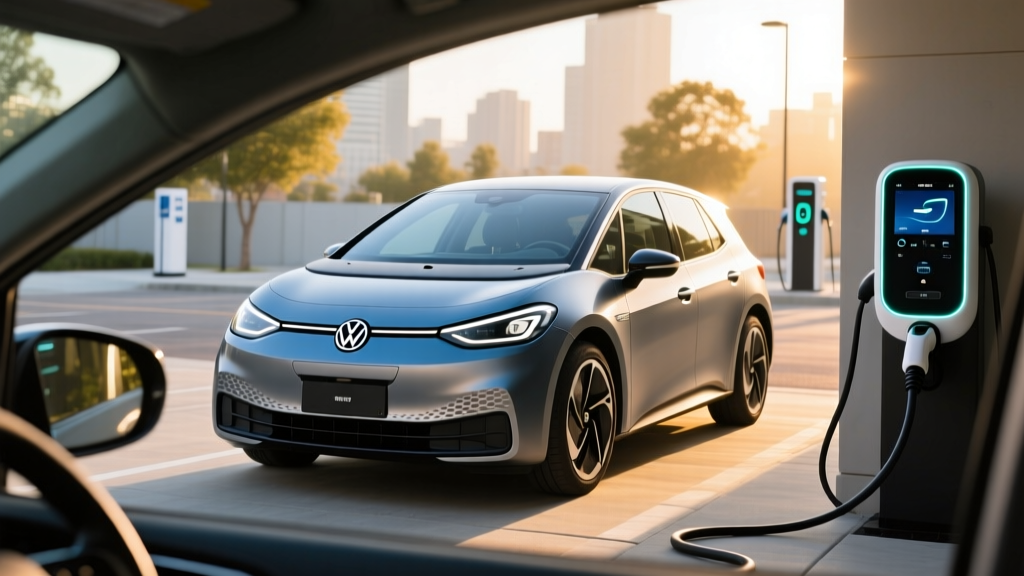
The Volkswagen ID.2 All arrives as VW's bid to own the affordable European electric hatchback segment — a segment the Golf once dominated in the ICE era. Positioned below the ID.3 and ID.4, the ID.2 All targets urban commuters and cost-conscious EV shoppers who want a practical daily driver without crossing the $35,000 threshold. But can a compact hatchback with a modest battery and front-wheel drive satisfy buyers accustomed to 300+ mile range figures? We break down every spec that matters.
Quick Verdict: Who the VW ID.2 All Is For
The ID.2 All is a sensible, no-nonsense urban EV. It prioritizes efficiency, packaging, and everyday usability over performance theatrics. If your commute is under 40 miles round-trip, you have access to Level 2 home charging, and you don't need to tow or road-trip cross-country regularly, this hatchback makes a compelling case. If you need AWD, 300+ miles of range, or rapid DC charging for frequent highway travel, look at the ID.4 or a competitor like the Chevy Equinox EV.
Range & Efficiency: EPA Numbers vs. Real-World Reality
Real-World Expectation: Expect 210–230 miles on mixed highway driving at 70 mph. In freezing temperatures (below 32°F / 0°C), plan for 170–195 miles due to cabin heating load and increased battery resistance. City driving with regen braking can push closer to the 260-mile sticker.
Volkswagen targets a WLTP range of approximately 450 km (~280 miles) for the ID.2 All. WLTP tends to overstate range by 10–15% compared to the EPA's more conservative testing cycle, so a ~260-mile EPA figure is our working estimate for the US market. The 58 kWh usable battery capacity (LFP chemistry) provides a solid energy density for a vehicle in this class, translating to roughly 115 MPGe combined or about 29 kWh/100 mi.
The LFP (lithium iron phosphate) chemistry is a deliberate choice: it sacrifices some energy density versus NMC but gains cycle life longevity, thermal stability, and lower raw-material cost. For a daily commuter that charges to 100% regularly, LFP is arguably the better chemistry — VW recommends periodic 100% charges to keep the BMS calibrated, unlike NMC packs where 80% daily limits are preferred.
Battery, Charging & Powertrain Specs
| Spec | Value |
|---|---|
| Battery Usable Capacity | 58 kWh (LFP chemistry) |
| Drivetrain | Front-wheel drive (single motor) |
| Horsepower | ~150 kW / 201 hp (estimated) |
| 0–60 mph | ~7.0 seconds (estimated) |
| Max DC Fast Charge Rate | 130 kW peak |
| 10–80% DC Fast Charge | ~26 minutes (estimated) |
| Level 2 AC Charge Rate | 11 kW (adds ~37 mi/hr) |
| Charging Port (US) | NACS (Tesla Supercharger compatible) |
| EPA Range (est.) | ~260 miles |
| Efficiency (est.) | ~115 MPGe / 29 kWh/100 mi |
Charging Speed in Practice
The 130 kW peak DC rate is modest by 2026 standards — the Hyundai Ioniq 5 peaks at 240 kW and the Tesla Model Y at 250 kW. However, LFP batteries tend to hold a flatter charge curve, meaning the ID.2 All should sustain closer to its peak rate for a longer portion of the session. Where NMC packs taper sharply above 50–60% SoC, LFP packs often sustain 80–90% of peak rate up to 70–75% SoC before the taper. The net result: a 10–80% session in roughly 26 minutes is competitive for a 58 kWh pack at this price point.
At home on a Level 2 charger (240V, 48A circuit), the 11 kW onboard charger replenishes the battery in about 5.5 hours from empty — overnight charging is effortless. On a standard 120V outlet (Level 1), expect roughly 3–4 miles of range per hour, which is fine for topping off but not practical as a primary charging strategy.
| Charging Level | Power | Miles Added per Hour | Full Charge Time |
|---|---|---|---|
| Level 1 (120V) | ~1.4 kW | ~3–4 mi/hr | ~40+ hours |
| Level 2 (240V, 48A) | 11 kW | ~37 mi/hr | ~5.5 hours |
| DC Fast Charge | 130 kW peak | ~150 mi in 20 min | 10–80% in ~26 min |
Interior, Cargo & Technology
The ID.2 All rides on VW's MEB-entry platform (a shortened variant of the modular electric architecture), which pushes wheels to the corners and frees up interior volume. Expect approximately:
- Front legroom: ~41.0 inches
- Rear legroom: ~36.5 inches
- Cargo volume (behind rear seats): ~16.0 cu ft
- Cargo volume (rear seats folded): ~44.0 cu ft
- Frunk: Small utility compartment (~1.5 cu ft) for charging cables
These numbers put the ID.2 All in line with the outgoing Golf — adequate for two adults and groceries, tight for four adults on longer trips. The cargo area is usefully square, and the split-folding rear seat adds flexibility.
Infotainment & Driver Assists
The cabin centers on a 12.9-inch touchscreen running VW's latest ID. Software 4.x, which addresses many of the lag and menu-complexity complaints from early ID.3 and ID.4 models. Wireless Apple CarPlay and Android Auto are standard. A 10.25-inch digital instrument cluster sits behind the steering wheel.
Standard driver-assistance features include:
- Adaptive cruise control with stop-and-go
- Lane-keeping assist (SAE Level 2 — driver must remain engaged)
- Automatic emergency braking with pedestrian detection
- Park assist with 360° camera (higher trims)
- Travel Assist (combined lane centering + adaptive cruise for highway use)
Notably absent: no hands-free driving system comparable to GM's Super Cruise or Ford's BlueCruise. VW's Travel Assist is a competent Level 2 system but requires hands on the wheel at all times.
Pricing, Trims & Federal Tax Credit Eligibility
| Trim | Est. MSRP | After Est. §30D Credit |
|---|---|---|
| ID.2 All Base | ~$27,000 | ~$19,500* |
| ID.2 All Pro | ~$31,000 | ~$23,500* |
| ID.2 All Pro S | ~$34,500 | ~$27,000* |
*Tax credit estimates assume full §30D eligibility. Actual credit depends on battery sourcing, buyer income, and MSRP caps. See details below.
Does the ID.2 All Qualify for the Federal EV Tax Credit?
The ID.2 All's sub-$35,000 MSRP clears the IRS §30D price cap for passenger cars ($55,000). However, eligibility for the full $7,500 credit depends on two additional hurdles that are particularly challenging for European-manufactured Volkswagens:
- Battery component sourcing: A percentage of battery components must be manufactured or assembled in North America. VW's LFP cells are likely sourced from CATL or a similar Asian supplier, which may disqualify partial or full credit.
- Critical minerals sourcing: A percentage of critical minerals must be sourced from the US or a free-trade-agreement country. LFP chemistry uses iron and phosphate (not nickel or cobalt), which may simplify compliance — but final determinations rest on the IRS's annual approved vehicle list.
- Buyer income caps: AGI must not exceed $150,000 (single) / $300,000 (joint) to claim the credit.
- Point-of-sale transfer: If eligible, the credit can be transferred to the dealer at purchase, reducing the purchase price directly rather than waiting for a tax refund.
Bottom line: The ID.2 All is a strong candidate for partial credit ($3,750) if it meets critical-minerals requirements but fails the battery-component test. Full $7,500 eligibility is uncertain given VW's current supply chain. Check the IRS approved-vehicle list at time of purchase — this changes annually.
Warranty & Ownership Costs
Volkswagen provides the following coverage for the ID.2 All:
- Battery warranty: 8 years / 100,000 miles (minimum 70% capacity retention guaranteed)
- Powertrain warranty: 8 years / 100,000 miles
- Bumper-to-bumper: 4 years / 50,000 miles
- Roadside assistance: 4 years / 50,000 miles
The 70% capacity retention threshold is industry standard. LFP chemistry typically degrades more slowly than NMC in calendar aging and high-cycle scenarios, so most owners should see well above 85% State of Health (SoH) at the 8-year mark based on VW's published cell testing data.
Estimated annual operating costs are low: electricity at $0.14/kWh means a full 58 kWh charge costs about $8.12, or roughly $0.03 per mile. Compare that to a 30 MPG gas car at $3.50/gallon ($0.12/mile) — the ID.2 All saves approximately $1,300 per year in fuel at 15,000 miles driven annually.
Pros, Cons & How It Compares
Pros
- Sub-$28K starting price — among the most affordable new EVs
- LFP battery: long cycle life, thermal stability, 100% charging OK
- NACS port: full Tesla Supercharger network access
- Compact dimensions ideal for city parking
- Low running costs (~$0.03/mi on average electricity)
- VW's improved ID. Software 4.x infotainment
Cons
- 130 kW DC charging is slow vs. 200+ kW competitors
- FWD only — no AWD option for snow-belt buyers
- ~260-mile range limits road-trip convenience
- Rear seat tight for taller passengers
- Federal tax credit uncertain due to battery sourcing
- No hands-free highway driving system
VW ID.2 All vs. Key Competitors
The ID.2 All competes against the Chevy Equinox EV (~$33,000, 319-mile range, 150 kW charging), the Nissan Leaf (if still in production, ~$28,000, 212-mile range, CHAdeMO), and the Hyundai Kona Electric (~$32,000, 261-mile range, 100 kW charging). The ID.2 All undercuts most on price but trails on range and DC charging speed. If range is your top priority, the Equinox EV wins. If lowest entry price matters most, the ID.2 All leads the pack.
Final Verdict: Is the VW ID.2 All Worth It?
The VW ID.2 All is a purpose-built urban commuter — not a road-trip warrior or performance machine. Its strengths are clear: low price, efficient LFP battery, NACS Supercharger access, and a practical hatchback form factor. Its weaknesses are equally clear: modest DC charging speed, limited range for highway-heavy drivers, and uncertain tax-credit eligibility.
Buy the ID.2 All if: You commute under 40 miles daily, have Level 2 home charging, want the lowest-cost new EV with Supercharger access, and don't need AWD or 300+ mile range.
Skip it if: You regularly drive 200+ miles between charges, need fast DC charging for road trips, live in a region with harsh winters and no garage, or require the full $7,500 tax credit to make the math work.
Frequently Asked Questions
What is the real-world range of the VW ID.2 All?
The EPA-estimated range is approximately 260 miles, but expect 210–230 miles on highway-heavy trips at 70 mph, and 170–195 miles in sub-freezing temperatures. City driving with regenerative braking gets closest to the EPA sticker.
How fast does the VW ID.2 All charge?
On DC fast charging, it peaks at 130 kW and charges from 10–80% in approximately 26 minutes. At home on a Level 2 charger (240V, 48A), the 11 kW onboard charger adds about 37 miles of range per hour, fully replenishing the battery in roughly 5.5 hours.
Does the VW ID.2 All qualify for the $7,500 federal tax credit?
It clears the MSRP cap ($55,000 for cars) and likely the buyer income caps, but full $7,500 eligibility is uncertain. The LFP battery's critical-mineral sourcing may qualify for $3,750, while battery-component manufacturing (likely outside North America) may disqualify the other $3,750. Check the IRS approved vehicle list at time of purchase.
Is the VW ID.2 All better than the Chevy Equinox EV?
It depends on your priority. The Equinox EV offers 319 miles of range and 150 kW DC charging but starts around $33,000. The ID.2 All starts ~$6,000 lower with ~60 fewer miles of range and slower charging. For budget-first buyers, the ID.2 All wins. For range-first buyers, the Equinox EV is the better choice.
What battery chemistry does the ID.2 All use?
LFP (lithium iron phosphate). LFP offers longer cycle life, better thermal stability, and lower cost than NMC, at the trade-off of lower energy density. VW recommends periodic 100% charges for LFP packs to maintain battery management system accuracy.
Can the VW ID.2 All use Tesla Superchargers?
Yes. The US-market ID.2 All is equipped with a NACS (North American Charging Standard) port, granting native access to the Tesla Supercharger network — the largest and most reliable DC fast-charging network in the country.