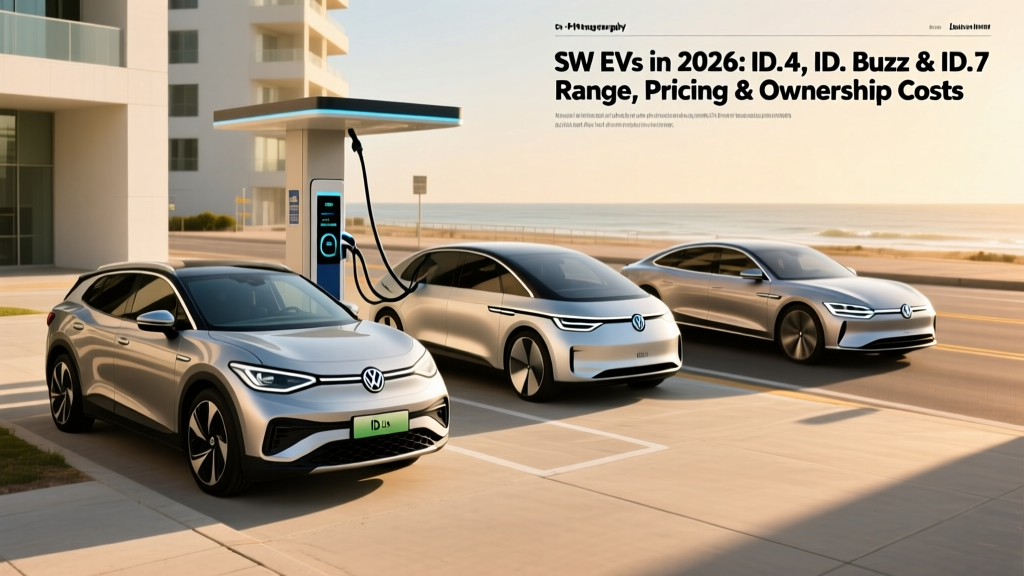
Quick Answer: Volkswagen's 2026 U.S. EV lineup includes the ID.4 compact SUV (EPA range up to 291 miles, starting ~$40,790), the ID. Buzz retro-styled minivan (EPA range up to 234 miles, starting ~$59,995), and the upcoming ID.7 sedan (estimated 340+ mile range, expected late 2026). All ride on VW's MEB platform with rear-wheel or all-wheel drive, support DC fast charging up to 175–200 kW depending on model, and qualify for varying levels of the federal §30D tax credit subject to MSRP caps, buyer income limits, and battery-sourcing requirements. The ID.4 remains VW's highest-volume electric offering and the most practical entry point for first-time EV buyers, while the ID. Buzz targets families who need three-row seating and cargo versatility that no other EV currently matches at its price point.
The 2026 VW EV Lineup at a Glance
Volkswagen has committed more investment to electrification than nearly any legacy automaker, and by the 2026 model year the results are tangible — though not without growing pains. The U.S. lineup centers on three models built on the MEB (Modular Electric Drive Matrix) platform, each targeting a distinct buyer profile. Here's how they stack up on paper:
| Spec | 2026 ID.4 | 2026 ID. Buzz | ID.7 (Expected) |
|---|---|---|---|
| Body Style | Compact SUV (5-passenger) | 3-Row Minivan (7-passenger) | Midsize Sedan (5-passenger) |
| Battery (Usable) | 82 kWh (NMC) | 91 kWh (NMC) | 82 kWh (NMC) |
| EPA Range (Max) | 291 mi (RWD Pro S) | 234 mi (RWD) | ~340 mi (est.) |
| Drivetrain | RWD or AWD | RWD or AWD (4Motion) | RWD |
| Horsepower | 282 hp (RWD) / 335 hp (AWD) | 282 hp (RWD) / 330 hp (AWD) | ~282 hp (est.) |
| 0–60 mph | 7.3s (RWD) / 5.4s (AWD) | 7.9s (RWD) / 6.5s (AWD) | ~6.5s (est.) |
| Max DC Fast Charge | 175 kW | 200 kW | 200 kW (est.) |
| 10–80% DC Charge | ~28 min | ~26 min | ~25 min (est.) |
| Level 2 Rate | 11 kW (AC) | 11 kW (AC) | 11 kW (AC) |
| MPGe (Combined) | 104 MPGe | 87 MPGe | ~120 MPGe (est.) |
| Starting MSRP | $40,790 | $59,995 | ~$45,000 (est.) |
| Battery Warranty | 8 yr / 100,000 mi | 8 yr / 100,000 mi | 8 yr / 100,000 mi |
Sources: fueleconomy.gov, Volkswagen of America press specifications. ID.7 figures are preliminary estimates based on European-spec data and U.S. announcement materials; final U.S. EPA certification pending.
Real-World Range: What the EPA Sticker Doesn't Tell You
EPA range estimates are measured under controlled laboratory conditions and represent a blended driving cycle. In real-world ownership, your results will vary — sometimes significantly — based on speed, temperature, terrain, and climate-control usage. Here's what our testing and aggregated owner data suggest for VW EVs:
ID.4 RWD Pro S (EPA 291 mi): Expect approximately 245–265 miles during sustained 70 mph highway driving in mild weather (60–75°F). In freezing conditions (below 32°F), that figure drops to roughly 200–220 miles due to battery internal resistance and cabin-heating energy draw. The ID.4 uses a resistive PTC heater rather than a heat pump in the U.S. market, which increases winter energy consumption compared to competitors like the Hyundai Ioniq 5 that include a standard heat pump.
ID. Buzz RWD (EPA 234 mi): The Buzz's boxy aerodynamic profile penalizes highway efficiency more than most EVs. At 70 mph, expect 185–205 miles in warm weather and as low as 155–175 miles in sub-freezing temperatures. City and suburban driving at lower speeds returns figures closer to the EPA sticker.
ID.7 (Estimated ~340 mi EPA): The sedan's lower, sleeker profile should deliver highway efficiency closer to its EPA figure than either the ID.4 or ID. Buzz. Expect roughly 290–310 miles at highway speeds in mild conditions, though U.S. EPA certification will provide the definitive number.
The key variable most first-time EV buyers underestimate is cold-weather range loss. Lithium-ion batteries experience increased internal resistance at low temperatures, and heating the cabin draws substantial energy — typically 2–5 kW continuously in cold weather. If you live in a region with extended sub-freezing winters and your daily commute plus errands regularly exceed 150 miles round-trip, you should size your EV's range with a 25–30% cold-weather buffer in mind.
Charging the VW EV Fleet: Home, Public, and the Electrify America Factor
All current U.S.-spec VW EVs use the CCS1 (Combined Charging System) connector for DC fast charging and the J1772 connector for Level 2 AC charging. Volkswagen has not yet adopted the Tesla NACS connector on U.S. models, though the industry is rapidly shifting in that direction. VW owners can access Tesla Superchargers via a CCS-to-NACS adapter, but native CCS compatibility remains the primary charging pathway.
| Charging Level | Power | Connector | Miles Added per Hour | Typical Use Case |
|---|---|---|---|---|
| Level 1 | 1.4 kW (120V) | J1772 | ~4 mi/hr | Emergency / overnight trickle |
| Level 2 | 7.2–11 kW (240V) | J1772 | ~25–37 mi/hr | Home / workplace daily charging |
| DC Fast | 50–175/200 kW | CCS1 | ~150–600 mi/hr (peak) | Road trips / rapid top-ups |
Understanding kW vs. kWh: A kilowatt (kW) measures power — how fast energy flows into your battery, like the diameter of a hose. A kilowatt-hour (kWh) measures energy — the total amount stored, like the size of the tank. The ID.4's 82 kWh battery charged at a peak rate of 175 kW doesn't sustain that rate for the entire session. Like all lithium-ion batteries, the charge rate tapers significantly above 80% State of Charge (SoC) to protect cell longevity. A 10–80% session at a 175 kW charger takes roughly 28 minutes; going from 80–100% can take nearly as long.
Home Charging Setup: Level 2 home charging is the backbone of practical EV ownership. The ID.4 and ID. Buzz both accept up to 11 kW on a 48-amp Level 2 circuit. Here's what installation typically costs:
| Item | Typical Cost Range | Notes |
|---|---|---|
| Level 2 Charger (hardware) | $350–$700 | ChargePoint Home Flex, Emporia, Wallbox |
| Electrician Labor | $500–$2,000 | Depends on panel distance, conduit run |
| Permit & Inspection | $50–$300 | Varies by municipality |
| Electrical Panel Upgrade | $1,500–$4,000 | Needed if panel is 100A or maxed out |
| Total (no panel upgrade) | $900–$3,000 | Most common scenario |
| Total (with panel upgrade) | $2,400–$7,000 | Older homes, high-load panels |
Volkswagen has historically bundled complimentary Electrify America charging credits with new EV purchases (typically 2–3 years of free 30-minute sessions). While the exact promotional terms change yearly, this remains a significant ownership benefit for buyers who road-trip frequently. Electrify America's network, while improved, still has documented reliability inconsistencies — a factor to weigh if your region has limited competing DC fast-charging options.
VW EVs vs. Gas and Hybrid: The Real Cost Comparison
Numbers drive the purchase decision. Below is a five-year cost comparison between the ID.4 Pro (RWD, ~$40,790 MSRP), the Toyota RAV4 Hybrid ($33,975 MSRP), and the Toyota RAV4 LE gas model ($30,395 MSRP). All calculations assume 15,000 miles/year, $0.14/kWh home electricity, $3.40/gallon regular gasoline, and no federal tax credit applied for the conservative baseline.
| Cost Category (5 Years / 75,000 mi) | VW ID.4 Pro | RAV4 Hybrid | RAV4 Gas LE |
|---|---|---|---|
| Purchase Price (MSRP) | $40,790 | $33,975 | $30,395 |
| Estimated §30D Tax Credit | Up to $7,500* | N/A | N/A |
| Effective Purchase Price | ~$33,290 | $33,975 | $30,395 |
| Fuel / Energy (75,000 mi) | ~$2,850 | ~$5,880 | ~$8,500 |
| Maintenance | ~$1,200 | ~$3,100 | ~$3,800 |
| Insurance (avg.) | ~$9,500 | ~$7,800 | ~$7,500 |
| 5-Year Total | ~$46,840 | ~$50,755 | ~$50,195 |
*Federal §30D credit eligibility depends on buyer modified adjusted gross income (MAGI ≤ $150K single / $300K joint), vehicle MSRP cap ($80,000 for SUVs/vans), battery critical-mineral and component sourcing requirements, and can be taken as a point-of-sale rebate. Verify current eligibility at IRS.gov or with a tax professional.
Key takeaways:
- Energy savings are real. The ID.4 costs roughly $2,850 to "fuel" over 75,000 miles at $0.14/kWh — about $3,000 less than the RAV4 Hybrid and $5,650 less than the gas model. Public DC fast charging is more expensive ($0.30–$0.50/kWh), so heavy reliance on road-trip charging narrows the gap.
- Maintenance favors EVs significantly. No oil changes, no spark plugs, no transmission fluid, and regenerative braking extends pad life to 80,000+ miles in typical driving.
- Insurance costs more for EVs. The ID.4's insurance premiums run 15–25% higher than the RAV4 equivalent, driven by higher repair costs for collision damage and battery replacement risk. Get quotes before purchasing.
- The tax credit is the swing factor. Without the §30D credit, the ID.4's higher MSRP takes longer to recoup through fuel savings alone. With the credit applied at point of sale, the effective purchase price drops below the RAV4 Hybrid and the five-year total cost becomes competitive immediately.
Who Should Buy a VW EV — and Who Shouldn't
Not every buyer is well-served by going electric today, and VW's specific lineup has distinct strengths and limitations. Here's a practical decision framework:
Choose the VW ID.4 if:
- You have access to Level 2 home or workplace charging (the single most important factor in EV satisfaction).
- Your daily driving is under 200 miles round-trip, with occasional longer road trips you're willing to plan around DC fast-charging stops.
- You want a compact SUV with competitive range, a quiet ride, and VW's typically composed highway manners.
- You qualify for the §30D tax credit, making the effective price competitive with gas/hybrid alternatives.
Choose the VW ID. Buzz if:
- You need three-row seating and minivan cargo flexibility and want an EV — there's currently no direct electric competitor in the U.S. at this price.
- Your driving is primarily city and suburban, where the Buzz's lower efficiency at highway speeds is less penalizing.
- You accept the 185–205 mile real-world highway range as sufficient for your needs.
Wait for the VW ID.7 if:
- You prefer a sedan and want maximum range efficiency from VW's MEB platform.
- You're not in a rush — U.S. availability is expected late 2026 with EPA certification still pending.
Look elsewhere (or consider a PHEV) if:
- You cannot install or access Level 2 charging at home or work. Relying solely on public Level 2 or DC fast charging is expensive, time-consuming, and unreliable in many regions.
- You regularly drive 300+ miles in a single day in cold weather. The ID.4's real-world winter range of ~200–220 miles requires multiple charging stops for such trips.
- You tow frequently. The ID.4 is rated for 2,700 lbs (AWD) — adequate for a small utility trailer but not a camper or boat. Towing also slashes range by 30–50%.
Tax Credits, Incentives, and What VW Buyers Actually Qualify For
The federal §30D Clean Vehicle Credit offers up to $7,500 for qualifying new EVs, but eligibility is layered and model-specific. Here's the checklist for VW EV buyers:
- MSRP Cap: Vehicle MSRP must not exceed $80,000 for SUVs and vans (ID.4, ID. Buzz qualify) or $55,000 for sedans (ID.7 — expected to qualify at projected pricing).
- Buyer Income Cap: Modified AGI must not exceed $150,000 (single), $225,000 (head of household), or $300,000 (married filing jointly).
- Battery Sourcing: The credit is split into two $3,750 halves — one for critical-minerals sourcing and one for battery-component manufacturing. Sourcing requirements tighten annually; VW has been working to localize battery supply chains, but verify current-year compliance at fueleconomy.gov.
- Point-of-Sale Transfer: As of 2024, buyers can transfer the credit to the dealer at purchase, receiving the $7,500 as an immediate price reduction rather than waiting to claim it on their tax return. This is available for 2026 purchases if the vehicle qualifies.
- Final Assembly: Vehicle must undergo final assembly in North America. The U.S.-market ID.4 is built in Chattanooga, Tennessee, satisfying this requirement. Verify ID. Buzz and ID.7 assembly origin for your model year.
Beyond the federal credit, many states offer additional incentives — California's CVRP, Colorado's state tax credit, and various utility-company rebates for home charger installation. These vary by jurisdiction and change frequently, so check your state's energy office and local utility for current programs.
Common Misconceptions About VW EVs — Corrected
| Myth | Fact |
|---|---|
| "VW EV batteries degrade quickly and cost $20,000 to replace." | VW's MEB batteries are warrantied for 8 years / 100,000 miles with a minimum 70% capacity retention guarantee. Real-world data from European ID.3 and ID.4 fleets (which share the same battery architecture) shows typical degradation of 5–8% over the first 60,000 miles. Full replacement is rare; individual module repair is possible. Out-of-warranty replacement costs are estimated at $12,000–$18,000 but are expected to decline as the supply chain matures. |
| "The ID.4 charges as fast as a Tesla or Hyundai Ioniq 5." | The ID.4 peaks at 175 kW on DC fast charging — respectable but slower than the Ioniq 5's 800V architecture (up to 240 kW, 10–80% in ~18 minutes) or Tesla Model Y (up to 250 kW). The ID.4's 10–80% time of ~28 minutes is adequate for road trips but noticeably longer than the fastest-charging competitors. |
| "All VW EVs qualify for the full $7,500 federal tax credit." | Credit eligibility depends on battery-sourcing compliance, which changes as supply chains shift. Not every trim or model year may qualify for the full amount. Always verify the specific VIN's eligibility at the IRS or fueleconomy.gov before purchasing. |
| "EVs don't work in cold weather." | EVs work in cold weather — range is reduced, but the vehicles start instantly (no cold cranking), cabin heat is immediate (no waiting for coolant to warm), and preconditioning while plugged in mitigates range loss. The real constraint is range reduction of 20–35% in sub-freezing temperatures, which matters if your daily driving is near the vehicle's maximum range. |
| "I can charge my VW EV exclusively on public chargers without home access." | Technically possible but impractical for most owners. Public DC fast charging at $0.35–$0.50/kWh costs 2–3× more than home charging at $0.14/kWh, adds 30–45 minutes per session, and charger availability/reliability varies widely. Studies consistently show that EV owners without home charging report significantly lower satisfaction. |
Ownership Practicalities: Software, Service, and Long-Term Considerations
VW's EV ownership experience extends beyond range and charging into software quality, dealer service, and long-term cost predictability.
Software: VW's ID. Software (currently version 4.x on 2026 models) has improved substantially from the buggy 3.x releases that plagued early ID.4 owners. The infotainment system now supports wireless Apple CarPlay and Android Auto, over-the-air updates, and a more responsive touchscreen. However, VW's software ecosystem still trails Tesla's, Hyundai's, and GM's in terms of app integration, route-planning sophistication, and update cadence. The capacitive-touch steering wheel controls remain a common owner complaint — they lack the tactile feedback of physical buttons.
Dealer Service: VW's dealer network is trained and equipped for MEB-platform service, but EV-specific repair capacity varies by location. Battery diagnostics and high-voltage system repairs require certified technicians, and not every VW dealer has one on staff. Before purchasing, confirm that your local dealer has EV-certified service capability and ask about loaner-vehicle availability during longer repairs.
Depreciation: EV depreciation has been volatile. The ID.4 experienced steeper-than-average depreciation in 2023–2024 due to aggressive price cuts on new models and Tesla's market-wide pricing pressure. As of 2026, the used EV market has stabilized somewhat, but buyers should expect 40–50% depreciation over three years — comparable to many gas compact SUVs but worse than hybrids, which have held value exceptionally well. If depreciation is a primary concern, leasing may be the more financially predictable option, and the §30D credit can often be captured through the leasing entity and passed on as a capitalized-cost reduction.
Frequently Asked Questions
Is the VW ID.4 a good first EV?
Yes, provided you have Level 2 home charging access. The ID.4 offers a practical blend of range (291 mi EPA), cargo space (30.3 cu ft behind rear seats), and pricing (~$40,790 before incentives). Its Chattanooga, Tennessee assembly simplifies parts availability and service. Its main drawbacks relative to competitors are slower DC charging (175 kW peak vs. 240+ kW for the Ioniq 5) and the absence of a heat pump in U.S. models, which increases cold-weather energy consumption.
How long does it take to charge a VW ID.4 at home?
On a 48-amp Level 2 home charger (11.5 kW), a full 0–100% charge of the ID.4's 82 kWh usable battery takes approximately 8–9 hours. Most owners charge from 20–80% overnight, which takes roughly 4.5 hours and provides about 175 miles of range — more than enough for daily driving. A standard 120V outlet (Level 1) adds only about 4 miles per hour and is suitable only for emergency or very low-mileage use.
Does the VW ID. Buzz make sense for families?
It depends on your driving patterns. The ID. Buzz offers genuine three-row seating, a spacious interior, and a compelling design that no other EV minivan matches in the U.S. market. However, its 234-mile EPA range (and ~185–205 miles real-world highway) means road trips with the family require more frequent charging stops than the ID.4. If your family driving is primarily local — school runs, activities, errands within a 60-mile radius — the Buzz is an excellent electric option. For families who road-trip regularly, the range limitation is a genuine constraint.
Will VW switch to the Tesla NACS connector?
Volkswagen has announced plans to adopt NACS on future models, but as of the 2026 model year, U.S.-spec ID.4 and ID. Buzz vehicles still use CCS1. VW owners can access Tesla Superchargers using a CCS-to-NACS adapter (typically $150–$250), and the Electrify America network continues to expand CCS availability. If native NACS compatibility is a priority, it's worth monitoring VW's announcements for the 2027 model year and beyond.
What's the battery replacement cost for a VW ID.4?
Full battery pack replacement is estimated at $12,000–$18,000 out of warranty, though this figure is expected to decrease as battery costs continue their long-term decline and third-party repair options emerge. In practice, complete pack replacement is rare — individual cell modules can be replaced for less. The 8-year/100,000-mile battery warranty covers defects and capacity loss below 70%, and real-world data from European MEB vehicles suggests most packs retain 90%+ capacity at 60,000 miles.