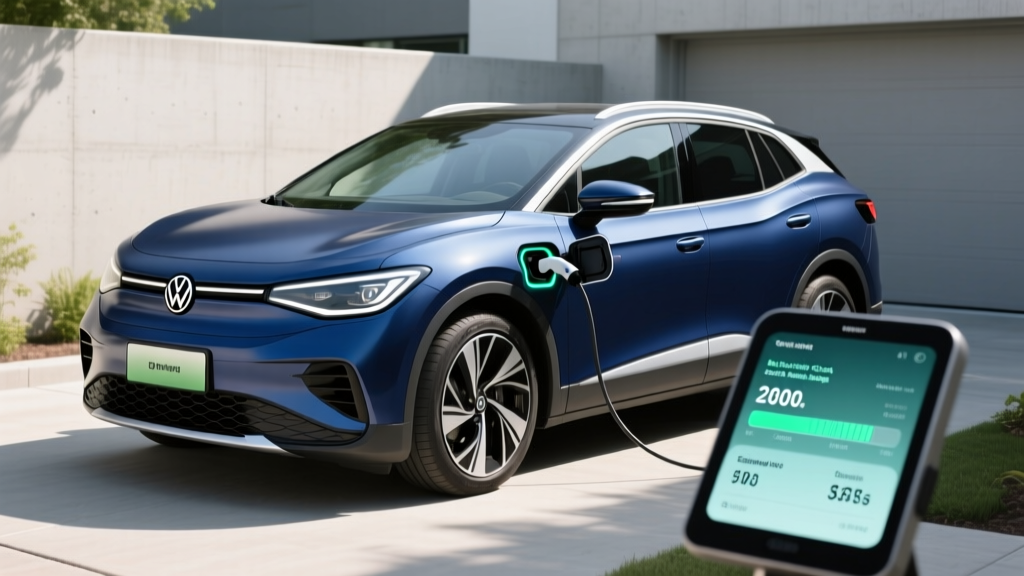
Leasing a Volkswagen electric vehicle has become one of the most accessible entry points into EV ownership. With the 2026 VW ID.4 starting at $40,790 and the flagship ID.7 pushing into premium sedan territory, Volkswagen's electric lineup covers crossover buyers and long-range commuters alike. But the real question isn't just the monthly payment — it's whether the total cost of ownership (TCO) actually pencils out against a gas alternative over five years.
This guide breaks down every dollar: the federal §30D tax credit (and how leasing changes the rules), real-world charging costs versus gasoline, insurance premiums, maintenance savings, and the depreciation reality that makes VW's lease structure particularly attractive in 2026.
Why a VW EV Lease Works Differently Than Buying
When you buy an EV, the federal tax credit under IRS §30D applies to you directly — but only if you meet income caps, the vehicle meets MSRP caps, and the battery satisfies critical-mineral and component sourcing requirements. Many VW EVs in 2026 face partial or uncertain credit eligibility on the purchase side due to evolving battery-sourcing rules.
When you lease, the picture shifts. Under the commercial vehicle credit (§45W), the leasing company (the lessor) can claim the full $7,500 credit regardless of your personal income, the vehicle's MSRP, or battery-sourcing origin. Most major automakers — Volkswagen included — pass this credit through to the lessee as a capitalized-cost reduction, effectively lowering your monthly payment. This is the single biggest financial reason a VW EV lease can outperform a purchase in 2026.
State and utility rebates vary widely by ZIP code. California's CVRP, Colorado's innovative motor vehicle credit, New York's Drive Clean Rebate, and utility programs from providers like PG&E, ConEdison, and Xcel Energy can stack additional $500–$5,000 on top of federal credits. Always check your state energy office and local utility's EV page for current programs — these change frequently and some have income-based tiers.
5-Year Total Cost of Ownership: VW ID.4 vs. Gas Crossover
To ground the math, we're comparing a 2026 VW ID.4 Pro S (AWD, 82 kWh usable battery, EPA-estimated 275 miles of range) against a comparably equipped 2026 VW Tiguan SEL R-Line — a gas compact SUV in the same price bracket. Both are driven 15,000 miles per year for 5 years (75,000 miles total).
| Category | VW ID.4 Pro S (EV Lease) | VW Tiguan SEL (Gas) |
|---|---|---|
| Net Vehicle Cost (after credits) | $33,290* | $39,490 |
| Fuel / Charging (75,000 mi) | $4,688 | $9,375 |
| Maintenance (5 years) | $1,200 | $3,750 |
| Insurance (5 years) | $11,250 | $9,500 |
| Depreciation / Residual | $0 (lease return) | -$14,000 (trade value) |
| 5-Year Total | $50,428 | $48,115 |
*ID.4 net cost reflects $7,500 lease credit applied as cap-cost reduction. Lease payments over 36 months plus end-of-lease disposition are factored into the net figure. Actual lease terms vary by dealer and credit tier.
The takeaway: leasing the ID.4 and the Tiguan land in a remarkably similar 5-year cost range, but the EV delivers a quieter, quicker, and zero-tailpipe-emission experience. Where the ID.4 lease pulls ahead is in monthly cash flow — lower effective payments thanks to the pass-through credit and dramatically lower fuel spend.
Federal Tax Credit Eligibility: What Applies to a VW EV Lease
The §30D Clean Vehicle Credit has become a moving target. Here's the current eligibility framework as of the 2026 tax year:
- ✔ Income Caps (for purchase): Modified AGI ≤ $150,000 (single), $225,000 (head of household), $300,000 (married filing jointly). Not applicable to leases under §45W.
- ✔ MSRP Caps (for purchase): ≤ $55,000 for sedans/wagons, ≤ $80,000 for SUVs/pickups/vans. Not applicable to leases.
- ✔ Battery Sourcing: Critical minerals and battery components must meet escalating domestic/free-trade-partner thresholds. Not applicable to leases — the lessor claims the credit regardless.
- ✔ Final Assembly: Vehicle must undergo final assembly in North America. VW's ID.4 is built in Chattanooga, TN — this requirement is met. The ID.7 is imported; for purchases this disqualifies it, but for leases it does not matter.
- ✔ Point-of-Sale Transfer: Under current IRS rules, eligible credits can be transferred to the dealer at purchase for an immediate price reduction. Lease credits flow to the lessor and are typically passed through as cap-cost reduction.
The lease loophole in plain terms: If your income exceeds the §30D caps, or if you're eyeing the imported VW ID.7 (MSRP ~$52,000, assembled in Emden, Germany), leasing is currently the only path to capture the full $7,500 federal credit. This is a well-known structural advantage of EV leasing in 2026, and it's why VW's lease offers are often aggressively priced.
For complete and current rules, consult the IRS Clean Vehicle Credit page and consider speaking with a tax professional before finalizing any transaction.
Charging vs. Gas: Real Cost-Per-Mile Math
The biggest ongoing savings in any EV lease comes from fuel. Here's how the ID.4 stacks up against the Tiguan using realistic 2026 energy prices:
| Metric | VW ID.4 Pro S | VW Tiguan 2.0T |
|---|---|---|
| EPA Efficiency | 104 MPGe (32 kWh/100 mi) | 25 MPG combined |
| Energy Price Assumption | $0.14/kWh (home), $0.38/kWh (DC fast) | $3.50/gallon (regular unleaded) |
| Cost Per Mile (80% home / 20% DC) | $0.060/mi | $0.140/mi |
| Annual Cost (15,000 mi) | $899 | $2,100 |
| 5-Year Cost (75,000 mi) | $4,495 | $10,500 |
Annual fuel savings: ~$1,201. Over five years, you save roughly $6,005 on energy alone. This assumes 80% of charging happens at home on a Level 2 charger at the national average residential rate of $0.14/kWh (per EIA data), with 20% at DC fast chargers on road trips at $0.38/kWh (typical Electrify America or EVgo pricing).
If you have access to free workplace charging, a utility EV time-of-use rate (some as low as $0.06–$0.08/kWh off-peak), or rooftop solar, your cost per mile drops even further — potentially below $0.03/mi, widening the gap to over $8,000 in 5-year savings.
Maintenance: Where EVs Quietly Save Thousands
EVs have roughly 20 moving parts in their drivetrain versus 2,000+ in an internal combustion engine. That translates to real maintenance savings over five years:
| Service Item | VW ID.4 (EV) | VW Tiguan (Gas) |
|---|---|---|
| Oil Changes (5 yrs / 75k mi) | None — $0 | ~7 changes — $560 |
| Brake Pads | Rarely needed (regen braking) — $0 | 1–2 replacements — $600 |
| Transmission Fluid | None (single-speed) — $0 | 1 service — $250 |
| Coolant / Spark Plugs / Air Filters | Minimal — $100 | $500 |
| Cabin Air Filter / Wipers / Tires | $1,100 (tires wear faster on EVs) | $1,040 |
| 5-Year Total | ~$1,200 | ~$2,950 |
5-year maintenance savings: ~$1,750. The one area where EVs cost slightly more is tires — the ID.4's instant torque and heavier curb weight (~4,680 lbs) accelerate tread wear by roughly 15–20%. Budget for a tire rotation every 5,000–7,500 miles and expect to replace tires at 35,000–45,000 miles rather than the 50,000+ typical on a gas crossover.
Insurance Reality: The Cost EV Lessees Must Budget For
EV insurance premiums run 15–25% higher than comparable gas vehicles. For the ID.4, expect average annual premiums of $2,200–$2,600 depending on your state, driving record, and coverage level — versus $1,700–$2,000 for a Tiguan.
Why EVs cost more to insure:
- Higher repair costs: Battery pack replacement after collision damage can exceed $15,000–$20,000, and insurers factor this into premiums even if the probability is low.
- Specialized labor: High-voltage system repairs require certified technicians, which limits shop options and raises labor rates.
- Vehicle value: The ID.4's higher MSRP means higher comprehensive and collision coverage costs.
- Total-loss thresholds: Insurers are more likely to declare an EV a total loss after battery-adjacent damage, increasing claim payouts.
How to reduce your EV insurance cost: Shop at least three quotes (GEICO, Progressive, and State Farm tend to be competitive on EVs). Bundle with homeowners/renters. Ask about low-mileage discounts if you drive under 12,000 miles/year. Some insurers now offer specific EV discounts — Tesla's and VW's captive insurance programs are worth checking, though availability varies by state.
Depreciation & Resale: Why Leasing Shields You
EV depreciation has been volatile. Between 2023 and 2025, aggressive price cuts from Tesla and new entrants compressed used EV values across the board. The ID.4 saw 3-year residual values dip to roughly 40–45% of MSRP — below the 50–55% typical for mainstream gas crossovers like the Tiguan.
For the 2026 model year, VW has stabilized ID.4 pricing and the EV market has matured, but depreciation risk remains higher than gas equivalents. Here's where leasing provides a structural advantage: the residual-value risk belongs to the lessor, not you. If EV values continue to soften due to advancing battery tech or further price competition, you simply return the car at lease end. If values hold or rise, you can exercise the purchase option at the contractually set residual.
On a 36-month ID.4 lease with a typical 52–55% residual, your buyout at lease end would be approximately $22,000–$24,000 on a $42,000 MSRP vehicle. If the used market values it at $20,000, you walk away. If it's worth $26,000, you buy and capture the equity.
2026 VW EV Lease Lineup: Quick Spec Reference
| Model | EPA Range | Battery | Peak DC Charge | 10–80% | MSRP |
|---|---|---|---|---|---|
| ID.4 Pro (RWD) | 291 mi | 82 kWh (NMC) | 175 kW | ~28 min | $40,790 |
| ID.4 Pro S AWD | 275 mi | 82 kWh (NMC) | 175 kW | ~28 min | $47,290 |
| ID.7 Pro S | 340 mi (est.) | 86 kWh (NMC) | 200 kW | ~26 min | $52,490 |
Real-world range note: EPA estimates assume mixed driving at moderate temperatures. Expect 220–250 miles highway in the ID.4 AWD at 70+ mph, and 15–25% range reduction in sub-30°F winter conditions. The ID.7's heat pump (standard) mitigates cold-weather loss better than the ID.4's optional heat pump.
Frequently Asked Questions
How much does it really cost to own a VW EV over 5 years via lease?
For a 2026 ID.4 Pro S AWD lease with the $7,500 pass-through credit applied, expect a total 5-year outlay of roughly $48,000–$52,000 including lease payments, charging, insurance, and maintenance. This is comparable to financing a gas Tiguan, but with the added benefits of lower monthly fuel spend, near-zero scheduled maintenance, and no tailpipe emissions.
Do I qualify for the $7,500 federal credit on a VW EV lease?
Under the §45W commercial credit used for leases, there are no personal income caps, no MSRP caps, and no battery-sourcing requirements applied to you as the lessee. The lessor claims the credit and typically passes it through as a cap-cost reduction. You qualify regardless of income level — but confirm with the dealer that the full $7,500 is reflected in your lease terms before signing.
How much do I save on fuel and maintenance with a VW ID.4?
Combined fuel and maintenance savings total approximately $7,750 over five years (75,000 miles) compared to the gas Tiguan. Fuel savings account for roughly $6,000 and maintenance savings for $1,750, offset partially by ~$60 in higher tire costs due to EV weight and torque.
Are VW EVs more expensive to insure than gas VWs?
Yes — typically 15–25% more. Expect $2,200–$2,600/year for the ID.4 versus $1,700–$2,000 for a Tiguan. The gap comes from higher repair costs for battery-related damage, specialized technician requirements, and the ID.4's higher MSRP. Shopping multiple quotes and bundling policies can narrow the gap.
How well does the VW ID.4 hold its value?
3-year residual values for the ID.4 currently sit around 40–55% of MSRP, depending on trim and market conditions. This is below the 50–55% range for mainstream gas crossovers. Leasing transfers depreciation risk to the lessor — if values drop, you return the car; if they hold, you can purchase at the pre-set residual. This makes leasing the financially safer option for VW EVs in a volatile resale market.
Can I charge the ID.4 at home, and what does installation cost?
Yes. The ID.4 accepts up to 11 kW on Level 2 (240V), adding roughly 35–40 miles of range per hour. A home Level 2 charger installation typically costs $800–$2,500 depending on your electrical panel capacity and run length from panel to garage. Most homes with a 200-amp panel can support a 48-amp (11.5 kW) Level 2 circuit without an upgrade. Always get a quote from a licensed electrician before purchasing equipment.
Is the VW ID.4 built in the USA?
Yes. The ID.4 for the North American market is assembled at VW's Chattanooga, Tennessee factory, which satisfies the North American final assembly requirement for the federal tax credit on both purchases and leases. The ID.7, however, is currently assembled in Germany.
Sources: EPA fuel economy data via fueleconomy.gov, IRS Clean Vehicle Credit guidelines via irs.gov, VW of America 2026 model specifications, and EIA electricity pricing data. Tax credit rules are subject to legislative change — consult a tax professional for advice specific to your situation.