What Is the Tesla Powerhub Megapack System?
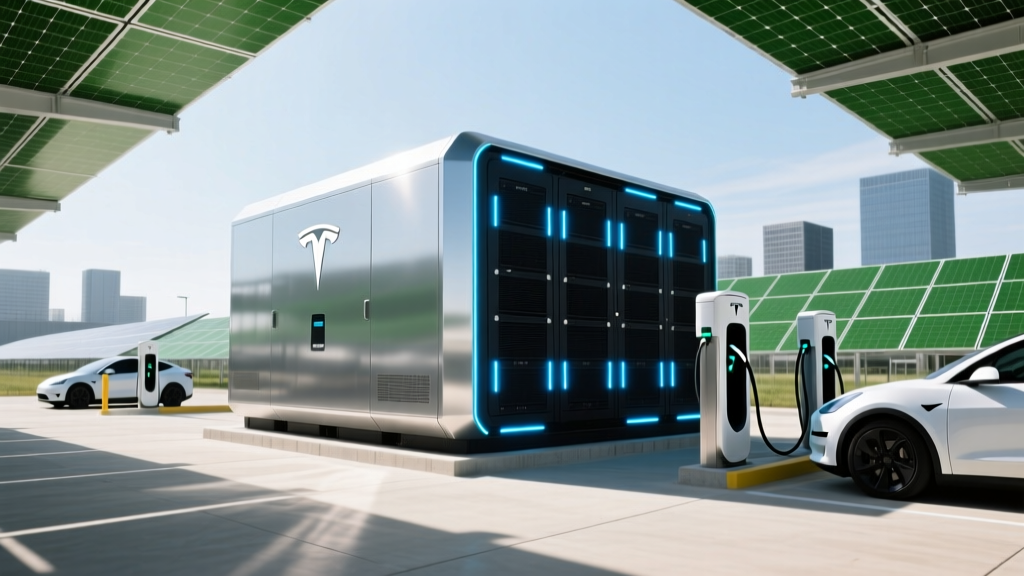
The Tesla Powerhub Megapack represents a shift in how high-power EV charging infrastructure gets deployed. Rather than waiting years for utility grid upgrades to support 350+ kW DC fast chargers, site operators can pair Megapack battery units with Powerhub inverters to create instant charging capacity. Each Megapack unit stores 3.9 MWh of energy and delivers up to 2.5 MW of continuous power through the Powerhub system.
This isn't a consumer EV—it's the backbone infrastructure that makes fast charging possible in locations where the local grid can't support multiple 350 kW chargers running simultaneously. Think highway rest stops, rural corridors, and commercial fleet depots.
| Specification | Value |
|---|---|
| Energy capacity per unit | 3.9 MWh (3,900 kWh) |
| Continuous power output | 2.5 MW via Powerhub inverter |
| Battery chemistry | LFP (lithium iron phosphate) |
| Round-trip efficiency | ~92% |
| Cycle life | 6,000+ cycles at 80% DoD |
| Operating temperature | -22°F to 122°F (-30°C to 50°C) |
| Physical dimensions | 23.5 ft L × 8.5 ft W × 9.5 ft H |
| Weight | ~84,000 lbs (38,100 kg) |
| Warranty | 15 years / performance guarantee |
| Grid connection | Medium voltage (12.47 kV typical) |
How Megapack Enables Fast EV Charging Without Grid Upgrades
The core problem: a single 350 kW DC fast charger draws as much instantaneous power as 100+ homes. Deploy four chargers at a highway location, and you need 1.4 MW of grid capacity—infrastructure that can take 3-5 years and $500K-$2M to build.
Megapack solves this by acting as a power buffer. The system charges slowly from the available grid connection (say, 500 kW continuous), stores energy in its 3.9 MWh battery, then discharges at up to 2.5 MW when EVs plug in. This means you can run multiple 350 kW chargers even with a modest grid connection.
Real-World Deployment Example
A typical highway charging plaza might deploy 2-4 Megapack units paired with a Powerhub system to support 8-12 DC fast chargers. During peak travel periods, the batteries discharge to meet demand; during off-peak hours, they recharge from the grid at lower rates—sometimes even participating in utility demand-response programs for additional revenue.
Grid Capacity Reality Check
Theoretical: 2.5 MW output can support seven 350 kW chargers simultaneously
Real-world: Sustained simultaneous charging at full power depletes a single Megapack in ~90 minutes. Most deployments use 3-4 units for redundancy and to handle back-to-back peak demand without grid strain.
Charging and Power Delivery Performance
The Powerhub inverter system handles bidirectional power flow, managing both grid charging and EV discharging. Here's how the system performs in practice:
| Operation | Power | Time | Notes |
|---|---|---|---|
| Grid charging (typical) | 500 kW - 1 MW | 4-8 hours (0-100%) | Limited by site grid connection |
| Maximum grid charge | 1.25 MW | ~3.5 hours | Requires robust medium-voltage connection |
| Discharge to EVs (peak) | 2.5 MW | ~90 min (100-10%) | Sustained; thermal management active |
| Single 350 kW charger support | 350 kW | ~10 hours | From single Megapack unit |
The LFP chemistry is critical here. Unlike NMC batteries, LFP tolerates daily deep cycling (80-100% depth of discharge) with minimal degradation. Tesla rates Megapack for 6,000+ cycles at 80% DoD while maintaining 70% capacity—translating to 15+ years of daily use in a charging-station application.
Deployment Costs and Economics
Megapack pricing isn't published like consumer products—Tesla quotes projects based on scale, site complexity, and grid interconnection requirements. However, industry data and recent project filings give us working estimates:
| Component | Estimated Cost | Notes |
|---|---|---|
| Megapack unit (3.9 MWh) | $1.1M - $1.4M | Volume discounts for 4+ units |
| Powerhub inverter system | $300K - $500K | Sized to site power requirements |
| Site preparation & foundation | $150K - $400K | Concrete pad, trenching, fencing |
| Grid interconnection | $200K - $800K | Medium-voltage switchgear, transformers |
| Installation & commissioning | $200K - $350K | Crane, electrical, software integration |
| Total (single unit system) | $1.95M - $3.45M | Varies heavily by site conditions |
Cost Comparison: Megapack vs. Grid Upgrade
The economics become compelling when you compare Megapack deployment against traditional grid infrastructure upgrades:
- Utility grid upgrade for 2 MW capacity: $1.5M - $4M, 3-5 year timeline, utility approval required
- Megapack deployment for equivalent buffer: $2M - $3.5M, 6-12 month timeline, site operator controlled
For sites facing multi-year utility upgrade timelines or prohibitive demand charges, Megapack often wins on both cost and speed-to-market.
Who Deploys Megapack for EV Charging?
This system targets specific use cases where grid constraints create charging bottlenecks:
Highway Corridor Fast-Charging Plazas
Rural highway locations often have weak grid infrastructure. Megapack enables 350 kW charging at rest stops and travel centers without waiting for utility transmission upgrades.
Fleet Depots (Delivery, Transit, Trucking)
Commercial fleets charging 20-50 vehicles overnight face massive peak demand charges. Megapack allows slow grid charging during off-peak hours, then rapid vehicle charging during shift changes—slashing demand charges by 40-60%.
Urban Charging Hubs
Dense city locations with limited grid capacity can deploy Megapack to add fast-charging capability to existing parking structures or surface lots.
Remote and Off-Grid Locations
National parks, ski resorts, and remote destinations pair Megapack with solar arrays to create charging infrastructure where grid extension would cost millions per mile.
Competitive Landscape: Alternatives to Megapack
Tesla isn't alone in grid-scale storage for EV charging. Key competitors include:
| System | Capacity | Power | Chemistry | Est. Cost/kWh |
|---|---|---|---|---|
| Tesla Megapack | 3.9 MWh | 2.5 MW | LFP | $280-$360 |
| Fluence Gridscale | 3.7 MWh | 2.0 MW | LFP | $300-$380 |
| BYD Cube Pro | 3.3 MWh | 1.8 MW | LFP | $250-$320 |
| Wärtsilä GEMS | Variable | Variable | LFP/NMC | $320-$400 |
Tesla's advantage lies in vertical integration—Megapack pairs natively with Supercharger hardware and Tesla's Autobidder software for automated energy trading. Competitors offer similar storage but require third-party integration with charging networks.
Pros and Cons of Megapack for Charging Infrastructure
Advantages
- Enables 350 kW charging at grid-constrained sites
- 6-12 month deployment vs. 3-5 year grid upgrades
- LFP chemistry: 15+ year lifespan, daily deep cycling
- Revenue from utility demand-response programs
- Reduces peak demand charges for fleet operators
- Native Supercharger integration (Tesla sites)
Limitations
- $2M+ entry cost per site
- Requires medium-voltage grid connection (12.47 kV)
- 84,000 lb units need heavy-equipment installation
- 90-minute sustained full-power discharge limit per unit
- Best economics require 4+ unit deployments
- Not applicable to residential or small commercial sites
Federal Incentives and Financing
While Megapack itself doesn't qualify for the §30D consumer EV tax credit (it's not a vehicle), deployments supporting EV charging infrastructure can access:
- §30C Alternative Fuel Vehicle Refueling Property Credit: Up to 30% of charging equipment costs (max $100K per item) in eligible census tracts
- Investment Tax Credit (ITC) §48: 30% base credit for energy storage systems ≥3 kWh, with bonus adders for domestic content and energy communities
- USDA REAP grants: Up to 50% of project costs for rural small businesses installing energy storage with charging
- State-specific programs: Vary widely—check DSIRE database for current incentives
These incentives can reduce effective Megapack deployment costs by 30-50%, making projects economically viable in more locations. Consult a tax professional for current-year eligibility.
Frequently Asked Questions
Can I buy a Megapack for my home?
No. Megapack is utility-scale infrastructure designed for commercial charging stations, fleet depots, and grid services. Residential users should consider Tesla Powerwall (13.5 kWh) for home backup and solar integration.
How long does a Megapack last?
Tesla warrants Megapack for 15 years with a performance guarantee. The LFP chemistry supports 6,000+ cycles at 80% depth of discharge while retaining 70% capacity—translating to 16+ years of daily cycling.
Does Megapack work with non-Tesla chargers?
Yes. While Tesla sites benefit from native Supercharger integration, Powerhub can interface with any DC fast charger via standard medium-voltage connections. ChargePoint, Electrify America, and EVgo have deployed Megapack at select locations.
What's the maintenance cost?
Megapack uses liquid thermal management with no moving parts in the battery modules. Annual maintenance focuses on inverter checks, coolant system inspection, and software updates—typically $15K-$25K/year for a multi-unit site.
Can Megapack go completely off-grid?
Technically yes, paired with sufficient solar or wind generation. However, most deployments maintain grid connection for reliability and to participate in utility markets. True off-grid applications exist at remote national parks and mining operations.
Bottom Line: When Megapack Makes Sense
Tesla Powerhub Megapack solves a specific, expensive problem: deploying high-power EV charging where grid infrastructure can't support it. For charging networks, fleet operators, and commercial sites facing multi-year utility upgrade timelines or prohibitive demand charges, Megapack offers a faster, often cheaper alternative.
For consumer EV owners, Megapack is invisible infrastructure—you'll benefit from it every time you plug into a 350 kW Supercharger at a rural highway stop that couldn't otherwise support that power level. The system doesn't qualify for consumer tax credits, but its deployment accelerates the charging buildout that makes EV ownership viable nationwide.
Sources: Tesla Megapack specifications, IRS §30C refueling property credit, DOE Investment Tax Credit overview