The Quick Answer: Which VW Electric Vehicle Should You Buy?
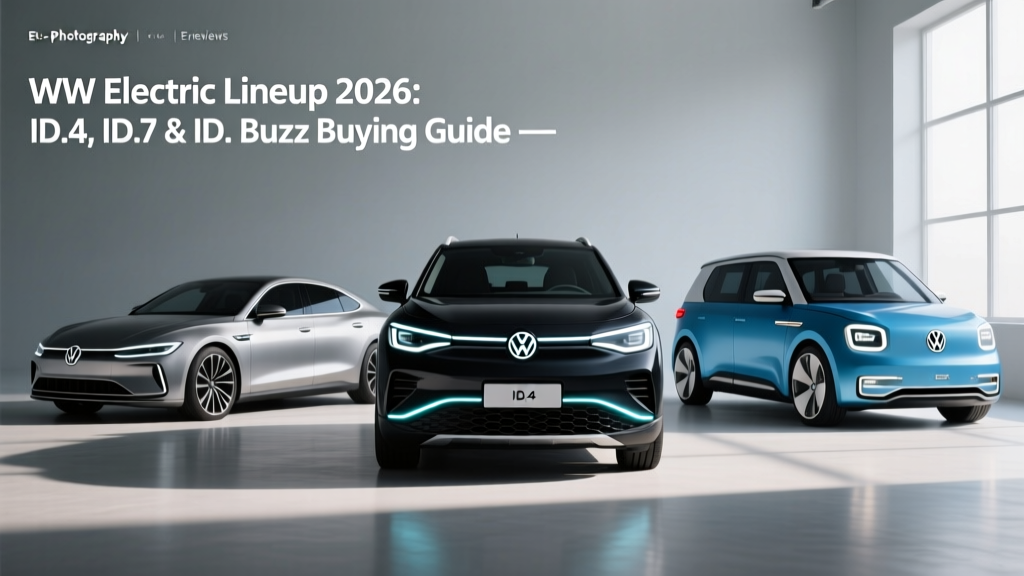
If you need a practical two-row crossover with strong tax-credit eligibility, the VW ID.4 (starting at $39,735, EPA range up to 291 miles) is Volkswagen's volume seller and best value. If you need three-row family hauling with retro charm, the ID. Buzz ($59,995, EPA 234 miles) fills a niche no other EV minivan occupies. The upcoming ID.7 sedan targets Tesla Model 3 buyers with an estimated 300+ mile range but remains unreleased in the US as of early 2026. All three ride on VW's MEB platform with NMC battery chemistry, CCS1 charging (with NACS adapters available), and 4-year/50,000-mile vehicle warranties plus 8-year/100,000-mile battery coverage.
VW Electric Models at a Glance: Specs That Matter
Volkswagen's US electric lineup centers on vehicles you can actually buy today, plus one highly anticipated sedan still pending stateside launch. Here's how the numbers stack up across the lineup:
| Spec | 2026 ID.4 Pro S AWD | 2026 ID. Buzz Pro S | ID.7 (Announced) |
|---|---|---|---|
| Base MSRP | $39,735 | $59,995 | TBD (~$50,000 est.) |
| EPA Range | 291 mi (RWD) / 263 mi (AWD) | 234 mi | ~300+ mi (est.) |
| Battery (Usable) | 82 kWh NMC | 91 kWh NMC | 86 kWh NMC (est.) |
| Peak DC Fast Charge | 175 kW | 170 kW | 200 kW (est.) |
| 10–80% DC Charge | ~28 min | ~26 min | ~25 min (est.) |
| Level 2 Rate | 11 kW (7.2 kW optional) | 11 kW | 11 kW (est.) |
| 0–60 mph | 5.4 sec (AWD) | 5.7 sec | ~6.0 sec (est.) |
| Horsepower | 295 hp (AWD) | 282 hp | 282 hp (est.) |
| MPGe (Combined) | 104 MPGe | 83 MPGe | ~120 MPGe (est.) |
| Cargo (behind 2nd row) | 30.3 cu ft | 75.5 cu ft | ~18 cu ft (est.) |
| §30D Tax Credit Eligible | Up to $7,500 | Up to $7,500 | TBD |
Sources: fueleconomy.gov, VW.com ID.4 specs. ID.7 figures are preliminary estimates for the US market.
Real-World Range vs. EPA Sticker
ID.4 AWD (EPA 263 mi): Expect 215–235 miles on highway trips at 70+ mph, and as low as 175–195 miles in sub-30°F weather without preconditioning. With the heat pump engaged and battery preconditioned, cold-weather loss typically caps at 20–25%.
ID. Buzz (EPA 234 mi): The boxy aerodynamics and 5,000+ lb curb weight mean highway range drops to roughly 185–200 miles. City driving with regenerative braking can match or slightly exceed the EPA figure.
How VW Electric Models Compare to Gas and Hybrid Alternatives
The ID.4 competes in the compact crossover segment against both gas and hybrid stalwarts. Here's what the ownership math looks like over five years, assuming 12,000 miles per year and national-average energy costs:
| Metric | VW ID.4 Pro S AWD | VW Tiguan SE (Gas) | Toyota RAV4 Hybrid |
|---|---|---|---|
| Base MSRP | $39,735 | $33,895 | $33,425 |
| Fed. Tax Credit (§30D) | Up to $7,500 | $0 | $0 |
| Effective Price | ~$32,235 | $33,895 | $33,425 |
| Energy Cost / Year | ~$575 (home L2) | ~$1,920 (gas) | ~$1,440 (gas) |
| 5-Year Energy Cost | ~$2,875 | ~$9,600 | ~$7,200 |
| 5-Year Maintenance | ~$1,200 | ~$3,500 | ~$3,000 |
| Combined MPGe / MPG | 104 MPGe | 26 MPG | 39 MPG |
Gas prices based on $3.60/gal national average; electricity at $0.16/kWh national average. Actual costs vary by state. Source: fueleconomy.gov.
The tax credit effectively erases the ID.4's price premium over gas rivals, and the energy-cost gap pays for itself within two to three years for most drivers charging primarily at home. However, if you rely exclusively on DC fast charging at $0.40–$0.60/kWh, your per-mile cost rises to roughly $0.08–$0.12/mile — closer to a hybrid's fuel cost.
Real Ownership Costs: The Full Picture
Purchase price and fuel savings tell only part of the story. Here's what first-time VW electric buyers should budget for:
| Cost Category | Year 1 | Years 2–5 (Annual) |
|---|---|---|
| Home Level 2 Charger (Equipment) | $500–$750 | $0 |
| Home L2 Installation (Electrician) | $800–$2,500 | $0 |
| Panel Upgrade (if needed) | $1,500–$3,500 | $0 |
| Electricity (12,000 mi/yr, home) | $575 | $575 |
| Insurance Premium | $2,100–$2,800 | $1,900–$2,600 |
| Scheduled Maintenance | $100–$200 | $200–$350 |
| Tire Replacement (sooner than gas) | $0 | $800–$1,200 (yr 3–4) |
Home charging access is the single biggest ownership variable. If you have a garage or dedicated parking spot with a 240V outlet (or can install one), the ID.4's 11 kW onboard charger adds roughly 37 miles of range per hour — a full overnight top-up from 20% takes about 7 hours. If you live in an apartment without charging access, you'll depend on public DC fast chargers, where the ID.4's 175 kW peak rate means a 10–80% session takes roughly 28 minutes at a capable station. VW includes 3 years of complimentary 30-minute charging sessions at Electrify America for new ID.4 buyers, which offsets early ownership costs.
Charging Reality: What 175 kW Actually Means
Volkswagen quotes a 175 kW peak DC fast-charge rate for the ID.4, but sustained charging follows a curve, not a flat line. Here's what happens at a 350 kW Electrify America station:
- 10–30% SoC: Peak ~170–175 kW sustained
- 30–60% SoC: Tapers to ~130–150 kW
- 60–80% SoC: Drops to ~80–100 kW
- Above 80% SoC: Sharp taper to <40 kW (skip this unless you need it)
The 10–80% time of ~28 minutes is realistic in moderate temperatures with battery preconditioning enabled. In cold weather (below 40°F) without preconditioning, add 5–10 minutes as the battery management system limits charge rate to protect the cells. Always use the navigation system's "route to charger" function — this triggers thermal preconditioning automatically.
Connector note: VW's US EVs ship with CCS1 connectors. With Tesla opening its Supercharger network to non-Tesla vehicles, VW offers a NACS adapter (or you can purchase one from third parties like Lectron) to access Tesla's 16,000+ stall network. This dramatically expands route flexibility on road trips.
Tax Credit Eligibility: Who Actually Gets $7,500?
The §30D federal tax credit can reduce the ID.4's effective price to under $33,000, but eligibility depends on several rules that change periodically. Here's the current framework:
§30D Credit Requirements (2026)
- MSRP Cap: SUVs/vans must be under $80,000; sedans under $55,000 — all current VW EVs qualify
- Income Cap: Modified AGI must not exceed $150,000 (single), $225,000 (head of household), or $300,000 (joint)
- Battery Sourcing: Critical minerals and battery components must meet escalating domestic-content thresholds — VW's Chattanooga, TN-built ID.4 currently qualifies for the full $7,500
- Point-of-Sale Transfer: You can transfer the credit to the dealer at purchase, reducing your out-of-pocket cost immediately rather than waiting for a tax refund
- Filing Requirement: You must have sufficient tax liability to claim the credit if not transferred at sale
Source: IRS §30D guidance. Always verify current-year rules with a tax professional before purchasing.
Common Misconceptions About VW Electric Vehicles
| Myth | Fact |
|---|---|
| "The ID.4 can't handle road trips." | With 175 kW DC charging and NACS adapter access to Tesla Superchargers, the ID.4 adds ~150 miles in a 20-minute stop — adequate for most highway corridors. |
| "EV batteries need replacing every 5 years." | VW warranties the battery for 8 years/100,000 miles with a 70% capacity retention guarantee. Real-world degradation data from early ID.4 owners shows ~5–8% loss over 3 years. |
| "The ID. Buzz is just a gimmick." | With 75.5 cu ft of cargo space and 7-passenger seating, the ID. Buzz offers minivan utility with EV running costs — it's the only electric minivan available in the US market. |
| "Home charging installation is prohibitively expensive." | A standard Level 2 install on an existing 240V circuit averages $800–$1,500. Even a panel upgrade rarely exceeds $3,500 — a one-time cost that pays for itself in fuel savings within 3–5 years. |
| "VW's EV software is still broken." | The ID.4's software received major OTA updates through 2024–2025 addressing infotainment lag and charging bugs. Current builds are markedly improved, though not class-leading versus Tesla or Hyundai. |
Decision Framework: Which VW Electric Model Is Right for You?
Choose the ID.4 If:
- You want the lowest effective price after tax credits (under $33,000)
- Your daily commute is under 80 miles round-trip and you can charge at home
- You need a two-row crossover with 263–291 miles of range
- You take 2–4 road trips per year on well-served charging corridors
Choose the ID. Buzz If:
- You need three-row seating and minivan cargo capacity
- You're willing to pay a $20,000 premium for design and utility
- Your daily driving stays under 150 miles and you charge at home
- You value the driving experience and head-turning design alongside practicality
Wait for the ID.7 If:
- You prefer a sedan over a crossover
- You want 300+ miles of range with sleek aerodynamics
- You're not in a rush — US availability remains unconfirmed for 2026
Don't Buy a VW Electric Vehicle If:
- You lack home charging access AND live in an area with sparse DC fast-charger coverage
- You regularly tow heavy loads (the ID.4 is rated for just 2,200 lbs)
- You need 350+ miles of range without stopping — consider the Hyundai Ioniq 6 or Tesla Model 3 Long Range instead
Frequently Asked Questions
Does the VW ID.4 qualify for the full $7,500 federal tax credit?
The Chattanooga-built ID.4 currently qualifies for the full $7,500 §30D credit for eligible buyers (income under $150K/$300K thresholds, MSRP under $80K cap). The credit can be transferred to the dealer at point of sale, reducing your drive-off cost immediately. Verify current eligibility on IRS.gov before purchasing, as battery-sourcing rules can shift.
How long does it take to charge the ID.4 at home?
On a Level 2 charger at 11 kW, the ID.4's 82 kWh battery charges from 10% to 100% in roughly 7.5 hours. At 7.2 kW (lower-cost charger option), plan for ~11 hours. Most owners plug in overnight and wake up to a full charge every morning — daily driving rarely uses more than 30–40% of the battery.
Is the ID.4 good in cold weather?
The ID.4 includes a heat pump (standard on most trims) and battery thermal management. Expect 20–25% range loss in sustained sub-30°F driving, meaning the AWD model's 263-mile EPA range drops to roughly 200–210 miles. Preconditioning the battery while plugged in significantly mitigates this loss and preserves fast-charging speed.
What's the maintenance schedule for a VW electric vehicle?
VW recommends a cabin air filter replacement every 2 years, brake fluid check every 3 years, and tire rotations every 10,000 miles. There's no engine oil, transmission fluid, spark plugs, or emissions system to service. Expect annual maintenance costs of $100–$350 — roughly one-third of a gas car's maintenance budget.
Can I use Tesla Superchargers with a VW ID.4?
Yes, with a NACS adapter. Tesla's Supercharger network is open to non-Tesla EVs at many locations via the built-in adapter or third-party CCS-to-NACS adapters. This adds thousands of charging stations to your road-trip options, particularly in rural corridors where Electrify America coverage is thinner.
How does the ID.4 compare to the Hyundai Ioniq 5?
The Ioniq 5 charges faster (peak 240 kW vs 175 kW, 10–80% in ~18 minutes vs ~28) and offers a slightly more spacious interior. The ID.4 counters with a lower entry price, US-built tax-credit reliability, and a more conventional crossover design. If fast-charging speed is your top priority for frequent road trips, the Ioniq 5 wins. If value and tax-credit certainty matter more, the ID.4 holds an edge.