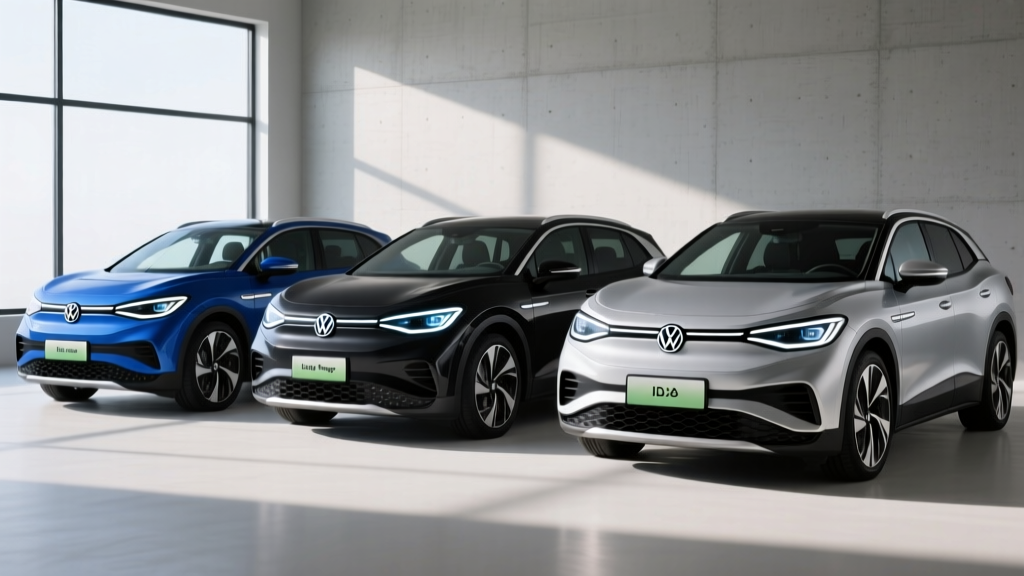
If you're researching a VW electric car in 2026, the Volkswagen ID.4 remains the brand's core EV offering for U.S. buyers — a compact electric SUV targeting mainstream families with an EPA-estimated range up to 291 miles, DC fast charging up to 170 kW, and a starting MSRP around $40,000 before incentives. It competes directly with the Hyundai Ioniq 5, Tesla Model Y, and Ford Mustang Mach-E. The real question isn't whether it's "good" in the abstract — it's whether its range, charging speed, pricing, and ownership economics work for your specific driving pattern, climate, and home-charging situation.
Quick Answer: Is a VW Electric Car Right for You?
The VW ID.4 is a strong pick if you need a practical compact EV SUV with comfortable ride quality, adequate range for daily commuting plus moderate road trips, and access to home Level 2 charging. It's less ideal if you prioritize blistering acceleration, cutting-edge ADAS, or regularly drive 400+ miles in cold weather without stopping. Expect real-world highway range closer to 230–260 miles depending on temperature and speed.
2026 VW ID.4: Specs, Range, and What the Numbers Actually Mean
Volkswagen's U.S. EV lineup centers on the ID.4, built at VW's Chattanooga, Tennessee plant. For the 2026 model year, the ID.4 continues with two battery options and rear-wheel or all-wheel drive configurations. Here's what the spec sheet looks like:
| Specification | ID.4 Standard Range (RWD) | ID.4 Pro (RWD) | ID.4 Pro S AWD |
|---|---|---|---|
| Usable Battery Capacity | 62 kWh (NMC) | 82 kWh (NMC) | 82 kWh (NMC) |
| EPA Range | ~206 mi | ~291 mi | ~263 mi |
| Combined MPGe | ~104 MPGe | ~107 MPGe | ~98 MPGe |
| Horsepower | 201 hp | 282 hp | 335 hp |
| 0–60 mph | ~7.7 sec | ~7.0 sec | ~5.4 sec |
| Peak DC Fast Charge | ~130 kW | ~170 kW | ~170 kW |
| 10–80% DC Charge Time | ~28 min | ~28 min | ~28 min |
| Level 2 Charge Rate | 11 kW | 11 kW | 11 kW |
| Base MSRP | ~$39,735 | ~$44,235 | ~$50,735 |
| Battery/Powertrain Warranty | 8 years / 100,000 miles (70% capacity retention) | ||
Real-World Range Reality Check
EPA sticker: Up to 291 miles (Pro RWD). What to actually expect: On highway trips at 70–75 mph in moderate temperatures, plan for roughly 245–260 miles before needing a charge. In cold weather (below 30°F), range can drop 20–30%, bringing a 291-mile Pro model down to 200–230 miles. The ID.4's heat pump (standard on most trims) mitigates some winter loss, but physics still applies. If your typical one-way commute exceeds 100 miles in winter, the Standard Range model may leave you anxious.
VW Electric Car vs. Gas Equivalent: The Real Cost Comparison
The most common question from EV-curious buyers: does a VW electric car actually save money compared to a gas-powered compact SUV like the VW Tiguan? The answer depends heavily on your local electricity rates, annual mileage, and whether you can charge at home. Let's run the numbers for a realistic 5-year ownership scenario.
| Cost Factor (5 Years) | VW ID.4 Pro (RWD) | VW Tiguan (Gas AWD) |
|---|---|---|
| Base MSRP | $44,235 | $31,995 |
| Federal Tax Credit (§30D) | Up to $7,500 (see eligibility below) | $0 |
| Effective Purchase Price | ~$36,735 | $31,995 |
| Fuel/Energy (75,000 mi total) | ~$4,050 (at $0.14/kWh home) | ~$9,375 (at $3.50/gal, 25 MPG combined) |
| Maintenance (5 yr) | ~$1,500 | ~$3,500 |
| Insurance (est. avg) | ~$10,500 | ~$8,500 |
| Estimated Depreciation | ~$18,000 | ~$14,000 |
| Total 5-Year Cost | ~$70,785 | ~$67,370 |
The ID.4 saves substantially on fuel and maintenance — roughly $5,325 on energy and $2,000 on maintenance over five years. But higher purchase price, insurance premiums (typically 15–25% more for EVs), and steeper depreciation partially offset those gains. If you qualify for the full $7,500 federal tax credit and charge primarily at home, the ID.4 approaches cost parity with the Tiguan. Without the credit, or if you rely on expensive public DC fast charging ($0.35–$0.50/kWh), the gas Tiguan retains a financial edge.
For a deeper look at the Tiguan's EPA figures, check the official data at fueleconomy.gov.
Federal Tax Credit: Does the VW ID.4 Qualify for $7,500?
The ID.4 is assembled in Chattanooga, Tennessee, which has historically positioned it well for the IRS §30D Clean Vehicle Credit. However, the full $7,500 credit is not guaranteed for every buyer. Here's the 2026 eligibility checklist:
- MSRP cap: SUVs must be priced at or below $80,000. The ID.4 clears this easily.
- Buyer income limits: Modified AGI must not exceed $150,000 (single), $225,000 (head of household), or $300,000 (joint). If your income is above these thresholds, you won't qualify.
- Battery sourcing requirements: A percentage of critical minerals and battery components must be sourced from the U.S. or free-trade-agreement countries. These thresholds increase annually. Volkswagen has worked to qualify the ID.4's supply chain, but confirm current-year eligibility with your dealer and cross-reference the IRS's qualifying vehicle list.
- Point-of-sale transfer: You can transfer the credit to the dealer at purchase, reducing your out-of-pocket cost immediately rather than waiting to claim it on your tax return.
Important caveat: Tax credit rules shift frequently. Always verify current eligibility on irs.gov and consult a tax professional before making a purchase decision based on the credit.
Charging the ID.4: Home Setup, Public Networks, and Real Charge Times
Charging is where EV ownership either clicks or frustrates. The ID.4 supports three charging levels, and understanding the difference between kW (power — how fast energy flows) and kWh (energy — how much the battery holds) is essential.
| Charging Level | Power (kW) | Miles Added Per Hour | Typical Use Case |
|---|---|---|---|
| Level 1 (120V outlet) | ~1.4 kW | ~3–4 mi/hr | Overnight top-up; emergency only |
| Level 2 (240V home/public) | Up to 11 kW | ~30–35 mi/hr | Daily home charging; full charge in ~8 hr |
| DC Fast Charging | Up to 170 kW (peak) | N/A (measured in minutes) | Road trips; 10–80% in ~28 min |
Home charging reality: If you can install a Level 2 home charger (a 240V circuit, typically 40–48 amps), the ID.4 replenishes from near-empty to full overnight. Installation costs typically range from $800 to $2,500 depending on your electrical panel's capacity and the distance from panel to charger location. If your panel needs an upgrade to 200 amps, add $1,500–$3,000.
DC fast charging curve: The ID.4 Pro peaks at 170 kW, but only in ideal conditions — warm battery, low state of charge. Expect the charge rate to taper significantly above 80% state of charge. A typical 10–80% session takes about 28 minutes at a compatible 175+ kW charger. On Electrify America or similar networks, that's roughly $15–$25 per session depending on local pricing.
Connector note: The ID.4 currently uses the CCS1 connector for DC fast charging. Volkswagen has announced a transition to the NACS (Tesla-style) connector for future models, and adapters are expected for existing CCS vehicles to access Tesla Superchargers. Confirm adapter availability and compatibility with VW before planning Supercharger access.
Common Misconceptions About VW Electric Cars
| Myth | Fact |
|---|---|
| "EV batteries need replacing every few years." | VW warranties the ID.4 battery for 8 years/100,000 miles with a 70% capacity retention guarantee. Industry data shows most NMC batteries retain 85–90% capacity after 100,000 miles with normal use. |
| "The ID.4 can drive itself." | The ID.4's IQ.DRIVE suite is a Level 2 driver-assistance system (per SAE classifications). It includes adaptive cruise and lane centering but requires continuous driver supervision. It is not autonomous driving. |
| "Charging takes forever." | At a 170 kW DC fast charger, the ID.4 adds roughly 150 miles of range in 15 minutes. Home Level 2 charging happens while you sleep — you wake up to a full battery every morning. |
| "EVs don't work in cold weather." | EVs work in cold weather, but range drops 20–30% in sub-freezing temperatures. The ID.4's heat pump helps. If you live in northern climates, plan for reduced winter range and precondition the battery while plugged in. |
| "The tax credit is automatic." | Not guaranteed. Income caps, MSRP caps, and battery-sourcing requirements all apply. Verify on IRS.gov before committing. |
Decision Framework: Should You Buy the VW ID.4?
Choose the VW ID.4 If:
- You have access to Level 2 home charging (garage or driveway with a 240V circuit).
- Your daily commute is under 80 miles round-trip, with occasional road trips under 250 miles one-way.
- You want a comfortable, quiet compact SUV with a smooth ride — not sporty handling.
- You qualify for the federal tax credit, bringing the effective price closer to $37,000.
- You value a U.S.-built vehicle with a mainstream dealer network for service.
Look Elsewhere If:
- You can't install or access reliable home or workplace charging — public-only charging adds cost and time.
- You regularly drive 350+ miles in a single day, especially in cold weather — consider a longer-range EV or a PHEV.
- You want the fastest-accelerating EV in the segment — the Tesla Model Y Performance or Hyundai Ioniq 5 N are quicker.
- You need best-in-class cargo space — the Model Y offers more rear cargo volume.
- You want the most advanced driver-assist tech — the ID.4's IQ.DRIVE is competent but not class-leading.
What First-Time EV Buyers Should Know Before Purchasing
If the ID.4 would be your first electric vehicle, here are the ownership realities that spec sheets don't emphasize:
1. Home charging access is the single biggest factor in EV satisfaction. If you can charge at home on Level 2, you'll rarely visit a public charger except on road trips. If you can't — because you live in an apartment, park on the street, or your building doesn't allow charger installation — EV ownership becomes significantly more inconvenient and expensive. Solve the home-charging question before you solve the car question.
2. Your electrical panel may need an upgrade. A Level 2 charger typically requires a dedicated 40–60 amp circuit. If your home has an older 100-amp panel, you'll likely need a 200-amp upgrade ($1,500–$3,000) before adding an EV circuit. Get an electrician's assessment early.
3. Insurance will likely cost more. EVs typically carry 15–25% higher insurance premiums than comparable gas vehicles, due to higher repair costs and parts pricing. Get quotes before purchasing to factor this into your budget.
4. Plan for winter range loss. If you live where temperatures regularly drop below freezing, mentally subtract 25% from the EPA range figure for winter planning. A 291-mile ID.4 Pro becomes a ~220-mile car in January in Minnesota.
5. Maintenance is minimal, but tires wear faster. EVs eliminate oil changes, spark plugs, and transmission fluid. But the ID.4's weight (~4,700 lbs) and instant torque mean tires wear 15–20% faster than on a gas equivalent. Budget for tire replacement every 30,000–40,000 miles.
Frequently Asked Questions
What is the real-world range of the VW ID.4?
The EPA rates the ID.4 Pro (RWD) at 291 miles. In real-world mixed driving at moderate temperatures, expect 250–270 miles. On sustained highway driving at 75 mph, expect 240–260 miles. In sub-freezing cold, expect 200–230 miles. These are not worst-case — they're realistic planning numbers.
How long does it take to charge the ID.4 at home?
On a Level 2 home charger (11 kW), a full charge from near-empty takes approximately 8 hours for the 82 kWh Pro model. Most owners plug in nightly and wake up to a full battery, rarely depleting below 30–40%.
Does the VW ID.4 qualify for the $7,500 federal tax credit?
The ID.4 has historically qualified for the full §30D credit due to its U.S. assembly and battery sourcing. However, eligibility depends on your income (must be under $150K single / $300K joint), the vehicle's MSRP (must be under $80K), and current-year battery-sourcing thresholds. Verify on irs.gov and with your dealer before purchasing.
Is the VW ID.4 better than the Tesla Model Y?
It depends on your priorities. The Model Y offers more range (up to ~330 miles), faster acceleration, access to the Supercharger network, and more cargo space. The ID.4 offers a more traditional driving feel, a quieter cabin, a more intuitive infotainment system for some users, and a lower starting price. Both are strong — test-drive both if possible.
What happens if the ID.4 battery degrades?
VW warranties the battery for 8 years or 100,000 miles against falling below 70% capacity. Real-world degradation data from similar NMC batteries suggests most retain 85–92% capacity at 100,000 miles with normal charging habits. Full battery replacement, if ever needed out of warranty, currently costs $15,000–$25,000 depending on the pack — but most EV batteries outlast the vehicle's useful life.
Can I use Tesla Superchargers with the VW ID.4?
Not natively. The ID.4 uses the CCS1 connector, while Tesla Superchargers use NACS. Volkswagen has indicated future models will adopt NACS, and CCS-to-NACS adapters are becoming available for existing vehicles. Check with VW and Tesla for the latest adapter compatibility and Supercharger network access before relying on this for travel.