Quick Answer: VW Bug Electric Conversion Kits in 2026
A complete VW Beetle electric conversion kit (motor, controller, battery pack, BMS, and wiring) typically costs $12,000 to $35,000 before professional installation labor, which adds another $5,000 to $15,000 depending on complexity. Most DIY builds yield 60 to 150 miles of real-world range from a 20–50 kWh battery pack. If you're doing it for the joy of preserving a classic car with zero tailpipe emissions, a conversion is deeply rewarding. If you're doing it purely to save money on transportation, a used modern EV like a 2023 Nissan Leaf ($14,000–$18,000 used) will give you more range, DC fast charging, safety features, and reliability for less total spend.
What a VW Bug Electric Conversion Kit Actually Includes
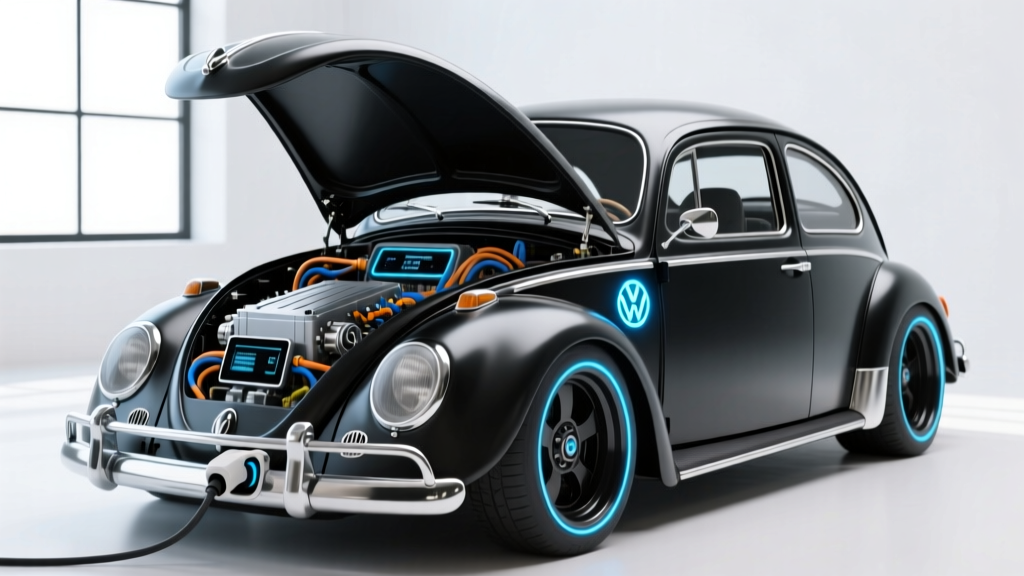
Before pricing one out, understand what you're buying. A "kit" is not a single box — it's a collection of matched components that replace the Beetle's air-cooled flat-four engine, fuel tank, exhaust, and manual transmission (though some builds retain the stock transaxle). Here's what a complete kit contains:
- Electric motor: Typically a NetGain HyPer 9, HPEVS AC-50, or salvaged Tesla/Leaf drive unit. Output ranges from 50 kW to 120 kW (67–161 hp).
- Motor controller: Matches the motor — Curtis, Sevcon, or AEM units rated for the system voltage (96V–400V).
- Battery modules: Lithium-ion cells (often salvaged Tesla Model S modules or new CATL/EVE LiFePO4 prismatic cells). Total capacity: 20–50 kWh usable.
- Battery Management System (BMS): Orion BMS 2 or similar — monitors cell voltage, temperature, and balancing. Non-negotiable for safety.
- Charger: Onboard Level 2 charger (3.3 kW–6.6 kW) for home charging.
- DC-DC converter: Steps high-voltage pack down to 12V for lights, wipers, and accessories.
- Throttle interface, contactors, fuses, high-voltage cabling, and adapters to mate the motor to the Beetle's transaxle.
The original VW Beetle weighed roughly 1,800–2,000 lbs. Converting it to electric typically adds 300–600 lbs of battery and hardware, bringing curb weight to 2,200–2,600 lbs. That's still light by modern EV standards (a Tesla Model Y is ~4,400 lbs), which helps efficiency — but the Beetle's 1960s chassis was never designed for that weight distribution or the instant torque of an electric motor.
Cost Breakdown: What You'll Actually Spend
Here's a realistic 2026 cost breakdown for a VW Beetle EV conversion, whether DIY or shop-built:
| Component / Service | Budget DIY Build | Mid-Range Build | Premium Shop Build |
|---|---|---|---|
| Motor + controller | $2,500–$4,000 | $4,000–$7,000 | $7,000–$12,000 |
| Battery pack (cells + BMS + enclosure) | $5,000–$8,000 | $8,000–$14,000 | $14,000–$20,000 |
| Charger + DC-DC + wiring | $1,500–$2,500 | $2,500–$4,000 | $4,000–$6,000 |
| Adapters, mounts, fabrication | $1,000–$2,000 | $2,000–$4,000 | $4,000–$8,000 |
| Instrumentation / display | $300–$800 | $800–$2,000 | $2,000–$4,000 |
| Donor Beetle (if needed) | $3,000–$8,000 | $5,000–$12,000 | $10,000–$25,000 |
| Professional labor (if not DIY) | $0 | $5,000–$10,000 | $15,000–$30,000 |
| Total | $13,300–$25,300 | $27,300–$49,000 | $56,000–$105,000 |
For context, premium shop conversions by firms like Zelectric Motors or EV West have historically charged $65,000–$100,000+ for turnkey electric Beetles with modern amenities (power steering upgrades, AC, upgraded brakes). A budget DIY build using salvaged Tesla modules and a HyPer 9 motor can come in under $20,000 if you already own the donor car and do all fabrication yourself.
Range, Charging, and Performance: The Numbers
The Beetle's light weight works in its favor for efficiency, but limited physical space constrains battery capacity. Here's what to expect:
| Metric | Original Gas Beetle (1970s) | Budget EV Conversion (25 kWh) | Premium EV Conversion (50 kWh) |
|---|---|---|---|
| Energy capacity | 10.6 gal fuel tank | 25 kWh battery | 50 kWh battery |
| Real-world range | ~250–300 mi | 60–85 mi | 120–150 mi |
| Efficiency | ~24 MPG combined | ~250–300 Wh/mi | ~280–330 Wh/mi |
| 0–60 mph | ~18–22 seconds | 8–12 seconds | 5–8 seconds |
| Horsepower | ~50–60 hp | 67–100 hp | 120–160 hp |
| "Refueling" time | 5 minutes at gas station | 7–8 hours (Level 2, 3.3 kW) | 7–8 hours (Level 2, 6.6 kW) |
| Top speed | ~75–80 mph | ~75–90 mph | ~90–110 mph |
Range reality check: The 60–150 mile range assumes moderate temperatures (60–80°F) and city/suburban driving at 35–55 mph. Highway driving at 70+ mph will cut range by 15–25% due to the Beetle's poor aerodynamics (drag coefficient ~0.48). Cold weather (below 32°F) without battery thermal management can reduce range by 20–40%, since most conversion kits use passive air-cooled battery enclosures with no active heating. If you live in Minnesota or Maine, plan for 40–50 usable winter miles on a 25 kWh build.
Charging: Nearly all conversion kits include a Level 2 onboard charger (typically 3.3 kW or 6.6 kW) using a standard J1772 connector. This means 7–8 hours for a full charge on a 240V home circuit. Most conversion kits do not include DC fast charging capability — adding CHAdeMO or CCS fast-charge hardware costs an additional $2,000–$5,000 and requires significant additional wiring, contactors, and BMS integration. For a car with 80 miles of range, DC fast charging is rarely worth the added cost and complexity.
Electric Beetle vs. Buying a Modern EV: The Real Comparison
This is the decision most prospective converters wrestle with. Here's an honest side-by-side against affordable modern EVs available in 2026:
| Factor | VW Bug EV Conversion (Mid-Range) | Used 2023 Nissan Leaf SV | New 2026 Chevy Equinox EV LT |
|---|---|---|---|
| Total cost | $27,000–$49,000 | $14,000–$18,000 | ~$33,000 (before credits) |
| EPA / real range | ~80–150 mi (no EPA rating) | 149 mi EPA / ~125 mi real | 319 mi EPA / ~270 mi real |
| DC fast charging | Rarely included | 50 kW CHAdeMO | 150+ kW CCS/NACS |
| Safety (airbags, ABS, crumple zones) | None (1960s chassis) | Full modern safety suite | Full modern safety suite |
| Warranty | None (DIY) / limited (shop) | Remaining factory or powertrain | 3yr/36k bumper + 8yr/100k battery |
| Federal tax credit (§30D) | Not eligible | Used EV credit up to $4,000 | Up to $7,500 (income/MSRP rules apply) |
| Insurance | Specialty classic-car EV policy | Standard (~$1,200–$1,800/yr) | Standard (~$1,400–$2,000/yr) |
| Maintenance | Low (no oil, few moving parts) | Low | Low |
| Emotional value | Extremely high | Appliance-transportation | Modern crossover utility |
The financial case is clear: a modern used or new EV delivers more range, safety, charging speed, and warranty protection for significantly less money. But the emotional case for converting a Beetle is real — you're preserving automotive history, creating a one-of-a-kind vehicle, and joining a passionate community of EV conversion enthusiasts. These are fundamentally different purchases.
Real-World Ownership: What First-Time Converters Must Know
Home Charging Access Is Essential
Without DC fast charging, a converted Beetle is entirely dependent on Level 1 (120V, ~1 kW) or Level 2 (240V, 3.3–6.6 kW) charging. Level 1 adds roughly 3–4 miles of range per hour — meaning a full recharge of a 25 kWh pack takes 20+ hours. A Level 2 home charger installation costs $800–$2,500 (equipment + electrician + permit) and is effectively mandatory. If you live in an apartment without charging access, a conversion is impractical.
Registration, Inspection, and Insurance Vary Wildly by State
Every U.S. state has different rules for registering a converted vehicle. Some states (California, Oregon, Washington) have relatively straightforward processes for re-classifying a gas car as electric. Others require special inspections, brake upgrades, or refuse registration entirely without factory certification. Before buying a kit, check your state DMV's EV conversion registration requirements. Insurance for a converted classic typically requires a specialty classic-car policy (Hagerty, Grundy) with agreed-value coverage — expect $600–$1,500/year depending on the stated value.
Safety Is the Biggest Compromise
A 1960s–1970s VW Beetle has no airbags, no ABS, no electronic stability control, minimal crumple zones, and drum brakes on many model years. Adding 400 lbs of battery changes the weight distribution and braking dynamics. Most reputable conversion shops upgrade to front disc brakes and reinforced suspension, but the fundamental crash safety of the chassis cannot be retrofitted. If this car will carry children or serve as a daily driver in heavy traffic, a modern EV is objectively safer. NHTSA crash data from the Beetle era is sobering by modern standards.
Maintenance: Lower Than Gas, But Not Zero
You'll never change oil, spark plugs, or a fuel filter again. But EV conversions require attention to battery cell balancing (the BMS handles this automatically, but cells degrade over time), coolant system maintenance (if liquid-cooled motor/controller), brake fluid changes, and high-voltage connection inspections. Budget $300–$600/year for basic upkeep. Battery replacement in 10–15 years will cost $5,000–$15,000 depending on pack size and cell availability.
Common Misconceptions About VW Bug EV Conversions
| Myth | Fact |
|---|---|
| "Converting my Beetle will qualify for the $7,500 federal EV tax credit." | False. The IRS §30D credit applies only to new qualified plug-in electric vehicles from certified manufacturers. Conversions of existing vehicles do not qualify. The used EV credit (up to $4,000) also requires purchase from a licensed dealer of a qualifying used EV — not a self-converted vehicle. |
| "An electric Beetle will have the same range as a Tesla." | False. Physical battery space in a Beetle limits packs to 25–50 kWh. A 2026 Tesla Model Y carries a ~75 kWh pack in a much larger vehicle. Expect 60–150 real-world miles, not 300. |
| "I can use any old battery cells I find." | Dangerous. Mismatched, damaged, or degraded cells without a proper BMS create serious fire risk. Only use cells with known history, matched capacity, and a quality BMS monitoring every cell group. |
| "The conversion is reversible — I can put the gas engine back." | Partially true. If you carefully preserve the original engine, transmission, and fuel system, reversion is possible. But most conversions involve cutting, welding, and modifying mounts. Plan for the conversion to be permanent. |
| "It'll be maintenance-free forever." | False. Battery degradation, BMS faults, contactor wear, coolant leaks, and 12V system issues all require attention. Budget for ongoing maintenance. |
Decision Framework: Should You Convert or Buy?
Choose a VW Bug EV Conversion If:
- You already own a Beetle (or can get one cheap) and it's sentimental — a family car, a project you've wanted for years.
- You have garage space, basic fabrication skills, and 100–300 hours to invest in a DIY build.
- Your daily driving is under 50 miles round-trip with reliable home Level 2 charging.
- You value uniqueness and the maker experience over spec-sheet optimization.
- You understand this is a passion project, not a cost-saving measure.
- You accept the safety trade-offs of a 1960s chassis and won't use it as a primary family vehicle.
Choose a Modern Used or New EV If:
- You need reliable daily transportation with 200+ miles of range and DC fast charging for road trips.
- You want federal tax credits (up to $7,500 new / $4,000 used, subject to IRS §30D eligibility rules including income caps and MSRP limits).
- You need modern safety features: airbags, ABS, automatic emergency braking, backup camera.
- You don't have 100+ hours or a workshop for a project car.
- You want a warranty, dealer service network, and straightforward insurance.
- You live in a cold climate where thermal-managed battery packs outperform passively-cooled conversion packs.
Where to Source VW Bug Electric Conversion Kits in 2026
The EV conversion aftermarket has matured significantly. Reputable suppliers offering Beetle-compatible kits or components include:
- EV West: Offers complete conversion kits and components for classic VW applications. Known for quality documentation and support.
- Thunderstruck Motors: Supplies motors, controllers, and complete drivetrain packages popular in the air-cooled VW community.
- Canadian Electric Vehicles (CEV): Long-running supplier of VW-specific conversion kits with detailed installation guides.
- Salvaged Tesla/Leaf drivetrains via eBay or EV forums: Budget option for experienced builders — a complete Tesla Model S drive unit can be had for $2,000–$4,000, but requires significant fabrication and custom controller integration.
Before purchasing, verify that the kit includes a BMS, detailed wiring diagrams, and technical support. The EV conversion community on forums like DIY Electric Car and the Open Inverter project are invaluable resources for troubleshooting.
Frequently Asked Questions
How long does a VW Bug electric conversion take?
A DIY conversion by a mechanically-skilled builder typically takes 150–300 hours over 3–6 months. A professional shop conversion takes 4–8 weeks of shop time but may have a multi-month wait list. First-time builders should budget more time than they expect — fabrication, wiring, and troubleshooting always take longer than planned.
Can I keep the original manual transmission?
Yes, and many builders do. The stock VW Beetle 4-speed transaxle can handle the torque of most conversion motors (up to ~150 lb-ft). Some builders use only 2nd and 3rd gears for simplicity, since electric motors produce full torque from zero RPM. Others install a single-speed reduction gear for a simpler, lighter setup.
Will my converted Beetle need a new title or registration?
Most states require you to update your vehicle's registration to reflect the fuel-type change from gasoline to electric. The process varies — some states require a special inspection, others just a DMV form. Check your state's specific requirements before starting the build, as some states have emissions or safety inspection rules that complicate converted-vehicle registration.
What happens to the battery after 10–15 years?
Lithium-ion batteries in conversions typically retain 70–85% of original capacity after 10 years, depending on chemistry (LiFePO4/LFP degrades slower than NMC), usage patterns, and thermal management. When replacement is needed, budget $5,000–$15,000 for new cells and labor. The old cells can often be repurposed for home energy storage or recycled.
Is a converted Beetle street-legal in all 50 states?
Not automatically. Street legality depends on your state's vehicle registration and inspection laws. Some states (notably California) have specific EV conversion registration pathways. Others may require the vehicle to pass inspections it was never designed for. Research your state's rules before investing in a kit — a few states make the process genuinely difficult.
Does converting my Beetle increase or decrease its value?
It depends entirely on the buyer. Classic-car collectors generally prefer original, numbers-matching gas Beetles — a conversion may reduce value for that market. But the EV-conversion enthusiast market is growing, and a well-executed conversion by a reputable shop can command $50,000–$80,000 at specialty auctions. A DIY conversion of uncertain quality typically reduces resale value.