The Short Answer on VW Beetle EV Conversions
A professional VW Beetle EV conversion typically costs between $15,000 and $35,000+ on top of the donor car price ($3,000–$12,000 depending on year and condition). Most builds deliver 60 to 150 miles of real-world range using 20–40 kWh battery packs, with Level 2 charging adding roughly 12–25 miles per hour. The result is a charming, zero-tailpipe-emission classic — but it will not qualify for the federal §30D EV tax credit, lacks modern safety equipment, and cannot DC fast charge in most builds. If your goal is affordable daily EV transportation, a used modern EV like a 2023 Chevrolet Bolt (often under $20,000 used, EPA range 259 mi) is a far more practical choice. A Beetle conversion makes sense only if the classic-car experience is the primary goal.
What a VW Beetle EV Conversion Actually Involves
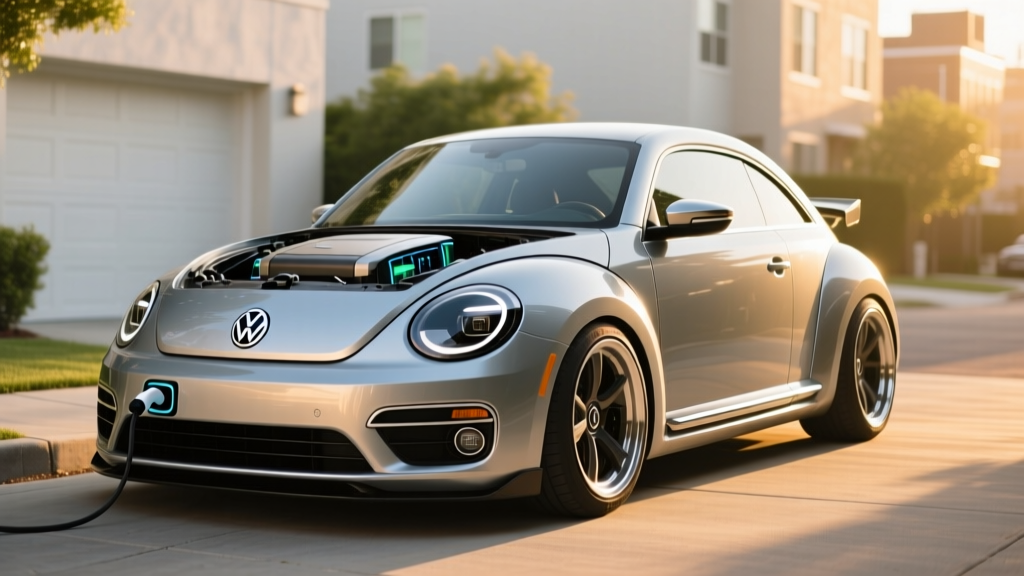
Converting a classic Volkswagen Beetle (typically a 1966–1979 model) to electric drive means removing the air-cooled flat-four engine, fuel tank, and exhaust system, then installing an electric motor, motor controller, battery pack, onboard charger, and high-voltage wiring. The original transmission is sometimes retained (adapted to the electric motor via a custom coupler), though many builds use a direct-drive setup or a single-speed reduction gear.
The most common motor choices in 2026 include the NetGain HyPer 9 (a brushed DC/AC induction system popular in hobbyist conversions, ~$3,000–$4,500 for the motor and controller combo) and repurposed drivetrains from wrecked Tesla Model S or Nissan Leaf units. Battery packs are typically assembled from salvaged Nissan Leaf modules, Chevy Bolt modules, or new LiFePO4 (LFP) prismatic cells sourced from companies like EVE or CATL.
A typical conversion shop will spend 200 to 400 labor hours on a complete build. At shop rates of $85–$150/hour, labor alone accounts for $17,000–$60,000 — which is why DIY builds are common in this space, and why turnkey conversions from reputable shops like Zelectric Motors or EV West routinely land in the $40,000–$70,000 total-vehicle range.
Cost Breakdown: What You Will Actually Spend
Here is a realistic parts-and-labor breakdown for a typical VW Beetle EV conversion using a mid-tier component set:
| Component | Budget Build | Mid-Range Build | Premium Build |
|---|---|---|---|
| Donor Beetle (1966–1979) | $3,000–$5,000 | $6,000–$9,000 | $10,000–$15,000 |
| Electric motor + controller | $2,500 (NetGain WarP 9) | $4,500 (HyPer 9 AC) | $7,000+ (Tesla SDU) |
| Battery pack (usable kWh) | $4,000 (15–20 kWh, salvaged Leaf) | $8,000 (30 kWh, LFP new) | $14,000+ (40–50 kWh, NMC) |
| BMS + wiring + contactors | $1,200 | $2,000 | $3,500 |
| Onboard charger (Level 2) | $800 (1.5 kW) | $1,500 (3.3 kW) | $2,500 (6.6 kW) |
| DC-DC converter, gauges, misc | $1,000 | $1,800 | $3,000 |
| Fabrication + labor (if pro) | $8,000 | $18,000 | $35,000+ |
| Total (professional) | $20,500–$22,500 | $41,300–$44,800 | $75,000+ |
| Total (DIY, no labor cost) | $12,500–$14,500 | $23,300–$26,300 | $40,000+ |
For context, a used 2023 Chevrolet Bolt EV with 259 miles of EPA range can be found for $17,000–$22,000 on the used market in 2026, and a new 2026 Nissan Leaf S starts at $28,140 MSRP with 149 miles of EPA range and eligibility for the full $7,500 §30D federal tax credit (subject to income and sourcing requirements — see IRS §30D rules).
Range, Charging, and Performance: The Real Numbers
Range in a Beetle conversion is a direct function of battery size and vehicle efficiency. A classic Beetle is not aerodynamic (drag coefficient around 0.48, compared to ~0.23 for a modern Tesla Model 3), and it is heavy relative to its size once batteries are added. Expect efficiency in the range of 250–350 Wh/mile depending on driving style, terrain, and climate.
| Vehicle | Battery / Tank | Efficiency | Real-World Range | "Fuel" Cost per Mile |
|---|---|---|---|---|
| VW Beetle EV (20 kWh pack) | 20 kWh usable | ~300 Wh/mi | 55–65 mi | ~$0.04 (home L2, $0.13/kWh) |
| VW Beetle EV (35 kWh pack) | 35 kWh usable | ~300 Wh/mi | 100–115 mi | ~$0.04 |
| VW Beetle EV (50 kWh pack) | 50 kWh usable | ~300 Wh/mi | 145–165 mi | ~$0.04 |
| Original 1974 Beetle (gas) | 10.6 gal tank | ~25 MPG combined | ~240 mi | ~$0.14 (at $3.50/gal) |
| 2026 Nissan Leaf S | 40 kWh usable | 28 kWh/100mi (121 MPGe) | 130–149 mi (EPA 149) | ~$0.04 |
| 2026 Chevy Equinox EV | 85 kWh usable | 32 kWh/100mi (105 MPGe) | 280–315 mi (EPA 315) | ~$0.04 |
Charging reality: Most Beetle conversions use a 3.3 kW or 6.6 kW onboard charger — meaning Level 2 charging from a 240V home outlet adds roughly 10–22 miles of range per hour. A full charge on a 35 kWh pack at 3.3 kW takes about 10–11 hours. Critically, most conversions do not support DC fast charging. Adding a CCS or NACS DC fast-charge port requires a high-voltage DC-DC architecture and compatible charge controller that most aftermarket conversion kits do not include. This means road trips require overnight stops with Level 2 access — not quick 20-minute top-ups.
Performance: A typical mid-range conversion produces 80–120 horsepower and can hit 0–60 mph in roughly 8–12 seconds. That is a meaningful upgrade from the original Beetle's 48 hp and 20+ second 0–60 time, but it is not a performance car. Top speed is usually electronically limited to 75–90 mph for efficiency and safety (the Beetle's drum brakes and swing-axle or trailing-arm suspension were not designed for sustained high-speed driving).
EV Conversion vs Buying a Modern EV: The Honest Comparison
This is the decision most people wrestle with. Here is how the two paths stack up across the factors that matter:
| Factor | VW Beetle EV Conversion | Modern EV (e.g., 2026 Bolt, Leaf, Equinox EV) |
|---|---|---|
| Upfront cost | $20,000–$75,000+ | $22,000 (used) – $45,000 (new) |
| Federal tax credit (§30D) | ❌ Not eligible | ✅ Up to $7,500 (if eligible) |
| Range | 55–165 mi (pack dependent) | 149–315+ mi (EPA rated) |
| DC fast charging | ❌ Rarely available | ✅ Standard (50–175+ kW) |
| Safety (crash structure, airbags, ABS) | ❌ 1960s–70s design | ✅ Modern crumple zones, 6+ airbags, AEB |
| Warranty | ❌ None (shop warranty varies) | ✅ 8 yr/100K mi battery, 3–5 yr bumper-to-bumper |
| Insurance | Specialty classic-car policy; $1,200–$2,500/yr | Standard EV policy; $1,400–$2,200/yr |
| Reliability / support | Custom one-off; you are the support network | Dealer network, OTA updates, recall coverage |
| Character / uniqueness | ✅ Unmatched classic style | ❌ Blends in at any charging station |
| Maintenance cost (annual) | $300–$800 (suspension, brakes, 12V) | $200–$500 (tires, cabin filter, wipers) |
Real-World Ownership Considerations
Home charging access is essential. Without a dedicated 240V Level 2 circuit (NEMA 14-50 or hardwired EVSE), a Beetle conversion with a 3.3 kW charger would need 20+ hours on a standard 120V outlet to fully charge a 35 kWh pack. A Level 2 home installation typically costs $800–$2,500 including a quality EVSE (like a ChargePoint Home Flex or Emporia Level 2) and electrician labor, assuming your electrical panel has capacity. Older homes may require a panel upgrade ($1,500–$3,500 additional).
Cold-weather range loss is real and amplified. Modern EVs use liquid-cooled battery packs with active thermal management and heat pumps. A conversion Beetle typically uses air-cooled or passively cooled packs with resistive cabin heat. Expect 30–45% range loss in sub-40°F weather — a 100-mile summer range becomes 55–70 miles in January. If you live in a cold climate, oversize your battery pack by at least 40% relative to your typical daily driving needs.
Registration and inspection vary by state. Some states (California, Texas, Florida) have established processes for registering converted EVs, often requiring a brake-and-light inspection, a verification of the electric drivetrain, and a new VIN assignment or "specially constructed vehicle" designation. Other states have no clear process, which can mean months of bureaucratic back-and-forth. Research your state DMV's requirements before starting a build.
Insurance requires specialty carriers. Standard auto insurers often will not cover a converted vehicle at its build value. You will likely need an agreed-value policy through a classic-car insurer like Hagerty or American Modern. Typical annual premiums: $1,200–$2,500 depending on agreed value, your driving record, and mileage limits.
Common Misconceptions About Beetle EV Conversions
| Myth | Fact |
|---|---|
| "I can convert a Beetle for under $5,000" | Only if you source heavily discounted used parts, do all labor yourself, and accept a very small (10–15 kWh) battery pack with 30–45 miles of range. Realistic DIY minimum is $12,000–$15,000. |
| "It qualifies for the $7,500 EV tax credit" | The IRS §30D credit applies only to new qualified plug-in EVs purchased from a manufacturer. Conversions of existing vehicles do not qualify. The now-expired Qualified Plug-In Electric Drive Motor Vehicle Credit for conversions (IRC §30D pre-2023) was capped at $4,000 and is no longer available. |
| "It will charge at Tesla Superchargers" | Almost no conversions support DC fast charging at all, let alone NACS protocol. You are limited to Level 2 (J1772 connector) at home and public destinations. |
| "Electric means zero maintenance" | The electric drivetrain is low-maintenance, but the 50-year-old chassis still has ball joints, bushings, drum brakes, and a steering box that need periodic attention. Budget $500–$800/year for chassis upkeep. |
| "A conversion is better for the environment than buying a new EV" | It depends. Reusing an existing chassis avoids manufacturing a new car (~6–10 metric tons of CO₂ for a modern EV's production). But a conversion with a small pack and short range may lead you to keep a gas car as a backup, negating some benefit. A new EV driven 12,000+ miles/year on a grid with meaningful renewable share typically breaks even on lifecycle emissions within 1–3 years (per EPA lifecycle analysis). |
Decision Framework: Should You Convert or Buy?
Choose a VW Beetle EV Conversion If:
- The classic Beetle aesthetic and driving experience is your primary motivation — not cost savings
- You have access to a garage with 240V Level 2 charging
- Your daily driving is under 40 miles round-trip (with a 30+ kWh pack)
- You enjoy hands-on mechanical projects or have a trusted conversion shop
- You understand this is a weekend/commuter car, not a road-trip vehicle
- You accept the safety limitations of a 1960s–70s chassis with no airbags, no ABS, and minimal crash protection
Choose a Modern Production EV If:
- You need a reliable daily driver with 200+ miles of range and DC fast charging for road trips
- You want the $7,500 federal tax credit (check current IRS eligibility for income caps, MSRP limits, and battery sourcing rules)
- Safety is a priority — modern crumple zones, AEB, blind-spot monitoring, airbags
- You want a warranty-backed battery with a guaranteed degradation threshold (typically 70% capacity at 8 years/100,000 miles)
- You do not have the time, tools, or budget for a multi-month custom build
- You need to carry passengers safely (rear seats in a modern EV vs the Beetle's tiny back seat with no head restraints)
First-Time EV Buyer Essentials (If You Go the Conversion Route)
If a Beetle conversion is your first EV experience, here is what you need to know that modern-EV owners take for granted:
- kW vs kWh: kW (kilowatts) is the rate of power — how fast your motor draws energy or your charger delivers it. kWh (kilowatt-hours) is the total energy stored in your battery, like gallons in a gas tank. A 30 kWh battery running at 15 kW of motor output will theoretically last 2 hours. Your charger's kW rating determines how quickly it refills the kWh.
- State of Charge (SoC) management: Unlike modern EVs with sophisticated BMS systems that buffer the top and bottom of the pack, many conversions expose the full cell voltage range. Avoid regularly discharging below 10% SoC or charging to 100% — this accelerates degradation, especially on NMC chemistry. LFP cells tolerate 100% SoC better but are heavier and less energy-dense.
- Regenerative braking is not a given: Some conversion motor controllers support regen (which recaptures energy during deceleration and extends range by 5–15%), while simpler DC motor setups do not. Ask your builder specifically whether regen is included, and if so, whether it is adjustable.
- Weight distribution changes: A stock Beetle is rear-engine and rear-heavy. An EV conversion moves significant battery weight into the front trunk (frunk) area and under the rear seat or in the engine bay. Proper weight distribution (aim for 45/55 to 50/50 front/rear) is critical for safe handling, especially given the Beetle's original suspension geometry.
- Preconditioning is manual: Modern EVs warm their battery packs before DC fast charging to optimize the charge curve. In a conversion, you are responsible for battery temperature management. In cold weather, range and charge speed will both suffer without an active thermal system.
Frequently Asked Questions
How long does a VW Beetle EV conversion battery last?
It depends on chemistry and usage. Salvaged Nissan Leaf NMC modules (the most common budget choice) may already have 10–25% degradation from their original life and could last 5–8 years before dropping below 70% capacity. New LFP cells (from EVE, CATL, or similar) can last 3,000–5,000 charge cycles — potentially 15–20 years at typical conversion usage levels. Replacement cost for a 30 kWh LFP pack: roughly $6,000–$9,000 in cells plus labor.
Can I DC fast charge a converted Beetle?
In nearly all cases, no. DC fast charging requires a high-voltage battery architecture (typically 350–400V nominal), a compatible CCS or NACS charge port, communication protocols between the charger and the vehicle's BMS, and liquid-cooled battery thermal management to handle the heat of 50+ kW charge rates. A few high-budget conversions ($60K+) have integrated Tesla or CCS DC charging, but it adds $5,000–$10,000 to the build and requires significant engineering. Plan on Level 2 only.
Is a converted Beetle safe to drive in modern traffic?
This is the most important question a prospective converter should ask. A 1966–1979 VW Beetle has no airbags, no crumple zones by modern standards, no anti-lock brakes (drum brakes all around on most years), no electronic stability control, and a fuel-tank-forward or battery-forward layout that was never crash-tested. The added weight of batteries (300–600 lbs) increases stopping distances on the original brake system. Upgrading to front disc brakes is strongly recommended. Drive it as a fair-weather, low-speed, aware-of-your-surroundings vehicle — not a freeway commuter in heavy traffic.
What is the best donor Beetle year for an EV conversion?
The 1973–1979 Super Beetle is generally preferred because it has a larger engine bay (more room for batteries and motor), MacPherson strut front suspension (better handling than the torsion-bar front end of earlier models), and a slightly larger chassis. The 1966–1972 standard Beetles are lighter and more aesthetically classic but offer less space for components and have more primitive suspension geometry.
How does the cost per mile compare to the original gas Beetle?
At $0.13/kWh (national average residential electricity rate in 2026) and 300 Wh/mile efficiency, the converted Beetle costs roughly $0.04 per mile to "fuel." The original gas Beetle at 25 MPG and $3.50/gallon costs about $0.14 per mile. That is a $0.10/mile savings, or about $1,200/year if you drive 12,000 miles. However, the conversion's $20,000–$40,000 upfront cost premium over simply keeping a running gas Beetle means the payback period on fuel savings alone is 17–33 years. The conversion is a passion project, not a financial optimization.