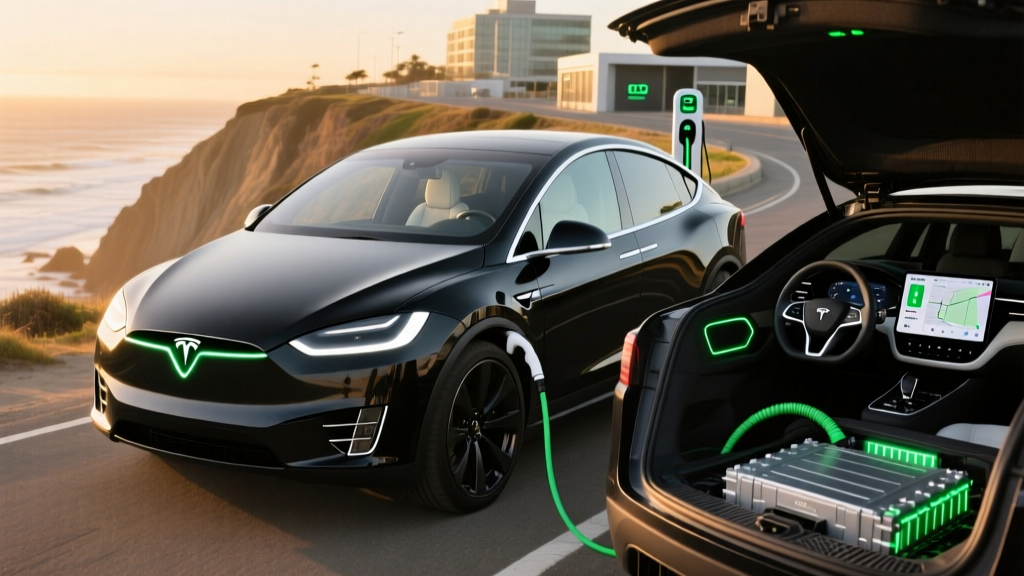
The Tesla Model X remains one of the most distinctive electric SUVs on the road, thanks to its falcon-wing rear doors, tri-motor Plaid powertrain option, and access to the Supercharger network. But beneath the theatrical doors lies a serious family hauler with competitive range, rapid DC charging, and a tech-forward cabin. For 2026, Tesla has refined the Model X lineup with updated battery management and continued software-driven improvements. This review examines every critical spec — from real-world range and charging curves to tax-credit eligibility — so you can decide whether the Model X earns a spot in your garage.
Quick Verdict: Who the Model X Is For
The 2026 Tesla Model X is best suited for tech-forward families who need three rows of seating, value access to the most reliable DC fast-charging network in North America, and want a premium EV with serious performance credentials. It's less ideal for buyers who prioritize traditional luxury build quality, want physical buttons, or need maximum third-row cargo space compared to rivals like the Rivian R1S or Kia EV9.
Range, Battery & Efficiency
The Long Range AWD model carries an EPA-estimated 320 miles of range. In real-world highway driving at 70–75 mph, expect approximately 270–290 miles. In cold weather (below 32°F), range can drop to 230–250 miles due to battery heating demands and cabin climate load. The Plaid trim is rated at 308 miles EPA, with real-world highway figures closer to 255–275 miles.
The Model X uses a ~100 kWh battery pack (approximately 95 kWh usable) with NMC (nickel manganese cobalt) chemistry. Tesla does not publish exact usable capacity, but independent teardowns and charging data consistently place the usable buffer in the 93–96 kWh range. NMC chemistry offers high energy density, which is necessary in a vehicle this size, but it requires more careful thermal management than LFP chemistry — something Tesla's active liquid cooling system handles well.
| Spec | Long Range AWD | Plaid (Tri-Motor AWD) |
|---|---|---|
| EPA Range | 320 mi | 308 mi |
| Battery (Usable) | ~95 kWh, NMC | ~95 kWh, NMC |
| Efficiency (MPGe) | 102 MPGe combined | 98 MPGe combined |
| Energy Consumption | 33 kWh/100 mi | 34 kWh/100 mi |
| 0–60 mph | 3.8 sec | 2.5 sec |
| Horsepower | 670 hp | 1,020 hp |
| Drivetrain | Dual-Motor AWD | Tri-Motor AWD |
| Top Speed | 155 mph | 163 mph |
| Towing Capacity | 5,000 lbs | 5,000 lbs |
Efficiency is respectable for a 5,100-pound SUV. The Long Range model achieves 102 MPGe combined (33 kWh per 100 miles) per fueleconomy.gov. That translates to roughly $0.05–$0.07 per mile when charging at home on a national average electricity rate of $0.16/kWh — dramatically cheaper than a comparable gasoline SUV at $0.18–$0.22 per mile.
Charging Speed: DC Fast, Level 2 & Home Setup
Charging speed is where the Model X's 800V-class architecture and Tesla's Supercharger network combine to offer a genuine road-trip advantage.
| Charging Level | Power / Rate | Time or Miles Added |
|---|---|---|
| DC Fast Charge (V3 Supercharger) | Peak 250 kW | 10–80% in ~30 min |
| DC Fast Charge (V4 Supercharger) | Peak 250 kW (cable-limited) | 10–80% in ~30 min |
| Level 2 (Tesla Wall Connector, 48A) | 11.5 kW | ~34 mi/hr, full charge ~9 hr |
| Level 2 (NEMA 14-50, 40A) | 9.6 kW | ~28 mi/hr, full charge ~10.5 hr |
| Level 1 (120V, 12A) | 1.4 kW | ~4 mi/hr (emergency only) |
Charging curve reality: The Model X peaks at 250 kW only at a low state of charge (roughly 10–25% SoC) and with a preconditioned battery. From 25–60%, expect sustained rates of 150–180 kW. Above 80%, charging slows dramatically to protect the NMC cells — typically dropping below 50 kW. This is why Tesla's navigation system recommends charging to 80% on road trips; pushing to 100% at a Supercharger adds minimal range but costs significant time.
At home, the Tesla Wall Connector on a 60-amp circuit delivers 48 amps (11.5 kW), adding roughly 34 miles of range per hour. Most owners will need a 240V/60A dedicated circuit installed. Expect home electrical installation costs of $500–$2,000 depending on panel proximity and whether a panel upgrade is needed. Always consult a licensed electrician for final specifications.
Performance & Driving Dynamics
Even the "base" Long Range Model X hits 0–60 mph in 3.8 seconds with 670 horsepower from its dual-motor AWD setup. That's supercar-rivaling acceleration from a three-row SUV. The Plaid variant, with three motors producing 1,020 hp, does it in 2.5 seconds — a figure that still seems absurd in a vehicle with a minivan-like door configuration.
Ride quality is firm but controlled, with adaptive air suspension that adjusts ride height automatically. The Model X can raise itself for rough driveways or lower for highway efficiency. Steering is precise and weighted appropriately, though the yoke steering wheel (now optional alongside a conventional round wheel) requires adaptation for low-speed maneuvering.
The 5,000-pound towing capacity is adequate for a small boat or light camper trailer, though towing will cut range roughly in half — plan for 150–170 miles between charging stops when pulling a load.
Interior, Cargo & Standout Tech Features
The Model X offers seating for up to seven passengers in a 2-3-2 configuration (five- and six-seat layouts are also available). Cargo volume behind the third row is 37.1 cubic feet, expanding to 81.5 cu ft with the third row folded. The front trunk (frunk) adds 6.7 cu ft of secure storage — useful for charging cables or groceries.
Second-row legroom measures 38.4 inches, and the third row offers 32.7 inches — adequate for children on longer trips but tight for adults. The falcon-wing doors are genuinely useful in tight parking spaces, opening vertically with minimal lateral clearance. However, they operate more slowly than conventional doors and can struggle in heavy rain due to their complex hinge sealing.
Standout tech features include:
- 17-inch center touchscreen with Netflix, YouTube, and full web browser — the infotainment benchmark
- HEPA air filtration with "Bioweapon Defense Mode" — hospital-grade cabin air quality
- Over-the-air updates that regularly add features (recent improvements to route planning, UI, and Sentry Mode)
- Sentry Mode — 360° camera recording when parked, with phone alerts
- Second-row entertainment screen (6-seat config) for rear passengers
- Autopilot standard with optional FSD (Supervised) — see the ADAS section below
Pricing, Trims & Federal Tax Credit Eligibility
| Trim | Base MSRP | Typical As-Tested | §30D Credit Eligibility |
|---|---|---|---|
| Long Range AWD | $79,990 | $85,000–$92,000 | Up to $7,500 (if eligible) |
| Plaid Tri-Motor AWD | $94,990 | $100,000–$110,000 | Up to $7,500 (if eligible) |
The Model X qualifies for the IRS §30D federal tax credit of up to $7,500, but eligibility depends on several factors that buyers must verify:
- MSRP cap: SUVs must have an MSRP at or below $80,000. The Long Range base price qualifies; Plaid does not.
- Buyer income cap: Modified AGI must not exceed $300,000 (joint), $225,000 (head of household), or $150,000 (individual).
- Battery sourcing: The vehicle must meet critical-mineral and battery-component requirements, which shift annually. Tesla's North American assembly helps, but specific battery-cell sourcing determines the full $7,500 vs. a partial $3,750 credit.
- Point-of-sale transfer: Eligible buyers can apply the credit as an upfront price reduction at purchase rather than waiting for tax filing.
Important: Tax credit rules change frequently. Always confirm current eligibility on IRS.gov or consult a tax professional before purchasing. State and local incentives may also apply — check your state's energy office for details.
Warranty & Long-Term Battery Outlook
Tesla covers the Model X battery and drive units with an 8-year/150,000-mile warranty (whichever comes first), guaranteeing a minimum of 70% capacity retention over that period. The vehicle limited warranty is 4 years/50,000 miles.
Based on long-term fleet data, Tesla's NMC packs typically degrade 10–15% over the first 100,000 miles, then slow considerably. Many high-mileage Model X owners report 85–90% state of health (SoH) at 100,000 miles. To maximize longevity, Tesla recommends daily charging to 80–90% for NMC batteries and only charging to 100% when needed for long trips — a practice that meaningfully extends cycle life.
Out-of-warranty battery replacement costs remain high — typically $15,000–$22,000 depending on pack configuration and labor. However, complete pack failures within the warranty period are covered, and partial degradation below the 70% threshold triggers a warranty claim.
Model X vs. Key Competitors: Is It Worth It?
- Supercharger network access is a priority for road trips
- You want the fastest-accelerating three-row SUV available (Plaid)
- You value OTA software updates and cutting-edge infotainment
- Falcon-wing doors genuinely help in your parking situation
- Build quality and panel consistency are top priorities
- You need a more usable third row for adult passengers
- You prefer physical controls and a more traditional luxury interior
- You want a lower starting price with similar range (Kia EV9)
Against the Rivian R1S, the Model X offers faster charging and a more mature software ecosystem, but the R1S provides better off-road capability, a more practical third row, and a more conventional (and reliable) door design. The Kia EV9 undercuts the Model X by $25,000+ while offering competitive range, though it lacks the Supercharger network (for now) and performance credentials.
Pros, Cons & Bottom Line
- Supercharger network — most reliable DC fast-charging in North America
- Class-leading acceleration (Plaid: 2.5 sec 0–60)
- 320-mile EPA range is competitive for the segment
- Exceptional infotainment and OTA update pipeline
- HEPA air filtration and Sentry Mode are genuinely useful
- Up to $7,500 federal tax credit (Long Range, income-eligible buyers)
- Falcon-wing doors: slow, complex, and prone to sensor issues
- Build quality inconsistency (panel gaps, interior rattles)
- Third row is tight for adults
- Plaid trim exceeds $80K MSRP cap — no federal tax credit
- High insurance premiums relative to segment
- Minimal physical controls — everything through the touchscreen
Frequently Asked Questions
What is the real-world range of the 2026 Tesla Model X?
The Long Range model's 320-mile EPA estimate translates to roughly 270–290 miles in real-world highway driving and 230–250 miles in cold weather. The Plaid achieves about 255–275 miles on the highway. These figures assume moderate climate control use and no towing.
How fast does the Model X charge at home and on the road?
On a DC fast charger, the Model X peaks at 250 kW and charges from 10–80% in approximately 30 minutes with a preconditioned battery. At home on a Level 2 Tesla Wall Connector (11.5 kW), it adds about 34 miles of range per hour, fully charging overnight in roughly 9 hours.
Does the 2026 Tesla Model X qualify for the $7,500 federal EV tax credit?
The Long Range trim (base MSRP $79,990) can qualify for the full $7,500 §30D credit if the buyer meets income caps ($300K joint / $150K individual) and the battery meets current-year critical-mineral and component sourcing rules. The Plaid trim ($94,990 MSRP) exceeds the $80,000 SUV cap and does not qualify. Always verify on IRS.gov.
Is the Tesla Model X worth buying over the Rivian R1S or Kia EV9?
The Model X wins on charging infrastructure, acceleration, and software. The Rivian R1S is better for off-road use and third-row practicality. The Kia EV9 offers the best value proposition at a significantly lower price. Your priority — performance, practicality, or price — determines the right choice.
How long will the Model X battery last?
Tesla warranties the battery for 8 years or 150,000 miles with a 70% capacity retention guarantee. Real-world data suggests NMC packs in the Model X retain 85–90% capacity at 100,000 miles when charged responsibly (daily limit of 80–90%). Replacement costs $15,000–$22,000 out of warranty.
Can I use non-Tesla chargers with the Model X?
Yes. The Model X uses the NACS (Tesla) connector natively, which is now the North American standard. Tesla also includes a CCS adapter for use with Electrify America, EVgo, and other CCS networks. As of 2026, most new public chargers are being built with NACS connectors.