Quick Verdict: Is the Volvo XC40 Recharge Worth It?
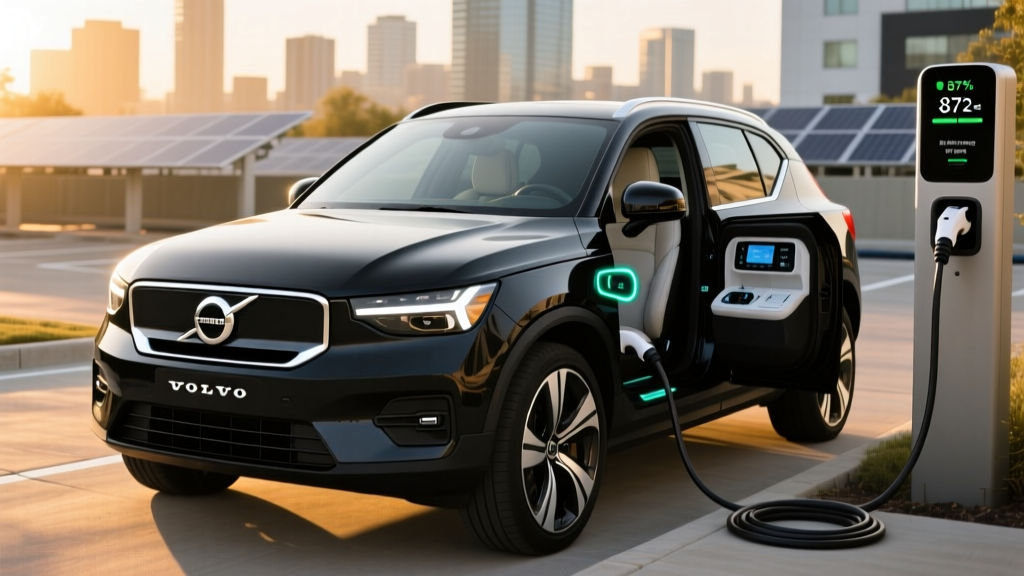
The 2026 Volvo XC40 Recharge is a premium compact electric SUV delivering an EPA-estimated 293 miles of range (Single Motor) or 269 miles (Twin Motor AWD), an 82 kWh usable NMC battery, and DC fast charging up to 200 kW (10–80% in approximately 28 minutes). Starting at roughly $54,950 before incentives, it competes directly with the Tesla Model Y, BMW iX1, and Hyundai Ioniq 5. It's best for buyers who prioritize Scandinavian design, strong build quality, and Google-based infotainment over maximum range-per-dollar. Real-world highway range drops to approximately 230–250 miles; cold-weather driving can reduce that by 20–30%.
Range, Battery & Real-World Efficiency
The 2026 XC40 Recharge uses an 82 kWh (usable) lithium-ion NMC (nickel manganese cobalt) battery pack. Volvo offers two powertrain configurations:
| Spec | Single Motor (RWD) | Twin Motor (AWD) |
|---|---|---|
| EPA Range | 293 miles | 269 miles |
| Battery (usable) | 82 kWh NMC | 82 kWh NMC |
| Horsepower | 248 hp | 402 hp |
| 0–60 mph | 6.9 sec | 4.5 sec |
| MPGe (combined) | 104 MPGe | 92 MPGe |
| Efficiency | 32 kWh/100mi | 36 kWh/100mi |
Real-World Range Reality: The EPA's 293-mile estimate assumes mixed driving. On sustained highway trips at 70+ mph, expect approximately 230–250 miles from the Single Motor variant. In freezing temperatures (below 32°F), range can drop 20–30%, bringing effective range to roughly 175–200 miles for the AWD model. The XC40 Recharge includes a heat pump on most trims, which mitigates some cold-weather loss compared to resistive heating systems. Always precondition the battery while plugged in to preserve range and optimize charging speed.
Compared to the gas Volvo XC40 B5 (EPA 26 mpg combined), the electric version is roughly 3.5× more energy-efficient per mile when measured in equivalent energy terms. Source: fueleconomy.gov.
Charging Speed & Connector Details
Understanding the difference between kW (power — how fast energy flows) and kWh (energy — how much the battery holds) is essential. The XC40 Recharge's 82 kWh battery fills at different rates depending on your charger:
| Charging Level | Power (kW) | Speed (miles/hr) | Full Charge Time |
|---|---|---|---|
| Level 1 (120V household) | ~1.4 kW | ~4 mi/hr | ~58 hours (0–100%) |
| Level 2 (240V home/public) | 11 kW (onboard max) | ~33 mi/hr | ~8 hours (0–100%) |
| DC Fast Charging | 200 kW peak | ~550 mi/hr (peak) | ~28 min (10–80%) |
Charging curve reality: The 200 kW peak rate applies only between roughly 10–40% State of Charge (SoC). Above 60%, the rate tapers significantly — by 80%, you're pulling roughly 60–80 kW. This means an 80–100% top-off can take nearly as long as the 10–80% session. For daily driving, charge to 80% to preserve battery longevity and minimize time at the charger.
The 2026 XC40 Recharge comes equipped with the NACS (North American Charging Standard) port, granting native access to Tesla Supercharger stations (15,000+ stalls in the US) without an adapter. This is a significant advantage over CCS-only vehicles for road-trip charging reliability.
Volvo XC40 Recharge vs Gas XC40: 5-Year Cost Breakdown
Let's compare the 2026 XC40 Recharge Twin Motor (AWD, $57,900 MSRP) against the gas XC40 B5 AWD ($42,550 MSRP) over 5 years and 60,000 miles. Electricity priced at $0.16/kWh (national average); gas at $3.50/gallon.
| Cost Category | XC40 Recharge (EV) | XC40 B5 (Gas) |
|---|---|---|
| Purchase Price (MSRP) | $57,900 | $42,550 |
| Est. Federal Tax Credit (§30D) | $0–$3,750* | $0 |
| Fuel/Energy (60k mi) | $3,504 | $8,077 |
| Maintenance (5 yr) | ~$1,800 | ~$3,500 |
| Insurance (5 yr avg) | ~$10,500 | ~$8,700 |
| 5-Year Total (before incentives) | $73,704 | $62,827 |
| 5-Year Total (after max credit) | $69,954 | $62,827 |
*The XC40 Recharge's §30D tax credit eligibility is limited. Due to battery component and critical mineral sourcing requirements under current IRS rules, the Twin Motor may qualify for up to $3,750 (critical minerals portion only), while the Single Motor may qualify for $0–$3,750 depending on the model year's sourcing updates. The full $7,500 credit requires meeting both battery component AND critical mineral thresholds. MSRP cap for SUVs: $80,000. Buyer income cap: $150K single / $300K joint. Always confirm eligibility with a tax professional before purchase. Point-of-sale transfer is available if eligible.
Key takeaway: The EV saves roughly $4,573 on fuel and $1,700 on maintenance over 5 years, but the higher purchase price and insurance premiums narrow the gap. Home charging is essential to realizing fuel savings — public DC fast charging at $0.40–$0.60/kWh can erase the cost advantage entirely.
Ownership Realities: What First-Time EV Buyers Must Know
Home Charging Is Non-Negotiable for Most Owners
Without home or workplace charging, the XC40 Recharge's convenience advantage over gas evaporates. A Level 2 home charger (240V, 48-amp circuit) costs $500–$800 for the unit plus $800–$2,500 for professional installation by a licensed electrician, depending on your panel's capacity and the run distance. Homes with older 100-amp electrical panels may need a $1,500–$3,000 panel upgrade. Budget $1,500–$4,000 total for a reliable home charging setup.
Cold Climate Considerations
If you live where winters regularly dip below freezing, plan for 20–30% range loss. The XC40 Recharge's heat pump helps, but it doesn't eliminate the physics of lithium-ion chemistry in cold temperatures. Garaging the vehicle and preconditioning while plugged in are the most effective mitigations. If your daily commute is under 60 miles round-trip, even cold-degraded range will cover it easily.
Insurance Costs Are Higher
EV insurance premiums run 15–25% higher than gas equivalents due to battery replacement costs and specialized repair requirements. Expect $1,800–$2,400/year for the XC40 Recharge depending on your state and driving record. Get quotes before committing to the purchase.
Battery Longevity & Warranty
Volvo covers the XC40 Recharge battery with an 8-year/100,000-mile warranty guaranteeing at least 70% capacity retention. NMC batteries typically degrade 10–15% over 8 years with normal use. Avoid frequent DC fast charging above 90% SoC and regular deep discharges below 10% to maximize longevity. Full battery replacement (out of warranty) runs approximately $15,000–$20,000 — a worst-case scenario that's rare but worth knowing.
Myth vs Fact: Common XC40 Recharge Misconceptions
| Myth | Fact |
|---|---|
| "The battery will need replacing in 5 years" | NMC batteries retain 85–90% capacity at 100,000 miles under normal use. Volvo warranties 70% at 8 years/100K miles. |
| "You can't road-trip an EV" | With NACS access to Tesla Superchargers (200 kW peak), a 10–80% charge takes ~28 minutes — comparable to a gas stop with a restroom break. |
| "EVs are worse in winter" | EVs start instantly in cold (no engine cranking), and the heat pump cabin warms quickly. Range drops, but daily usability remains strong with preconditioning. |
| "The XC40 Recharge gets the full $7,500 tax credit" | Due to battery sourcing rules, most 2026 XC40 Recharge trims qualify for $0–$3,750 only. Verify on fueleconomy.gov before purchase. |
| "Level 2 charging is too slow overnight" | At 11 kW, 8 hours of sleep adds ~264 miles — more than enough to refill the battery for almost any daily driving pattern. |
Decision Framework: Should You Buy the XC40 Recharge?
Choose the Volvo XC40 Recharge if:
- You have reliable home or workplace Level 2 charging access
- Your daily driving is under 120 miles round-trip (covers most commutes even in cold weather)
- You value premium interior materials, Google Built-in infotainment, and Volvo's safety reputation
- You want native Tesla Supercharger access via NACS for road trips
- You prefer a traditional SUV silhouette over crossover-coupe styling
Look elsewhere if:
- You need maximum range-per-dollar — the Hyundai Ioniq 5 (318 mi EPA, ~$43K) or Tesla Model Y (320+ mi, ~$45K) deliver more range at lower prices
- You lack any access to home or workplace charging and rely entirely on public infrastructure
- You regularly tow — the XC40 Recharge is rated for only 2,000 lbs
- You need three rows of seating — consider the Kia EV9 or Volvo EX90
- Maximizing the federal tax credit is a priority — several competitors qualify for the full $7,500
How It Stacks Up Against Key Rivals
| Spec | Volvo XC40 Recharge (AWD) | Tesla Model Y LR (AWD) | Hyundai Ioniq 5 (RWD) |
|---|---|---|---|
| EPA Range | 269 mi | 320 mi | 318 mi |
| Battery | 82 kWh NMC | ~78 kWh NMC | 77.4 kWh NMC |
| DC Fast Charge (peak) | 200 kW | 250 kW | 240 kW |
| 10–80% Time | ~28 min | ~22 min | ~18 min |
| 0–60 mph | 4.5 sec | 4.8 sec | 7.2 sec |
| Base MSRP | $54,950 | ~$45,990 | ~$42,950 |
| Connector | NACS | NACS | CCS1 (NACS adapter avail.) |
The XC40 Recharge trades range and charging speed for build quality, cabin refinement, and Volvo's safety engineering (standard Pilot Assist with run-off-road protection). The Ioniq 5 charges fastest and costs least; the Model Y offers the best range and Supercharger-native convenience. The Volvo occupies a niche: premium compact SUV buyers who don't need class-leading range.
Frequently Asked Questions
Does the 2026 Volvo XC40 Recharge qualify for the $7,500 federal tax credit?
Most likely not the full amount. Under current IRS §30D rules, the credit depends on battery component and critical mineral sourcing. The XC40 Recharge may qualify for $0–$3,750 depending on the specific trim and model year sourcing updates. Buyer income caps ($150K single / $300K joint) and the $80,000 SUV MSRP cap also apply. Confirm on fueleconomy.gov and with your tax professional before purchasing. The credit can be transferred to the dealer at point of sale as a down payment reduction if eligible.
How long does it take to charge the XC40 Recharge at home?
On a Level 2 home charger (240V, 11 kW onboard acceptance), a full 0–100% charge takes approximately 8 hours. Most owners plug in overnight and wake to a full battery every morning. On a standard 120V outlet (Level 1), expect roughly 4 miles of range per hour of charging — sufficient only for very low-mileage drivers or emergency top-offs.
Is the XC40 Recharge good for road trips?
Yes, with planning. The NACS connector provides native access to Tesla Superchargers, which offer the most reliable DC fast-charging network in the US. At 200 kW peak, you'll add roughly 150 miles in a 20-minute stop. For a 500-mile trip, plan one 25–30 minute charging stop. Use the Volvo Cars app or A Better Routeplanner to plan stops around your specific route and conditions.
What's the real-world range in winter?
In sustained temperatures below 32°F, expect 20–30% range reduction. The Twin Motor AWD's 269-mile EPA rating drops to roughly 188–215 miles in deep cold. The heat pump helps, but preconditioning while plugged in is the single most effective way to preserve range. For winter-heavy climates, the XC40 Recharge remains viable for commutes under 80 miles round-trip without mid-day charging.
How does the XC40 Recharge compare to the Volvo C40 Recharge?
Volvo has consolidated naming for 2026: the C40 (coupe-like roofline) has been absorbed into the EX40 designation in some markets, while the XC40 Recharge continues as the traditional SUV body style. Both share the same 82 kWh battery, powertrain options, and charging hardware. The XC40 offers slightly more cargo space (roughly 16 cu ft behind the rear seats vs the C40's 14.6 cu ft) due to its taller roofline.