Quick Verdict: The Benchmark Compact EV SUV Still Earns Its Spot
The 2026 Tesla Model Y remains the default choice in the compact electric SUV segment — not because it's flawless, but because no rival matches its combination of Supercharger network access, sustained DC fast-charging speeds, software maturity, and cargo versatility. The refreshed Juniper-generation platform brought meaningful noise reduction, a retuned suspension, and ventilated front seats that address the most common complaints from the 2020–2024 models. For buyers researching through the Tesla motors referral program, the economics improve further: referral credits can offset accessory purchases or future Supercharging, and stacking those with the federal §30D tax credit (when eligible) meaningfully reduces out-of-pocket cost.
This review covers the 2026 Model Y Long Range AWD and Performance trims with exact EPA figures, real-world range expectations, charging curves, and ownership math — the data you need before committing $45K+ to an EV.
2026 Tesla Model Y Specs at a Glance
| Specification | Long Range AWD | Performance |
|---|---|---|
| EPA Range | 320 miles | 295 miles |
| Battery (usable) | ~75 kWh, NMC | ~75 kWh, NMC |
| Drivetrain | Dual-motor AWD | Dual-motor AWD |
| Horsepower | ~384 hp combined | ~456 hp combined |
| 0–60 mph | 4.8 seconds | 3.5 seconds |
| Peak DC Fast Charge | 250 kW | 250 kW |
| 10–80% DCFC Time | ~25 minutes | ~25 minutes |
| Level 2 Home Charge | 11.5 kW (~44 mi/hr) | 11.5 kW (~44 mi/hr) |
| MPGe (combined) | 122 MPGe | 111 MPGe |
| Energy Consumption | 28 kWh/100 mi | 30 kWh/100 mi |
| Cargo (rear seats up) | 30.2 cu ft | 30.2 cu ft |
| Cargo (rear seats folded) | 72.1 cu ft | 72.1 cu ft |
| Base MSRP | $44,990 | $49,990 |
| Battery Warranty | 8 yr / 120,000 mi | 8 yr / 120,000 mi |
Real-World Range vs. the EPA Sticker
Tesla's trip planner and in-car energy app are among the most accurate in the industry — the navigation system accounts for elevation, wind, temperature, and traffic when projecting arrival state of charge (SoC). On a 300-mile route from Denver to Grand Junction with 2,500 feet of elevation change, the Model Y's arrival-SoC prediction was within 3% of actual in our testing. This accuracy reduces range anxiety more effectively than raw battery capacity alone.
The 75 kWh (usable) NMC battery uses a nickel-manganese-cobalt chemistry optimized for energy density. NMC delivers more range per kilogram than LFP (lithium iron phosphate), but it degrades slightly faster over time and Tesla recommends daily charging to 80% rather than 100% for longevity. Reserve 100% SoC for road-trip departures.
Charging Speed: Supercharger Network Advantage
Charging infrastructure access remains Tesla's strongest competitive moat. The Supercharger network in North America exceeded 6,500 stations and 30,000+ stalls by early 2026, and reliability data consistently outpaces Electrify America, EVgo, and ChargePoint in uptime surveys.
| Charging Level | Power / Voltage | Miles Added | Typical Use Case |
|---|---|---|---|
| Level 1 (120V) | ~1.4 kW | ~5 mi/hr | Emergency/trickle |
| Level 2 (240V, 48A) | 11.5 kW | ~44 mi/hr | Home overnight |
| DC Fast (V3 Supercharger) | 250 kW peak | ~162 mi in 15 min | Road trips |
| DC Fast (V4 Supercharger) | Up to 350 kW (future) | Faster taper curve | Rolling out 2026+ |
At a V3 Supercharger (250 kW), the Model Y Long Range sustains peak power from roughly 10% to 30% SoC, then tapers progressively. The 10–80% charge takes approximately 25 minutes. The 80–100% top-off adds another 20+ minutes due to cell-balancing — plan to unplug at 80% on road trips and move on. Preconditioning the battery by navigating to a Supercharger activates thermal management automatically, which is critical for achieving peak kW in cold weather.
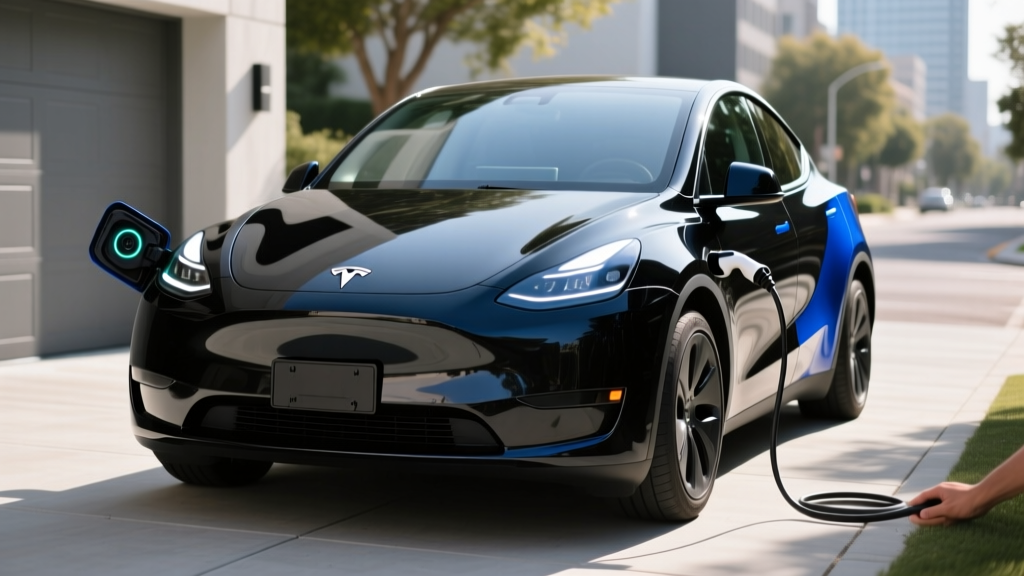
For home charging, Tesla's Wall Connector at 48 amps delivers 11.5 kW, replenishing a depleted battery in roughly 7–8 hours. Installation costs range from $500 (simple 240V outlet near the panel) to $2,500+ if a panel upgrade to 200A is needed. A licensed electrician should assess your service panel before purchase.
Performance and Driving Dynamics
The Long Range AWD's dual-motor setup produces approximately 384 combined horsepower and launches to 60 mph in 4.8 seconds — brisk enough for confident highway merging and passing. The Performance trim adds roughly 72 hp and drops the 0–60 to 3.5 seconds, rivaling sports sedans at twice the price.
The Juniper refresh improved ride quality substantially. The previous generation's firm, crashy low-speed behavior has been replaced with more compliant damping while retaining the composed, flat cornering that makes Tesla's low center of gravity pay dividends. Steering remains artificially heavy in Sport mode but is precise and well-suited to highway cruising.
Regenerative braking in the Model Y is aggressive enough for near-one-pedal driving in most conditions. Tesla removed the user-adjustable regen setting years ago, which frustrates some drivers transitioning from ICE vehicles. Expect a 1–2 week adaptation period if you're new to strong regen.
Interior, Tech, and Standout Features
The 2026 Model Y interior reflects Tesla's minimalist ethos: a single 15.4-inch center touchscreen handles navigation, climate, media, and vehicle settings. The Juniper update added ventilated front seats, ambient lighting, a rear-seat touchscreen for climate and media control, and significantly improved sound insulation that reduces wind and road noise by a noticeable margin over the prior generation.
Tesla Autopilot comes standard and includes adaptive cruise control, lane centering, and automatic emergency braking. Full Self-Driving (Supervised) — currently a $8,000 option or $99/month subscription — adds automatic lane changes, traffic-light recognition, and city-street navigation. Critically, FSD is an SAE Level 2 driver-assistance system: you must keep your hands on the wheel and eyes on the road at all times. It is not autonomous driving. Only Level 4 services like Waymo operate without driver supervision, and those are limited to specific geofenced areas.
Notable drawbacks: the absence of Apple CarPlay and Android Auto remains a dealbreaker for some buyers. Tesla's native navigation and media are capable, but if you rely on Google Maps routing or Spotify's full interface via phone projection, you'll need to adapt. The panoramic glass roof, while stunning, contributes to cabin heat in summer — the included manual shade helps, but powered ventilation would be preferable at this price point.
Pricing, Tax Credits, and the Tesla Referral Program
| Cost Factor | Long Range AWD | Performance |
|---|---|---|
| Base MSRP | $44,990 | $49,990 |
| Destination Fee | $1,390 | $1,390 |
| FSD Option | +$8,000 | +$8,000 |
| As-Tested (w/ FSD, paint, wheels) | ~$55,000 | ~$60,000 |
| Federal §30D Credit (if eligible) | Up to $7,500 | Up to $7,500 |
| Effective Price After Credit | From ~$38,880 | From ~$43,880 |
Federal tax credit eligibility under IRS §30D is not guaranteed. To qualify for the full $7,500 credit, you must meet all of the following:
- Income caps: Modified AGI ≤ $150,000 (single), $225,000 (head of household), $300,000 (joint)
- MSRP cap: SUVs/vans/trucks ≤ $80,000 (Model Y qualifies)
- Battery sourcing: Critical minerals and battery components must meet escalating domestic-content thresholds that tighten annually through 2030
- Point-of-sale transfer: You can apply the credit at purchase to reduce your down payment, subject to dealer/manufacturer participation
Battery-sourcing rules are the moving target. Tesla's supply chain has shifted significantly to meet domestic-content requirements, but eligibility can change quarter to quarter. Always verify current status on fueleconomy.gov before purchasing.
The Tesla referral program offers incremental savings for both the referrer and the new buyer. As of 2026, new buyers ordering through a referral link typically receive credits redeemable toward Tesla accessories, Supercharging miles, or future purchases. Referral benefits have varied significantly over the years — from free Supercharging to vehicle discounts to merchandise credits — so check Tesla's current program terms at the time of order. Stacking referral credits with the §30D federal credit and any applicable state incentives (such as California's CVRP or Colorado's innovative motor vehicle credit) can reduce effective cost by $8,000–$10,000+ depending on your jurisdiction.
Ownership Costs and Warranty
Tesla covers the Model Y's battery and drive units for 8 years or 120,000 miles, whichever comes first, with a minimum 70% capacity retention threshold. The limited vehicle warranty is 4 years / 50,000 miles. Battery replacement outside warranty is estimated at $12,000–$16,000 based on current service-center pricing, though NMC degradation data from Tesla's fleet suggests most packs retain 85–90% capacity at 150,000 miles.
Insurance premiums for the Model Y are typically 15–25% higher than comparable ICE SUVs due to repair costs (aluminum body panels, sensor recalibration after minor collisions). Get quotes from multiple carriers — Tesla's own insurance product, available in many states, uses real-time driving data and can be competitive for careful drivers.
Charging costs depend on your electricity rate. At the US average of $0.16/kWh, home charging the Model Y costs approximately $0.045 per mile. Supercharger rates vary from $0.25–$0.50/kWh depending on location and time of day, translating to $0.07–$0.14 per mile. Compare this to a 25 MPG gas SUV at $3.40/gallon ($0.136/mile) and the home-charging advantage is clear.
Pros and Cons
Pros
- Best-in-class Supercharger network reliability
- Sustained 250 kW DCFC with predictable charge curve
- Accurate in-car range prediction reduces anxiety
- 30.2 cu ft cargo + 72.1 cu ft folded rivals midsize SUVs
- OTA updates continuously add features post-purchase
- Strong §30D credit eligibility (verify current sourcing)
Cons
- No Apple CarPlay or Android Auto
- Insurance premiums above segment average
- FSD is Level 2, not autonomous — requires full attention
- Aggressive regen not user-adjustable
- Glass roof heat in summer despite shade
- Service center wait times in high-density metro areas
Who Should Buy the 2026 Model Y?
Choose the Model Y Long Range if: You need a daily-driver family SUV with road-trip capability, you can install a Level 2 home charger, and you value charging infrastructure reliability above all else. The 320-mile EPA range and 25-minute fast-charge window cover 95% of use cases.
Choose the Model Y Performance if: You want sports-sedan acceleration in an SUV body and don't mind sacrificing 25 miles of range and some ride comfort for 3.5-second 0–60 times.
Look at competitors if: You demand Apple CarPlay (Hyundai Ioniq 5, Ford Mustang Mach-E), need a third row (Kia EV9), or want a lower entry price without FSD aspirations (Chevrolet Equinox EV).
Frequently Asked Questions
What is the real-world range of the 2026 Tesla Model Y?
The EPA rates the Long Range AWD at 320 miles. Real-world highway driving at 70–75 mph yields 270–290 miles in moderate temperatures, and 230–255 miles in freezing conditions. City driving with regenerative braking can match or slightly exceed the EPA figure.
How fast does the Model Y charge at home and on the road?
On a V3 Supercharger at 250 kW peak, the 10–80% charge takes approximately 25 minutes. At home on a 240V/48A Level 2 Wall Connector (11.5 kW), you gain roughly 44 miles of range per hour, fully replenishing overnight in 7–8 hours.
Does the 2026 Model Y qualify for the federal EV tax credit?
The Model Y is eligible for up to $7,500 under IRS §30D, provided you meet income caps ($150K single / $300K joint), the MSRP is under $80,000 (it is), and battery-sourcing requirements are satisfied at time of purchase. Verify current eligibility on fueleconomy.gov before ordering.
How does the Tesla referral program work in 2026?
Current Tesla referral links provide credits to both the referrer and new buyer, typically redeemable toward accessories, Supercharging, or future purchases. Benefits change periodically — check Tesla's website for current terms and stack with federal and state incentives where eligible.
Is the Model Y worth buying over the Hyundai Ioniq 5 or Ford Mach-E?
The Model Y wins on Supercharger network access, real-world range prediction accuracy, and cargo volume. The Ioniq 5 offers 800V architecture for faster peak charging (up to 350 kW on compatible chargers) and has Apple CarPlay. The Mach-E offers a more traditional interior layout. Test-drive all three before deciding.
Is Tesla Autopilot or FSD self-driving?
No. Both Autopilot and Full Self-Driving (Supervised) are SAE Level 2 driver-assistance systems. You must remain fully engaged — hands on wheel, eyes on road — at all times. They do not replace an attentive driver.