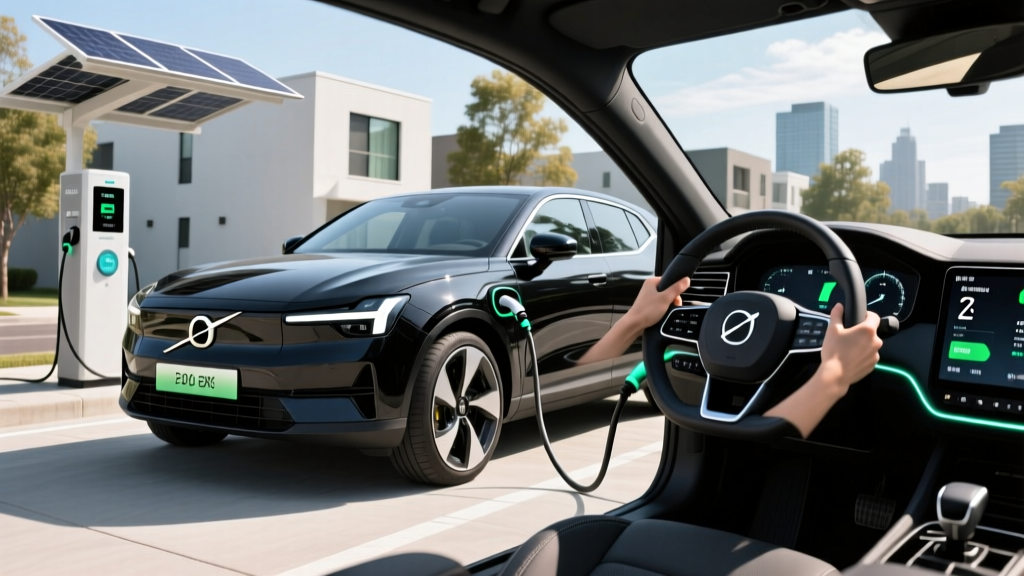
The Volvo EX40 (formerly the C40 Recharge) occupies a specific niche in the premium compact electric SUV segment: Scandinavian design, standard all-wheel drive, and a Google-built infotainment system, all wrapped in a coupe-like silhouette. For the 2025 model year, Volvo extended the battery pack, pushed range past 290 miles on most trims, and improved DC fast-charge speeds. Now badged as the EX40 for 2026, the question is whether these updates make it competitive against the Tesla Model Y, BMW iX1, and Genesis GV60.
We've compiled the exact specs — EPA range, battery chemistry, charge curves, pricing, and federal tax credit eligibility — so you can evaluate the EX40 on numbers, not marketing.
Volvo EX40 Specs at a Glance
| Spec | EX40 Core / Plus | EX40 Ultra |
|---|---|---|
| EPA Range | 296 mi (est.) | 293 mi (est.) |
| Battery (usable) | 79 kWh, NMC lithium-ion | |
| Drivetrain | Dual-motor AWD | |
| Horsepower | 402 hp | |
| 0–60 mph | 4.5 seconds | |
| DC Fast Charge (peak) | 200 kW | |
| 10–80% DC Charge Time | ~28 minutes | |
| Level 2 Home Charge | 11 kW (~33 mi/hr) | |
| EPA Efficiency | 98 MPGe / 34 kWh/100 mi | |
| Cargo (rear seats up) | 14.6 cu ft | |
| Cargo (seats folded) | 49.8 cu ft | |
| Frunk | 1.1 cu ft | |
| Base MSRP | $55,050 | $60,350 |
| Battery Warranty | 8 yr / 100,000 mi | |
Range and Efficiency: EPA vs. the Real World
EPA Estimate: 296 miles (Core/Plus), 293 miles (Ultra with 20" wheels)
Real-World Expectation: Plan for 250–270 miles on sustained highway driving at 70+ mph. In freezing temperatures (below 32°F), expect a 20–30% reduction, dropping effective range to roughly 200–230 miles. City driving with regenerative braking recovers closer to the EPA sticker.
The EX40's 79 kWh usable NMC (nickel manganese cobalt) battery is a meaningful upgrade from the earlier 75 kWh pack in the C40 Recharge. NMC chemistry offers higher energy density than LFP (lithium iron phosphate), which keeps the pack compact, though it does not tolerate frequent 100% charges as well — Volvo recommends daily charging to 80–90% for longevity.
Efficiency lands at approximately 98 MPGe combined (34 kWh per 100 miles), which is competitive but not class-leading. The Tesla Model Y Long Range AWD achieves 111 MPGe combined on a similarly sized battery, owing partly to its lighter curb weight and more aerodynamic profile. The EX40's boxy rear end and coupe roofline create more drag at highway speeds, which is where you'll feel the range penalty most.
Charging Speed: DC Fast and Level 2 Home Charging
| Charging Level | Power | Speed / Time | Connector |
|---|---|---|---|
| Level 1 (120V outlet) | ~1.4 kW | ~4 mi/hr | J1772 / NACS (adapter) |
| Level 2 (240V home) | 11 kW | ~33 mi/hr (full in ~8 hrs) | J1772 / NACS |
| DC Fast Charge | Peak 200 kW | 10–80% in ~28 min | CCS1 / NACS (adapter) |
The 200 kW peak DC fast-charge rate is a notable improvement over the prior-generation C40's 150 kW ceiling. On a 350 kW Electrify America or Tesla Supercharger (via NACS adapter), the EX40 will sustain roughly 175–190 kW through the 20–60% state-of-charge window, then taper progressively. Expect the final 60–80% segment to pull closer to 90–110 kW, which is why the 10–80% time stretches to 28 minutes rather than the theoretical minimum.
For home charging, the 11 kW onboard charger is a strong point. A full charge from empty takes about 8 hours on a 48-amp Level 2 circuit — meaning you can arrive home at 10 PM with a low battery and wake up fully charged by 6 AM. If your home panel only supports a 32-amp circuit (7.7 kW), plan for roughly 11 hours for a full charge. Consult a licensed electrician to assess whether your panel can support a 60-amp dedicated circuit for the full 11 kW benefit.
Note: kW (kilowatts) measures charging power — how fast energy flows. kWh (kilowatt-hours) measures battery capacity — how much energy is stored. The EX40 charges at up to 200 kW into a 79 kWh battery.
Performance and Driving Dynamics
Every 2026 EX40 comes with dual motors and all-wheel drive — there is no single-motor RWD variant. The combined output is 402 horsepower and 494 lb-ft of torque, launching the EX40 from 0–60 mph in 4.5 seconds. That's brisk by any measure, and the instant torque delivery makes highway merging and city acceleration effortless.
Ride quality leans firm but composed. The low center of gravity from the under-floor battery pack keeps body roll in check on twisty roads, and the steering is precise if slightly numb. Volvo's one-pedal driving mode (aggressive regenerative braking) is well-calibrated — it brings the car to a near-stop without touching the brake pedal, though it won't hold the car at a complete stop on inclines like some competitors.
What the EX40 does not offer: adaptive air suspension, a sport-tuned chassis mode, or any pretense of track capability. This is a comfort-oriented luxury cruiser, not a performance EV in the Porsche Macan Electric mold.
Interior, Tech, and Cargo Practicality
The cabin follows Volvo's minimalist Scandinavian ethos: clean lines, high-quality materials (including available wool-blend upholstery), and a portrait-oriented 9-inch touchscreen running Google Built-In. This means native Google Maps navigation (with real-time EV routing and charger preconditioning), Google Assistant voice control, and access to the Play Store for apps like Spotify and YouTube (parked only).
Notable tech features include:
- Standard 12.3-inch digital driver display
- Google Built-In infotainment with OTA updates
- Harman Kardon premium audio (13 speakers, Ultra trim)
- Pilot Assist (SAE Level 2 adaptive cruise + lane centering)
- 360-degree surround camera with top-down view
- Wireless Apple CarPlay (Android Auto integrated natively via Google)
- Heat pump (standard) for improved cold-weather efficiency
ADAS Clarification: Volvo's Pilot Assist is an SAE Level 2 driver-assistance system. It provides adaptive cruise control and lane centering, but the driver must remain fully engaged with hands on the wheel and eyes on the road at all times. It is not autonomous or "self-driving."
Cargo space is the EX40's most obvious compromise. The coupe-like roofline cuts into rear storage: 14.6 cubic feet behind the rear seats and 49.8 cubic feet with the 60/40 split seats folded. The frunk (front trunk) is a shallow 1.1 cubic feet — enough for a charging cable bag, not a carry-on. For comparison, the Tesla Model Y offers 30.2 cu ft rear and 76.2 cu ft total. If you regularly haul bulky cargo or a stroller, the EX40's sibling — the boxier EX90 or the XC40-based EX40 with a more upright roofline — may serve you better.
Rear-seat legroom is 36.1 inches, adequate for adults on shorter trips but tighter than the Model Y (40.5 in). Headroom is also reduced by the sloping roofline for passengers over 6 feet tall.
Pricing, Trims, and Federal Tax Credit Eligibility
| Trim | Base MSRP | Est. Destination | Total Before Credit | Est. After §30D Credit* |
|---|---|---|---|---|
| Core | $55,050 | $1,295 | $56,345 | ~$48,845 |
| Plus | $57,550 | $1,295 | $58,845 | ~$51,345 |
| Ultra | $60,350 | $1,295 | $61,645 | ~$54,145 |
*Federal tax credit eligibility depends on multiple factors. See checklist below.
The EX40 qualifies as an SUV under IRS vehicle-classification rules, meaning it falls under the $80,000 MSRP cap for SUVs, vans, and pickup trucks (as defined under IRS §30D). All three trims clear that threshold comfortably.
- MSRP Cap: Must be ≤ $80,000 for SUVs. All EX40 trims qualify. ✓
- Buyer Income Limits (MAGI): $300,000 joint filers / $225,000 head of household / $150,000 single. Verify with a tax professional.
- Battery Sourcing: Critical minerals and battery components must meet phased-in percentages from U.S. or FTA-partner countries. Volvo sources NMC cells primarily from CATL and LG Energy Solution — confirm current-year sourcing compliance on the fueleconomy.gov credit lookup.
- Point-of-Sale Transfer: As of 2024+, you can transfer the credit to the dealer at purchase, reducing your out-of-pocket cost immediately rather than waiting for tax filing. The dealer must be IRS-registered.
- Final Assembly: Must occur in North America. The EX40 is assembled in Ghent, Belgium — this may disqualify it from the §30D credit. Verify current assembly location on the IRS eligible vehicle list before purchase.
Critical caveat: Because the EX40 is built in Belgium, it may not meet the North American final assembly requirement for the full $7,500 federal credit. Volvo has been shifting production of some EV models, so confirm the specific VIN's eligibility with your dealer and cross-reference the IRS eligible vehicle list before committing. If the EX40 does not qualify, the effective price increases significantly compared to U.S.-assembled competitors like the Tesla Model Y (Austin, TX) or the Hyundai Ioniq 5 (Ellabell, GA).
How the EX40 Stacks Up Against Key Competitors
| Spec | Volvo EX40 Ultra | Tesla Model Y LR AWD | Genesis GV60 Advanced | BMW iX xDrive50 |
|---|---|---|---|---|
| EPA Range | 293 mi | 330 mi | 294 mi | 324 mi |
| Battery (usable) | 79 kWh (NMC) | ~75 kWh (NMC) | 77.4 kWh (NMC) | 111.5 kWh (NMC) |
| Peak DC Charge | 200 kW | 250 kW | 233 kW | 195 kW |
| 0–60 mph | 4.5 sec | 4.8 sec | 5.5 sec | 4.4 sec |
| HP | 402 | 384 | 314 | 516 |
| Cargo (rear up) | 14.6 cu ft | 30.2 cu ft | 24.0 cu ft | 35.5 cu ft |
| Base MSRP | $60,350 | $48,590 | $53,350 | $87,250 |
| U.S. Assembly | No (Belgium) | Yes (Texas) | No (Korea) | No (Germany) |
The EX40's closest rival is the Genesis GV60 — similar in size, price, and Korean/European assembly (no §30D credit either). The Model Y wins decisively on range, cargo space, charging speed, and tax-credit eligibility. The BMW iX is larger, far more expensive, but offers superior range and a more spacious cabin.
The EX40's edge is design and interior ambiance. If you prioritize Scandinavian luxury, tactile quality, and understated styling over maximum range or cargo volume, the Volvo makes a compelling case. If practicality and lowest total cost dominate your decision, the Model Y is the spreadsheet winner.
Warranty, Ownership Costs, and Long-Term Battery Outlook
Volvo covers the EX40's battery and drive components with an 8-year / 100,000-mile warranty, with a capacity retention threshold of 70%. If the battery degrades below 70% of its original 79 kWh capacity within that window, Volvo will repair or replace it. The bumper-to-bumper limited warranty runs 4 years / 50,000 miles, and complimentary scheduled maintenance is included for 3 years / 36,000 miles.
Based on industry data from sources like Recurrent Auto, modern NMC packs with active thermal management (like the EX40's) typically retain 85–92% capacity after 100,000 miles. The heat pump and liquid cooling system help mitigate degradation from fast charging and extreme temperatures.
Insurance premiums for the EX40 run higher than average for the compact luxury SUV class — expect $1,800–$2,400 annually depending on your profile, per industry estimates. EVs generally carry higher collision and comprehensive costs due to battery replacement expense and specialized repair networks.
Pros and Cons: The Honest Summary
Pros
- Standard 402-hp dual-motor AWD on every trim
- Google Built-In infotainment with native EV route planning
- Premium Scandinavian interior with available wool-blend seats
- Heat pump standard (better cold-weather range retention)
- 11 kW Level 2 onboard charger (faster than many rivals)
- 8-yr/100,000-mi battery warranty with 70% retention guarantee
- Distinctive coupe-SUV styling stands out in a sea of crossovers
Cons
- Limited cargo space (14.6 cu ft rear, small frunk)
- Tight rear-seat headroom for tall passengers
- Belgian assembly may disqualify from $7,500 federal tax credit
- EPA range trails Tesla Model Y and BMW iX
- 200 kW peak DC charge rate is average, not class-leading
- No hands-free driving system (Pilot Assist requires hands-on)
- 9-inch touchscreen is small for the price point
Who Should Buy the Volvo EX40?
Choose the EX40 if: You want a stylish, premium compact electric SUV with standard AWD, value interior quality over maximum cargo space, have reliable home Level 2 charging, and primarily commute or take moderate-length road trips (under 250 miles between stops).
Look elsewhere if: You need maximum range for frequent 300+ mile road trips (Tesla Model Y or BMW iX), require substantial cargo room for family gear, or depend on the $7,500 federal tax credit to make the math work — the Belgian assembly is a real risk to eligibility.
Frequently Asked Questions
What is the real-world range of the Volvo EX40?
The EPA rates the EX40 at 293–296 miles depending on trim and wheel size. In real-world mixed driving, expect 250–270 miles on the highway at 70+ mph, and as low as 200–230 miles in sub-freezing temperatures. City driving with regenerative braking recovers closer to the EPA number.
How fast does the EX40 charge at home and on DC fast chargers?
At home on a 240V Level 2 charger (48-amp circuit), the EX40 charges at 11 kW, adding roughly 33 miles of range per hour — a full charge takes about 8 hours. On DC fast chargers, it peaks at 200 kW, reaching 10–80% in approximately 28 minutes. Actual speed depends on charger output, battery temperature, and state of charge.
Does the Volvo EX40 qualify for the $7,500 federal EV tax credit?
Possibly, but it's uncertain. The EX40 meets the MSRP cap ($80,000 for SUVs) and may meet battery-sourcing requirements, but it is assembled in Ghent, Belgium. The §30D credit requires North American final assembly. Check the IRS eligible vehicle list and confirm with your dealer before purchasing. State and local incentives may still apply — check your jurisdiction's energy office.
How does the EX40 compare to the Tesla Model Y?
The Model Y offers more range (330 vs. 293 mi), significantly more cargo space (30.2 vs. 14.6 cu ft), faster DC charging (250 vs. 200 kW), a lower starting price ($48,590 vs. $55,050), and qualifies for the full federal tax credit. The EX40 counters with a more premium interior, standard heat pump, distinctive styling, and Google Built-In infotainment. If specs-per-dollar matter most, the Model Y wins. If interior ambiance and design matter more, the EX40 has an edge.
Is the EX40's battery NMC or LFP, and does that matter?
The EX40 uses an NMC (nickel manganese cobalt) battery. NMC offers higher energy density than LFP, keeping the pack compact and range high. However, NMC degrades slightly faster if routinely charged to 100%. Volvo recommends daily charging to 80–90% and reserving 100% for long trips. The 8-year/100,000-mile warranty (70% retention) provides long-term peace of mind.
What is the Volvo EX40's towing capacity?
The EX40 is rated to tow up to 2,000 pounds when properly equipped — sufficient for a small utility trailer or a pair of dirt bikes, but not a camper or boat. If towing is a priority, look at the Volvo EX90 (up to 5,000 lb) or the Rivian R1S.
Sources: EPA Fuel Economy, Volvo Cars USA, IRS §30D Clean Vehicle Credit. All specifications reflect 2025/2026 model year data available at time of publication. Confirm final specs, pricing, and tax-credit eligibility with your dealer and a qualified tax professional before purchase.