Quick Verdict: A Tech-Forward Subcompact EV With Google Built-In
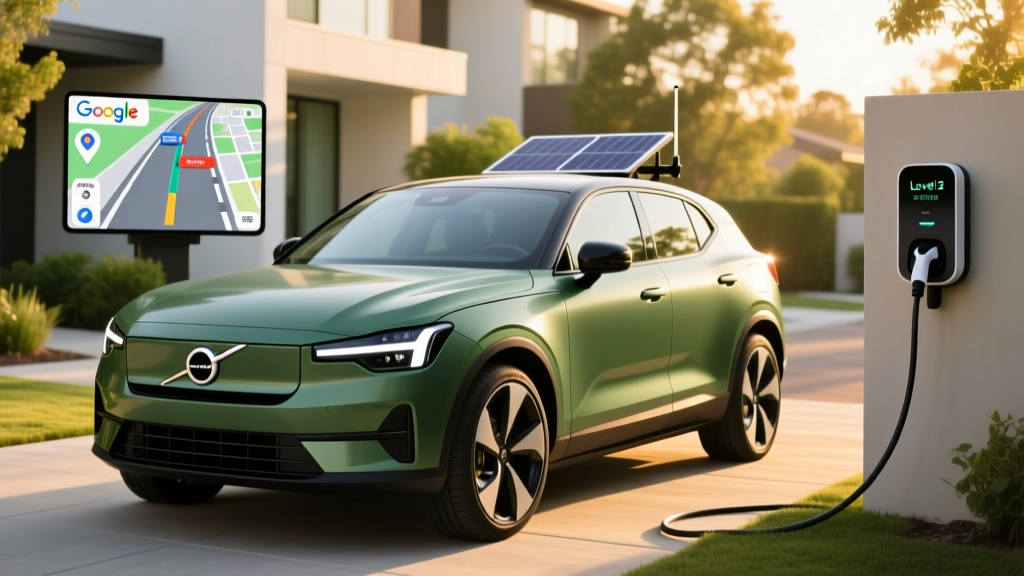
The 2026 Volvo EX30 is the Swedish brand's entry into the fiercely competitive subcompact electric crossover segment, and it leads with one of the most seamless infotainment integrations on the market: Google Maps with lane assist baked directly into the instrument cluster and center stack via Google Built-In. For EV buyers who want turn-by-turn navigation that automatically factors in battery state of charge, charging stops, and lane-level guidance on complex highway interchanges, the EX30 delivers a genuinely useful daily-driver experience. But beneath the software story lies a capable electric powertrain with 261 miles of EPA-estimated range (Single Motor Extended Range), a 69 kWh NMC battery, and DC fast charging that peaks at 153 kW. Let's break down whether the numbers add up for your next EV purchase.
Range, Battery, and Real-World Efficiency
The 2026 EX30 is offered in two powertrain configurations, each with distinct range and performance profiles:
| Spec | Single Motor Extended Range | Twin Motor Performance (AWD) |
|---|---|---|
| EPA Range | 261 miles | 242 miles |
| Battery (Usable) | 69 kWh (NMC) | 69 kWh (NMC) |
| Efficiency (MPGe) | 110 MPGe combined | 102 MPGe combined |
| Efficiency (kWh/100 mi) | 30 kWh/100 mi | 33 kWh/100 mi |
| Drivetrain | RWD (single motor) | AWD (dual motor) |
| Horsepower | 272 hp | 422 hp |
| 0-60 mph | 5.3 seconds | 3.4 seconds |
The 69 kWh usable battery uses NMC (nickel manganese cobalt) chemistry, which offers higher energy density than LFP but requires more careful long-term state-of-charge management. Volvo recommends charging to 80% for daily use and reserving 100% charges for road trips — a practice that extends NMC battery longevity. The EX30 includes a configurable charge-limit setting in the infotainment system to automate this.
For efficiency context, the Single Motor's 30 kWh/100 mi is competitive with the Hyundai Kona Electric (28 kWh/100 mi) and slightly less efficient than the Tesla Model Y RWD (27 kWh/100 mi), reflecting the EX30's boxier crossover proportions and standard heat pump inclusion across all trims.
Charging Speed: DC Fast, Level 2, and Level 1
Charging performance is where the EX30's 400-volt architecture shows its limitations compared to 800V rivals like the Hyundai Ioniq 5 or Kia EV6, but the numbers remain practical for most owners.
| Charging Level | Max Power | Speed / Time | Connector |
|---|---|---|---|
| DC Fast Charge | 153 kW (peak) | 10-80% in ~26.5 minutes | CCS1 (NACS adapter available) |
| Level 2 (Home/Public AC) | 11 kW | ~7 hours (0-100%); ~37 mi/hr | J1772 / NACS |
| Level 1 (120V Household) | ~1.4 kW | ~5 mi/hr added | Standard outlet |
Charging curve reality: The 153 kW peak rate is achievable between roughly 10-40% state of charge. From 40-60%, the rate tapers to approximately 110-120 kW, and above 80% it drops significantly to protect the NMC cells. On a road trip, the 10-80% time of about 26.5 minutes means a typical rest stop covers a meaningful charge — but it's not the 18-minute sprints you'll find on 800V platforms.
For home charging, the 11 kW onboard charger is a strong point. A Level 2 wallbox (48A circuit, hardwired) will replenish the full 69 kWh battery overnight in roughly seven hours. This is faster than the Tesla Model Y's 11.5 kW and competitive within the segment. Most EX30 owners charging at home each morning will rarely need the full seven hours — a typical 40-mile daily commute requires only about 1.5 hours of Level 2 charging.
Google Maps With Lane Assist and Standout Tech
The EX30 runs Google Built-In as its native infotainment platform, which means Google Maps is not a phone projection — it's the car's actual navigation system. This integration delivers several EV-specific advantages:
- EV-aware routing: Google Maps automatically calculates routes based on current battery state of charge, elevation changes, ambient temperature, and available charging stations along your path.
- Lane assist on the driver display: Lane-level guidance appears on the 12.3-inch instrument cluster, showing exactly which lane to occupy for upcoming highway splits, exits, and complex interchanges. This is especially useful in unfamiliar metro areas.
- Battery preconditioning: When Google Maps routes you to a DC fast charger, the EX30 automatically begins preconditioning the battery thermal system to optimize charge speed upon arrival.
- Google Assistant voice control: "Hey Google, find the nearest Electrify America station" works natively without touching the screen.
The center stack is dominated by a 12.3-inch portrait touchscreen that consolidates nearly all vehicle controls — climate, mirrors, glovebox release, and drive settings — into the interface. There is no traditional instrument cluster behind the steering wheel; instead, a compact display strip at the top of the windshield shows speed, range, and navigation prompts. This minimalist approach is polarizing: some drivers love the clean aesthetic, while others miss dedicated physical buttons for climate and volume.
Driver assistance (SAE Level 2): The EX30 comes standard with Volvo's Pilot Assist suite, which includes adaptive cruise control, lane centering, and automatic emergency braking. The optional Pilot Assist with Lane Support adds more assertive lane-keeping on highways. This is SAE Level 2 driver assistance — you must keep your hands on the wheel and eyes on the road at all times. It is not autonomous driving.
Pricing, Trims, and Federal Tax Credit Eligibility
The 2026 Volvo EX30 starts at an accessible price point for a premium-badge EV, though trim escalation moves it into more competitive territory.
| Trim | Powertrain | MSRP | Est. After §30D Credit* |
|---|---|---|---|
| Core (Single Motor ER) | RWD, 272 hp | $36,345 | ~$28,845 |
| Plus (Single Motor ER) | RWD, 272 hp | $39,345 | ~$31,845 |
| Ultra (Twin Motor) | AWD, 422 hp | $44,995 | ~$37,495 |
| Ultra (Single Motor ER) | RWD, 272 hp | $42,345 | ~$34,845 |
*Federal tax credit estimates assume buyer eligibility under current IRS §30D rules. The full $7,500 credit requires meeting all battery-sourcing and critical-mineral requirements, buyer income caps ($150K single / $300K joint MAGI), and the vehicle's MSRP must not exceed $80,000 for SUVs (the EX30 qualifies). Credit can be transferred to the dealer at point of sale as an immediate price reduction. Verify eligibility with a tax professional and Volvo's credit-estimator tool before purchase.
The Core trim at ~$28,845 after credit is one of the most affordable premium EVs on the market, undercutting the Tesla Model Y Long Range by a significant margin and competing directly with the Hyundai Kona Electric and Chevrolet Equinox EV on price. The Ultra Twin Motor at ~$37,495 after credit offers supercar-rivaling 3.4-second 0-60 times at a fraction of the cost.
Interior Space, Cargo, and Practicality
The EX30 is Volvo's smallest SUV, and its dimensions reflect a city-oriented design brief:
- Cargo volume (behind rear seats): 11.2 cu ft
- Cargo volume (rear seats folded): 32.9 cu ft
- Front trunk (frunk): 2.5 cu ft (enough for a charging cable bag)
- Rear legroom: 35.7 inches
- Front headroom: 39.4 inches
- Wheelbase: 103.9 inches
- Overall length: 166.7 inches
For context, the 11.2 cu ft of cargo space behind the rear seats is tight — comparable to a Honda HR-V and significantly less than the Tesla Model Y's 30.2 cu ft. If you regularly haul strollers, hockey bags, or Costco runs, the EX30 will feel limiting. However, for singles, couples, or small families whose cargo needs are modest, the compact footprint makes the EX30 exceptionally easy to park and maneuver in urban environments.
The rear seats accommodate two adults comfortably for short trips, but taller passengers (6'0"+) will find headroom snug due to the sloping roofline. The flat floor (no transmission tunnel) helps with middle-seat foot space, though Volvo designates the EX30 as a four-seater in practice.
Warranty, Battery Coverage, and Long-Term Ownership
Volvo backs the EX30 with warranty coverage that matches industry standards:
- Battery warranty: 8 years / 100,000 miles (whichever comes first), covering capacity retention below 70% of original state of health
- Powertrain warranty: 4 years / 50,000 miles
- Bumper-to-bumper: 4 years / 50,000 miles
- Corrosion warranty: 12 years, unlimited mileage
- Roadside assistance: 4 years / unlimited mileage
The 70% battery capacity retention threshold is standard for the industry (matching Tesla, Hyundai, and BMW). Real-world NMC degradation data from fueleconomy.gov and owner surveys suggest most modern NMC packs lose approximately 8-12% capacity over the first 100,000 miles when charged responsibly (avoiding frequent 100% charges and extreme heat exposure). The EX30's thermal management system includes active liquid cooling and heating to mitigate temperature-related degradation.
Volvo also includes complimentary scheduled maintenance for the first 3 years / 36,000 miles, which covers cabin air filter replacement, brake fluid checks, and tire rotation — a meaningful ownership-cost offset compared to non-premium competitors.
Pros, Cons, and Who Should Buy the EX30
Pros
- Google Maps with lane assist and EV-aware routing is genuinely best-in-class
- Core trim under $29K after federal tax credit — exceptional value for a premium EV
- 11 kW Level 2 onboard charger (faster than many competitors)
- Twin Motor AWD hits 0-60 in 3.4 seconds — fastest Volvo ever produced
- Compact footprint ideal for urban parking and city commuting
- Standard heat pump across all trims improves cold-weather efficiency
- Volvo's strong safety reputation and standard Pilot Assist suite
Cons
- Cargo space (11.2 cu ft) is among the smallest in the EV crossover segment
- 153 kW peak DC charging is outpaced by 800V rivals (Ioniq 5: 240 kW)
- Nearly all controls funneled through touchscreen — no physical volume knob or climate buttons
- Rear seat headroom is tight for taller passengers
- No rear wiper (an omission that frustrates in rain/snow)
- 400V architecture limits future charging-infrastructure upside
Look elsewhere if: You need family-hauler cargo capacity (consider the Tesla Model Y or Hyundai Ioniq 5), you road-trip frequently and want the fastest possible DC charging (Ioniq 5/EV6 with 800V), or you prefer physical buttons and knobs for climate and audio controls.
Competitor Comparison: EX30 vs. the Subcompact EV Field
| Spec | 2026 Volvo EX30 (SM ER) | 2026 Hyundai Kona Electric | 2026 Tesla Model Y (LR RWD) |
|---|---|---|---|
| EPA Range | 261 mi | 261 mi | 320 mi |
| Battery | 69 kWh (NMC) | 65.4 kWh (NMC) | 75 kWh (LFP) |
| DC Fast Charge (peak) | 153 kW | 100 kW | 250 kW |
| 10-80% Time | ~26.5 min | ~43 min | ~22 min |
| Level 2 Charger | 11 kW | 10.9 kW | 11.5 kW |
| 0-60 mph | 5.3 sec | 7.5 sec | 6.6 sec |
| Cargo (behind rear) | 11.2 cu ft | 25.5 cu ft | 30.2 cu ft |
| Base MSRP | $36,345 | $34,990 | $44,990 |
| Navigation | Google Maps built-in | Hyundai w/ EV routing | Tesla Nav |
The EX30 and Kona Electric tie on EPA range, but the EX30 charges significantly faster (153 kW vs. 100 kW) and accelerates more briskly (5.3s vs. 7.5s). The Kona wins decisively on cargo space — nearly 2.5x more than the EX30. The Tesla Model Y dominates on range and cargo but costs roughly $8,600 more before credits. For buyers who value infotainment integration and the Google Maps with lane assist experience, the EX30 has no direct rival in this price bracket.
Frequently Asked Questions
What is the real-world range of the 2026 Volvo EX30?
The Single Motor Extended Range model carries a 261-mile EPA estimate. In real-world mixed driving at moderate temperatures, expect 230-250 miles. Sustained highway driving at 75 mph reduces this to roughly 220-235 miles. Cold weather (below freezing) can drop range by 15-25%, yielding approximately 195-220 miles depending on cabin heating usage and whether you precondition the battery while plugged in.
How fast does the EX30 charge at home and on the road?
On a DC fast charger, the EX30 peaks at 153 kW and charges from 10-80% in approximately 26.5 minutes. At home on a Level 2 wallbox (240V, 48A), the 11 kW onboard charger adds roughly 37 miles of range per hour and fills the full 69 kWh battery in about 7 hours. On a standard 120V outlet (Level 1), expect about 5 miles of range per hour — suitable only for emergency trickle charging.
Does the 2026 Volvo EX30 qualify for the federal EV tax credit?
The EX30's MSRP (all trims under $45,000) falls well below the IRS §30D SUV cap of $80,000. However, full $7,500 credit eligibility depends on battery-component sourcing and critical-mineral requirements that change annually. Buyer income must not exceed $150,000 (single) or $300,000 (joint) modified adjusted gross income. Check the current IRS clean vehicle credit page and consult a tax professional before relying on the credit. If eligible, the credit can be transferred to Volvo at point of sale for an immediate price reduction.
How does Google Maps with lane assist work in the EX30?
Google Maps runs natively on the EX30's Google Built-In platform — not as a phone projection. Lane assist displays lane-level guidance on the driver information strip, showing which lane to occupy for upcoming exits, merges, and highway splits. The system also provides EV-aware routing that accounts for battery charge, terrain, weather, and charger availability, automatically adding charging stops when needed for longer trips.
Is the Volvo EX30 worth buying over competitors?
The EX30 is worth serious consideration if you want a premium, compact EV with top-tier infotainment (Google Maps with lane assist is a genuine differentiator), strong acceleration, and a post-credit price under $30K on the Core trim. It's less compelling if cargo capacity is a priority — the Kona Electric and Model Y offer substantially more room. For frequent road-trippers, the 153 kW DC charge rate is adequate but not class-leading; the Ioniq 5's 800V architecture charges meaningfully faster.
Is Volvo Pilot Assist self-driving?
No. Pilot Assist is an SAE Level 2 driver-assistance system. It provides adaptive cruise control and lane centering on highways, but you must remain fully engaged — hands on the wheel, eyes on the road. It cannot navigate autonomously, handle construction zones independently, or operate without driver supervision. Only Level 4 services like Waymo operate without a human driver.