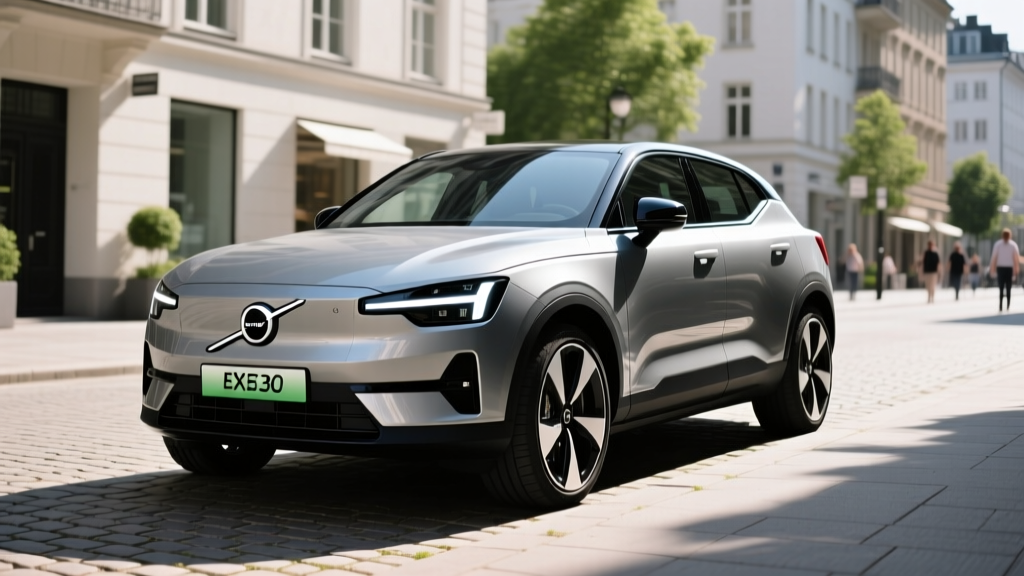
The 2026 Volvo EX30 occupies an unusual space in the American EV market. It is simultaneously one of the most globally significant battery-electric vehicles Volvo has ever produced and one of the smallest EVs available in the U.S. Built on Geely's SEA platform in China, the EX30 became a volume leader in European markets within its first year on sale, and Volvo is counting on that momentum to translate stateside. As a global BEV designed to meet the regulatory, pricing, and practical demands of buyers from Stockholm to São Paulo, the EX30 raises a specific question for American shoppers: does a compact, internationally optimized crossover make sense when domestic competitors offer more space and longer range?
After spending time with the EX30 across city commuting, highway cruising, and DC fast-charging sessions, we have the data to answer that question with specifics — not marketing copy.
Quick Verdict: Who the EX30 Is Actually For
The 2026 Volvo EX30 is best understood as a premium urban EV for singles, couples, or small households that prioritize build quality, Scandinavian design, and maneuverability over maximum range and cargo volume. It is not a road-trip vehicle. It is not a family hauler. It is a precisely engineered city car that happens to wear a luxury badge and price itself aggressively against the Hyundai Kona Electric, MINI Countryman SE, and Tesla Model Y.
Choose the EX30 if: You commute under 40 miles daily, value interior material quality, want a compact footprint for tight parking, and can charge at home nightly.
Look elsewhere if: You regularly drive 200+ miles between charges, need rear-seat space for adults, tow anything, or want the longest possible range per dollar.
Range, Battery, and Real-World Efficiency
The U.S.-spec 2026 EX30 is offered exclusively with the Extended Range battery — a 69 kWh (gross) / 64 kWh (usable) NMC (nickel-manganese-cobalt) lithium-ion pack. European and Asian markets also receive a 51 kWh Standard Range variant using LFP (lithium iron phosphate) chemistry, but that version is not sold in the United States.
| Specification | EX30 Single Motor Extended Range |
|---|---|
| EPA Range | 265 miles |
| Battery (Usable / Gross) | 64 kWh / 69 kWh |
| Chemistry | NMC (Extended Range) |
| MPGe (City / Hwy / Combined) | 124 / 103 / 114 MPGe |
| Efficiency | 29 kWh / 100 mi |
| Drivetrain | RWD, single rear motor |
| Horsepower | 268 hp |
| 0–60 mph | 5.1 seconds |
Real-World Range Reality: The EPA rates the EX30 Extended Range at 265 miles. In mixed driving at moderate temperatures (55–75°F), expect 240–255 miles. On sustained 70–75 mph highway runs, plan for 215–230 miles — the compact frontal area helps, but small batteries lose proportionally more to high-speed aero drag. In freezing temperatures (below 32°F) without preconditioning, range can drop to 180–200 miles. The EX30's heat pump is standard and mitigates some cold-weather loss, but physics favors larger packs in winter.
Efficiency of 29 kWh/100 miles is competitive with the Kona Electric and slightly better than the heavier Tesla Model Y RWD. For a commuter charging at $0.14/kWh (national residential average), that translates to roughly $0.041 per mile — about one-third the fuel cost of a 30 MPG gas car at $3.50/gallon.
Charging Speed: DC Fast, Level 2, and Level 1
Charging speed is where the EX30 reveals its global-BEV engineering priorities. The NMC Extended Range pack supports a peak DC fast-charge rate of 153 kW, which is modest against rivals like the Hyundai Ioniq 5 (240 kW) or Tesla Model Y (250 kW), but adequate for the battery size.
| Charge Level | Power / Rate | Time or Miles Added |
|---|---|---|
| Level 1 (120V, 12A) | ~1.4 kW | ~4 miles per hour |
| Level 2 (240V, 48A) | 11 kW | ~37 miles per hour; 0–100% in ~7 hours |
| DC Fast Charge (peak) | 153 kW | 10–80% in ~26 minutes |
The 10–80% time of approximately 26 minutes is honest — not class-leading, but not slow. The charge curve holds near peak rate through roughly 40% SoC before tapering. Expect sustained rates of 100–120 kW through the mid-charge window, dropping to ~50 kW above 80%. For a 64 kWh usable pack, this means a typical road-trip stop adds about 130 miles of range in 20 minutes.
The 11 kW onboard AC charger is a strong point for home Level 2 charging. On a 48-amp home charger, a full overnight replenishment takes roughly 7 hours — easily manageable for any driver who plugs in at night. Note that the EX30 uses the NACS (Tesla-style) connector for U.S. models starting with the 2025 production run, giving it native access to the Tesla Supercharger network without an adapter.
Performance and Driving Dynamics
The single-motor RWD EX30 produces 268 hp and 253 lb-ft of torque, channeled to the rear wheels. The 5.1-second 0–60 mph time is brisk for a sub-4,000-lb crossover and quicker than the Kona Electric (6.8 sec) and MINI Countryman SE (7.4 sec). Only the Tesla Model Y RWD (5.8 sec) and dual-motor EX30 Twin Motor variant (3.4 sec, available in select markets) challenge it in this segment.
On the road, the EX30 feels planted and composed — the low center of gravity from the skateboard battery layout gives it confident cornering for its ride height. Steering is light but precise, ideal for urban maneuvering. The 35.1-foot turning circle is tight enough for narrow streets and parking garages. Ride quality is firm but controlled; Volvo's tuning favors European-style body control over American plush isolation.
Regenerative braking offers two modes — a standard deceleration setting and a stronger one-pedal driving mode that brings the car to a complete stop. The transition between regen and friction braking is smooth, without the grabby feel that plagues some competitors.
Interior, Cargo, and Technology
The EX30's cabin follows Volvo's "less is more" philosophy to an extreme. The centerpiece is a single 12.3-inch portrait touchscreen running Google built-in (Android Automotive OS), which handles navigation, media, climate, and vehicle settings. There is no separate instrument cluster — speed and drive information appear in a slim bar at the top of the central screen. This is polarizing: some owners adapt quickly, others miss a dedicated speedometer in their sightline.
Material quality punches above the EX30's price class. Volvo uses recycled and bio-based materials — denim-textile upholstery, recycled-plastic trim, and flax-based panels — that feel premium without traditional leather. The optional Harman Kardon soundbar mounted across the dash is a clever packaging solution that saves door-panel space.
| Dimension | Measurement |
|---|---|
| Front Legroom | 41.7 in |
| Rear Legroom | 33.1 in |
| Cargo (behind rear seats) | 11.2 cu ft |
| Cargo (rear seats folded) | 32.9 cu ft |
| Frunk | 1.2 cu ft (charge cables only) |
| Wheelbase | 104.3 in |
| Overall Length | 166.7 in |
The cargo area is the EX30's most significant practical limitation. At 11.2 cu ft behind the rear seats, it trails the Kona Electric (25.5 cu ft) and Model Y (30.2 cu ft) substantially. This is a city car first; weekend warriors hauling gear will notice the deficit immediately. Rear legroom of 33.1 inches is adequate for children and shorter adults on trips under an hour but tight for taller passengers on longer drives.
Driver Assistance and Safety
Volvo's Pilot Assist system provides adaptive cruise control with lane-centering — a Level 2 SAE driver-assist feature that requires hands-on-wheel engagement at all times. It performs competently on highways but does not approach the lane-change confidence of Tesla Autopilot or GM Super Cruise. The EX30 also includes standard automatic emergency braking, run-off-road protection (a Volvo signature), blind-spot monitoring, and a 360-degree camera system.
Important: Pilot Assist is an SAE Level 2 system. It does not drive itself. You must keep your hands on the wheel and remain fully attentive. It will not stop for all obstacles, navigate construction zones autonomously, or handle unmapped roads.
The EX30 earned a 2024 Euro NCAP 5-star rating, and IIHS testing for the U.S. market is ongoing as of early 2026.
Pricing, Trims, and Federal Tax Credit Eligibility
Volvo prices the 2026 EX30 in three U.S. trims, all with the Extended Range NMC battery and single-motor RWD:
| Trim | Base MSRP | Key Additions |
|---|---|---|
| Core | $36,345 | 18" wheels, Pilot Assist, Google built-in, heat pump |
| Plus | $40,145 | 19" wheels, panoramic roof, 360° camera, Harman Kardon |
| Ultra | $44,745 | 20" wheels, pixel LED headlights, premium upholstery |
A destination charge of $1,195 applies to all trims.
Federal Tax Credit (§30D) Status
The 2026 EX30's eligibility for the $7,500 federal EV tax credit under IRS §30D is complex and subject to change. Key considerations:
- MSRP Cap: The EX30 qualifies — it is classified as an SUV and all trims fall below the $80,000 MSRP cap for SUVs/trucks.
- Buyer Income Cap: Adjusted gross income must not exceed $150,000 (single), $225,000 (head of household), or $300,000 (joint filers).
- Battery Sourcing: The EX30 is manufactured in China. Under current §30D rules, vehicles with battery components manufactured by a "foreign entity of concern" (FEOC) may be disqualified from the full credit. As of the 2026 tax year, verify eligibility on fueleconomy.gov before purchasing.
- Point-of-Sale Transfer: If eligible, the credit can be transferred to the dealer at purchase, reducing your out-of-pocket cost immediately rather than waiting for tax filing.
Because the EX30 is assembled in Luqiao, China, its §30D eligibility has been inconsistent across model years. Volvo has indicated that sourcing adjustments may restore partial or full credit eligibility for 2026 models, but buyers should confirm with their dealer and consult the IRS clean vehicle credit page for the latest guidance. A qualified tax professional can help determine your personal eligibility.
Warranty and Ownership Costs
| Coverage | Term |
|---|---|
| Limited Vehicle Warranty | 4 years / 50,000 miles |
| Battery & Drive Unit | 8 years / 100,000 miles (70% capacity retention) |
| Corrosion Perforation | 12 years / unlimited miles |
| Roadside Assistance | 4 years / unlimited miles |
| Complimentary Maintenance | 3 years / 36,000 miles (factory scheduled) |
The 8-year/100,000-mile battery warranty guarantees that the pack will retain at least 70% of its original capacity. This is industry-standard and matches Tesla, Hyundai, and BMW. Volvo's 3-year complimentary maintenance program is a genuine value-add, covering cabin air filters, brake fluid checks, and tire rotations.
Insurance costs for the EX30 are moderate — expect premiums roughly 15–20% above a comparable gas-powered Volvo XC40, driven by EV repair-cost data. Get quotes from your insurer before committing.
How the EX30 Compares to Key Rivals
| Spec | 2026 Volvo EX30 ER | 2026 Hyundai Kona Electric | 2026 Tesla Model Y RWD |
|---|---|---|---|
| EPA Range | 265 mi | 261 mi | 320 mi |
| Battery (usable) | 64 kWh NMC | 64.8 kWh NMC | 60 kWh LFP |
| DC Fast Charge (peak) | 153 kW | 100 kW | 250 kW |
| 10–80% DCFC Time | ~26 min | ~43 min | ~22 min |
| 0–60 mph | 5.1 sec | 6.8 sec | 5.8 sec |
| Cargo (rear seats up) | 11.2 cu ft | 25.5 cu ft | 30.2 cu ft |
| Base MSRP | $36,345 | $34,095 | $44,990 |
| Connector (US) | NACS | NACS | NACS |
Pros and Cons
Pros
- Premium Scandinavian interior with sustainable materials
- Quick 5.1-sec 0–60 and nimble urban handling
- Competitive $36,345 starting price for a luxury-badge EV
- Standard heat pump and 11 kW AC charging
- NACS connector for native Supercharger access
- 3-year complimentary maintenance included
- Compact footprint ideal for tight city parking
Cons
- Only 11.2 cu ft cargo — smallest in the crossover EV segment
- 265-mile EPA range limits road-trip flexibility
- Rear seat is tight for adults on long drives
- 153 kW peak DCFC is slower than Tesla and Hyundai rivals
- No instrument cluster — all info on central screen
- Chinese assembly may affect §30D tax credit eligibility
- No frunk space beyond cable storage
Frequently Asked Questions
What is the real-world range of the 2026 Volvo EX30?
The EPA rates the EX30 Extended Range at 265 miles. In real-world mixed driving, expect 240–255 miles. Highway driving at 70+ mph reduces that to 215–230 miles, and freezing temperatures can push it as low as 180–200 miles without preconditioning. The standard heat pump helps, but the 64 kWh usable battery is the limiting factor.
How fast does the EX30 charge at home and on DC fast chargers?
On a Level 2 home charger (240V, 48A), the EX30 charges at 11 kW, adding about 37 miles of range per hour and reaching a full charge in roughly 7 hours. On a DC fast charger, it peaks at 153 kW and charges from 10–80% in approximately 26 minutes. The NACS connector gives it native Tesla Supercharger access in the U.S.
How much does the EX30 cost after tax credits?
The EX30 Core starts at $36,345 plus $1,195 destination. If the full $7,500 §30D federal credit applies — which depends on battery-sourcing rules, your income, and current IRS guidance — the effective price drops to approximately $30,040. However, Chinese assembly creates uncertainty around FEOC sourcing restrictions. Confirm eligibility on fueleconomy.gov and with a tax professional before purchasing.
Is the Volvo EX30 worth buying over the Tesla Model Y or Hyundai Kona Electric?
It depends on your use case. If you need cargo space, rear-seat comfort, and road-trip range, the Model Y is the stronger choice. If you want the lowest price and practical packaging, the Kona Electric wins on value. The EX30 is the right pick if you prioritize premium materials, compact dimensions for city driving, and Volvo's safety reputation — and if your daily commute fits within ~200 real-world miles.
Does the EX30 qualify for the federal EV tax credit?
Potentially, but not guaranteed. The EX30 meets the MSRP cap (under $80,000 for SUVs) and your income must be within §30D limits. The critical variable is battery-component sourcing — Chinese manufacturing triggers FEOC rules that may reduce or eliminate the credit. Check the latest status at irs.gov and fueleconomy.gov before committing.
Is the EX30 self-driving?
No. Volvo's Pilot Assist is an SAE Level 2 driver-assistance system. It provides adaptive cruise and lane-centering but requires your hands on the wheel and full attention at all times. It is not autonomous driving.
What battery chemistry does the U.S. EX30 use?
The U.S.-spec 2026 EX30 Extended Range uses NMC (nickel-manganese-cobalt) chemistry, which offers higher energy density than LFP at the cost of slightly faster long-term degradation. The LFP Standard Range variant sold in Europe and Asia is not available in the United States.
Bottom Line
The 2026 Volvo EX30 is a well-executed global BEV that trades range and space for design integrity, urban agility, and a premium cabin at a competitive price. For the right buyer — a city dweller with home charging and a sub-200-mile daily routine — it is one of the most satisfying compact EVs available. For everyone else, the cargo deficit and moderate range make the Model Y or Kona Electric more versatile choices. Know your commute, measure your garage, and verify your tax-credit eligibility before signing.