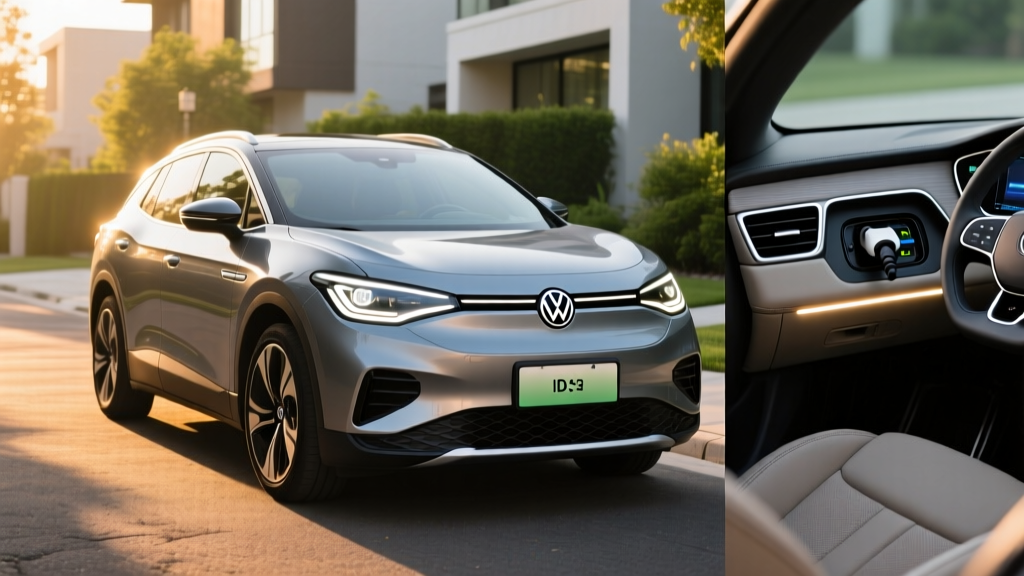
The 2026 Volkswagen ID.4 remains one of the most practical mainstream electric SUVs on the market, blending family-friendly packaging with competitive range and DC fast-charging capability. But for spec-focused buyers, one question often surfaces: how does the Volkswagen ID.4 weight influence its real-world efficiency, handling, and energy consumption? At between 4,682 and 4,933 pounds depending on trim and drivetrain, the ID.4 sits squarely in the middle of the compact electric SUV class — heavy enough to feel planted on the highway, light enough to avoid the efficiency penalties that plague larger electric crossovers.
In this deep-dive profile, we cover every number that matters — EPA range, battery chemistry, charge curves, real-world highway and cold-weather expectations, and exactly what you'll pay after federal tax credits. If you're cross-shopping the ID.4 against the Hyundai Ioniq 5, Tesla Model Y, or Ford Mustang Mach-E, these are the figures that should drive your decision.
2026 VW ID.4 Weight and Core Specifications
Vehicle weight affects everything from tire wear to regenerative braking effectiveness to the energy required to maintain highway speeds. The ID.4's curb weight varies meaningfully across its lineup, primarily driven by the difference between single-motor rear-wheel-drive and dual-motor all-wheel-drive configurations. The AWD system adds a front motor, associated power electronics, and reinforced drivetrain components — roughly 250 pounds of additional mass.
| Spec | Standard / Pro (RWD) | Pro S (RWD) | Pro S Plus (RWD) | AWD Pro S | AWD Pro S Plus |
|---|---|---|---|---|---|
| Curb Weight | 4,682 lbs | 4,717 lbs | 4,739 lbs | 4,911 lbs | 4,933 lbs |
| Battery (Usable) | 82 kWh (NMC) | 82 kWh (NMC) | 82 kWh (NMC) | 82 kWh (NMC) | 82 kWh (NMC) |
| Horsepower | 282 hp | 282 hp | 282 hp | 335 hp | 335 hp |
| Torque | 339 lb-ft | 339 lb-ft | 339 lb-ft | 402 lb-ft | 402 lb-ft |
| 0-60 mph | 7.3 sec | 7.3 sec | 7.3 sec | 5.4 sec | 5.4 sec |
| EPA Range | 291 mi | 275 mi | 275 mi | 263 mi | 263 mi |
| EPA Efficiency | 107 MPGe | 104 MPGe | 104 MPGe | 101 MPGe | 101 MPGe |
| Drivetrain | RWD | RWD | RWD | AWD | AWD |
The base Standard trim's 4,682-pound curb weight is competitive with the Hyundai Ioniq 5 (~4,500 lbs for the standard-range RWD) and slightly lighter than the Ford Mustang Mach-E Extended Range RWD (~4,700 lbs). This weight positioning helps the ID.4 achieve its 107 MPGe combined rating on the base trim — respectable for a vehicle with this much interior volume.
Real-World Range vs. EPA Estimates
Real-World Expectation: Plan for 240–265 miles on highway-heavy trips at 70–75 mph in moderate temperatures. In cold weather (below 32°F), expect 190–225 miles depending on cabin heat usage and whether you precondition the battery.
The ID.4's 82 kWh usable battery pack uses NMC (nickel manganese cobalt) chemistry, which offers higher energy density than LFP alternatives but trades some long-term cycle-life robustness. In practice, NMC packs in modern thermal-management systems like Volkswagen's degrade slowly — most owners report 90%+ state of health after 50,000 miles based on fleet data from earlier model years.
Where the weight penalty shows up most clearly is highway efficiency. At a steady 75 mph, the ID.4 AWD consumes roughly 310–330 Wh/mile. That translates to about 248–264 miles from a full charge in ideal conditions. Push speeds to 80+ mph or encounter sustained headwinds and mountain grades, and 220–235 miles is realistic. City driving with frequent regenerative braking opportunities plays to the ID.4's strengths — its mass helps capture more kinetic energy during deceleration, and real-world city range often meets or slightly exceeds the EPA sticker.
Cold weather is the equalizer. NMC chemistry loses roughly 20–30% of usable capacity in sub-freezing temperatures when the battery is cold-soaked. The ID.4's heat pump (standard on Pro S and above, optional on base trims) mitigates cabin energy draw but doesn't fully solve battery-level losses. Preconditioning while plugged in is essential for winter commuters — it warms the pack using grid power rather than battery energy, preserving range.
Charging Speed: DC Fast Charge and Home Level 2
Charging speed is where the ID.4 has historically drawn criticism, and the 2026 model carries forward the same architecture with incremental software refinements. Understanding the difference between peak kW (the maximum rate the car can accept at a specific state of charge) and sustained kW (the average rate across a charging session) is critical for trip planning.
| Charging Level | Power / Rate | Time / Miles Added | Notes |
|---|---|---|---|
| Level 1 (120V) | ~1.4 kW | ~3–4 miles/hour | Emergency/trickle only; 82 kWh takes 58+ hours |
| Level 2 (240V, 48A) | 11.5 kW | ~34 miles/hour; full charge in ~8.5 hrs | Requires 60A dedicated circuit; NEMA 14-50 or hardwired |
| DC Fast Charge (CCS) | Peak 175 kW | 10–80% in ~30 minutes | Peak only between 5–25% SoC; tapers significantly above 60% |
| DC Fast Charge (NACS adapter) | Peak 175 kW | 10–80% in ~30 minutes | Tesla Supercharger access via included adapter; same charge curve |
The 175 kW peak DC fast-charge rate is the ID.4's most debated specification. Competitors like the Hyundai Ioniq 5 (peak 240 kW on its 800V architecture) and the Tesla Model Y (peak ~250 kW) charge substantially faster in the 10–80% window. The ID.4's charge curve holds its peak rate for a relatively narrow state-of-charge window — roughly 5% to 25% SoC — before tapering to 120–130 kW through the mid-range and dropping below 60 kW past 80%.
On a road trip, this means your typical 10–80% stop takes about 30 minutes at a 350 kW Electrify America or Tesla Supercharger station. That's 8–12 minutes slower than an Ioniq 5 under similar conditions. For daily home charging on Level 2, the 11.5 kW onboard charger is excellent — a full overnight replenishment is effortless, and the math works out to roughly 34 miles of range per hour of charging.
Volkswagen includes three years of complimentary charging on the Electrify America network (with a kWh cap that varies by model year), which meaningfully offsets road-trip fuel costs for early ownership. NACS adapter access to Tesla's Supercharger network is now standard, dramatically expanding reliable DC fast-charging coverage in rural and highway corridors.
Pricing, Trims, and Federal Tax Credit Eligibility
The 2026 ID.4 lineup starts at a competitive price point and benefits from Volkswagen's aggressive positioning against Korean and American rivals. However, federal tax credit eligibility under IRS §30D is not universal — it depends on your income, the vehicle's MSRP, and battery-component/critical-mineral sourcing requirements that shift annually.
| Trim | Drivetrain | Base MSRP | Est. After §30D Credit* |
|---|---|---|---|
| Standard | RWD | $40,790 | ~$33,290 |
| Pro | RWD | $44,290 | ~$36,790 |
| Pro S | RWD | $47,790 | ~$40,290 |
| Pro S Plus | RWD | $51,290 | ~$43,790 |
| AWD Pro S | AWD | $50,290 | ~$42,790 |
| AWD Pro S Plus | AWD | $53,790 | ~$46,290 |
*Federal §30D credit of up to $7,500 is available at point of sale as a price reduction, but only if you meet ALL of the following requirements. Verify current-year eligibility with a tax professional and the IRS §30D guidance page.
- MSRP Cap: SUVs must be at or below $80,000 — all ID.4 trims qualify.
- Buyer Income Cap: Modified AGI must not exceed $150,000 (single), $225,000 (head of household), or $300,000 (joint filers).
- Battery Sourcing: Critical minerals and battery components must meet escalating domestic/free-trade-partner sourcing thresholds. Volkswagen's Chattanooga, TN assembly and supply-chain positioning have historically supported partial or full credit — confirm current-year status at purchase.
- Point-of-Sale Transfer: You can transfer the credit to the dealer at purchase for an immediate price reduction, or claim it on your federal tax return.
Interior Space, Cargo, and Daily Practicality
The ID.4's packaging is one of its strongest selling points. Volkswagen's MEB platform dedicates the entire floor area to the battery, freeing up interior volume that rivals midsize SUVs despite the ID.4's compact exterior footprint.
- Front legroom: 41.1 inches
- Rear legroom: 37.6 inches
- Cargo behind rear seats: 30.3 cu ft
- Cargo with rear seats folded: 64.2 cu ft
- Front trunk (frunk): Not available on AWD trims; minimal storage compartment on RWD
Compared to the Tesla Model Y (30.2 cu ft rear / 72.1 cu ft total with the frunk included), the ID.4 offers similar rear-seat comfort with slightly less total cargo capacity. The rear seats are notably more upright and supportive than the Model Y's, which matters for longer family trips. The panoramic fixed glass roof on Pro S and above trims opens up the cabin visually without the mechanical complexity of a retractable panel.
One practical consideration tied to weight: the ID.4's Gross Vehicle Weight Rating (GVWR) is approximately 5,800 pounds, leaving roughly 1,100 pounds of payload capacity for passengers and cargo in the AWD Pro S Plus. That's adequate for a family of four with luggage, but tight if you're loading four adults plus gear for a ski trip. The ID.4 is rated to tow up to 2,700 pounds (AWD trims with factory tow package), which covers a small utility trailer or a pair of dirt bikes but rules out most camper trailers.
Technology, Driver Assistance, and Notable Drawbacks
The 2026 ID.4 runs Volkswagen's latest ID. Software 4.0, which addresses many of the infotainment complaints that plagued early ID.4 model years. The 12.9-inch center touchscreen is responsive, supports wireless Apple CarPlay and Android Auto, and now features improved voice recognition. The digital instrument cluster is compact but legible, with a column-mounted shifter that frees up center-console space.
Standard driver-assistance features include:
- Adaptive cruise control with stop-and-go
- Lane-keeping assist with centering
- Automatic emergency braking with pedestrian detection
- Blind-spot monitoring with rear cross-traffic alert
- Travel Assist (combined lane centering + adaptive cruise) — SAE Level 2
Notable drawbacks persist. The capacitive-touch steering wheel controls remain frustrating for many drivers — they lack the tactile feedback of physical buttons and can trigger accidental inputs. The ID.4 does not offer a front trunk (frunk) on AWD models, and the RWD frunk is a small compartment better suited for charging cables than groceries. Rear drum brakes (on RWD trims) are an unusual choice that draws questions, though VW argues they reduce cost and parasitic drag while the regenerative braking system handles most deceleration.
- Competitive base price with strong value on Standard/Pro trims
- Spacious, comfortable rear seat with 37.6" legroom
- Smooth, quiet ride quality — among the best in the segment
- 11.5 kW Level 2 onboard charger for fast home replenishment
- Tesla Supercharger access via NACS adapter
- Complimentary Electrify America charging included
- 175 kW peak DC charge rate trails Ioniq 5 (240 kW) and Model Y (~250 kW)
- Charge curve tapers early — 30-min 10–80% session is slower than rivals
- Capacitive-touch steering wheel controls lack tactile feedback
- No meaningful frunk storage
- Infotainment learning curve despite Software 4.0 improvements
- AWD trims are pricey once options are added
Warranty, Battery Longevity, and Ownership Costs
Volkswagen backs the 2026 ID.4 with a competitive warranty package that should reassure buyers concerned about long-term battery health:
- New Vehicle Limited Warranty: 4 years / 50,000 miles
- Powertrain Warranty: 4 years / 50,000 miles
- High-Voltage Battery Warranty: 8 years / 100,000 miles (minimum 70% capacity retention)
- Roadside Assistance: 4 years / 50,000 miles
The 8-year/100,000-mile battery warranty with a 70% state-of-health floor is industry-standard and aligns with federal requirements. Based on real-world data from 2021–2024 ID.4 models, degradation has been modest — most high-mileage owners report 92–95% SoH at 40,000–60,000 miles, well above the warranty threshold. NMC chemistry in a well-thermally-managed pack like the MEB platform's tends to hold up well, particularly when owners avoid frequent DC fast-charging to 100% and instead keep daily charges between 20–80%.
Insurance costs for the ID.4 are moderate for the EV segment. Expect annual premiums in the $1,400–$1,900 range depending on your state, driving record, and trim level — roughly 15–25% higher than a comparably priced gas compact SUV but in line with EV peers. According to fueleconomy.gov, the ID.4 Pro RWD achieves 107 MPGe combined, translating to an electricity cost of approximately $550–$700 per year for 12,000 miles of driving at average U.S. residential electricity rates — roughly one-third the fuel cost of a 28 MPG gas SUV.
Who Should Buy the 2026 VW ID.4?
- Choose the ID.4 RWD if: You prioritize ride comfort, interior space, and value pricing over peak charging speed. Best for suburban commuters, families with young children, and buyers who charge primarily at home overnight. The 291-mile EPA range handles most daily needs with margin.
- Choose the ID.4 AWD if: You live in a region with snow or unpaved roads, want the 5.4-second 0–60 sprint, or plan to tow light loads (up to 2,700 lbs). Accept the 28-mile range penalty and ~$2,500 price premium.
- Look elsewhere if: Road-trip charging speed is your top priority (consider the Hyundai Ioniq 5 or Kia EV6 with their 800V / 240 kW architecture), you need a third row (Kia EV9), or you want a frunk for gear storage (Ford Mustang Mach-E, Rivian R1S).
The ID.4's weight — 4,682 to 4,933 pounds — positions it as a comfortable, stable cruiser rather than a sporty handler. If driving dynamics matter more than passenger comfort, the Model Y or Ioniq 5 feel more agile. But if your priority is a quiet, spacious cabin with a compliant ride and straightforward ownership economics, the ID.4 delivers at a price point that undercuts many competitors — especially after the federal tax credit.
Frequently Asked Questions
What is the real-world range of the 2026 VW ID.4?
On highway-heavy trips at 70–75 mph in mild weather, expect 240–265 miles from the RWD trims and 220–240 miles from AWD models. In freezing temperatures with cabin heat, plan for 190–225 miles. City driving with regenerative braking often matches or slightly exceeds the EPA sticker of 291 miles (RWD) or 263 miles (AWD).
How fast does the ID.4 charge on DC fast chargers and at home?
DC fast charging peaks at 175 kW, with a 10–80% session taking approximately 30 minutes. The charge curve tapers significantly above 60% SoC. At home on a Level 2 charger (240V, 48A), the ID.4 charges at 11.5 kW, adding about 34 miles per hour and reaching a full charge in roughly 8.5 hours.
How much does the 2026 ID.4 cost after the federal EV tax credit?
If you qualify for the full §30D credit of $7,500 (meeting income caps, MSRP limits, and battery-sourcing requirements), the base Standard trim drops to approximately $33,290. The popular Pro S RWD comes in around $40,290 after credit. Eligibility is not guaranteed — verify with the IRS and your tax professional before purchase.
Does the VW ID.4 qualify for the $7,500 federal EV tax credit?
All ID.4 trims fall under the $80,000 SUV MSRP cap. However, you must also meet buyer income limits ($150K single / $300K joint) and the vehicle's battery must satisfy current-year critical-mineral and component sourcing requirements. Volkswagen assembles the ID.4 in Chattanooga, Tennessee, and has historically met partial or full sourcing thresholds. Confirm current-year status at the point of purchase.
Is the ID.4 worth buying vs. the Hyundai Ioniq 5 or Tesla Model Y?
The ID.4 wins on ride comfort, rear-seat space, and base pricing. The Ioniq 5 wins on DC fast-charging speed (240 kW peak, ~18 min 10–80%) and design. The Model Y wins on Supercharger-native convenience, cargo volume (with frunk), and performance efficiency. Your priority — comfort vs. charging speed vs. ecosystem — determines the best choice.
What is the ID.4's battery chemistry and will it last?
The ID.4 uses an 82 kWh usable NMC (nickel manganese cobalt) lithium-ion battery. NMC offers high energy density suitable for the ID.4's weight and range targets. The battery is warrantied for 8 years / 100,000 miles with a minimum 70% capacity retention guarantee. Real-world data from earlier model years shows degradation of approximately 5–8% over the first 50,000 miles with normal charging habits.