Is the 2026 Volkswagen ID.4 the Right Lease for Goodyear Drivers?
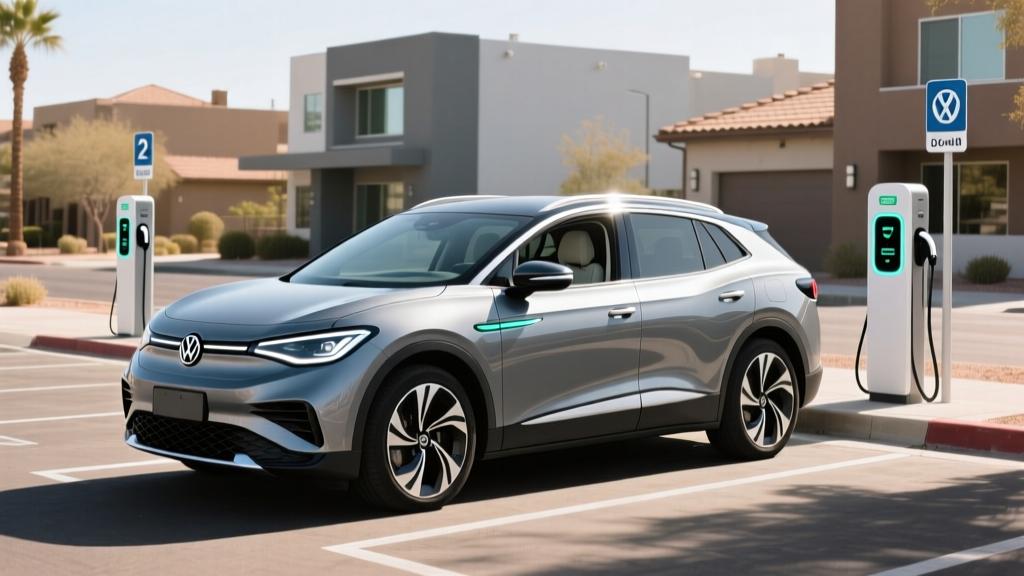
The Volkswagen ID.4 occupies a specific niche in the compact electric SUV segment: it prioritizes ride comfort and cabin practicality over performance theatrics. For shoppers researching Volkswagen ID.4 leasing in Goodyear, Arizona — a fast-growing West Valley suburb with single-family homes well-suited to Level 2 home charging — the ID.4's combination of competitive pricing, Volkswagen's dealer network, and federal tax-credit eligibility makes it worth a serious look. But it isn't the quickest-charging or longest-range option in its class, and understanding its real-world limitations is essential before signing a lease.
| Spec | RWD (Standard Range) | RWD (Pro) | AWD (Pro S) |
|---|---|---|---|
| EPA Range | 206 miles | 291 miles | 263 miles |
| Usable Battery | 62 kWh (NMC) | 82 kWh (NMC) | 82 kWh (NMC) |
| Horsepower | 201 hp | 282 hp | 335 hp |
| 0–60 mph | ~8.0 sec | ~7.2 sec | ~5.4 sec |
| Peak DC Fast Charge | 135 kW | 175 kW | 175 kW |
| 10–80% DCFC Time | ~30 min | ~28 min | ~28 min |
| Level 2 Home Charge | 11 kW (~37 mi/hr) | 11 kW (~37 mi/hr) | 11 kW (~37 mi/hr) |
| EPA Efficiency | 104 MPGe | 107 MPGe | 98 MPGe |
| Base MSRP | $39,735 | $44,235 | $51,235 |
Sources: fueleconomy.gov, Volkswagen USA. Prices exclude destination; specs reflect 2026 model year.
Real-World Range: What the EPA Sticker Doesn't Tell You
The EPA estimates the ID.4 Pro (RWD, 82 kWh pack) at 291 miles — respectable for the class. But Goodyear's desert climate and driving patterns shift that number meaningfully.
EPA Rating: 291 miles (ID.4 Pro RWD) | 263 miles (Pro S AWD)
Real-World Expectation — Goodyear, AZ:
- City/suburban (surface streets, I-10 commuter traffic): ~270–285 miles — stop-and-go driving with regen braking favors EV efficiency.
- Highway at 75+ mph (I-10 toward Phoenix or Blythe): ~240–260 miles — aerodynamic drag dominates at sustained speed.
- Summer with A/C maxed (110°F+ ambient): ~250–275 miles — cabin cooling draws 1–3 kW continuously; the heat pump helps but desert heat is punishing.
- Winter (rare cold snaps, 40°F mornings): ~265–285 miles — minimal cold-weather loss compared to northern states, a genuine Goodyear advantage.
Unlike buyers in Minnesota or Maine, Goodyear drivers rarely face the 20–30% winter range loss that plagues colder climates. The bigger efficiency enemy here is summer heat and highway speed. Running the cabin at 72°F on a 115°F July afternoon will cost you roughly 10–15 miles of range on a full charge versus mild-weather driving.
Charging Speeds: Home and DC Fast Charging
Charging infrastructure is the make-or-break factor for EV satisfaction, and Goodyear's residential layout — mostly single-family homes with garages — makes Level 2 home charging straightforward.
| Level | Power | Connector | Speed (mi/hr) | Notes |
|---|---|---|---|---|
| Level 1 (120V) | ~1.4 kW | J1772 / NACS (adapter) | ~3–4 mi/hr | Emergency/trickle only; 82 kWh pack takes 3+ days 0–100% |
| Level 2 (240V) | 11 kW | J1772 / NACS (adapter) | ~37 mi/hr | Full charge in ~8–9 hrs (82 kWh); ideal overnight |
| DC Fast Charge | Peak 175 kW | CCS1 / NACS (adapter) | ~185 mi in 30 min | 10–80% in ~28 min; taper significant above 80% |
The Charge Curve Reality
Volkswagen quotes a peak of 175 kW on the 82 kWh models, but that rate holds only from roughly 10–35% State of Charge (SoC). By 60%, the rate tapers to ~100 kW, and above 80% it drops below 50 kW to protect the NMC cells. A realistic 10–80% session takes about 28 minutes at a functioning 175+ kW charger. If you arrive at a 50 kW unit — still common at older Electrify America or ChargePoint stations along I-10 — expect 10–80% in roughly 70 minutes.
For Goodyear homeowners, a Level 2 home installation on a NEMA 14-50 outlet (240V/48A circuit) typically costs $800–$2,200 including electrician labor and permit, depending on panel proximity. If your electrical panel needs a 200A upgrade, add $1,500–$3,500. A licensed electrician should evaluate your panel before committing to a charger.
Pricing, Lease Deals, and the Federal Tax Credit
The 2026 ID.4 lineup starts at $39,735 for the Standard Range RWD — one of the lowest entry points in the compact electric SUV class. But understanding how leasing interacts with the federal §30D tax credit is critical.
| Trim | MSRP | Est. Lease (36 mo) | §30D Credit Potential | Effective Lease Reduction |
|---|---|---|---|---|
| Standard Range RWD | $39,735 | $349–$429/mo | Up to $7,500 (if eligible) | Passed through as cap-cost reduction by lessor |
| Pro RWD | $44,235 | $399–$489/mo | Up to $7,500 | Same — lessor captures credit, applies to lease |
| Pro S AWD | $51,235 | $479–$569/mo | Up to $7,500 | Same — confirm with dealer |
The Lease Loophole Explained
Under the "commercial entity" leasing structure recognized by the IRS, the leasing company (not the lessee) claims the §30D credit. Most major automaker captive finance arms — including Volkswagen Credit — then pass that credit through as a capitalized-cost reduction, effectively lowering your monthly payment. This means that even if you personally exceed the IRS income cap ($150,000 single / $300,000 joint for new EVs), the lease structure may still allow the credit to reduce your cost. Always confirm with the Goodyear-area VW dealer that the credit is being applied to your specific lease agreement.
§30D Federal Tax Credit Requirements (2026 rules):
- MSRP cap: SUVs must be ≤$80,000 (all ID.4 trims qualify).
- Buyer income cap (purchase): AGI ≤$150,000 single / $300,000 joint (does not apply to lease loophole).
- Battery sourcing: Critical minerals and battery component percentages must meet escalating annual thresholds — verify current-year compliance with the dealer or at irs.gov.
- North American assembly: The ID.4 for the U.S. market is assembled in Chattanooga, Tennessee — this requirement is met.
- Point-of-sale transfer: Eligible buyers purchasing (not leasing) can transfer the credit to the dealer at sale for an immediate price reduction.
Interior, Cargo, and Daily Practicality
The ID.4's cabin prioritizes function. Rear legroom measures 37.6 inches — enough for two adults on longer drives without complaint. Cargo volume behind the second row is 30.3 cubic feet, expanding to 64.2 cu ft with the 60/40 split rear seats folded. That's competitive with the Hyundai Ioniq 5 (27.2 / 59.3 cu ft) and slightly behind the Tesla Model Y (30.2 / 72.1 cu ft with seats folded, though the Model Y's sloping roofline makes bulk loading less practical).
The 12.9-inch infotainment screen (on Pro and above) runs VW's latest software, which has improved responsiveness over the laggy 2021–2023 units. Wireless Apple CarPlay and Android Auto are standard. However, VW's reliance on touch-capacitive sliders for volume and climate — rather than physical knobs — remains a usability frustration, particularly when driving.
Driver assistance includes Travel Assist (adaptive cruise + lane centering), which is an SAE Level 2 system. The driver must keep hands on the wheel and eyes on the road at all times. This is not autonomous driving — it's a well-tuned highway companion that reduces fatigue on I-10 commutes but requires constant supervision.
How the ID.4 Stacks Up Against Key Competitors
Goodyear shoppers cross-shopping the ID.4 will likely encounter the Tesla Model Y, Hyundai Ioniq 5, and Ford Mustang Mach-E. Each has distinct trade-offs.
| Attribute | VW ID.4 Pro RWD | Tesla Model Y LR | Hyundai Ioniq 5 LR RWD | Ford Mach-E ER RWD |
|---|---|---|---|---|
| EPA Range | 291 mi | 330 mi | 303 mi | 305 mi |
| Peak DCFC | 175 kW | 250 kW | 240 kW | 150 kW |
| 10–80% Time | ~28 min | ~20 min | ~18 min | ~36 min |
| 0–60 mph | 7.2 sec | 5.0 sec | 7.0 sec | 6.1 sec |
| Base MSRP | $44,235 | $46,630 | $47,400 | $45,995 |
| Supercharger Access | Yes (NACS adapter) | Native | Yes (NACS adapter) | Yes (NACS adapter) |
🏆 Best Ride Comfort: VW ID.4 — softest suspension tuning in the class; absorbs Goodyear's occasional rough pavement gracefully.
🏆 Fastest Charging: Hyundai Ioniq 5 — 800V architecture enables 18-minute 10–80% sessions at 350 kW chargers.
🏆 Longest Range: Tesla Model Y — 330 miles EPA still leads the segment, and native Supercharger access is unmatched.
🏆 Lowest Entry Price: VW ID.4 Standard Range — $39,735 undercuts every rival here by $5,000+.
Battery Warranty, Longevity, and Chemistry
The ID.4 uses NMC (nickel manganese cobalt) lithium-ion cells — the same chemistry in most long-range EVs. NMC offers high energy density but is more sensitive to sustained high-SoC storage and extreme heat than LFP (lithium iron phosphate). In Goodyear's summer heat, parking in shade or a garage when possible will slow long-term degradation.
Volkswagen covers the battery pack for 8 years / 100,000 miles with a minimum 70% capacity retention threshold. If the pack drops below 70% usable capacity within that window, VW will repair or replace it. Based on industry degradation data from similar NMC packs, expect roughly 2–3% capacity loss per year under normal use — meaning after 5 years, you'd likely still have ~87–90% of original capacity. For a lease (typically 36 months), battery degradation is essentially a non-concern.
Pros, Cons, and Who Should Lease the ID.4 in Goodyear
✅ Pros
- Lowest starting price in the compact EV SUV segment
- Comfortable, compliant ride — best-in-class for daily comfort
- Chattanooga assembly helps ensure §30D eligibility
- Spacious rear seat and usable cargo area
- Lease structure can bypass personal income caps for the tax credit
- Now compatible with Tesla Superchargers via NACS adapter
❌ Cons
- DC fast charging slower than Ioniq 5, Model Y, and most rivals
- Infotainment still lags behind Tesla and Hyundai in responsiveness
- Touch-capacitive volume/climate controls frustrate while driving
- Standard Range model's 206-mile EPA range limits road-trip flexibility
- No front trunk (frunk) — under-hood space houses HVAC components
- Regenerative braking lacks true one-pedal driving mode
Choose the VW ID.4 if: You want the most affordable compact electric SUV, prioritize ride comfort over acceleration, will charge primarily at home overnight, and plan to lease (capturing the tax credit regardless of personal income).
Choose a competitor if: You regularly road-trip 300+ miles and need the fastest DC charging possible (Ioniq 5), want maximum range and Supercharger convenience without adapters (Model Y), or prioritize sporty handling (Mach-E).
Frequently Asked Questions
What is the real-world range of the VW ID.4 in Goodyear's climate?
Expect 240–285 miles from the 82 kWh Pro model depending on driving style and season. Highway driving at 75+ mph and peak-summer A/C use will push you toward the lower end. Goodyear's mild winters mean you avoid the severe cold-weather range loss seen in northern states.
How fast does the ID.4 charge at home and on the road?
On a Level 2 home charger (240V/11 kW), the 82 kWh pack refills in roughly 8–9 hours — add about 37 miles of range per hour. On DC fast chargers, the 82 kWh models peak at 175 kW and reach 10–80% in approximately 28 minutes, though actual speed depends on charger output, battery temperature, and SoC at arrival.
Does the 2026 VW ID.4 qualify for the $7,500 federal EV tax credit?
The ID.4 meets the MSRP cap ($80,000 for SUVs) and is assembled in Chattanooga, TN. Battery-sourcing and critical-mineral requirements change annually — verify current-year compliance at irs.gov or with your dealer. When leasing, the lessor typically claims the credit and passes it through as a cap-cost reduction, potentially available regardless of your personal income.
Is the ID.4 worth leasing versus buying?
Leasing offers two advantages: the tax credit may apply even if you exceed income caps, and you avoid long-term battery-degradation risk. Buying makes more sense if you plan to keep the vehicle 6+ years, drive under 12,000 miles annually, and qualify for the credit directly. Compare total cost over 36 months with your Goodyear-area VW dealer's finance team.
Can I use Tesla Superchargers with the VW ID.4?
Yes. Volkswagen provides a NACS adapter that allows ID.4 owners to access Tesla's Supercharger network (over 20,000 stalls in the U.S.). The ID.4 uses CCS1 natively, and the adapter enables NACS compatibility. Several Supercharger stations exist along I-10 and in the greater Phoenix area.
How does Goodyear's heat affect the ID.4 battery?
Sustained high ambient temperatures accelerate NMC cell degradation over time. The ID.4's active liquid thermal management system mitigates this, but parking in a garage or shaded carport during summer months will further protect long-term battery health. For a 36-month lease, this is largely a non-issue.