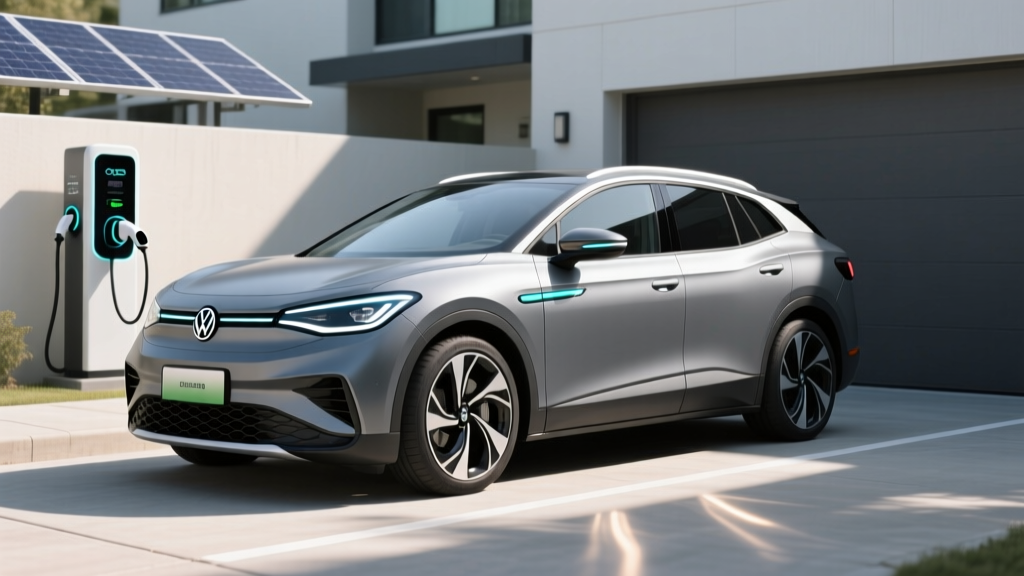
The Volkswagen ID.4 has occupied a specific niche since its US launch: a mainstream, mid-size electric crossover that prioritizes comfort and practicality over headline-grabbing performance. For 2026, VW continues to refine the formula with incremental software and packaging updates, but the real story for shoppers is financial. With aggressive manufacturer incentives and competitive lease residuals, the ID.4 frequently surfaces as one of the most attainable new EVs on the market when you look past the sticker price.
This review dissects the 2026 Volkswagen ID.4 from the perspective of a prospective lessee or buyer who needs hard numbers — not marketing copy. We'll cover real-world range, charging behavior, the true out-of-pocket cost after federal incentives, and whether the ID.4 still makes sense against a field of increasingly capable rivals.
Range, Battery, and Real-World Efficiency
The 2026 ID.4 is offered with two battery configurations. The base Standard trim uses a 62 kWh (usable) lithium-ion pack with NMC (nickel manganese cobalt) chemistry, while the Pro and Pro S trims step up to an 82 kWh usable NMC battery. Volkswagen does not currently offer an LFP (lithium iron phosphate) variant in the US market.
- ID.4 Standard (62 kWh, RWD): EPA-estimated 206 miles. Expect ~170–185 miles in mixed highway driving; ~140–155 miles in sustained sub-30°F cold weather.
- ID.4 Pro / Pro S (82 kWh, RWD): EPA-estimated 291 miles. Expect ~245–265 miles highway at 70–75 mph; ~200–220 miles in freezing temperatures without preconditioning.
- ID.4 Pro S AWD (82 kWh): EPA-estimated 263 miles. Expect ~225–240 miles highway; ~185–200 miles in deep cold.
The ID.4's heat pump (standard on Pro trims) mitigates cold-weather cabin energy draw, but battery chemistry still loses efficiency below freezing. Preconditioning the battery while plugged in recovers a meaningful 10–15% of range in winter.
Efficiency for the RWD Pro model is rated at 107 MPGe combined (city 111 / highway 102) per EPA data on fueleconomy.gov, which translates to roughly 31 kWh per 100 miles. That's mid-pack for the segment — the Hyundai Ioniq 5 and Tesla Model Y are measurably more efficient, while the Ford Mustang Mach-E is comparable. For a lessee paying a residential electricity rate of $0.14/kWh, that works out to roughly $0.043 per mile in energy cost — about one-third the per-mile fuel cost of a comparable gas crossover at $3.30/gallon.
| Spec | Standard (RWD) | Pro (RWD) | Pro S AWD |
|---|---|---|---|
| Usable Battery | 62 kWh (NMC) | 82 kWh (NMC) | 82 kWh (NMC) |
| EPA Range | 206 mi | 291 mi | 263 mi |
| Horsepower | 201 hp | 282 hp | 335 hp |
| 0–60 mph | ~7.7 sec | ~7.0 sec | ~5.4 sec |
| MPGe (combined) | 104 | 107 | 98 |
| Drivetrain | Rear-Wheel Drive | Rear-Wheel Drive | Dual-Motor AWD |
| Max DC Fast Charge | 140 kW | 175 kW | 175 kW |
| 10–80% DC Time | ~30 min | ~28 min | ~28 min |
| Level 2 Home Rate | 11 kW (~37 mi/hr) | 11 kW (~37 mi/hr) | 11 kW (~37 mi/hr) |
Charging Speed: DC Fast and Home Level 2
The ID.4's DC fast-charging performance is adequate but no longer class-leading. The 82 kWh models peak at 175 kW on a compatible CCS connector, reaching from 10% to 80% State of Charge (SoC) in approximately 28 minutes under ideal thermal conditions. The 62 kWh Standard model peaks at 140 kW, taking about 30 minutes for the same 10–80% session.
A critical ownership detail: the ID.4 uses the CCS1 connector for DC fast charging. Volkswagen has not yet transitioned the US-market ID.4 to the NACS (Tesla-style) connector, though VW has committed to NACS adoption across its lineup. If you're leasing a 2026 ID.4, you'll use the CCS plug at Electrify America, EVgo, and most non-Tesla networks. VW includes a complimentary Electrify America charging plan (typically 2 years of 30-minute sessions) with new ID.4 purchases and leases, which meaningfully offsets public charging costs during the lease term.
| Charge Level | Power | Connector | Miles Added per Hour | Notes |
|---|---|---|---|---|
| Level 1 (120V) | ~1.4 kW | J1772 | ~4 mi/hr | Emergency/trickle only |
| Level 2 (240V, 48A) | 11 kW | J1772 | ~37 mi/hr | Full charge in ~7–9 hrs |
| DC Fast (CCS) | 175 kW peak | CCS1 | ~220 mi in 30 min | Tapers above 80% SoC |
At home on a Level 2 wallbox (240V, 48-amp circuit), the ID.4 accepts up to 11 kW, adding roughly 37 miles of range per hour. A full 0–100% charge on the 82 kWh battery takes about 8.5 hours — easily achievable overnight. Home charging installation typically runs $800–$2,000 depending on your electrical panel's capacity and the distance from panel to garage; a 200-amp panel upgrade can add $1,500–$3,000 if your home needs one.
Performance and Driving Dynamics
The ID.4 was never engineered to win drag races, and that's reflected in the numbers. The base RWD model produces 201 horsepower and hits 60 mph in roughly 7.7 seconds — perfectly adequate for merging and passing but noticeably relaxed compared to a Tesla Model Y Long Range (5.0 seconds). The 282 hp RWD Pro trims shave that to about 7.0 seconds.
The performance standout is the Pro S AWD with its dual-motor setup delivering 335 hp and a 0–60 time of approximately 5.4 seconds. More importantly for daily driving, the AWD model's instant torque delivery makes it feel quicker than the stopwatch suggests in around-town acceleration. The ride quality is a genuine strength: VW tuned the ID.4's suspension for compliance over sportiness, and it absorbs broken pavement and expansion joints with a maturity that outclasses the firmer-riding Ioniq 5 and Model Y.
Regenerative braking in the ID.4 is modest. Unlike many competitors, VW does not offer true one-pedal driving — lifting off the accelerator slows the car, but it will not come to a complete stop without touching the brake pedal. This is a deliberate engineering choice (VW argues it reduces unexpected deceleration for following traffic), but EV veterans accustomed to one-pedal operation may find it an adjustment. The B (Brake) mode on the shift drum increases regen intensity but still falls short of full stop-holding.
Interior, Cargo, and Technology
The ID.4's cabin is spacious and material quality is competitive for the price point, though it won't be mistaken for a luxury interior. Passenger volume is generous: 99.9 cubic feet of passenger space with 41.1 inches of front legroom and 37.6 inches of rear legroom — enough for adults on longer trips without complaint.
Cargo capacity is a strong suit at 30.3 cubic feet behind the rear seats and 64.2 cubic feet with the rear seats folded flat. Notably, the ID.4 does not offer a front trunk (frunk) — the space under the hood houses electronics and the cabin air-filter assembly. For lessees who need max cargo flexibility, the Model Y's frunk and slightly larger total volume (76.2 cu ft) are worth noting.
The infotainment system runs on VW's ID. Software 4.0 (updated for 2025–2026 models), which addressed many of the early ID.4's most-criticized issues: sluggish response times, confusing menu structures, and non-backlit capacitive sliders. The 12.9-inch touchscreen is now responsive and logically organized, with wireless Apple CarPlay and Android Auto standard. However, the touch-capacitive steering wheel controls remain a point of frustration for some drivers who prefer tactile buttons, and the lack of physical HVAC knobs means climate adjustments require a screen tap — a dealbreaker for a vocal segment of buyers.
On the driver-assistance front, the ID.4 comes equipped with VW IQ.DRIVE, a suite of Level 2 (SAE) driver-assistance features including adaptive cruise control with stop-and-go, lane-centering assist, front and rear automatic emergency braking, and blind-spot monitoring. This is a hands-on-wheel, eyes-on-road system — it does not offer hands-free highway driving like GM's Super Cruise or Ford's BlueCruise. For lessees expecting Tesla Autopilot-level engagement, the ID.4's system is more conservative and requires continuous steering input.
Pricing, Lease Deals, and Tax Credit Eligibility
The 2026 ID.4 lineup starts at $41,190 for the Standard trim (62 kWh, RWD), including destination. The volume-selling Pro trim sits at approximately $46,190, while the range-topping Pro S AWD reaches $56,190. These MSRPs place the ID.4 squarely in the mainstream EV crossover bracket, undercutting the Tesla Model Y and Hyundai Ioniq 5 on base price but offering less range per dollar at the lower trims.
| Trim | MSRP (incl. dest.) | Est. Lease (36 mo/12k) | §30D Credit Eligible? | Effective Price After Credit |
|---|---|---|---|---|
| Standard RWD | $41,190 | ~$299–$349/mo* | Yes — subject to sourcing & income caps | ~$33,690 |
| Pro RWD | $46,190 | ~$349–$419/mo* | Yes — subject to sourcing & income caps | ~$38,690 |
| Pro S Plus AWD | $56,190 | ~$449–$529/mo* | Yes — subject to sourcing & income caps | ~$48,690 |
*Lease estimates reflect typical market deals with VW dealer incentives applied; actual payments vary by region, credit tier, and dealer.
Regarding the federal §30D EV tax credit (up to $7,500), the ID.4's eligibility is nuanced. Per current IRS guidelines, the credit is split into two halves: $3,750 for meeting battery-component sourcing requirements and $3,750 for critical-minerals sourcing. The ID.4's battery is assembled at VW's Chattanooga, Tennessee plant, which satisfies the North American component requirement. Critical-minerals sourcing compliance varies by model year and supply-chain updates — buyers should verify current-year status on the IRS eligible-vehicle list before finalizing a purchase.
- MSRP cap: Vehicle must be ≤$80,000 for SUVs/crossovers (ID.4 qualifies at all trims)
- Buyer income cap: Modified AGI ≤$300,000 (married filing jointly), ≤$225,000 (head of household), ≤$150,000 (single)
- Final assembly: Must occur in North America (ID.4: Chattanooga, TN ✓)
- Battery sourcing: Component + critical-minerals thresholds must be met — verify on IRS list
- Point-of-sale transfer: Eligible buyers can apply the credit as a down-payment reduction at the dealer
Tax rules change frequently. Consult a tax professional and the IRS §30D page before relying on credit eligibility.
For lessees specifically, there's an important structural advantage: under §45W (the commercial clean vehicle credit), the leasing entity (the bank or captive finance company) technically claims the EV credit and may pass the savings through as a "lease cash" incentive, reducing monthly payments. VW Credit frequently applies this as a capitalized-cost reduction, which is why ID.4 lease deals can appear significantly cheaper than the purchase price would suggest. This "lease loophole" has no buyer income cap or MSRP cap, making it accessible even to high-income shoppers who wouldn't qualify for §30D on a purchase.
ID.4 vs. Key Competitors: Is It Worth It?
The ID.4's competitive set is deep in 2026. Here's how it stacks up on the metrics that matter most:
| Attribute | VW ID.4 Pro RWD | Tesla Model Y LR | Hyundai Ioniq 5 SEL | Ford Mach-E Select |
|---|---|---|---|---|
| Base MSRP | $46,190 | $46,630 | $46,650 | $44,995 |
| EPA Range | 291 mi | 320 mi | 303 mi | 250 mi |
| Battery (usable) | 82 kWh NMC | 75 kWh NMC | 77.4 kWh NMC | 70 kWh NMC |
| Max DC Charge | 175 kW | 250 kW | 240 kW | 150 kW |
| 10–80% Time | ~28 min | ~22 min | ~18 min | ~37 min |
| 0–60 mph | 7.0 sec | 5.0 sec | 5.1 sec (AWD) | 6.1 sec (AWD) |
| Cargo (rear seats up) | 30.3 cu ft | 30.2 cu ft | 27.2 cu ft | 29.7 cu ft |
| Connector | CCS1 | NACS | CCS1 (NACS adapter avail.) | CCS1 |
Where the ID.4 wins: Ride comfort and suspension tuning are best-in-class for this price point. The cabin is quieter at highway speed than the Model Y and Ioniq 5. Cargo volume with seats up is the segment's largest (tied with Model Y). VW's 2-year complimentary Electrify America plan is a meaningful ownership perk. The Chattanooga-built ID.4 has strong §30D eligibility.
Where it falls short: DC fast-charging speed (175 kW peak) is outpaced by the Ioniq 5 (240 kW) and Model Y (250 kW), which matters on road trips. The lack of a frunk costs practicality points. The touch-capacitive controls and no one-pedal driving are persistent irritants for EV veterans. And the CCS connector, while widely supported, locks you out of Tesla Superchargers without an adapter (which VW has not yet bundled).
Warranty and Long-Term Ownership
Volkswagen backs the ID.4 with a competitive warranty package:
- New-vehicle limited warranty: 4 years / 50,000 miles
- Battery & powertrain warranty: 8 years / 100,000 miles (covers battery capacity falling below 70% of original)
- Roadside assistance: 4 years / 50,000 miles
The 70% capacity-retention threshold on the battery warranty is industry-standard, matching Hyundai, Ford, and Tesla. For lessees on a 36-month term, long-term battery degradation is largely a theoretical concern — most ID.4 batteries lose 3–5% capacity in the first three years based on owner-reported data, well within the warranty floor. If you plan to purchase at lease-end and keep the vehicle long-term, the 8-year coverage provides meaningful protection.
Who the ID.4 Is For — And Who Should Look Elsewhere
- You prioritize ride comfort and cabin quietness over sporty handling
- You need maximum cargo space in a mid-size EV crossover
- You want strong §30D tax credit eligibility with US-built sourcing
- Your typical commute is under 200 miles round-trip (RWD Pro covers this easily)
- You value VW's complimentary Electrify America charging plan
- You take frequent road trips and want the fastest DC charging available (Ioniq 5 or Model Y)
- You need hands-free highway driving (BlueCruise on Mach-E, Super Cruise on Cadillac Lyriq)
- You want NACS / Supercharger access without an adapter (Model Y, or wait for VW's NACS transition)
- One-pedal driving is a must-have (nearly every competitor offers it)
- You want a frunk for charging cables or extra storage
Pros and Cons at a Glance
- Class-leading ride comfort and cabin isolation
- 291-mile EPA range on Pro RWD is competitive
- Chattanooga-built: strong §30D tax credit eligibility
- Generous cargo volume (30.3 cu ft seats up)
- 2 years of complimentary Electrify America charging
- Heat pump standard on Pro trims (cold-weather efficiency)
- Attractive lease pricing via §45W commercial credit passthrough
- 175 kW DC fast-charge peak is below segment leaders
- CCS1 connector — no native NACS/Supercharger access
- No front trunk (frunk)
- Touch-capacitive steering and climate controls frustrate some drivers
- No true one-pedal driving mode
- IQ.DRIVE requires constant steering input (no hands-free mode)
- Base Standard trim's 206-mile range is limiting
Frequently Asked Questions
What is the real-world range of the 2026 Volkswagen ID.4?
The Pro RWD's EPA-estimated 291 miles translates to roughly 245–265 miles in real-world highway driving at 70–75 mph, and around 200–220 miles in sustained freezing temperatures. The AWD model's 263-mile EPA figure drops to approximately 225–240 miles highway. These figures assume you're driving to a low state of charge; most owners charge to 80% daily for battery longevity, which yields about 230 usable highway miles on the Pro RWD.
How fast does the ID.4 charge at home and on DC fast chargers?
On a Level 2 home charger (240V, 48A), the ID.4 accepts up to 11 kW, adding approximately 37 miles of range per hour — a full overnight charge covers any daily driving. On DC fast chargers, the 82 kWh models peak at 175 kW and reach 10–80% in about 28 minutes. Charging speed tapers significantly above 80% SoC; a 10–100% session takes roughly 50 minutes. The 62 kWh Standard model peaks at 140 kW.
Does the 2026 ID.4 qualify for the $7,500 federal EV tax credit?
The ID.4 is eligible for up to $7,500 under IRS §30D, split between battery-component and critical-minerals sourcing requirements. Because it's assembled in Chattanooga, TN, it meets the North American final-assembly requirement. However, eligibility depends on your income (≤$300K joint / ≤$150K single), the vehicle's MSRP (must be ≤$80K for SUVs — ID.4 qualifies at all trims), and current-year battery-sourcing compliance. Verify on the IRS eligible-vehicle list before purchasing. For leases, the §45W commercial credit often applies without income or MSRP caps.
Is the ID.4 a good EV for road trips?
It's adequate but not best-in-class. The 291-mile EPA range (Pro RWD) means realistic 240-mile legs between charges, which works on most Interstate corridors with Electrify America coverage. However, the 175 kW peak charge rate and ~28-minute 10–80% sessions mean longer stops than an Ioniq 5 (~18 minutes) or Model Y (~22 minutes). The complimentary Electrify America plan offsets cost, and the ID.4's comfortable ride makes it pleasant on long drives — just budget extra time at charging stops.
Should I lease or buy the ID.4?
For most shoppers in 2026, leasing is the financially stronger move. VW's lease cash incentives (powered by the §45W commercial credit passthrough) often make monthly payments significantly lower than financing at the same price. Leasing also shields you from EV depreciation risk, which remains elevated as battery technology and charging infrastructure evolve rapidly. If you plan to keep the vehicle 8+ years and drive under 15,000 miles annually, buying with the §30D credit applied at point-of-sale can make sense — but run both scenarios with your dealer before deciding.
What are the biggest drawbacks of the ID.4?
The most common owner complaints center on the lack of one-pedal driving, the touch-capacitive controls (steering wheel and climate), CCS-only charging (no native Supercharger access), and DC fast-charge speeds that lag behind the Ioniq 5 and Model Y. The absence of a frunk is a practicality miss. None of these are deal-breaking in isolation, but together they make the ID.4 feel a half-generation behind the segment's technology leaders despite its competitive range and pricing.