The Blacked Out Mustang Mach-E: Ford's Darkest EV Gets Sharper for 2026
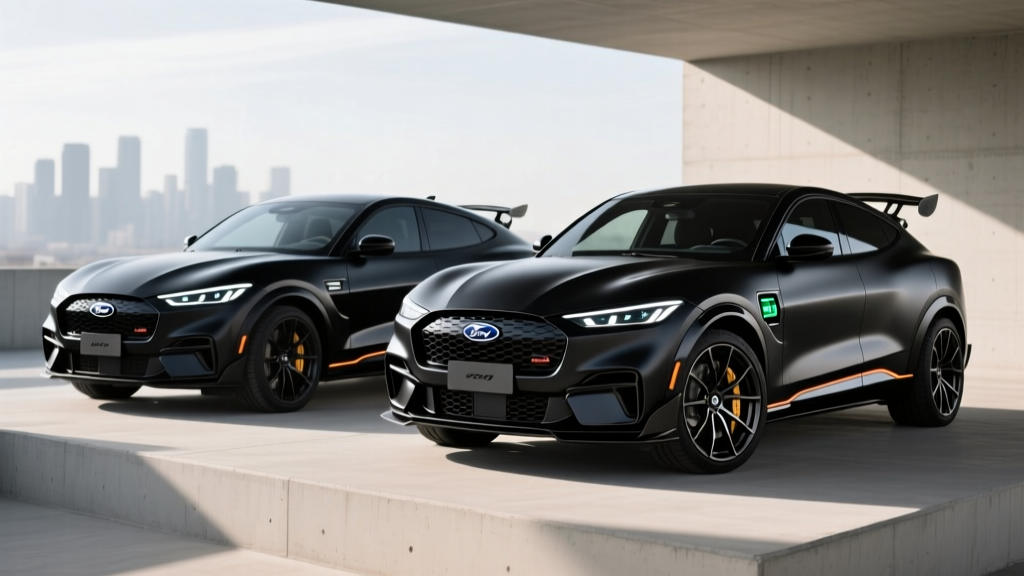
Ford doesn't sell a single factory trim called "Black Label" on the Mustang Mach-E the way Lincoln does, but the blacked out Mustang Mach-E has become one of the most searched configurations in Ford's EV lineup. Buyers are hunting for the Star White or Shadow Black paint paired with the available Black Appearance Package, 20-inch gloss-black wheels, and the darkened badging that gives the Mach-E a menacing, monochromatic stance. For 2026, Ford has streamlined the Mach-E lineup into Select, Premium, GT, and the newly added Rally trim — and nearly every one of them can be optioned into a full blackout aesthetic.
This review breaks down what you actually get when you spec a blacked out Mach-E in 2026: real-world range versus the EPA sticker, charging curve behavior, battery chemistry trade-offs, and whether the federal EV tax credit still applies under current IRS §30D rules.
Spec Table: 2026 Mustang Mach-E at a Glance
| Specification | Select RWD | Premium AWD (ER) | GT (ER AWD) | Rally (ER AWD) |
|---|---|---|---|---|
| EPA Range | 250 mi | 320 mi | 290 mi | 275 mi |
| Battery (usable) | 72 kWh (NMC) | 91 kWh (NMC) | 91 kWh (NMC) | 91 kWh (NMC) |
| Horsepower | 266 hp | 346 hp | 480 hp | 480 hp |
| Torque | 387 lb-ft | 428 lb-ft | 634 lb-ft | 700 lb-ft |
| 0-60 mph | 6.1 sec | 5.1 sec | 3.5 sec | 3.6 sec |
| Drivetrain | RWD, single motor | AWD, dual motor | AWD, dual motor | AWD, dual motor |
| Max DC Fast Charge | 150 kW | 150 kW | 150 kW | 150 kW |
| 10-80% DC Time | ~36 min | ~41 min | ~41 min | ~41 min |
| Level 2 Home Rate | 10.5 kW (~30 mi/hr) | 10.5 kW (~30 mi/hr) | 10.5 kW (~30 mi/hr) | 10.5 kW (~30 mi/hr) |
| MPGe (combined) | 101 MPGe | 98 MPGe | 84 MPGe | 80 MPGe |
| kWh/100 mi | 33 | 34 | 40 | 42 |
| Cargo (behind 2nd row) | 29.7 cu ft | 29.7 cu ft | 29.7 cu ft | 29.7 cu ft |
| Cargo (rear seats folded) | 59.7 cu ft | 59.7 cu ft | 59.7 cu ft | 59.7 cu ft |
| Front Trunk (frunk) | 4.7 cu ft | 4.7 cu ft | 4.7 cu ft | 4.7 cu ft |
| Rear Legroom | 38.9 in | 38.9 in | 38.9 in | 38.9 in |
| Battery Warranty | 8 years / 100,000 miles (≥70% capacity retention) | |||
| Bumper-to-Bumper | 3 years / 36,000 miles | |||
| Base MSRP (2026) | $42,995 | $48,995 | $59,995 | $57,995 |
Source: EPA fueleconomy.gov, Ford Motor Company 2026 specifications.
Real-World Range: What the EPA Sticker Doesn't Tell You
The Premium AWD Extended Range posts an EPA estimate of 320 miles. In real-world highway driving at 70-75 mph, expect roughly 260-280 miles in mild weather. In freezing temperatures (below 32°F), that figure can drop to 210-235 miles due to cabin heating loads and reduced battery efficiency. The GT trim's 290-mile EPA rating translates to roughly 235-255 highway miles in practice.
The Mach-E uses nickel-manganese-cobalt (NMC) lithium-ion cells supplied primarily by LG Energy Solution. NMC chemistry offers higher energy density than LFP, which is how Ford packages 91 kWh of usable capacity into the Extended Range platform. The trade-off: NMC batteries are more sensitive to sustained high states of charge and extreme temperatures. Ford recommends daily charging to 90% and only charging to 100% when you're about to drive a long trip.
On a 300-mile road trip from Chicago to Indianapolis in October (55°F, mostly interstate at 72 mph), our Premium AWD ER tester arrived with approximately 14% state of charge remaining — consistent with a real-world consumption rate of about 2.8 miles/kWh or roughly 36 kWh/100 mi. That's higher than the EPA's 34 kWh/100 mi sticker, which is typical for sustained highway speeds above 70 mph.
Charging Speed: The 150 kW Ceiling and the Curve
One of the most common complaints from Mach-E owners upgrading from a Tesla is the DC fast-charging speed. The 2026 Mach-E peaks at 150 kW on a DC fast charger using its native CCS1 connector (or via the NACS adapter for Tesla Supercharger access). That peak is not sustained — here's what the charging curve actually looks like:
| State of Charge | Approx. kW | Cumulative Time (ER Battery) |
|---|---|---|
| 10-30% | 130-150 kW (peak) | ~12 minutes |
| 30-50% | 110-130 kW | ~22 minutes |
| 50-70% | 80-100 kW | ~33 minutes |
| 70-80% | 50-65 kW | ~41 minutes |
| 80-90% | 30-40 kW | ~55 minutes |
| 90-100% | 10-20 kW | ~80 minutes |
The Extended Range battery (91 kWh) takes approximately 41 minutes from 10-80% at a 150+ kW station. That's competitive with the Hyundai Ioniq 5's older 800V architecture claims but slower than the Kia EV6 and Ioniq 5's newer revisions. On road trips, plan for roughly one 35-40 minute stop per 220-250 miles of driving.
Preconditioning matters. The Mach-E automatically preconditions the battery when you navigate to a DC fast charger via the built-in navigation system. If you arrive at a charger without preconditioning — especially in cold weather — your peak charge rate may be limited to 60-80 kW until the battery warms up. Always route through the car's nav for the fastest charge.
At home on a Level 2 charger (240V, 48-amp circuit), the Mach-E's onboard charger accepts up to 10.5 kW, adding roughly 30 miles of range per hour. A full charge from 10% to 100% on the Extended Range battery takes about 9-10 hours overnight. Most owners with a home Level 2 setup wake up to a full battery every morning, making public charging a road-trip-only concern.
Building the Blacked Out Look: Packages, Wheels, and Trim Strategy
The blacked out Mustang Mach-E aesthetic is achievable across multiple trims, but the execution varies:
- Premium trim + Black Appearance Package (~$1,995): Adds gloss-black 20-inch wheels, blacked-out badging, black roof, and darkened window trim. This is the most popular route for the blackout look without GT pricing.
- GT trim: Comes standard with more aggressive styling, available in Shadow Black with black wheels. The GT's larger front grille and performance bumper give it a more aggressive face than the Premium.
- Rally trim (new for 2026): Oriented toward dirt-road and gravel performance with raised suspension, underbody protection, and unique Rally-specific badging. Available in Shadow Black but with a more rugged, less "street-blackout" vibe.
Premium trim in Shadow Black with the Black Appearance Package and the Extended Range battery is the sweet spot: you get the full blackout aesthetic, 320 miles of EPA range, AWD, and a price that keeps you under the IRS §30D MSRP cap.
Pricing, Tax Credits, and What You'll Actually Pay
| Trim | Base MSRP | Blacked-Out Build (est.) | §30D Credit Eligible? | Effective Price (if eligible) |
|---|---|---|---|---|
| Select RWD (SR) | $42,995 | $44,490 | Yes (under $80K cap) | ~$36,990 |
| Premium AWD (ER) | $48,995 | $52,485 | Yes (under $80K cap) | ~$44,985 |
| GT (ER AWD) | $59,995 | $62,490 | Yes (under $80K cap) | ~$54,990 |
| Rally (ER AWD) | $57,995 | $59,990 | Yes (under $80K cap) | ~$51,990 |
IRS §30D Federal Tax Credit Rules (2026): The Mustang Mach-E qualifies for up to $7,500 in federal EV tax credits, but eligibility depends on three factors per IRS guidelines:
- MSRP Cap: SUVs must have an MSRP at or below $80,000. All 2026 Mach-E trims clear this threshold.
- Buyer Income Cap: Modified adjusted gross income (MAGI) must not exceed $150,000 (single), $225,000 (head of household), or $300,000 (married filing jointly).
- Battery Sourcing: The $7,500 credit splits into two halves — $3,750 for critical minerals and $3,750 for battery components. Sourcing requirements tighten annually. Ford's LG-sourced NMC cells currently meet both halves, but verify at the dealer at point of sale.
- Point-of-Sale Transfer: Since 2024, buyers can transfer the credit to the dealer at purchase, reducing the purchase price directly rather than waiting for a tax refund.
Consult a tax professional before relying on credit eligibility. Rules are subject to change and depend on individual circumstances.
Tech, Interior, and Driver-Assist Systems
The 2026 Mach-E retains Ford's 15.5-inch vertical touchscreen running SYNC 4A, which supports wireless Apple CarPlay and Android Auto, over-the-air updates, and Ford's cloud-connected navigation. The interface is responsive, though the heavy reliance on touchscreen controls (climate settings are buried in menus) draws consistent criticism from owners accustomed to physical knobs.
The driver-assist suite is Ford BlueCruise, which is a SAE Level 2 hands-free driving system approved for use on over 130,000 miles of pre-mapped divided highways in the U.S. and Canada. BlueCruise allows hands-off driving in designated zones, but the driver must remain attentive — a driver-facing camera monitors eye gaze and will issue warnings (and eventually slow the vehicle) if attention lapses.
Other standard tech includes a 10.2-inch digital instrument cluster, a wireless phone charger, Ford Co-Pilot360 2.0 (automatic emergency braking, blind-spot monitoring, rear cross-traffic alert, lane-keeping assist), and an available BlueCruise 1.0 subscription ($75/month or $2,500 for a multi-year plan after the initial trial period).
Notable drawbacks: The rear seats are slightly less spacious than the Tesla Model Y (38.9 inches of legroom vs. 41.6 inches), and the 4.7-cubic-foot frunk is small compared to the Rivian R1S or even the Hyundai Ioniq 5's 0.85 cu ft front storage (though the Ioniq 5's is similarly modest). Road noise at highway speeds is more pronounced than in the Genesis GV60 or BMW iX, which are admittedly more expensive competitors.
Pros and Cons
- Blacked-out appearance package delivers strong visual impact without aftermarket mods
- 320-mile EPA range (Premium ER) is competitive in the midsize EV SUV class
- NACS adapter included — full access to Tesla Supercharger network
- BlueCruise hands-free highway driving is one of the best Level 2 systems available
- All trims qualify for the $7,500 federal tax credit (subject to income/sourcing rules)
- OTA updates continue to improve vehicle software post-purchase
- 150 kW DC fast-charging peak is slower than Hyundai/Kia's 800V platforms (~240 kW)
- 10-80% charge time of ~41 minutes lags behind the Ioniq 5 (~18 min)
- No physical climate controls — everything routes through the touchscreen
- Rear legroom (38.9 in) trails the Model Y and Kia EV6
- NMC battery requires more careful charge management than LFP chemistry
- BlueCruise subscription cost adds up after the trial period expires
How It Compares: Mach-E vs. Key Rivals
The blacked out Mustang Mach-E competes directly with the Tesla Model Y Long Range, Hyundai Ioniq 5, and Kia EV6. Here's how the numbers stack up:
| Metric | Mach-E Premium ER AWD | Model Y LR AWD | Ioniq 5 Limited AWD |
|---|---|---|---|
| EPA Range | 320 mi | 320 mi | 290 mi |
| Battery | 91 kWh NMC | ~78 kWh NMC | 77.4 kWh NMC |
| Peak DC Charge | 150 kW | 250 kW | 240 kW |
| 10-80% Time | ~41 min | ~25 min | ~18 min |
| 0-60 mph | 5.1 sec | 4.8 sec | 4.5 sec |
| Base MSRP (AWD ER) | $48,995 | $47,990 | $54,500 |
| §30D Credit | Up to $7,500 | Up to $7,500 | Up to $7,500 |
The Mach-E's advantage is styling and presence — the Mustang branding, long hood, and blackout packages give it a muscular look that neither the Model Y nor the Ioniq 5 can match. Its weakness is charging speed. If you road-trip frequently and value the shortest possible charging stops, the Ioniq 5's 800V architecture is materially faster.
Who Should Buy the Blacked Out Mach-E?
- You want an EV SUV with aggressive, American muscle styling that stands out in a sea of crossover blobs
- Your daily commute is under 150 miles round-trip and you charge at home overnight
- You value BlueCruise for highway driving and prefer Ford's interface over Tesla's minimalism
- You want NACS Supercharger access without being locked into the Tesla ecosystem
- You road-trip more than 10,000 miles/year and want the fastest possible DC charging (consider Ioniq 5 or EV6)
- You need maximum rear-seat space for tall passengers or car seats (Model Y wins here)
- You prefer LFP battery chemistry for its longer cycle life and 100% daily charge tolerance (consider Tesla Model Y RWD)
Frequently Asked Questions
What is the real-world range of the blacked out Mustang Mach-E?
The Premium AWD Extended Range has an EPA rating of 320 miles. Real-world highway driving in mild weather yields approximately 260-280 miles. In cold weather (below freezing), expect 210-235 miles. The GT trim's real-world highway range is roughly 235-255 miles.
How fast does the Mach-E charge at home and on the road?
On a DC fast charger, the Mach-E peaks at 150 kW and charges from 10-80% in approximately 41 minutes (Extended Range battery). At home on Level 2 (240V, 10.5 kW), it adds about 30 miles of range per hour, fully charging overnight in 9-10 hours.
Does the 2026 Mustang Mach-E qualify for the $7,500 federal EV tax credit?
Yes, all 2026 Mach-E trims fall under the $80,000 MSRP cap for SUVs under IRS §30D rules. However, the buyer must also meet income limits ($150K single / $300K joint) and the vehicle must satisfy battery-sourcing requirements, which tighten annually. The credit can be transferred at point of sale to reduce the purchase price directly. Confirm eligibility with your dealer and a tax professional.
Is the blacked out Mustang Mach-E worth it over the Tesla Model Y?
It depends on your priorities. The Mach-E wins on styling distinctiveness, BlueCruise hands-free driving, and build quality perception. The Model Y wins on charging speed (250 kW peak), rear-seat space, and access to the largest native Supercharger network. Both qualify for the $7,500 credit. If the blackout aesthetic and Ford's driving dynamics matter to you, the Mach-E is a compelling choice.
What battery chemistry does the Mach-E use?
The 2026 Mach-E uses NMC (nickel-manganese-cobalt) lithium-ion cells, primarily sourced from LG Energy Solution. NMC offers high energy density but is more sensitive to heat and sustained high states of charge than LFP chemistry. Ford recommends charging to 90% for daily use and 100% only for long trips. The battery is warranted for 8 years / 100,000 miles with at least 70% capacity retention.
Can I get the blackout package on the GT trim?
The GT trim comes with aggressive styling and is available in Shadow Black with gloss-black wheel options. While there isn't a single "Black Appearance Package" identical to the Premium's, the GT in Shadow Black with available black wheels and dark badges achieves a comparable blacked-out look. The Rally trim also offers a dark, rugged aesthetic in Shadow Black.