Verdict: A Practical Electric SUV With Aggressive Pricing
The Volkswagen ID.4 has carved out a distinct position in the electric crossover segment by prioritizing ride comfort, cabin space, and accessible pricing over blistering acceleration or cutting-edge software. For 2026, Volkswagen continues to sharpen the ID.4's value proposition with competitive lease incentives and pricing that undercuts rivals like the Hyundai Ioniq 5 and Ford Mustang Mach-E. If you're hunting for Volkswagen ID.4 deals, the combination of a sub-$40,000 starting price, a spacious interior, and strong federal tax credit eligibility makes this one of the most compelling family EVs on the market.
2026 Volkswagen ID.4 Specifications at a Glance
| Specification | ID.4 Pro (RWD) | ID.4 Pro S AWD |
|---|---|---|
| EPA Range | 291 miles | 263 miles |
| Usable Battery Capacity | 82 kWh (NMC) | 82 kWh (NMC) |
| Peak DC Fast-Charge Rate | 175 kW | 175 kW |
| 10–80% DC Fast-Charge Time | ~28 minutes | ~28 minutes |
| Level 2 Home Charging Rate | 11 kW (~37 mi/hr) | 11 kW (~37 mi/hr) |
| Horsepower | 282 hp | 335 hp |
| 0–60 mph | 7.7 seconds | 5.4 seconds |
| MPGe (Combined) | 107 MPGe | 98 MPGe |
| Efficiency | 31 kWh/100 mi | 34 kWh/100 mi |
| Cargo Volume (rear seats up) | 30.3 cu ft | 30.3 cu ft |
| Cargo Volume (rear seats folded) | 64.2 cu ft | 64.2 cu ft |
| Base MSRP | $39,735 | $47,735 |
Source: fueleconomy.gov and Volkswagen USA. Prices exclude destination charge (~$1,395).
Charging Speed: Home and DC Fast Charging
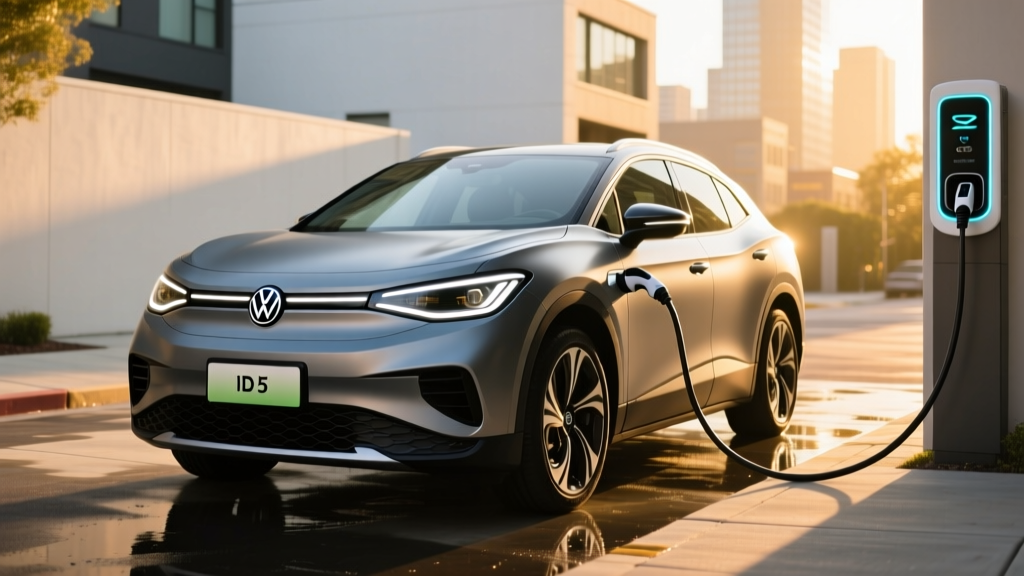
Charging speed remains a common pain point for EV shoppers, and the ID.4's 175 kW peak DC fast-charge rate is competent but not class-leading. Competitors like the Hyundai Ioniq 5 (peak 240 kW on 800V architecture) and the Kia EV6 can charge from 10–80% in roughly 18 minutes, compared to the ID.4's ~28 minutes. On a road trip, that 10-minute gap per stop adds up.
| Charging Level | Power (kW) | Approximate Speed | Notes |
|---|---|---|---|
| Level 1 (120V household outlet) | ~1.4 kW | ~4–5 miles per hour | Emergency/trickle only; full charge takes days |
| Level 2 (240V home/public) | 11 kW (max onboard) | ~37 miles per hour | Full charge in ~9 hours from empty |
| DC Fast Charge | Peak 175 kW | 10–80% in ~28 min | Tapers significantly above 80% SoC |
Charging curve reality: The 175 kW peak rate holds roughly from 10–30% State of Charge (SoC). After that, the rate tapers to approximately 120–130 kW through 60%, then drops further to 50–70 kW as you approach 80%. If you're on a road trip, the most time-efficient strategy is to charge from 10–60% and skip topping off to 80% unless you need the extra range to reach your next stop.
The ID.4 uses the CCS1 connector standard. Volkswagen has confirmed NACS (Tesla Supercharger) compatibility via adapter for current models, and future model years will transition to a native NACS port. Check with your dealer for the latest adapter availability and Supercharger network access details.
Pricing, Trims, and Federal Tax Credit Eligibility
The 2026 ID.4 lineup starts at $39,735 for the Pro trim (RWD) and climbs to approximately $54,735 for the fully loaded Pro S Plus AWD. Volkswagen frequently offers lease incentives and loyalty bonuses that can bring effective monthly payments well below what the MSRP suggests.
| Trim | MSRP (excl. destination) | Estimated Price After §30D Credit | Drivetrain |
|---|---|---|---|
| Pro | $39,735 | ~$32,235* | RWD |
| Pro S | $44,735 | ~$37,235* | RWD |
| Pro S AWD | $47,735 | ~$40,235* | AWD |
| Pro S Plus AWD | $54,735 | ~$47,235* | AWD |
*Assumes full $7,500 §30D federal tax credit eligibility. Actual credit depends on battery sourcing, buyer income, and MSRP cap compliance. See IRS rules below.
IRS §30D Federal EV Tax Credit Requirements
The ID.4 is assembled in Chattanooga, Tennessee, which gives it a structural advantage for the critical-minerals and battery-component sourcing requirements under IRS §30D. However, eligibility is not automatic. Key requirements for 2026:
- MSRP Cap: SUVs must have an MSRP at or below $80,000 — all ID.4 trims qualify.
- Buyer Income Cap: Modified adjusted gross income (MAGI) must not exceed $150,000 (single), $225,000 (head of household), or $300,000 (joint filing).
- Battery Sourcing: Critical minerals and battery components must meet phased-in percentage thresholds from US or FTA-partner countries. Volkswagen has worked to localize supply chains, but confirm current-year eligibility with your dealer and cross-reference the fueleconomy.gov tax credit tracker.
- Point-of-Sale Transfer: The §30D credit can now be transferred to the dealer at purchase, reducing your out-of-pocket cost immediately rather than waiting for a tax refund.
Tax-credit caveat: Battery-sourcing rules tighten annually. A trim that qualifies in January may face supply-chain shifts by December. Always verify eligibility at the point of sale and consult a tax professional for your specific situation.
Battery, Warranty, and Long-Term Ownership
The ID.4 uses an 82 kWh usable-capacity battery pack with NMC (nickel manganese cobalt) chemistry. NMC offers higher energy density than LFP (lithium iron phosphate), which helps the ID.4 achieve its 291-mile EPA rating in a relatively compact package. However, NMC chemistry is more sensitive to prolonged high-State-of-Charge storage and extreme heat, meaning owners should avoid routinely charging to 100% unless needed for a long trip.
Volkswagen backs the ID.4 battery with an 8-year/100,000-mile warranty covering defects and capacity loss below 70% of original capacity. The limited vehicle warranty covers 4 years/50,000 miles. These terms are competitive with the segment — Hyundai offers 10-year/100,000-mile battery coverage, while Tesla provides 8-year/120,000-mile.
Degradation expectations: Based on data from early ID.4 owners (2021–2023 models), battery degradation has averaged 5–8% over the first 100,000 miles under normal use. DC fast charging exclusively will accelerate degradation; owners with home Level 2 access who charge primarily at 240V tend to see better long-term State of Health (SoH) retention.
Interior, Tech, and Daily Livability
The ID.4's cabin prioritizes simplicity and space. Rear-seat legroom measures 37.6 inches — generous for the compact electric SUV class and enough to comfortably seat adults on longer trips. Cargo volume stands at 30.3 cubic feet behind the rear seats and 64.2 cubic feet with them folded, which is competitive with the RAV4 Prime and slightly behind the Ioniq 5 (56.2 cu ft seats-up, but with a more versatile flat-load floor).
Infotainment: The 12.9-inch touchscreen (on Pro S and above) runs VW's latest ID. Software 4.0, which has improved responsiveness over the laggy early ID.4 systems. Wireless Apple CarPlay and Android Auto are standard. However, the touch-capacitive sliders for volume and climate remain a frustration point — they lack backlighting and are imprecise compared to physical knobs.
Driver assistance: The ID.4 includes Volkswagen's IQ.DRIVE suite with Travel Assist (adaptive cruise + lane centering), which operates as an SAE Level 2 driver-assist system. This means the driver must keep hands on the wheel and eyes on the road at all times. It is not a self-driving system. Travel Assist works well on highways but lacks the hands-free capability of GM's Super Cruise or Ford's BlueCruise.
Pros and Cons
Pros
- Competitive starting price; strong value after §30D credit
- Comfortable, quiet ride quality — among the best in class
- Spacious rear seat and cargo area for a compact SUV
- US-assembled (Chattanooga, TN) — strong tax credit eligibility
- Standard 11 kW Level 2 onboard charger (faster than some rivals at 7.2 kW)
- Turning radius of 31.5 feet — excellent for urban maneuvering
Cons
- DC fast-charge speed (175 kW peak) lags Ioniq 5/EV6 (240 kW)
- Touch-capacitive climate/volume sliders are frustrating
- No front trunk (frunk) — lost cargo opportunity
- Heat pump not standard on all trims (hurts cold-weather range)
- Infotainment still not as fluid as Tesla or Hyundai systems
- AWD range penalty is significant (263 vs 291 mi)
Who Should Buy the Volkswagen ID.4?
The ID.4 is best suited for:
- Suburban commuters who charge at home nightly and want a comfortable, quiet daily driver with enough range for errands and the occasional 200-mile round trip.
- Young families who need rear-facing car-seat space and cargo room for strollers and groceries without stepping up to a larger, more expensive SUV.
- Budget-conscious EV buyers who want to maximize the §30D tax credit and get into a well-rounded electric SUV for under $35,000 after incentives.
The ID.4 is not ideal for frequent road-trippers who prioritize the fastest possible DC charging, buyers who need hands-free highway driving (look at Super Cruise or BlueCruise vehicles), or those in extremely cold climates where the lack of a standard heat pump will significantly reduce winter range.
Look elsewhere if: You take frequent long road trips and need the fastest DC charging (Ioniq 5/EV6), you want hands-free highway driving (Mach-E with BlueCruise), or you need maximum range in cold weather (consider a heat-pump-equipped rival).
Frequently Asked Questions
What is the real-world range of the Volkswagen ID.4?
The RWD ID.4 Pro delivers an EPA-estimated 291 miles, but real-world highway driving at sustained speeds yields approximately 240–260 miles. In cold weather (below freezing), expect 200–220 miles. City driving with frequent regenerative braking can match or slightly exceed the EPA estimate.
How fast does the ID.4 charge at home and on DC fast chargers?
On a Level 2 home charger (240V), the ID.4 charges at up to 11 kW, adding roughly 37 miles of range per hour — a full charge from empty takes about 9 hours. On DC fast chargers, it peaks at 175 kW and reaches 10–80% in approximately 28 minutes, though the rate tapers significantly above 60% SoC.
Does the Volkswagen ID.4 qualify for the $7,500 federal tax credit?
The ID.4 is assembled in the US and has strong eligibility for the full §30D credit, but qualification depends on your income (MAGI caps apply), the specific battery-sourcing compliance at time of purchase, and the vehicle's MSRP (all trims fall under the $80,000 SUV cap). Verify current eligibility at fueleconomy.gov and with your dealer before purchase.
Is the ID.4 worth buying vs. the Hyundai Ioniq 5 or Tesla Model Y?
The ID.4 wins on ride comfort and pricing, especially after tax credits. The Ioniq 5 charges significantly faster (10–80% in ~18 min vs ~28 min) and has a more distinctive design. The Model Y offers superior range (up to 330 mi EPA), faster Supercharger access, and a more polished software experience but at a higher starting price. If charging speed and road-trip efficiency are priorities, the Ioniq 5 has the edge. If value and comfort matter most, the ID.4 is the stronger pick.
Does the ID.4 have a heat pump for cold weather?
A heat pump is available on higher trims (Pro S and above) but is not standard on the base Pro. Without a heat pump, cabin heating draws directly from the traction battery, which can reduce winter range by 20–30%. Cold-climate buyers should prioritize trims that include the heat pump.
What is the ID.4's towing capacity?
The AWD ID.4 is rated to tow up to 2,700 pounds (braked), which is sufficient for a small utility trailer or a pair of jet skis. The RWD model is not rated for towing. Note that towing will reduce range by 30–50% depending on trailer weight and aerodynamics.