Quick Verdict: The Sensible Compact Electric SUV
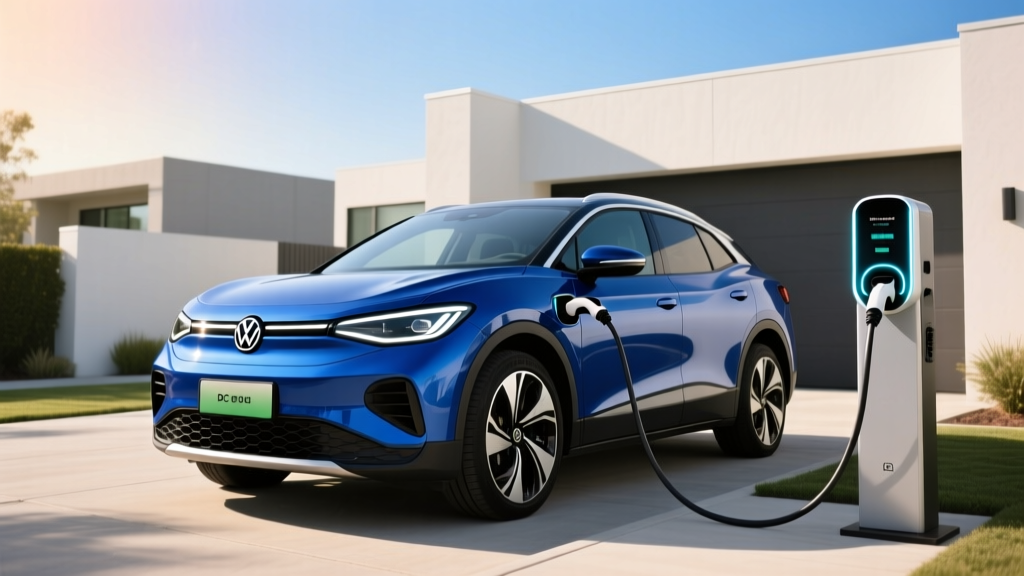
The Volkswagen ID.4 occupies a specific niche in the electric-vehicle market: a roomy, comfortable, no-drama compact crossover EV that prioritizes daily livability over headline-grabbing performance. For the 2026 model year, VW has refined the formula with a larger 82 kWh (gross) battery pack across most trims, a revamped infotainment system, and pricing that — when combined with federal incentives — undercuts rivals like the Hyundai Ioniq 5 and Ford Mustang Mach-E on a cost-per-mile-of-range basis.
If you need a practical family EV with solid cargo space, comfortable ride quality, and access to the Tesla Supercharger network (via VW's NACS adoption), the ID.4 deserves a serious look. It won't win drag races or set lap records, but it will quietly handle a 250-mile round trip without breaking a sweat — and recharge at home overnight for a fraction of what gas would cost.
| Spec | Standard Range (RWD) | Pro S (RWD) | AWD Pro S |
|---|---|---|---|
| EPA Range | 263 mi | 291 mi | 270 mi |
| Battery (gross / usable) | 62 kWh / 58 kWh | 82 kWh / 77 kWh | 82 kWh / 77 kWh |
| Battery Chemistry | NMC | NMC | NMC |
| Drivetrain | RWD (single motor) | RWD (single motor) | AWD (dual motor) |
| Horsepower | 201 hp | 282 hp | 335 hp |
| 0–60 mph | ~7.7 sec | ~7.0 sec | ~5.4 sec |
| Max DC Fast Charge | 140 kW | 175 kW | 175 kW |
| 10–80% DCFC Time | ~28 min | ~28 min | ~28 min |
| Level 2 Home Charge | 11 kW (7.2 kW capable) | 11 kW | 11 kW |
| MPGe (combined) | 104 MPGe | 104 MPGe | 98 MPGe |
| kWh/100 mi | 32 kWh | 32 kWh | 34 kWh |
| Cargo (behind rear seats) | 30.3 cu ft | ||
| Cargo (seats folded) | 64.2 cu ft | ||
| Rear Legroom | 37.6 in | ||
| Base MSRP | $39,735 | $43,735 | $47,735 |
| Battery Warranty | 8 yr / 100,000 mi (≥70% capacity) | ||
Real-World Range: What the EPA Sticker Doesn't Tell You
Real-World Expectation: ~240–260 miles on mixed highway driving at 70+ mph; ~200–220 miles in sustained cold weather (below 32°F) with cabin heat.
The ID.4 Pro S carries an 82 kWh gross battery pack (approximately 77 kWh usable, with the remainder held as a buffer to protect long-term battery health). The EPA rates the Pro S RWD at 291 miles, which is competitive with the segment but demands context.
In real-world highway testing at sustained speeds of 70–75 mph, expect roughly 240–260 miles before hitting 10% state of charge (SoC). EVs consume energy disproportionately faster at highway speeds due to aerodynamic drag, and the ID.4's bluff SUV profile doesn't help. Efficiency hovers around 3.0–3.2 miles per kWh on the highway versus the EPA's blended 3.1 mi/kWh.
Cold weather compounds the picture. At temperatures below freezing, lithium-ion chemistry slows and cabin heating draws significant power. Without preconditioning, plan for a 25–35% range reduction — meaning a 291-mile sticker becomes roughly 190–220 miles in bitter winter conditions. The ID.4's available heat pump (standard on Pro S and above in the U.S. market for 2026) mitigates this somewhat, recovering perhaps 5–10% of that loss versus resistive heating alone.
For daily commuting under 80 miles round-trip, even the Standard Range model's 263 EPA miles is more than sufficient, and most owners will charge at home overnight, rarely dipping below 50% SoC on weekdays.
Charging Speed: DC Fast and Home Level 2 Breakdown
Charging speed is where the ID.4 is adequate rather than exceptional. The Pro S and AWD models peak at 175 kW on a DC fast charger, while the Standard Range caps at 140 kW. That's slower than the Hyundai Ioniq 5's 240 kW peak or the Tesla Model Y's ~250 kW, but it still gets the job done on road trips.
| Charge Level | Power / Voltage | Miles Added per Hour | Typical Use Case |
|---|---|---|---|
| Level 1 (120V outlet) | ~1.4 kW | ~4 mi/hr | Emergency / trickle top-off |
| Level 2 (240V, 32A) | 7.7 kW | ~24 mi/hr | Home overnight (standard circuit) |
| Level 2 (240V, 48A) | 11 kW | ~34 mi/hr | Home overnight (full onboard capability) |
| DC Fast (Standard Range) | Peak 140 kW | ~150 mi in 30 min | Road-trip stops |
| DC Fast (Pro S / AWD) | Peak 175 kW | ~180 mi in 30 min |
Understanding the charge curve: The 175 kW peak on Pro S models is not sustained. The battery management system tapers charge rate as SoC increases to protect cell health. You'll see peak rates between roughly 10–35% SoC, after which the rate steps down progressively. The 10–80% charge takes approximately 28 minutes at a sufficiently powerful charger (180+ kW capable). Charging from 80–100% slows dramatically — often 30+ additional minutes — so plan road-trip stops around the 80% mark.
Home charging: The ID.4's onboard charger accepts up to 11 kW on Level 2 (240V, 48 amps). That means a full overnight charge from near-empty takes roughly 7–8 hours on a properly installed 60-amp circuit with a 48A EVSE (Electric Vehicle Supply Equipment). Most owners installing a Level 2 home charger should budget $500–$1,500 for equipment and electrician labor, depending on panel proximity and whether a panel upgrade (to 200A service) is needed.
For 2026, VW includes three years of complimentary 30-minute DC fast-charging sessions on the Electrify America network — a meaningful perk that offsets public-charging costs during the early ownership period.
Driving Dynamics, Performance, and the NACS Transition
The ID.4 rides on VW's MEB platform, which places the battery pack low in the chassis for a favorable center of gravity. Ride quality is a genuine strength: the suspension absorbs highway expansion joints and city potholes with a compliance that makes it one of the more comfortable entries in the compact EV SUV segment. Steering is light and accurate, if devoid of feedback.
The RWD Pro S's 282 hp and 339 lb-ft of torque deliver confident highway merging and passing. The 0–60 mph time of roughly 7.0 seconds won't thrill enthusiasts, but it's entirely adequate for the daily grind. The AWD Pro S, with dual motors producing 335 hp and 354 lb-ft, drops the sprint to about 5.4 seconds and adds genuine all-weather traction — a worthwhile upgrade for snow-belt buyers.
One-pedal driving is available but not as aggressive as some competitors. The ID.4's regenerative braking decelerates the car but doesn't bring it to a complete stop; you'll still use the brake pedal in stop-and-go traffic. Some drivers prefer this natural coasting feel; others find it a missed opportunity for true one-pedal convenience.
NACS connector adoption: For the 2026 model year, Volkswagen has transitioned U.S.-market ID.4 vehicles to the NACS (North American Charging Standard) connector — the Tesla-style plug. This grants native access to Tesla's Supercharger network (over 25,000 stalls in North America) without an adapter. CCS adapters are available for legacy Electrify America and other CCS stations. This is a significant practical advantage for road-trip charging reliability.
Pricing, Trims, and Federal Tax Credit Eligibility
The 2026 ID.4 lineup spans four main trims, with pricing that positions it competitively in the compact EV SUV segment:
| Trim | Base MSRP | Est. w/ Destination | §30D Credit (max) | Effective Price |
|---|---|---|---|---|
| Standard Range | $39,735 | $41,130 | Up to $7,500* | ~$33,630 |
| Pro | $41,235 | $42,630 | Up to $7,500* | ~$35,130 |
| Pro S | $43,735 | $45,130 | Up to $7,500* | ~$37,630 |
| Pro S AWD | $47,735 | $49,130 | Up to $7,500* | ~$41,630 |
| Pro S Plus (top) | $51,235 | $52,630 | Up to $7,500* | ~$45,130 |
*Credit amount depends on battery-sourcing and critical-minerals compliance under current IRS §30D rules. The ID.4 is assembled in Chattanooga, TN, which satisfies the North American final-assembly requirement. Verify current-year eligibility at purchase, as sourcing rules tighten annually.
Key §30D eligibility factors for the ID.4:
- MSRP cap: The ID.4 qualifies as an SUV under IRS classification, so the MSRP cap is $80,000 — all trims clear this comfortably.
- Buyer income cap: Adjusted gross income must not exceed $300,000 (married filing jointly), $225,000 (head of household), or $150,000 (single). Check your prior-year AGI.
- Battery sourcing: The credit splits into two halves — $3,750 for critical-minerals sourcing and $3,750 for battery-component manufacturing. VW's U.S. assembly helps, but the exact credit amount depends on the supply chain for the specific model year. Some 2026 ID.4 variants may qualify for the full $7,500; others may receive a partial credit. Confirm with your dealer and tax professional before purchase.
- Point-of-sale transfer: Since 2024, buyers can transfer the credit to the dealer at purchase, reducing the vehicle price on the spot rather than waiting for a tax refund. This effectively lowers your out-of-pocket cost at signing.
Interior, Cargo, and Everyday Practicality
The ID.4's interior is where it earns its family-SUV credentials. Rear-seat legroom measures 37.6 inches — generous for the segment and enough for adults on longer trips without complaint. The flat floor (no transmission tunnel) makes the middle rear seat genuinely usable.
Cargo space behind the second row is 30.3 cubic feet, expanding to 64.2 cu ft with the 60/40-split rear seats folded. That's competitive with the Toyota RAV4 Hybrid (37.6 / 69.8 cu ft) and slightly behind the Hyundai Ioniq 5 (27.2 / 59.3 cu ft — the ID.4 actually wins here). A small front trunk (frunk) is notably absent on AWD models and minimal on RWD trims — VW uses that space for HVAC components.
The 2026 infotainment overhaul addresses one of the ID.4's historical pain points. VW has replaced the sluggish previous-generation system with a larger 12.9-inch touchscreen running updated software with faster response times, a revised menu structure, and backlit capacitive slider controls for volume and climate — a direct response to widespread owner complaints about the prior unlit touch sliders.
Wireless Apple CarPlay and Android Auto are standard. The available 360-degree camera, head-up display with augmented-reality navigation arrows, and IQ.DRIVE suite (adaptive cruise, lane centering, automatic emergency braking) round out a tech package that's comprehensive if not class-leading.
Pros and Cons at a Glance
Pros
- Comfortable, compliant ride quality — one of the best in the segment for daily driving
- Generous rear-seat legroom and cargo volume for a compact SUV
- Competitive pricing, especially after §30D tax credit
- NACS connector provides native Tesla Supercharger access
- Strong battery warranty: 8 years / 100,000 miles at ≥70% capacity retention
- U.S. assembly (Chattanooga, TN) supports tax-credit eligibility
- 3 years of complimentary Electrify America DC fast charging
Cons
- DC fast-charge speed (175 kW peak) trails Ioniq 5, Model Y, and EV6
- No one-pedal driving to a full stop — regen is mild
- Frunk is absent or negligible depending on drivetrain
- Base infotainment still lags behind Hyundai/Kia and Tesla in responsiveness
- AWD model's range drops to 270 mi EPA — a 21-mile penalty
- Towing capacity limited to 2,700 lbs (AWD) / 2,200 lbs (RWD)
How the ID.4 Stacks Up Against Key Competitors
The compact EV SUV segment is crowded. Here's how the ID.4 Pro S compares to the most direct rivals on the specs that matter most to buyers:
| Spec | VW ID.4 Pro S | Hyundai Ioniq 5 SEL | Tesla Model Y LR | Ford Mach-E Premium |
|---|---|---|---|---|
| EPA Range | 291 mi | 303 mi | 320 mi | 290 mi |
| Battery (usable) | 77 kWh (NMC) | 77.4 kWh (NMC) | ~75 kWh (NMC) | 75.7 kWh (NMC) |
| Peak DC Charge | 175 kW | 240 kW | ~250 kW | 150 kW |
| 10–80% Time | ~28 min | ~18 min | ~20 min | ~33 min |
| 0–60 mph | 7.0 sec | 7.4 sec | 5.0 sec | 6.1 sec |
| Cargo (rear seats up) | 30.3 cu ft | 27.2 cu ft | 30.2 cu ft | 29.7 cu ft |
| Base MSRP (comparable trim) | $43,735 | $46,650 | $44,990 | $43,995 |
Where the ID.4 wins: cargo volume, ride comfort, and effective pricing after tax credits. It's also the most conservative, approachable EV for buyers transitioning from a gas SUV.
Where it loses: DC fast-charging speed is the most significant gap. On road trips, the Ioniq 5 and Model Y will get you back on the road 8–10 minutes faster per stop. The Model Y also holds an advantage in Supercharger network maturity (though the ID.4's NACS adoption narrows this) and software sophistication.
Who Should Buy the Volkswagen ID.4?
Choose the ID.4 if:
- You prioritize ride comfort and cabin quietness over sporty handling
- Your daily commute is under 100 miles round-trip and you can charge at home
- You need strong cargo and rear-seat space for a growing family
- You want access to the Supercharger network via NACS without switching to Tesla
- Budget matters and you qualify for the §30D tax credit
Look elsewhere if:
- You take frequent 400+ mile road trips and want the fastest possible DC charging (Ioniq 5 or Model Y)
- You need more than 2,700 lbs of towing capacity (consider the F-150 Lightning or Rivian R1S)
- You want cutting-edge software, over-the-air updates, and an app ecosystem (Tesla still leads here)
- You want one-pedal driving to a full stop (Hyundai/Kia or Tesla)
Frequently Asked Questions
What is the real-world range of the 2026 VW ID.4?
The EPA rates the Pro S RWD at 291 miles. In real-world mixed highway driving at 70 mph, expect approximately 240–260 miles. In cold weather (below 32°F), that drops to roughly 200–220 miles. The Standard Range model's 263-mile EPA rating translates to about 215–230 miles in mixed real-world use.
How fast does the ID.4 charge at home and on DC fast chargers?
On a 240V Level 2 home charger at 48 amps (11 kW), the ID.4 adds roughly 34 miles of range per hour — a full overnight charge from near-empty takes 7–8 hours. On a DC fast charger, the Pro S and AWD peak at 175 kW, reaching 10–80% in approximately 28 minutes. The Standard Range model peaks at 140 kW.
Does the 2026 VW ID.4 qualify for the federal EV tax credit?
The ID.4 is assembled in Chattanooga, Tennessee, satisfying the North American final-assembly requirement. It clears the $80,000 SUV MSRP cap. However, the full $7,500 credit depends on battery-component and critical-minerals sourcing requirements that tighten each year under IRS §30D. Buyer income caps also apply ($150K single / $300K joint). Verify eligibility with your dealer and a tax professional at time of purchase. The credit can be transferred to the dealer at point of sale, reducing your purchase price directly.
Is the ID.4 worth buying over the Hyundai Ioniq 5 or Tesla Model Y?
It depends on your priorities. If ride comfort, cargo space, and value after tax credits top your list, the ID.4 is an excellent choice. If fast DC charging speed and road-trip efficiency are paramount, the Ioniq 5 (240 kW peak) or Model Y (~250 kW) are stronger. The ID.4's NACS adoption for 2026 narrows the charging-network gap with Tesla significantly.
What is the ID.4's battery warranty?
Volkswagen covers the ID.4's high-voltage battery for 8 years or 100,000 miles (whichever comes first), guaranteeing at least 70% capacity retention. If the battery degrades below 70% of its original capacity within that period, VW will repair or replace it. The vehicle's general warranty is 4 years / 50,000 miles bumper-to-bumper.
Does the ID.4 have a frunk (front trunk)?
AWD models have no frunk — the front motor occupies that space. RWD models have a small compartment under the hood, but it's primarily used for charging cables and is not a practical cargo area like the frunks found in the Ford F-150 Lightning or Rivian R1T.
How does the ID.4 handle in snow and winter conditions?
The AWD dual-motor variant provides confident traction in snow and ice, with electronic stability control and VW's IQ.DRIVE assists. Combined with winter tires, the AWD ID.4 is a capable winter vehicle. The heat pump (standard on Pro S and above) helps preserve range in cold weather by heating the cabin more efficiently than resistive elements alone.