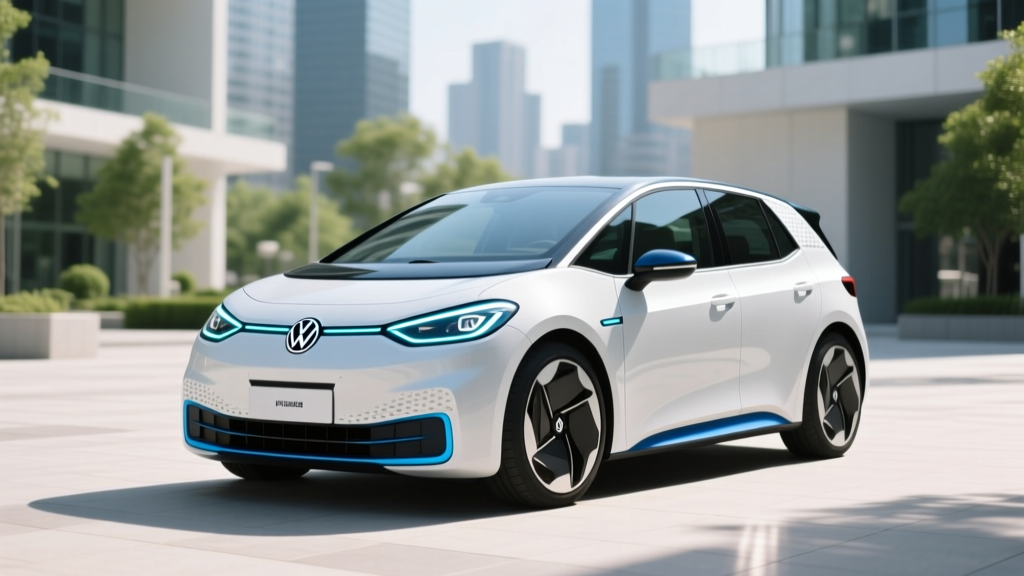
Compact, affordable, and electric — the Volkswagen ID.2 has been one of the most anticipated entries in VW's ID. family since its concept debut. Positioned below the ID.4 in VW's electric lineup, the ID.2 targets urban commuters and cost-conscious buyers who want a practical EV without the crossover premium. But as we move through 2026, the biggest question for US-based shoppers remains: when (or if) will the Volkswagen ID.2 arrive stateside?
This preview compiles every confirmed and estimated specification available for the ID.2, drawing from Volkswagen's official European disclosures, platform engineering details, and industry reporting. Where US-specific data (EPA range, pricing, tax credit eligibility) is not yet confirmed, we provide well-reasoned estimates based on comparable vehicles and VW's historical US-market adjustments. Nothing in this article should be interpreted as a currently available US purchase — the ID.2 remains an announced model for international markets with US availability still unconfirmed.
What Is the Volkswagen ID.2?
The ID.2 is Volkswagen's entry-level electric hatchback, built on a shortened variant of the MEB platform (sometimes referred to as MEB Entry or MEB21). It slots beneath the ID.3 (Europe-only) and ID.4 in VW's EV hierarchy, aiming squarely at the sub-€25,000 / sub-$28,000 segment that includes competitors like the upcoming BYD Seagull, the Citroën ë-C3, and the Renault 5 E-Tech.
In VW's vision, the ID.2 replaces the spiritual role of the Polo or Golf in an electric era — a practical, everyday hatchback with enough range for daily commuting and weekend errands, wrapped in a package small enough for tight city parking but spacious enough for a small family.
Estimated Specs at a Glance
| Specification | Estimated / Confirmed Value |
|---|---|
| Battery Capacity | ~48 kWh usable (LFP chemistry expected for base trim) |
| EPA Est. Range | ~180–210 miles (estimated; WLTP target is up to 450 km / 280 mi for higher-capacity variant) |
| Motor / Drivetrain | Single front-mounted motor, FWD |
| Horsepower | ~113–154 hp (85–115 kW) depending on variant |
| 0–60 mph | ~9.0–10.5 seconds (estimated) |
| Max DC Fast Charge | ~80–100 kW peak (estimated) |
| 10–80% DC Charge Time | ~28–35 minutes (estimated) |
| Level 2 Home Charging | 7.2–11 kW onboard charger; ~20–30 miles of range per hour |
| MPGe (est.) | ~110–125 MPGe combined (estimated) |
| Cargo Volume | ~14–16 cu ft (rear seats up); ~42–48 cu ft (folded) — estimated |
| Base MSRP (US est.) | ~$25,000–$28,000 (if US launch occurs) |
| Battery Warranty | 8 years / 100,000 miles (VW standard EV warranty) |
Note: European-spec WLTP range figures are typically 15–25% higher than US EPA estimates for the same vehicle. VW's stated WLTP target of up to 450 km translates to roughly 280 miles WLTP, which we estimate at 210–230 miles EPA for a larger battery variant, and 180–200 miles EPA for the base 48 kWh pack.
Range and Real-World Efficiency
EPA estimated: ~180–210 miles (depending on battery variant)
Real-world highway (70 mph, moderate climate): ~155–180 miles
Cold-weather (below 32°F, mixed driving): ~130–160 miles
City / stop-and-go with regen: ~190–220 miles
The ID.2's compact battery and lightweight platform are optimized for efficiency rather than brute-force range. VW has emphasized that the MEB Entry platform prioritizes low energy consumption — targeting roughly 14–16 kWh per 100 km (WLTP), which translates to approximately 22–26 kWh per 100 miles in EPA-adjusted terms.
For context, that efficiency figure is competitive with the Chevrolet Bolt EV (28 kWh/100mi) and slightly better than the Hyundai Kona Electric (27 kWh/100mi). In practical terms, city commuters doing 30–40 miles round-trip will easily go a full work week without charging, while road-trippers should plan stops every 150–170 miles at highway speeds.
Cold-weather impact is real. Without confirmed heat pump standardization on the base ID.2, buyers in northern climates should budget for 25–35% range loss in sustained sub-freezing temperatures. VW has offered heat pumps as optional or standard on higher ID. trims — we expect the same strategy for the ID.2, where the heat pump may be a package add-on rather than standard on the base trim.
Charging Speed and Infrastructure
Charging speed is where budget EVs often compromise, and the ID.2 is no exception to the physics of smaller batteries. A ~48 kWh pack with an estimated 80–100 kW peak DC fast-charge rate means:
| Charging Level | Power (kW) | Miles Added per Hour | Notes |
|---|---|---|---|
| Level 1 (120V) | ~1.4 kW | ~4–5 mi/hr | Emergency / overnight trickle only |
| Level 2 (240V, 32A) | 7.2 kW | ~22–26 mi/hr | Full charge in ~6–7 hours |
| Level 2 (240V, 48A) | 11 kW | ~32–38 mi/hr | Full charge in ~4.5–5 hours (if 11 kW onboard) |
| DC Fast Charge | 80–100 kW peak | N/A (time-based) | 10–80% in ~28–35 min; tapers significantly above 80% |
Key charging insight: The ~80–100 kW peak rate may seem modest compared to the 200+ kW rates of larger EVs, but with a smaller battery, the C-rate (charge rate relative to capacity) is actually reasonable. At 100 kW into a 48 kWh pack, you're charging at roughly 2C — comparable to a 250 kW rate into a 120 kWh pack. The charge curve will taper above 80% SoC, so plan to unplug at 80% on road trips rather than waiting for a full top-up.
For daily home charging, a standard 240V / 32A Level 2 wallbox will fully replenish the ID.2 overnight — approximately 6–7 hours from near-empty. This is perfectly adequate for the target use case and means most ID.2 owners will rarely, if ever, need public charging for daily driving.
Battery Chemistry: LFP vs. NMC
Volkswagen has signaled that its entry-level ID. models will adopt LFP (lithium iron phosphate) battery chemistry for base trims, reserving NMC (nickel manganese cobalt) for higher-range variants. This is a significant detail for prospective buyers:
| Factor | LFP (Expected Base) | NMC (Expected Higher Trim) |
|---|---|---|
| Energy Density | Lower (~160 Wh/kg cell-level) | Higher (~220–260 Wh/kg cell-level) |
| Cycle Life | 3,000–5,000+ cycles | 1,000–2,000 cycles |
| Cold-Weather Performance | More range loss in cold | Better cold-weather retention |
| Recommended SoC | Can charge to 100% daily | 80% daily recommended; 100% for trips |
| Cost | Lower (no cobalt/nickel) | Higher |
| Safety | Higher thermal stability | Good, but lower thermal runaway threshold |
For a budget commuter EV, LFP is arguably the better choice. The ability to charge to 100% daily without long-term degradation concerns means the usable daily range of a 48 kWh LFP pack is effectively all 48 kWh — whereas NMC owners are advised to keep daily charging at 80%, effectively reducing a 58 kWh NMC pack to ~46 kWh for routine use. The trade-off is slightly worse cold-weather performance and a heavier pack for the same energy capacity.
Performance and Driving Dynamics
The ID.2 is not a performance EV — and it doesn't pretend to be. With an estimated 113–154 hp (85–115 kW) from a single front-mounted motor driving the front wheels, acceleration is adequate for city merging and suburban driving but won't win any stoplight drag races.
- 0–60 mph: Estimated 9.0–10.5 seconds (base to higher-output variant)
- Top speed: Electronically limited, likely ~99 mph (160 km/h)
- Drivetrain: Front-wheel drive only — no AWD option expected
- Towing: Not rated for towing (typical for subcompact EVs)
Where the ID.2 should shine is in urban maneuverability. The MEB Entry platform's short wheelbase and tight turning circle (estimated ~33 feet / 10.1 m curb-to-curb) make it ideal for parallel parking and narrow city streets. VW's EV driving philosophy — smooth torque delivery, one-pedal driving capability, and low center of gravity — should carry over, giving the ID.2 a planted, composed feel despite its modest power output.
Pricing, Trims, and Tax Credit Eligibility
Volkswagen has positioned the ID.2 as its most affordable EV, with a European starting price target of approximately €25,000. Translating this to US pricing involves accounting for market adjustments, regulatory compliance costs, and feature differences — but VW's US pricing historically tracks close to European equivalents for volume models.
| Trim (Estimated) | Est. US MSRP | After §30D Credit (if eligible) |
|---|---|---|
| Base (48 kWh LFP) | ~$25,000–$27,000 | ~$17,500–$19,500 |
| Mid (larger battery or added features) | ~$28,000–$31,000 | ~$20,500–$23,500 |
| Top (if offered) | ~$32,000–$35,000 | ~$24,500–$27,500 |
If the ID.2 launches in the US, its sub-$35,000 MSRP would comfortably clear the IRS §30D MSRP cap of $55,000 for sedans/hatchbacks. However, full $7,500 credit eligibility depends on:
- Buyer income caps: AGI ≤ $150,000 (single) / $300,000 (joint)
- Battery component sourcing: Must meet escalating US/free-trade-agreement manufacturing thresholds
- Critical minerals sourcing: Must meet escalating percentage requirements for US or FTA-partner-sourced minerals
- Final assembly: Must occur in North America
Critical caveat: If VW manufactures the ID.2 exclusively in Europe (likely Emden or Wolfsburg, Germany), it would NOT qualify for the §30D credit due to the North American final assembly requirement. A point-of-sale transfer option would also depend on meeting all criteria. Always consult a tax professional and verify current rules at irs.gov before making a purchase decision.
Interior, Tech, and Practicality
The ID.2's interior follows VW's ID. family design language — minimalist, screen-forward, with the compact digital instrument cluster and a central touchscreen (expected 10–12.9 inches depending on trim). Key expected features include:
- Infotainment: VW ID. Software 4.x with wireless Apple CarPlay and Android Auto, over-the-air updates
- Driver assistance: Travel Assist (adaptive cruise + lane centering, SAE Level 2), Front Assist with automatic emergency braking, Park Assist
- Connectivity: VW Car-Net connected services, remote preconditioning via app
- Seating: 5-passenger capacity; estimated 40+ inches front legroom, ~36–37 inches rear legroom
- Cargo: ~14–16 cu ft behind rear seats; ~42–48 cu ft with rear seats folded
- Frunk: Possible small front trunk (~1–2 cu ft) for charging cables, though not confirmed
The ID.2's hatchback form factor gives it a practicality edge over subcompact sedans. The rear hatch opening and fold-flat rear seats make it viable for IKEA runs, camping gear, or a week's worth of groceries for a family of four. It won't match the cargo volume of an ID.4 (~30 cu ft behind rear seats), but for its footprint, the utility is strong.
Who Should Consider the Volkswagen ID.2?
- Commute 20–60 miles round-trip and can charge at home overnight
- Want the lowest possible EV entry price without going used
- Live in a city or suburb where compact size is an advantage
- Prioritize LFP battery longevity and daily 100% charging convenience
- Don't need AWD, towing, or 300+ mile road-trip range
Look elsewhere if you:
- Regularly drive 200+ miles between charging stops
- Need AWD for snow-belt winters (consider the ID.4 AWD or Hyundai Ioniq 5 AWD)
- Require 3+ rear passengers with generous legroom
- Want the latest Level 2+ hands-free driving features (BlueCruise, Super Cruise)
Competitive Landscape
If and when the ID.2 reaches the US, it enters a competitive sub-$30,000 EV space. Here's how it stacks up against key rivals (using confirmed or best-available data):
| Model | EPA Range | Battery | DC Charge | Base MSRP |
|---|---|---|---|---|
| VW ID.2 (est.) | ~180–210 mi | ~48 kWh LFP | ~80–100 kW | ~$25,000–$27,000 |
| Chevrolet Bolt EV | 259 mi | 65 kWh NMC | 55 kW (CCS) | ~$26,500 |
| Hyundai Kona Electric | 261 mi | 64.8 kWh NMC | ~100 kW | ~$32,675 |
| Nissan Leaf (S) | 149 mi | 40 kWh | 50 kW (CHAdeMO) | ~$28,140 |
The Bolt EV remains the range and value benchmark in this segment with its 259-mile EPA rating, though its 55 kW DC charging is a notable weakness on road trips. The ID.2 would need to deliver competitive real-world range and significantly better DC charging to displace it — particularly given the Bolt's established US service network and confirmed §30D eligibility.
Warranty and Ownership Considerations
Volkswagen's standard EV warranty package is expected to carry over to the ID.2:
- Battery warranty: 8 years / 100,000 miles (capacity retention threshold typically ≥70%)
- Powertrain warranty: 8 years / 100,000 miles
- Bumper-to-bumper: 4 years / 50,000 miles
- Roadside assistance: 4 years / unlimited miles (varies by market)
LFP chemistry, if confirmed for the base ID.2, offers a compelling longevity story. With 3,000–5,000+ cycle life, an LFP pack could theoretically endure 150,000–250,000+ miles of full cycles before reaching 80% State of Health (SoH) — well beyond the warranty period and likely the vehicle's practical lifespan. This is a meaningful ownership advantage over NMC-equipped competitors for buyers planning to keep the vehicle long-term.
Insurance note: EVs typically carry 15–25% higher insurance premiums than equivalent ICE vehicles due to higher repair costs and parts pricing. Budget accordingly — get quotes before committing.
Frequently Asked Questions
What is the real-world range of the Volkswagen ID.2?
Based on VW's European WLTP data and typical EPA adjustments, we estimate the ID.2 at approximately 180–210 miles EPA, depending on battery variant. Real-world highway driving at 70 mph will yield roughly 155–180 miles, and cold-weather driving (below 32°F) may drop to 130–160 miles. City driving with regenerative braking can approach or slightly exceed the EPA estimate.
How fast does the VW ID.2 charge?
The estimated DC fast-charge peak is 80–100 kW, delivering a 10–80% charge in approximately 28–35 minutes. At home on a 240V Level 2 charger (32A / 7.2 kW), expect about 22–26 miles of range per hour, or a full charge in 6–7 hours. On an 11 kW (48A) Level 2 circuit, that improves to ~32–38 miles per hour and a full charge in roughly 4.5–5 hours.
How much will the Volkswagen ID.2 cost after tax credits?
Estimated base MSRP is $25,000–$27,000. If the vehicle qualifies for the full $7,500 §30D federal tax credit, the effective price could drop to $17,500–$19,500. However, qualification depends on North American final assembly, battery sourcing rules, and buyer income limits — all of which are uncertain for the ID.2 given VW's European manufacturing footprint. Verify eligibility with a tax professional before purchasing.
Is the VW ID.2 worth buying vs. competitors?
If it arrives in the US at its target price point, the ID.2 would be one of the most affordable new EVs available, with the added benefit of likely LFP battery chemistry for long-term durability. However, the Chevrolet Bolt EV offers significantly more EPA range (259 miles) at a similar price, and the Hyundai Kona Electric provides a more refined package with better range (261 miles) at a higher cost. The ID.2's value proposition hinges on its actual US pricing, confirmed range, and whether VW can solve the tax-credit assembly question.
What are the biggest pros and cons of the ID.2?
- Lowest entry price in VW's EV lineup
- LFP battery = long cycle life, daily 100% charging OK
- Compact footprint, ideal for urban parking
- Hatchback practicality with fold-flat rear seats
- VW's established dealer and service network
- OTA software updates
- Modest EPA range (~180–210 mi est.) limits road-trip utility
- DC fast charging (~80–100 kW) is slower than segment leaders
- No AWD option — limiting for snow-belt buyers
- US availability unconfirmed; may not launch stateside
- Tax credit eligibility uncertain (assembly likely in Europe)
- Modest power (113–154 hp) — not a performance vehicle
Does the Volkswagen ID.2 qualify for the federal EV tax credit?
Unlikely in its current form. The IRS §30D credit requires final assembly in North America. VW's ID.2 is expected to be manufactured in Germany. Unless VW shifts production to a North American plant (such as its Chattanooga, TN facility), the ID.2 would not qualify for the $7,500 federal credit. It may still qualify for certain state or utility incentives — check your local programs at the Alternative Fuels Data Center.
When will the VW ID.2 be available in the United States?
As of mid-2026, Volkswagen of America has not confirmed a US launch date for the ID.2. The model is rolling out in select European markets. Industry analysts speculate a US introduction is possible in the 2027–2028 timeframe, potentially as a 2028 model year, but this remains unconfirmed. VW has previously skipped US launches for models like the ID.3, so there is no guarantee the ID.2 will arrive at all.
Sources: Volkswagen Newsroom, fueleconomy.gov (EPA), IRS §30D Clean Vehicle Credits, Alternative Fuels Data Center.
Disclaimer: Specifications, pricing, and availability cited in this article reflect the best available information as of mid-2026. The Volkswagen ID.2 is an announced model not yet available for purchase in the United States. All US-facing figures are estimates. Consult Volkswagen of America and a qualified tax professional for confirmed specifications and incentive eligibility before making a purchase decision.