Quick Verdict: The ID. Buzz Is a Statement, Not a Bargain
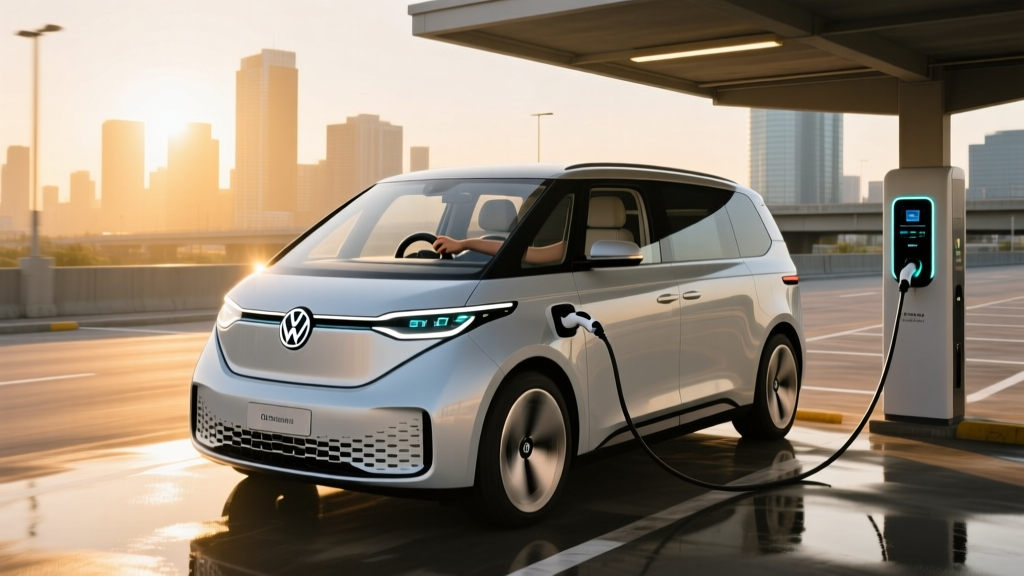
The 2025 Volkswagen ID. Buzz arrives in the U.S. as a three-row, all-electric minivan wrapped in retro Microbus styling. Underneath the two-tone paint and nostalgia sits VW's MEB platform, a 91 kWh battery (86 kWh usable), and standard 4MOTION all-wheel drive. It is the first mainstream electric minivan sold in America, and it carries a price to match its uniqueness: starting at $59,995 before destination.
For families who want a three-row EV and refuse to buy a crossover, the ID. Buzz fills a genuine gap. But with an EPA range of 234 miles, a modest 170 kW peak DC charge rate, and no federal tax credit eligibility at launch, buyers need to go in with eyes wide open about what this van can and cannot do.
Range and Efficiency: EPA Sticker vs. Real-World Reality
EPA Estimated: 234 miles (Pro S trim, 20-inch wheels)
Real-World Highway (70 mph, mild weather): ~195–215 miles
Real-World Cold Weather (below 32°F, mixed driving): ~165–185 miles
City / Stop-and-Go: Up to ~240+ miles (regen-heavy routes favor the ID. Buzz)
The EPA rates the ID. Buzz at 234 miles for the Pro S trim equipped with 20-inch wheels. The higher trims (Pro S Plus and 1st Edition) with 20-inch wheels and additional equipment carry the same rating, though real-world results will vary based on driving style and conditions.
The ID. Buzz is a tall, boxy vehicle with the aerodynamic profile of, well, a bus. At highway speeds above 70 mph, drag takes a significant toll. In mixed highway testing, expect roughly 195 to 215 miles before you need to find a charger. In freezing temperatures, the MEB platform's thermal management helps but cannot eliminate the typical 20–30% range reduction that all lithium-ion packs experience in cold weather. Plan for 165–185 miles of usable range on a frigid January road trip.
Efficiency lands at approximately 87 MPGe combined (EPA), translating to roughly 38–42 kWh per 100 miles in mixed driving. That is thirsty by EV standards — for comparison, a Tesla Model Y AWD achieves about 28 kWh/100 mi. The penalty of moving 6,000+ pounds with a brick-like drag coefficient is unavoidable.
Battery, Platform, and Powertrain
| Spec | Value |
|---|---|
| Battery (gross / usable) | 91 kWh / 86 kWh |
| Chemistry | NMC (Nickel Manganese Cobalt) |
| Drivetrain | AWD (dual-motor, 4MOTION) |
| Horsepower | 282 hp (combined) |
| Torque | 339 lb-ft |
| 0–60 mph | ~5.7 seconds |
| Top Speed | 99 mph (electronically limited) |
| EPA Range | 234 miles |
| MPGe (combined) | 87 MPGe |
| Curb Weight | ~5,970 lbs |
| Towing Capacity | Not rated for towing (US) |
The ID. Buzz uses Volkswagen's MEB platform with an NMC (nickel manganese cobalt) lithium-ion battery. NMC chemistry offers a strong balance of energy density and performance, though it is more sensitive to sustained high state-of-charge storage than LFP (lithium iron phosphate). VW recommends keeping the battery between 20% and 80% for daily use and charging to 100% only before long trips — standard practice for NMC packs.
All U.S. ID. Buzz models come with dual-motor all-wheel drive. The front motor adds traction and modest power, bringing the combined output to 282 horsepower and 339 lb-ft of torque. The 0–60 mph sprint takes approximately 5.7 seconds — genuinely quick for a vehicle this size and fully adequate for highway merging and passing. The electronic top-speed limiter at 99 mph reflects the van's aerodynamic realities.
Charging Speed: DC Fast, Level 2, and the Charge Curve
| Level | Max Rate | Speed / Time | Connector |
|---|---|---|---|
| Level 1 (120V) | ~1.4 kW | ~3–4 mi/hr | J1772 / NACS adapter |
| Level 2 (240V) | 11 kW (AC onboard) | ~24–28 mi/hr; 0–100% in ~9 hr | J1772 / NACS adapter |
| DC Fast Charge | 170 kW peak | 10–80% in ~26 min | CCS1 (NACS adapter included) |
The ID. Buzz's DC fast-charging peak of 170 kW is adequate but not class-leading. Competitors like the Hyundai Ioniq 5 and Kia EV9 accept 235 kW and 236 kW respectively, translating to shorter pit stops on road trips.
Here is the charge-curve reality that spec sheets omit: the ID. Buzz sustains close to its 170 kW peak from roughly 10% to 35% state of charge, then tapers progressively. Between 50% and 80%, expect sustained rates closer to 80–110 kW. The 10–80% time of approximately 26 minutes assumes a warm battery and a charger capable of delivering full power — conditions you will not always find at Electrify America or third-party CCS stations.
At home on a Level 2 charger, the 11 kW onboard AC charger is a strong point. A full 0–100% charge takes about 9 hours on a 48-amp Level 2 circuit. This means overnight charging easily replenishes a full day's driving. Most ID. Buzz owners will rarely use DC fast charging except on road trips, making the home-charging experience the one that matters most.
Volkswagen includes a NACS adapter with the ID. Buzz, enabling access to Tesla Supercharger stalls (now opening to non-Tesla EVs via the North American Charging Standard). This significantly expands the available fast-charging network for road trips.
Interior Space, Cargo, and Three-Row Practicality
The ID. Buzz is a minivan first and an EV second, and that shows in its interior packaging. The short-wheelbase U.S. version seats seven in a 2-3-2 configuration across three rows.
| Measurement | Value |
|---|---|
| Front Headroom | ~41.0 in |
| Second-Row Legroom | ~38.6 in |
| Third-Row Legroom | ~32.0 in (best for children) |
| Cargo (behind 3rd row) | ~18.2 cu ft |
| Cargo (3rd row folded) | ~55.0 cu ft |
| Cargo (all rear rows folded) | ~100.6 cu ft |
| Frunk | None |
The third row is best suited for children or occasional adult use on short trips — legroom is tight at roughly 32 inches. Cargo space behind the third row at 18.2 cubic feet is enough for a few grocery bags or a compact stroller, but you will want to fold the third row for any serious hauling. The available power-folding third row (on Pro S Plus and 1st Edition trims) makes this easier.
Notably, there is no front trunk (frunk). The MEB platform's packaging in the ID. Buzz leaves the front area occupied by the drive motor and HVAC components. This is a missed opportunity for sealed, weatherproof storage of charging cables.
Pricing, Trims, and Federal Tax Credit Status
| Trim | Base MSRP | Key Features |
|---|---|---|
| Pro S | $59,995 | AWD, 20" wheels, heated front seats, 12.9" touchscreen, IQ.DRIVE |
| Pro S Plus | $63,495 | Adds panoramic roof, power-folding 3rd row, Harman Kardon audio, ventilated front seats |
| 1st Edition | $65,495 | Exclusive two-tone colors, unique interior trim, all Pro S Plus features, numbered badge |
Destination charges add approximately $1,395 to all trims. A fully loaded 1st Edition ID. Buzz can exceed $67,000 out the door before any incentives.
The 2025 ID. Buzz does not currently qualify for the $7,500 federal EV tax credit under IRS §30D. The battery cell sourcing and critical-minerals requirements under the Inflation Reduction Act have not been met by VW's supply chain for this model as of the 2025 model year. Always verify current eligibility at the IRS qualified vehicles list, as manufacturer eligibility can change with supply-chain updates.
Additional §30D constraints to know:
- MSRP cap for vans/SUVs: $80,000 (the ID. Buzz clears this)
- Buyer income caps: $300K joint / $225K head of household / $150K single (modified AGI)
- Point-of-sale transfer available for qualifying vehicles (reduces purchase price at the dealer)
Technology, Driver Assists, and Notable Drawbacks
The ID. Buzz features VW's latest infotainment system on a 12.9-inch touchscreen with wireless Apple CarPlay and Android Auto, a 10.3-inch digital instrument cluster, and available augmented-reality head-up display on higher trims. The system is a marked improvement over earlier ID.4 software, with faster response times and a more logical menu structure, though VW's capacitive-touch steering wheel controls remain a frustration point for many drivers.
The IQ.DRIVE suite comes standard and includes:
- Adaptive cruise control with stop-and-go
- Lane-keeping assist and lane-centering
- Front and rear automatic emergency braking
- Blind-spot monitoring with rear cross-traffic alert
- Travel Assist (combined lane-centering + adaptive cruise for highway use)
VW's Travel Assist and IQ.DRIVE are SAE Level 2 driver-assistance systems. They can steer, accelerate, and brake under certain conditions, but the driver must remain fully engaged with hands on the wheel and eyes on the road. This is not autonomous driving.
Notable drawbacks:
- No frunk: Missed storage opportunity for cables and small items.
- Capacitive steering wheel controls: Prone to accidental inputs; tactile buttons would be preferable.
- Towing not rated: Unlike the Rivian R1S or Kia EV9, the ID. Buzz has no U.S. towing rating.
- Third-row space: Tight for adults on longer drives.
- 170 kW DC peak: Slower than Hyundai/Kia E-GMP rivals on road-trip charging stops.
Pros and Cons
- Only mainstream 3-row electric minivan in the U.S.
- Iconic retro design with modern EV underpinnings
- Spacious cabin with excellent headroom and visibility
- 11 kW AC onboard charger — strong home charging
- Standard AWD on all trims
- NACS adapter included for Supercharger access
- Comfortable ride quality, quiet at speed
- 234-mile EPA range is modest for the price
- 170 kW DC fast-charge peak trails competitors
- No federal tax credit eligibility (as of launch)
- Starting near $60,000 — expensive for a minivan
- No frunk
- Third row tight for adults
- No towing capacity
- Efficiency (87 MPGe) is low for an EV
Who Should Buy the ID. Buzz?
- You need a three-row vehicle and want an EV, not a plug-in hybrid
- You primarily drive in urban/suburban settings under 150 miles per day
- You have reliable home Level 2 charging and rarely road-trip beyond 200 miles between stops
- You value unique design and want something that stands out in the school drop-off line
- You want standard AWD for snow-belt climates
- You regularly drive 250+ miles between charging stops (consider the Kia EV9 with 304-mile range)
- You need towing capability (Rivian R1S or EV9 with tow package)
- Budget is a primary concern — the tax-credit-eligible Kia EV9 starts ~$5,000 less and qualifies for the $7,500 credit
- You want maximum DC fast-charging speed for frequent road trips
Warranty Coverage
| Coverage | Term |
|---|---|
| Basic Vehicle Warranty | 4 years / 50,000 miles |
| Battery & Powertrain | 8 years / 100,000 miles |
| Battery Capacity Retention | ≥70% of original capacity over 8 yr / 100,000 mi |
| Roadside Assistance | 4 years / 50,000 miles |
Volkswagen's 8-year / 100,000-mile battery warranty with a 70% capacity retention floor is industry-standard and matches most competitors. NMC batteries in VW's MEB platform have shown moderate degradation in real-world ID.4 fleet data — typically 5–8% loss over the first 60,000 miles — though the ID. Buzz's larger pack and newer thermal management may yield slightly different results.
Frequently Asked Questions
What is the real-world range of the VW ID. Buzz?
The EPA rates the ID. Buzz at 234 miles. In real-world highway driving at 70 mph, expect 195–215 miles. In cold weather below freezing, plan for 165–185 miles. City driving with frequent regenerative braking can push range slightly above the EPA estimate.
How fast does the ID. Buzz charge at home and on the road?
At home on Level 2 (240V), the 11 kW onboard charger delivers roughly 24–28 miles of range per hour, with a full 0–100% charge in about 9 hours. On DC fast chargers, it peaks at 170 kW and charges from 10% to 80% in approximately 26 minutes under ideal conditions.
Does the ID. Buzz qualify for the $7,500 federal EV tax credit?
As of the 2025 model year, the ID. Buzz does not qualify for the federal §30D tax credit due to battery sourcing requirements. Check the IRS qualified vehicle list for the latest status, as eligibility can change. State and utility incentives may still apply.
Is the VW ID. Buzz worth buying vs. the Kia EV9 or Rivian R1S?
The ID. Buzz is the only electric minivan, so if you specifically need minivan packaging (sliding doors, low step-in height, flat floor), it has no direct rival. Against the Kia EV9 (3-row SUV, 304 mi range, ~$54,900, tax-credit-eligible), the EV9 offers more range, faster charging, and lower effective cost. The Rivian R1S offers more performance, towing, and off-road capability at a higher price point. The ID. Buzz wins on character and minivan practicality; it loses on range-per-dollar and charging speed.
Can the ID. Buzz tow a trailer?
Volkswagen has not rated the U.S.-spec ID. Buzz for towing. If you need to tow, look at the Kia EV9 (up to 5,000 lbs with tow package) or the Rivian R1S (up to 7,700 lbs).
Does the ID. Buzz have a frunk?
No. The ID. Buzz does not have a front trunk. All cargo space is in the rear.