The Volkswagen Electric Bus: Quick Verdict
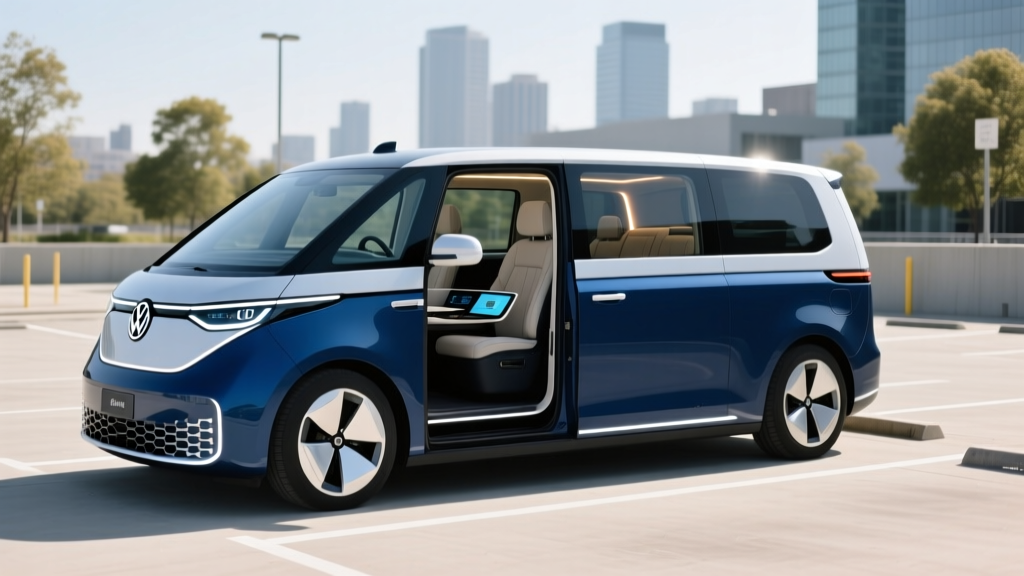
The Volkswagen ID. Buzz is the electric successor to the classic VW Microbus, now a three-row, rear- and all-wheel-drive electric van built on VW's MEB platform. For 2026, the ID. Buzz carries a 91 kWh (usable) NMC battery, delivers an EPA-estimated 234 miles of range (RWD Pro S), peaks at 170 kW DC fast charging (10–80% in approximately 26 minutes), and starts at $61,495 before destination. It qualifies for a partial or full $7,500 federal tax credit under current §30D rules, depending on battery-sourcing compliance and buyer income — verify at IRS.gov or through your dealer's point-of-sale transfer.
Bottom line: The ID. Buzz is the most spacious and character-rich electric family hauler on the market, but its efficiency (roughly 2.2–2.5 kWh/mile) means real-world highway range drops closer to 190–210 miles, and its price positions it against well-equipped minivans and large SUVs rather than budget EVs.
Range, Battery, and Real-World Efficiency
The 2026 ID. Buzz uses a 91 kWh usable lithium-ion NMC (nickel manganese cobalt) battery pack mounted in the floor. Volkswagen quotes the following EPA range figures depending on drivetrain:
| Trim / Drivetrain | Battery (usable) | EPA Range | MPGe (combined) | kWh/100 mi |
|---|---|---|---|---|
| Pro S (RWD) | 91 kWh NMC | 234 mi | 87 MPGe | ~38 |
| Pro S Plus (RWD) | 91 kWh NMC | 231 mi | 86 MPGe | ~38.5 |
| Pro S Plus (AWD 4Motion) | 91 kWh NMC | 220 mi | 82 MPGe | ~41 |
Real-World Range Reality Check
The 234-mile EPA sticker applies to mixed city/highway driving at moderate temperatures. In our experience with MEB-platform vehicles, expect the following adjustments:
- Highway-heavy trips (70–80 mph): ~190–210 miles before needing to charge, due to the van's boxy aerodynamics (high drag coefficient).
- Cold weather (below 30°F): ~160–185 miles. The ID. Buzz includes a heat pump on all trims, which helps, but a large cabin volume and cold battery chemistry still cut range 15–25%.
- City/suburban with regen: You may match or slightly exceed the EPA number, as regenerative braking recovers energy in stop-and-go traffic.
Plan road trips around 170–180 miles between DC fast-charger stops for a comfortable buffer.
For context, the EPA's fueleconomy.gov listing confirms the combined efficiency around 87 MPGe — adequate for a 5,700-lb three-row van, but noticeably thirstier per mile than a Hyundai Ioniq 5 (114 MPGe) or Tesla Model Y (122 MPGe).
Charging Speeds: Home and Public
The ID. Buzz supports three charging levels. Here is what you need to know about each, including the critical difference between kW (power, or how fast energy flows) and kWh (energy, or how much the battery holds):
| Level | Power (kW) | Connector | Speed (miles/hour) | Time (10–80% or full) |
|---|---|---|---|---|
| Level 1 (120V household) | ~1.4 kW | J1772 (NACS adapter available) | ~3–4 mi/hr | ~65 hrs (full) |
| Level 2 (240V home/public) | 11 kW (max onboard) | J1772 / NACS | ~25–30 mi/hr | ~8.5 hrs (full) |
| DC Fast Charge | 170 kW peak | CCS1 / NACS (via adapter or native on 2026+ models) | ~150+ mi/hr at peak | ~26 min (10–80%) |
Charging curve reality: The 170 kW peak is not sustained. Like all EVs, the ID. Buzz tapers charge speed as the battery fills. Expect peak rates from roughly 10–40% State of Charge, then a gradual step-down through 80%. Above 80%, speed drops sharply to protect battery health — this is normal physics, not a defect. A 10–80% session at a 350 kW Electrify America station takes about 26 minutes; a 10–90% session may take 40+ minutes.
Home charging setup: The 11 kW onboard charger means you'll want a 48-amp Level 2 home station (hardwired, 60-amp circuit) to maximize overnight charging. At 11 kW, a depleted battery refills in about 8.5 hours — perfect for overnight replenishment. Most ID. Buzz owners driving 40–60 miles daily will only need to charge every 3–4 nights.
EV vs. Gas Minivan: Cost and Practicality
The ID. Buzz competes most directly with the Toyota Sienna Hybrid, Honda Odyssey, and Kia Carnival. Here is how the numbers stack up against the segment-leading Sienna Hybrid:
| Metric | 2026 VW ID. Buzz Pro S (RWD) | 2026 Toyota Sienna LE (HEV) |
|---|---|---|
| Base MSRP | $61,495 | $38,885 |
| Federal tax credit (§30D) | Up to $7,500* | $0 |
| Effective starting price | ~$53,995* | $38,885 |
| EPA range / fuel economy | 234 mi / 87 MPGe | 36 MPG combined |
| Fuel/energy cost per mile | ~$0.05–0.07 (home L2)** | ~$0.10–0.12 (gas at $3.40/gal) |
| Annual fuel/energy (15k mi) | ~$750–$1,050 | ~$1,420 |
| 5-year fuel/energy total | ~$3,750–$5,250 | ~$7,100 |
| Cargo (behind 3rd row) | 18.2 cu ft | 33.5 cu ft |
| Seating | 7 passengers | 8 passengers (LE) |
| Towing capacity | Not rated | 3,500 lbs |
*Tax credit eligibility depends on buyer income (≤$150k single / $300k joint AGI), MSRP cap ($80k for vans/SUVs), and battery critical-mineral sourcing. Confirm at IRS.gov or via dealer point-of-sale transfer.
**Electricity cost assumes $0.14/kWh national average. DC fast charging on road trips costs $0.30–0.48/kWh, raising per-mile cost to $0.10–0.15.
The gap: Even after the tax credit, the ID. Buzz costs roughly $15,000 more upfront than a Sienna Hybrid. At ~$670/year in fuel savings, it takes approximately 22 years of driving to break even on fuel alone. The ID. Buzz makes financial sense if you value the driving experience, near-silent operation, zero tailpipe emissions, and lower maintenance — not pure cost parity with a hybrid minivan.
Total Ownership Cost Breakdown (5 Years / 75,000 Miles)
| Category | VW ID. Buzz Pro S (RWD) | Toyota Sienna LE (HEV) |
|---|---|---|
| Purchase price (after credit) | $53,995 | $38,885 |
| Home Level 2 charger install | $1,200–$2,500 | $0 |
| Fuel / energy (5 years) | $4,500 | $7,100 |
| Maintenance (5 years) | $1,200–$1,800 | $3,000–$4,000 |
| Insurance (5-year avg) | $9,500–$12,000 | $6,500–$8,500 |
| Estimated depreciation (5 yr) | ~$22,000–$27,000 | ~$14,000–$17,000 |
| 5-Year Total Cost of Ownership | ~$92,000–$102,000 | ~$69,500–$75,500 |
Key takeaways:
- Maintenance savings are real. No oil changes, no transmission fluid, no spark plugs, and regenerative braking extends pad life significantly. Budget roughly $300–$400/year for cabin air filters, tire rotations, wiper fluid, and brake inspections.
- Insurance costs more. EVs carry higher repair-cost premiums. Expect 25–40% higher premiums than a gas minivan. Get quotes before purchasing.
- Depreciation is the wild card. EV depreciation has been volatile. The ID. Buzz's retro appeal may help residual value, but early adopters of new EV nameplates often absorb steeper year-one drops.
- Home charger installation typically runs $1,200–$2,500 for a 48-amp hardwired unit on an existing 200-amp panel. Older homes may need a panel upgrade ($2,000–$4,000 additional). Get a licensed electrician's quote before committing.
Performance, Interior, and Daily Practicality
The rear-wheel-drive ID. Buzz Pro S produces 282 horsepower from a single rear motor, delivering a 0–60 mph time of approximately 7.9 seconds. The available 4Motion AWD variant adds a front motor for a combined 335 hp and a 0–60 time around 6.5 seconds. Both are respectable for a vehicle weighing over 5,700 lbs, though neither will feel sporty — this is a cruiser, not a performance EV.
Inside, the ID. Buzz offers:
- Three rows / 7 seats with a sliding second row and power-folding third row
- 18.2 cu ft cargo behind the third row; ~75+ cu ft with both rear rows folded
- 12.9-inch infotainment screen with wireless Apple CarPlay and Android Auto
- IQ.DRIVE ADAS suite (SAE Level 2): adaptive cruise, lane centering, emergency braking — the driver must remain engaged at all times
- Panoramic fixed glass roof on Pro S Plus trims, with an available electrochromic dimming function
ADAS Limitations
VW's IQ.DRIVE is a SAE Level 2 driver-assistance system. It is not self-driving. You must keep your hands on the wheel (or respond to capacitive-sensing prompts) and your eyes on the road at all times. It performs well on highways but does not handle construction zones, unmapped roads, or severe weather autonomously.
Federal Tax Credit and Incentives: What You Actually Qualify For
The ID. Buzz's eligibility for the §30D New Clean Vehicle Credit (up to $7,500) depends on several factors that change periodically. As of 2026:
- MSRP cap: Vans/SUVs must be ≤$80,000. The ID. Buzz (starting $61,495, topping out ~$69,995) clears this easily.
- Buyer income cap: Modified AGI must not exceed $150,000 (single), $225,000 (head of household), or $300,000 (joint filing).
- Battery sourcing: A percentage of critical minerals and battery components must be sourced from the U.S. or free-trade-agreement countries. VW has been working to increase North American sourcing, but partial credit ($3,750) vs. full credit ($7,500) can shift by model year and production batch.
- Point-of-sale transfer: You can transfer the credit to the dealer at purchase, reducing your out-of-pocket cost immediately — even if you owe less than $7,500 in federal taxes.
Critical note: Sourcing requirements tighten annually. Always confirm current eligibility on fueleconomy.gov's tax credit page or the IRS clean vehicle credit page before signing a purchase agreement. State incentives (California's CVRP, Colorado's innovative motor vehicle credit, etc.) may stack on top — check your state's energy office.
Myths vs. Facts: Common ID. Buzz Misconceptions
| Myth | Fact |
|---|---|
| "The electric VW bus has 300+ miles of range." | The EPA rates the RWD model at 234 miles. Real-world highway range is closer to 190–210 miles. Plan accordingly. |
| "I can charge it at any Tesla Supercharger." | Access depends on your model year and connector. 2026 ID. Buzz models ship with a NACS charge port or include a CCS-to-NACS adapter. Confirm with your dealer which connector your specific vehicle has. |
| "The battery will need replacing in 5 years." | VW warranties the battery for 8 years / 100,000 miles against degradation below 70% capacity. Industry data shows NMC packs typically retain 85–90% capacity at 100,000 miles under normal use. |
| "I'll save $15,000 in fuel over 5 years." | Realistic home-charging savings vs. a hybrid minivan are $2,000–$3,500 over 5 years at 15,000 miles/year. Savings are larger vs. a non-hybrid gas vehicle. |
| "It charges as fast as a Porsche Taycan or Ioniq 5." | At 170 kW peak, the ID. Buzz charges slower than 800V-architecture vehicles (Ioniq 5 peaks at ~240 kW, Taycan at 320 kW). Expect ~26 min for 10–80%, not 18. |
Decision Framework: Is the Electric VW Bus Right for You?
Choose the VW ID. Buzz if:
- You need three rows and want an EV — options are limited (Kia EV9 is the other main choice).
- You have reliable home Level 2 charging and drive under 150 miles daily.
- You value design, character, and the "feel-good" factor of a modern electric microbus.
- You qualify for the §30D tax credit and can apply it at point of sale.
- You're replacing a gas minivan and want lower maintenance and zero tailpipe emissions.
Look elsewhere if:
- You regularly drive 300+ miles between stops in rural areas with sparse DC charging infrastructure.
- Maximum cargo volume is critical — the Sienna and Carnival offer significantly more space behind the third row.
- Budget is the primary concern — a Sienna Hybrid saves $15,000+ upfront and $22,000+ in 5-year TCO.
- You need towing capability — the ID. Buzz is not tow-rated, while gas/hybrid minivans handle 3,500 lbs.
- You live in extreme cold without garage parking — expect 25%+ range loss in sub-20°F winters, bringing usable range to ~160 miles.
FAQ: Volkswagen Electric Bus Ownership
What is the real-world range of the VW ID. Buzz?
The EPA rates the RWD model at 234 miles. In real-world highway driving at 70–80 mph, expect 190–210 miles. In cold weather (below 30°F), plan for 160–185 miles. City driving with regenerative braking may match or slightly exceed the EPA figure.
How long does it take to charge the ID. Buzz at home?
On a 48-amp Level 2 home charger (11 kW), a full charge from empty takes approximately 8.5 hours. Most daily drivers covering 40–60 miles will only need 3–4 hours of overnight charging to replenish.
Does the ID. Buzz qualify for the $7,500 federal tax credit?
It can, depending on your income (≤$300k joint AGI), the vehicle's battery-sourcing compliance at time of purchase, and the MSRP cap ($80k for vans). Partial credit ($3,750) is possible if only one of the two sourcing thresholds is met. Always verify current eligibility at IRS.gov before purchasing.
How does the ID. Buzz compare to the Kia EV9?
The Kia EV9 offers similar three-row EV seating with up to 304 miles of EPA range (Light RWD Long Range), faster 800V charging (~235 kW peak, 10–80% in ~20 min), and a lower starting price (~$56,395). The ID. Buzz wins on interior character, cargo versatility with its flat-load floor, and the emotional appeal of the Microbus heritage. The EV9 is the more pragmatic, efficiency-focused choice.
What is the ID. Buzz battery warranty?
Volkswagen covers the high-voltage battery for 8 years or 100,000 miles (whichever comes first) against defects and capacity loss below 70% of original capacity. The basic vehicle warranty is 4 years / 50,000 miles.
Can I tow with the VW ID. Buzz?
As of the 2026 model year, the ID. Buzz is not rated for towing in the U.S. market. If towing is a requirement, consider the Kia EV9 (rated up to 5,000 lbs with the GT-Line AWD) or a conventional hybrid minivan.
Is the ID. Buzz self-driving?
No. The IQ.DRIVE system is SAE Level 2 driver assistance — it handles adaptive cruise control and lane centering but requires continuous driver supervision. It does not navigate autonomously, handle complex intersections, or drive without human oversight.