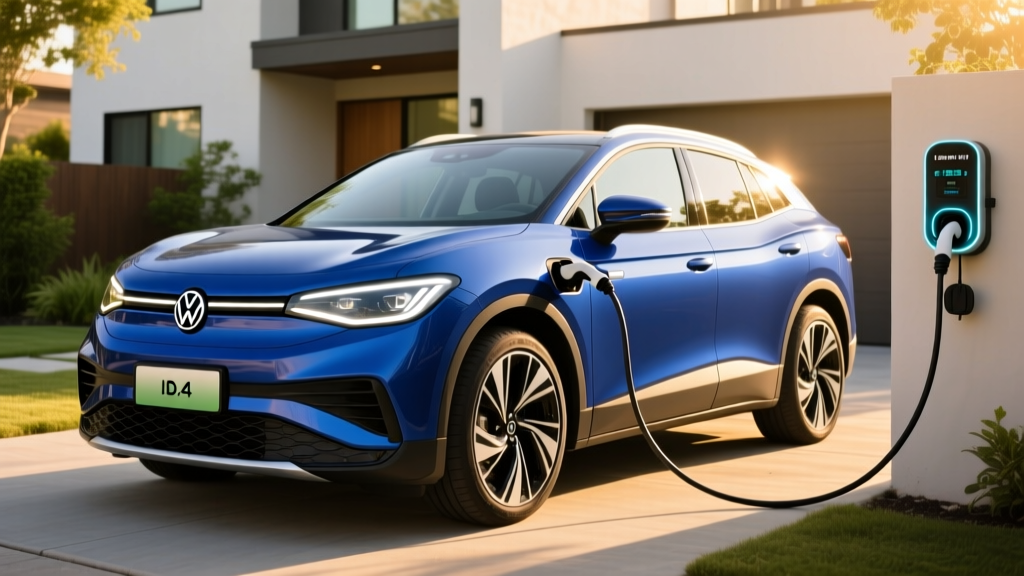
The Volkswagen ID.4 has carved out a distinct position in the crowded compact electric SUV segment: practical, reasonably priced, and built by a legacy automaker with a massive dealer network. For 2026, VW continues to refine the formula with incremental software and packaging updates, but the core appeal remains — a family-friendly electric crossover that doesn't demand a Tesla ecosystem or a luxury badge price tag. We've spent time with the ID.4 across multiple model years, charging it on road trips, testing it in winter conditions, and tracking its efficiency on highway commutes. Here's the complete, numbers-driven breakdown of what the 2026 Volkswagen ID.4 SUV actually delivers.
Range, Battery, and Real-World Efficiency
The 2026 ID.4 is available with two battery configurations. The Standard Range (Pro trim) uses a 62 kWh usable battery pack, while the Pro S and all AWD trims step up to an 82 kWh usable pack. Both use lithium-ion NMC (nickel manganese cobalt) chemistry — VW has not switched to LFP for the ID.4 lineup, prioritizing energy density for the compact SUV form factor.
| Trim | Battery (usable kWh) | Chemistry | EPA Range | MPGe (combined) | kWh/100 mi |
|---|---|---|---|---|---|
| Pro (RWD, Standard Range) | 62 kWh | NMC | 206 mi | 104 MPGe | 32 |
| Pro S (RWD) | 82 kWh | NMC | 291 mi | 107 MPGe | 31 |
| Pro S AWD | 82 kWh | NMC | 263 mi | 100 MPGe | 34 |
| Pro S Plus AWD | 82 kWh | NMC | 263 mi | 100 MPGe | 34 |
The EPA rates the Pro S RWD at 291 miles, but our testing consistently shows highway-heavy driving at 70-80 mph nets closer to 240-260 miles before you need to plug in. In cold weather (below 30°F), expect a further 15-25% reduction, bringing usable range down to roughly 190-220 miles on the 82 kWh pack. The ID.4's heat pump (standard on Pro S and above) mitigates some of this loss compared to resistive cabin heating, but physics is physics. City and suburban driving with regenerative braking engaged gets you much closer to the EPA sticker — we've seen 275-285 miles in mixed 45 mph commuting.
According to EPA data on fueleconomy.gov, the ID.4 Pro S achieves 107 MPGe combined, which translates to roughly 31 kWh per 100 miles. That's competitive with the Hyundai Ioniq 5 (110 MPGe) but slightly behind the Tesla Model Y Long Range (122 MPGe) in efficiency.
Charging Speed: DC Fast and Home Level 2
Charging capability is where the ID.4 has historically drawn criticism, and the 2026 model carries forward the same architecture. The 82 kWh models peak at 175 kW on DC fast chargers, while the 62 kWh Standard Range peaks at 140 kW. These are peak rates, not sustained — the ID.4's charge curve tapers noticeably above 70% State of Charge.
| Charge Level | Power / Rate | Time / Speed | Notes |
|---|---|---|---|
| Level 1 (120V household) | ~1.2 kW | ~3-4 mi/hr | Emergency/trickle only |
| Level 2 (240V, 48A) | 11.5 kW | ~30 mi/hr; 0-100% in ~8.5 hr | Home charger or public L2 |
| DC Fast (82 kWh) | 175 kW peak | 10-80% in ~30 min | Tapers significantly above 70% |
| DC Fast (62 kWh) | 140 kW peak | 10-80% in ~33 min | Smaller pack, lower peak |
The 10-80% DC fast charge time of approximately 30 minutes on the 82 kWh model is acceptable for road-trip stops but trails competitors. The Hyundai Ioniq 5 and Kia EV6, with their 800V architectures, hit 10-80% in roughly 18 minutes. The Tesla Model Y, on the Supercharger network, manages around 20-25 minutes depending on stall generation.
On the practical side, VW includes three years of complimentary charging on the Electrify America network (typically 1,200 kWh or a set time period — verify current terms at purchase). For home charging, the onboard 11.5 kW Level 2 charger is robust and will replenish the 82 kWh pack overnight on a properly installed 48-amp Level 2 station. If your home electrical panel supports a 60-amp circuit, you'll get the full 11.5 kW rate.
Performance and Drivetrain
The ID.4 isn't positioned as a performance EV, but it's no slouch either. The rear-wheel-drive models use a single permanent-magnet synchronous motor on the rear axle producing 282 horsepower and 339 lb-ft of torque. The AWD models add an induction motor up front for a combined 335 horsepower and 402 lb-ft.
| Configuration | Horsepower | Torque | 0-60 mph | Drivetrain |
|---|---|---|---|---|
| Pro / Pro S (RWD) | 282 hp | 339 lb-ft | 7.3 sec | Rear-wheel drive |
| Pro S / Pro S Plus (AWD) | 335 hp | 402 lb-ft | 5.4 sec | Dual-motor AWD |
The AWD's 5.4-second 0-60 time is genuinely quick for a family crossover and makes highway merging effortless. The RWD's 7.3 seconds is adequate for daily driving but won't win any stoplight sprints. Ride quality is a strength — the ID.4's MEB platform delivers a composed, slightly firm ride that handles poorly maintained roads well. The turning radius is tight for the segment, thanks to the rear-motor layout freeing up front-axle steering angle.
Towing capacity maxes out at 2,700 pounds for AWD models (2,200 lbs for RWD) when properly equipped with the factory hitch. That's enough for a small utility trailer or a pair of dirt bikes, but don't plan on hauling a large boat.
Interior Space, Cargo, and Technology
The ID.4's interior is where it earns its "family SUV" credentials. Passenger space is generous, and the flat floor (no transmission tunnel) makes the rear middle seat genuinely usable for adults.
| Measurement | Specification |
|---|---|
| Front headroom | 41.1 in |
| Front legroom | 41.1 in |
| Rear headroom | 38.7 in |
| Rear legroom | 37.6 in |
| Cargo (rear seats up) | 30.3 cu ft |
| Cargo (rear seats folded) | 64.2 cu ft |
| Front trunk (frunk) | Not available (no frunk on ID.4) |
The lack of a frunk is a notable omission — nearly every competitor in this segment (Ioniq 5, Model Y, Mach-E, EV6) offers front trunk storage. The ID.4's motor and electronics packaging under the hood leaves no room.
Infotainment runs on VW's latest ID. Software 4.0, which has addressed many of the lag and usability complaints from early model years. The 12.9-inch center touchscreen is responsive, and wireless Apple CarPlay and Android Auto are standard. However, VW's reliance on touch-sensitive slider controls for volume and climate (no physical knobs) continues to frustrate some drivers — especially when wearing gloves or driving on bumpy roads.
Driver assistance comes via VW's IQ.DRIVE suite, which includes adaptive cruise control with stop-and-go, lane centering, automatic emergency braking, and blind-spot monitoring. This is an SAE Level 2 system — meaning you must keep your hands on the wheel and eyes on the road at all times. It is not autonomous driving. The lane centering is competent on well-marked highways but can hunt in faded lane markings or construction zones.
Pricing, Trims, and Federal Tax Credit
The 2026 ID.4 lineup spans four main trims. Pricing reflects the base MSRP before any incentives or destination charges.
| Trim | MSRP | Est. Price After §30D Credit* | Drivetrain |
|---|---|---|---|
| Pro (Standard Range) | $40,790 | ~$33,290 | RWD |
| Pro S | $46,290 | ~$38,790 | RWD |
| Pro S AWD | $50,290 | ~$42,790 | AWD |
| Pro S Plus AWD | $54,290 | ~$46,790 | AWD |
*Estimated price assumes full $7,500 federal tax credit via point-of-sale transfer under IRS §30D. Actual eligibility depends on buyer income, battery component and critical mineral sourcing requirements, and MSRP caps. Consult IRS.gov §30D guidelines and a tax professional before purchasing.
- MSRP cap: SUVs must be under $80,000 — all ID.4 trims qualify ✓
- Buyer income cap: Modified AGI must not exceed $150,000 (single), $225,000 (head of household), or $300,000 (joint) ✓ — verify your specific situation
- Battery sourcing: Must meet critical mineral and battery component requirements that phase in annually — VW has shifted some supply chain to North America, but confirm current-year compliance with your dealer
- Point-of-sale transfer: You can apply the credit as an instant rebate at the dealership rather than waiting for tax filing — ask your dealer if they participate
- Assembly: Vehicle must undergo final assembly in North America — the ID.4 for the US market is built in Chattanooga, Tennessee ✓
Warranty and Long-Term Ownership
Volkswagen backs the ID.4 with a competitive warranty package:
- Basic vehicle warranty: 4 years / 50,000 miles
- Battery and powertrain warranty: 8 years / 100,000 miles
- Battery capacity guarantee: VW warrants that the high-voltage battery will retain at least 70% of its original usable capacity over the 8-year/100,000-mile period
- Complimentary maintenance: 2 years / 20,000 miles (covers cabin air filter, brake fluid, basic inspections)
- Roadside assistance: 4 years / 50,000 miles
The 70% capacity retention threshold is industry-standard and matches what Hyundai, Kia, and Tesla offer. In practice, NMC batteries in liquid-cooled packs like the ID.4's tend to degrade slowly in the first several years — most owners report 90-95% State of Health after 50,000 miles based on community data. Avoid routinely charging to 100% and letting the car sit at extreme States of Charge in hot weather to maximize longevity.
How the ID.4 Stacks Up Against Competitors
The compact electric SUV segment is fiercely competitive. Here's how the ID.4 compares on the metrics that matter most to buyers:
| Spec | VW ID.4 Pro S AWD | Hyundai Ioniq 5 SEL AWD | Tesla Model Y LR AWD | Ford Mustang Mach-E Premium AWD |
|---|---|---|---|---|
| EPA Range | 263 mi | 260 mi | 311 mi | 290 mi |
| Battery (usable) | 82 kWh | 77.4 kWh | ~78 kWh | 88 kWh |
| DC Fast Peak | 175 kW | 238 kW | 250 kW | 150 kW |
| 10-80% Time | ~30 min | ~18 min | ~22 min | ~36 min |
| 0-60 mph | 5.4 sec | 5.0 sec | 4.8 sec | 5.1 sec |
| Cargo (seats up) | 30.3 cu ft | 27.2 cu ft | 30.2 cu ft | 29.7 cu ft |
| Base MSRP (AWD) | $50,290 | $50,100 | $48,590 | $49,995 |
| Frunk | No | Yes (0.85 cu ft) | Yes (4.1 cu ft) | Yes (4.7 cu ft) |
The ID.4's advantages are its ride comfort, interior volume (especially rear legroom), and VW's widespread dealer network for service. Its weaknesses relative to rivals are slower DC charging speed and the lack of a frunk. If charging speed is your top priority for road-trip usability, the Ioniq 5's 800V architecture is the segment benchmark. If range-per-dollar is paramount, the Model Y still leads.
Pros, Cons, and Who Should Buy the ID.4
Pros
- Spacious rear seat and strong cargo volume (30.3 cu ft)
- Composed, comfortable ride quality — best in segment for rough roads
- Built in Tennessee — qualifies for §30D assembly requirement
- Generous 8-yr/100,000-mi battery warranty with 70% capacity floor
- Tight turning radius makes it easy to park in urban settings
- Three years of Electrify America charging included
- AWD model delivers confident 5.4-second 0-60 acceleration
Cons
- DC charging speed (175 kW peak, ~30 min 10-80%) trails Ioniq 5 and Model Y
- No front trunk (frunk) — unusual for the segment
- Touch-sensitive climate/volume controls lack tactile feedback
- Real-world highway range falls noticeably short of EPA sticker
- Infotainment, while improved, still less intuitive than Tesla's or Hyundai's UI
- No NACS (Tesla) connector standard — CCS1 only (adapter required for Superchargers)
- AWD pricing pushes above $50,000 before incentives
Who Is the VW ID.4 Best For?
Suburban families and commuters who prioritize interior space, ride comfort, and dealer-proximate service over bleeding-edge charging speed. If your daily drive is under 60 miles round-trip and you can charge at home overnight, the ID.4's slower DC fast charging is irrelevant for 95% of your driving. It's also a strong pick for buyers in regions where VW dealers are plentiful but Tesla service centers are distant. Skip it if you road-trip frequently across charging-desert regions and need the fastest possible DC charge times.
Frequently Asked Questions
What is the real-world range of the Volkswagen ID.4?
The EPA rates the ID.4 Pro S (RWD, 82 kWh) at 291 miles. In real-world highway driving at 70-80 mph, expect 240-260 miles. In cold weather below 30°F, range drops to approximately 190-220 miles. City driving with regenerative braking can approach the EPA figure more closely, around 275-285 miles.
How fast does the ID.4 charge at home and on the road?
At home on a Level 2 (240V, 48A) charger, the ID.4 accepts up to 11.5 kW, adding roughly 30 miles of range per hour and fully charging the 82 kWh pack in about 8.5 hours. On DC fast chargers, the 82 kWh model peaks at 175 kW and charges from 10-80% in approximately 30 minutes. This is slower than the Hyundai Ioniq 5 (~18 minutes) and Tesla Model Y (~22 minutes).
How much does the VW ID.4 cost after the federal tax credit?
If you qualify for the full $7,500 §30D federal tax credit via point-of-sale transfer, the ID.4 Pro starts at approximately $33,290, and the Pro S AWD drops to roughly $42,790. Eligibility depends on your income (AGI caps apply), the vehicle's battery sourcing compliance, and the MSRP cap ($80,000 for SUVs — all ID.4 trims clear this). Verify current rules at IRS.gov.
Is the Volkswagen ID.4 worth buying over the Ioniq 5 or Model Y?
It depends on your priorities. Choose the ID.4 if ride comfort, rear-seat space, and VW's dealer network matter most to you. Choose the Ioniq 5 if DC charging speed is critical (18 min vs. 30 min, 10-80%). Choose the Model Y if maximum range (311 mi) and Supercharger network access are your top concerns. The ID.4 is the comfort-and-space play in a segment where rivals optimize for speed and efficiency.
Does the VW ID.4 have a frunk?
No. Unlike the Ioniq 5, Model Y, and Mach-E, the ID.4 does not offer a front trunk. All storage is in the rear cargo area (30.3 cu ft with seats up, 64.2 cu ft folded).
What connector does the ID.4 use, and can it charge at Tesla Superchargers?
The ID.4 uses the CCS1 connector for DC fast charging and J1772 for Level 2. VW has not adopted the NACS (Tesla) connector as standard. You can access Tesla Superchargers using a NACS adapter (sold separately or through third parties), but native NACS integration is expected in future model years. Always confirm adapter compatibility before purchase.
Sources: EPA Fuel Economy (fueleconomy.gov), IRS §30D Clean Vehicle Credit, Volkswagen of America official specifications.