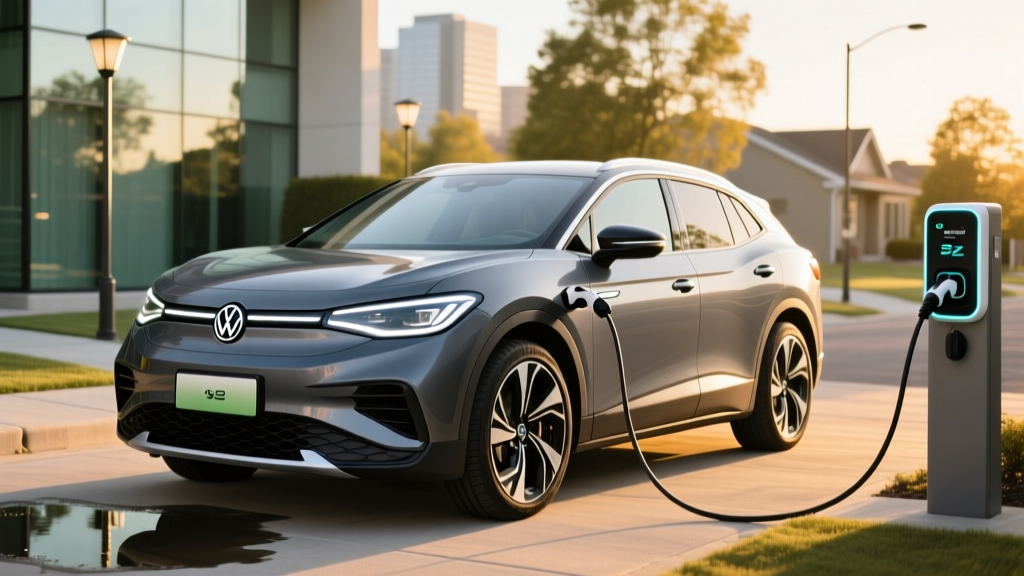
The Volkswagen ID.4 Pro S occupies a specific niche in the compact electric SUV segment: practical, comfortable, and deliberately unflashy. While rivals chase headline-grabbing acceleration and 350 kW charging speeds, VW has positioned the ID.4 as the sensible electric family hauler — the one that drives like a Golf but rides higher and plugs in at night. For 2026, the Pro S trim sits near the top of the lineup, bundling the larger 82 kWh battery with premium features like panoramic glass, heated seats, and VW's latest IQ.DRIVE assist suite. But with the EV market more crowded than ever, does the ID.4 Pro S still make the cut?
We've spent time with the ID.4 Pro S on highway loops, suburban commutes, and DC fast-charging stops to separate marketing claims from reality. Below is everything you need to know — exact range figures, charging speeds, pricing after the federal tax credit, and where this VW stands against the Hyundai Ioniq 5, Tesla Model Y, and Ford Mustang Mach-E.
Range & Efficiency: EPA vs. the Real World
The 2026 ID.4 Pro S with rear-wheel drive carries an EPA-estimated 275 miles of range. The AWD Pro S variant drops to approximately 263 miles due to the added weight and drag of the front motor. Efficiency for the RWD model lands at 104 MPGe combined (roughly 32 kWh per 100 miles), which is competitive but trails the class-leading Ioniq 5 and Model Y.
- EPA sticker: 275 miles
- Mixed suburban/highway (65-75 mph): ~240–260 miles
- Sustained 80 mph highway: ~220–235 miles
- Cold weather (below 32°F, cabin heat on): ~190–220 miles
The ID.4's heat pump (standard on Pro S trims) helps mitigate winter losses compared to EVs without one, but expect a 15–25% range reduction in freezing temperatures. Highway driving at 75+ mph also pushes consumption noticeably higher than the EPA combined cycle suggests.
The usable battery capacity is approximately 77 kWh from a gross 82 kWh pack. VW uses a top and bottom buffer to protect long-term cell health, which is standard practice but worth noting when comparing to competitors advertising gross capacity. The battery chemistry is NMC (nickel manganese cobalt), which offers higher energy density than LFP but requires more careful thermal management and typically benefits from daily charging limits around 80%.
Charging Speed: DC Fast, Level 2 & Home Setup
Charging is where the ID.4 Pro S shows its pragmatic engineering rather than segment-leading performance. The 2026 model peaks at 175 kW on a DC fast charger — an improvement over earlier 135 kW models but still behind the Hyundai Ioniq 5's 240 kW and the Tesla Model Y's ~250 kW capability.
| Charging Level | Max Power | Speed / Time | Connector |
|---|---|---|---|
| Level 1 (120V household) | 1.2 kW | ~3–4 miles per hour | J1772 / NACS adapter |
| Level 2 (240V home/public) | 11 kW (48A) | ~30–33 miles per hour; 0–100% in ~8.5 hrs | J1772 / NACS |
| DC Fast Charge | 175 kW peak | 10–80% in ~28 minutes | CCS1 / NACS |
On a 350 kW Electrify America or compatible station, the ID.4 Pro S sustains close to its peak rate from roughly 10% to 35% SoC, then tapers progressively. From 10–80%, expect approximately 28 minutes under ideal thermal conditions. If you arrive at a charger without preconditioning the battery (navigating to a charge point in the infotainment triggers this automatically), add 5–10 minutes to that estimate in cooler weather.
At home, the 11 kW onboard charger is a strong point — it's faster than the 7.7 kW chargers on some competitors, meaning a full overnight replenishment is easily achievable on a 48-amp Level 2 circuit. Most owners will need a NEMA 14-50 outlet or hardwired wallbox installed by a licensed electrician; budget $500–$2,000 for installation depending on your panel capacity and run length.
Performance & Drivetrain
The rear-wheel-drive ID.4 Pro S produces 282 horsepower and 339 lb-ft of torque from a single permanent-magnet motor on the rear axle. VW quotes a 0–60 mph time of 7.2 seconds. That's adequate for highway merging and around-town driving, but it won't win stoplight drag races against the dual-motor Model Y Long Range (4.8 seconds) or the Ioniq 5 AWD (5.0 seconds).
Opt for the AWD Pro S and you gain a front induction motor for a combined 335 horsepower and a 0–60 time of approximately 5.4 seconds. The AWD system is torque-biased rearward in normal driving and engages the front motor under hard acceleration or low-traction conditions. It's not a dedicated off-roader, but it handles snow and rain confidently.
Ride quality is where the ID.4 genuinely shines. The suspension tuning is compliant without being floaty, and the cabin is remarkably quiet at highway speeds. VW's turning circle of 31.5 feet (RWD) is impressively tight for a compact SUV — a direct benefit of the rear-mounted motor freeing up front-axle steering angle.
Interior, Cargo & Technology
Inside, the Pro S trim delivers a step up from the base Pro with standard features including a panoramic fixed-glass roof, heated front seats, a heated steering wheel, leatherette upholstery, and a 12.9-inch infotainment touchscreen running VW's latest software. The digital cockpit behind the steering wheel is compact but legible, displaying speed, range, and assist-system status.
Cargo space measures 30.3 cubic feet behind the second row and 64.2 cubic feet with the rear seats folded — competitive with the segment but trailing the Model Y's ~76 cu ft. There is no front trunk (frunk); VW uses that space for power electronics. Rear-seat legroom is a generous 37.6 inches, and headroom is excellent thanks to the flat floor and tall roofline.
| Specification | 2026 VW ID.4 Pro S (RWD) |
|---|---|
| EPA Range | 275 miles |
| Battery (usable / gross) | 77 kWh / 82 kWh, NMC |
| Efficiency | 104 MPGe (32 kWh/100 mi) |
| Motor | Single rear, 282 hp, 339 lb-ft |
| 0–60 mph | 7.2 seconds |
| DC Fast Charge Peak | 175 kW (10–80% in ~28 min) |
| Level 2 Charge Rate | 11 kW (48A) |
| Cargo (rear up / folded) | 30.3 / 64.2 cu ft |
| Rear Legroom | 37.6 inches |
| Drivetrain | RWD (AWD optional) |
| Base MSRP | $46,290 (before incentives) |
| Battery/Powertrain Warranty | 8 years / 100,000 miles |
The infotainment system has improved over the ID.4's rocky launch-year software, with faster response times and more intuitive menus. Wireless Apple CarPlay and Android Auto are standard. However, VW's reliance on touch-sensitive sliders for volume and climate control remains a frustration — there are no physical knobs, and the backlit slider strips are hard to see at night. This is the single most common owner complaint.
On the driver-assist front, IQ.DRIVE bundles adaptive cruise control with stop-and-go, lane-centering, and Travel Assist (hands-on-wheel semi-autonomous highway driving). This is an SAE Level 2 system — it does not drive the car for you, and you must keep your hands on the wheel and eyes on the road. It works well on divided highways but can hunt lane markings on faded rural roads.
Pricing, Trims & Federal Tax Credit
The 2026 Volkswagen ID.4 Pro S starts at a base MSRP of $46,290 (including destination). Adding AWD bumps the price to approximately $50,290. A fully loaded Pro S Plus with the Gradient package (two-tone paint, 20-inch wheels) can reach the low $50,000s before options.
| Trim | Base MSRP | Est. After §30D Credit* |
|---|---|---|
| Pro S (RWD) | $46,290 | ~$38,790 |
| Pro S (AWD) | $50,290 | ~$42,790 |
| Pro S Plus (AWD) | $53,290 | ~$45,790 |
*Federal §30D credit eligibility requires meeting all current-year criteria. Consult IRS.gov and a tax professional before purchasing.
- MSRP cap: SUVs must be at or below $80,000 MSRP — the ID.4 Pro S qualifies easily.
- Buyer income cap: AGI must not exceed $150,000 (single), $225,000 (head of household), or $300,000 (joint) — check your most recent tax year.
- Battery sourcing: Critical minerals and battery components must meet phased-in percentages from US/free-trade partners. VW has been working to localize supply, but verify current-year compliance on the fueleconomy.gov credit lookup before signing.
- Point-of-sale transfer: You can transfer the credit to the dealer at purchase to reduce your out-of-pocket cost, rather than waiting to claim it on your tax return.
Because sourcing rules tighten annually, the credit amount can change mid-year or between model years. Always confirm eligibility in the month you plan to buy.
Ownership Costs, Warranty & Longevity
VW backs the ID.4's battery and drive unit with an 8-year / 100,000-mile warranty, guaranteeing at least 70% capacity retention over that period. The bumper-to-bumper warranty runs 4 years / 50,000 miles, and VW includes 3 years of complimentary Electrify America charging (typically 2,100 kWh or roughly 30,000 miles of driving), which is a meaningful offset for early ownership.
Electricity costs for the ID.4 Pro S average roughly $0.04–$0.06 per mile on a national-average residential rate of $0.16/kWh, compared to $0.12–$0.15/mile for a 28-MPG gas SUV at $3.40/gallon. Over five years and 75,000 miles, that's a potential fuel savings of $5,000–$7,000, though actual savings depend on local electricity rates, public-charging usage (which is more expensive), and gas prices in your area.
Insurance premiums for the ID.4 tend to run 10–20% higher than a comparable gas Tiguan, reflecting higher repair costs for EV-specific components. Get quotes before committing.
ID.4 Pro S vs. Key Competitors
The ID.4 Pro S doesn't exist in a vacuum. Here's how it stacks up against three obvious cross-shops:
If road-trip charging speed is your top priority, the Ioniq 5 or Model Y are stronger picks. If you value ride refinement, a quiet cabin, and a less tech-overloaded driving experience, the ID.4 Pro S makes a compelling case.
Pros, Cons & Verdict
- Comfortable, quiet ride quality — class-leading refinement
- Tight turning circle (31.5 ft) makes it easy in parking lots
- 11 kW onboard Level 2 charger — faster overnight fills than many rivals
- Generous rear-seat legroom and passenger space
- 3 years of free Electrify America charging included
- Below $80K MSRP cap — eligible for full §30D credit (if sourcing rules met)
- Heat pump standard on Pro S for better cold-weather range
- 175 kW DC peak is slower than Ioniq 5, Model Y, and EV6
- Touch-sensitive volume/climate sliders are frustrating in daily use
- No front trunk (frunk) — missed cargo opportunity
- 275-mile range is adequate but trails 300+ mile competitors
- Infotainment learning curve; some menus remain unintuitive
- AWD acceleration (5.4s) still lags dual-motor rivals
The 2026 Volkswagen ID.4 Pro S is the EV for buyers who want a calm, competent electric SUV without chasing spec-sheet bragging rights. It's not the fastest-charging, longest-range, or most tech-forward option in the segment, but it is one of the most livable — especially for families who charge at home most nights and take road trips a few times a year.
Frequently Asked Questions
What is the real-world range of the VW ID.4 Pro S?
The EPA rates the RWD Pro S at 275 miles. In real-world mixed driving at moderate temperatures, expect 240–260 miles. Sustained highway speeds above 75 mph and cold weather below freezing can reduce that to 190–235 miles. The standard heat pump helps limit winter losses.
How fast does the ID.4 Pro S charge at home and on the road?
At home on a 240V Level 2 circuit, the 11 kW onboard charger adds roughly 30–33 miles per hour, fully replenishing the battery in about 8.5 hours. On a DC fast charger, the 175 kW peak delivers a 10–80% charge in approximately 28 minutes under good conditions.
Does the ID.4 Pro S qualify for the $7,500 federal tax credit?
It can, but eligibility depends on current-year IRS §30D rules including your income (AGI caps apply), the vehicle's MSRP (under the $80K SUV cap), and battery-critical-mineral sourcing requirements that tighten annually. Check fueleconomy.gov and consult a tax professional before purchasing. The credit can be transferred to the dealer at point of sale.
Is the VW ID.4 Pro S worth buying over the Tesla Model Y or Ioniq 5?
If your priorities are ride comfort, cabin quietness, and a traditional driving feel, yes. If you prioritize maximum range, fastest charging, or maximum cargo volume, the Model Y and Ioniq 5 have measurable advantages. The ID.4's 3 years of free Electrify America charging is a genuine differentiator for early ownership costs.
What is the ID.4 Pro S battery warranty?
Volkswagen covers the high-voltage battery and electric drive unit for 8 years or 100,000 miles, whichever comes first, guaranteeing at least 70% capacity retention. The bumper-to-bumper warranty is 4 years / 50,000 miles.
Does the ID.4 have a frunk (front trunk)?
No. VW uses the front compartment for power electronics. All cargo space is in the rear: 30.3 cu ft behind the second row, 64.2 cu ft with seats folded.
Is IQ.DRIVE self-driving?
No. IQ.DRIVE and Travel Assist are SAE Level 2 driver-assistance systems. They provide adaptive cruise control and lane-centering, but you must keep your hands on the wheel and remain fully engaged at all times. The car does not drive itself.