Quick Verdict: The ID.4 as a Lease Play in 2026
The 2026 Volkswagen ID.4 occupies a narrow but important lane in the compact electric SUV segment: it's the mainstream, no-drama choice. With an EPA-estimated 291 miles of range on the rear-wheel-drive Pro S, a usable 77 kWh NMC battery, and DC fast charging that peaks at 170 kW, it covers the daily commute and weekend road trip without theatrics. For buyers researching a Volkswagen ID.4 lease, the calculus often comes down to VW's aggressive lease cash incentives, which can stack on top of the $7,500 federal EV tax credit passed through the lessor — making monthly payments competitive with the Hyundai Ioniq 5 and Tesla Model Y even when the sticker price looks higher.
But the ID.4 isn't a spec-sheet winner. Its 0-60 time of 7.7 seconds (RWD) won't excite anyone, the infotainment software remains a friction point, and real-world highway range drops noticeably below the EPA sticker. This review breaks down every number that matters before you sign.
Range, Efficiency, and the Real-World Gap
The 2026 ID.4 lineup offers three EPA range tiers depending on trim and drivetrain:
- Pro (RWD): 291 miles EPA
- Pro S (RWD): 291 miles EPA
- Pro S Plus (AWD, dual-motor): 263 miles EPA
EPA estimates assume a mix of city and highway driving at moderate temperatures. In our experience and consistent with independent testing, expect ~240–260 miles on a highway-heavy road trip at 70–75 mph in the RWD models. In cold weather (below 30°F), range loss of 20–30% is typical for the ID.4, which lacks a standard heat pump on base trims — plan for ~190–210 miles in freezing conditions with cabin heat running. The AWD model will return roughly 220–235 miles highway in fair weather.
Efficiency lands at 104 MPGe combined (RWD) per fueleconomy.gov, translating to about 32 kWh per 100 miles. That's midpack — the Ioniq 5 RWD returns 114 MPGe combined, while the Model Y Long Range achieves 122 MPGe. The ID.4's 2,960-pound curb weight and less aggressive aero show up here.
Battery Chemistry, Capacity, and Longevity
The 2026 ID.4 uses an 82 kWh gross / 77 kWh usable lithium-ion battery pack with NMC (nickel manganese cobalt) chemistry. VW does not offer an LFP option in the US market. NMC provides higher energy density than LFP, which is why VW can package 291 miles of range in a compact SUV footprint, but it also means VW recommends capping daily charges at 80% to preserve long-term health — unlike LFP packs that tolerate regular 100% charges.
| Spec | Pro / Pro S (RWD) | AWD Pro S Plus |
|---|---|---|
| Battery (usable) | 77 kWh (NMC) | 77 kWh (NMC) |
| EPA Range | 291 mi | 263 mi |
| Efficiency | 104 MPGe / 32 kWh/100mi | 95 MPGe / 35 kWh/100mi |
| Horsepower | 282 hp | 335 hp |
| 0–60 mph | 7.7 sec | 5.4 sec |
| Drivetrain | Rear-wheel drive | Dual-motor AWD |
| Max DC Fast Charge | 170 kW | 170 kW |
| 10–80% DC Charge | ~28 min | ~28 min |
| Level 2 Home Charge | 11 kW (~37 mi/hr) | 11 kW (~37 mi/hr) |
| Cargo (rear seats up) | 30.3 cu ft | 30.3 cu ft |
| Cargo (rear seats down) | 64.2 cu ft | 64.2 cu ft |
| Rear Legroom | 37.6 in | 37.6 in |
| Battery Warranty | 8 yr / 100,000 mi | 8 yr / 100,000 mi |
| Base MSRP (incl. destination) | $41,215 (Pro) | $50,715 (Pro S Plus) |
Charging Speed: Home and DC Fast Charging
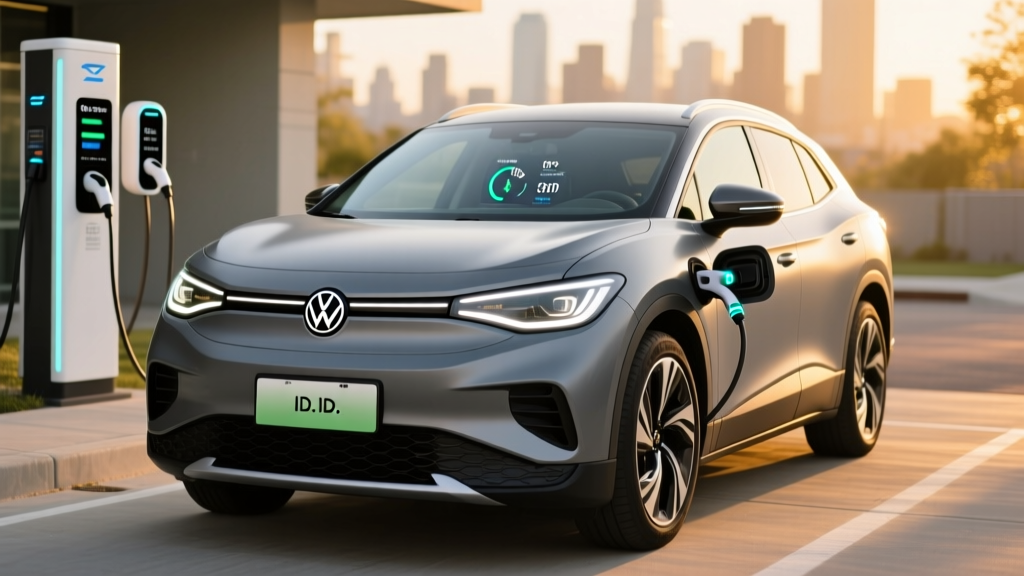
The ID.4 supports a peak DC fast-charge rate of 170 kW on CCS-equipped models. VW has begun transitioning to the NACS (Tesla) connector on newer builds, and 2026 models with NACS can access Tesla Supercharger V3/V4 stations via adapter or native port. At 170 kW peak, a 10–80% charge takes approximately 28 minutes under ideal battery preconditioning. However, the charge curve tapers sharply above 80% — a 10–100% session will stretch closer to 50 minutes. Plan your road-trip stops around 80% to avoid wasting time at the tail end.
| Charging Level | Power | Approx. Miles Added per Hour | Best Use Case |
|---|---|---|---|
| Level 1 (120V) | ~1.4 kW | ~4 mi/hr | Overnight trickle, emergencies |
| Level 2 (240V, 48A) | 11 kW | ~37 mi/hr | Daily home charging — full charge in ~7.5 hr |
| DC Fast (CCS/NACS) | 170 kW peak | ~200+ mi in 28 min (10–80%) | Road trips, highway corridors |
For home Level 2 charging, the ID.4's 11 kW onboard charger means you'll need a 48-amp, 240V circuit (hardwired or NEMA 14-50) to unlock the full rate. A full 0–100% home charge takes roughly 7.5 hours — easily handled overnight. Installation costs for a dedicated Level 2 circuit typically run $800–$2,500 depending on panel capacity and conduit distance, per licensed electrician estimates.
Pricing, Lease Economics, and Federal Tax Credit
The 2026 ID.4 starts at $41,215 for the Pro trim (including destination) and climbs to $50,715 for the AWD Pro S Plus. The volume trim is the Pro S at ~$46,215, which adds panoramic glass roof, heated seats, and the upgraded 12.9-inch infotainment display.
| Trim | Base MSRP | Est. Monthly Lease (36 mo, 10k mi/yr)* | Federal Credit Applied? |
|---|---|---|---|
| Pro (RWD) | $41,215 | $299–$379 | Yes — passed through lessor |
| Pro S (RWD) | $46,215 | $349–$429 | Yes — passed through lessor |
| Pro S Plus (AWD) | $50,715 | $429–$519 | Yes — passed through lessor |
*Lease estimates reflect VW's typical lease cash incentives ($7,500–$9,500 in recent programs) applied as cap-cost reduction. Actual payments vary by region, dealer, credit tier, and current incentives.
Does the ID.4 Qualify for the Federal EV Tax Credit?
Here's where leasing the ID.4 gets interesting. Under IRS §30D rules, the $7,500 federal clean vehicle credit is subject to MSRP caps ($80,000 for SUVs), buyer income limits ($150K single / $300K joint AGI), and strict battery critical-mineral and component sourcing requirements. However, when you lease an EV, the credit goes to the lessor (the financing company), and most manufacturers — VW included — pass the full $7,500 to the lessee as a capitalized-cost reduction. This "lease loophole" (technically a commercial credit under §45W) bypasses the buyer income and battery-sourcing restrictions entirely.
- MSRP Cap: ID.4 qualifies (all trims under $80,000 SUV cap)
- Income Cap (purchase only): $150K single / $225K HOH / $300K joint — does NOT apply to leases
- Battery Sourcing (purchase only): Critical minerals and component requirements — does NOT apply to leases via §45W
- Lease Credit Mechanism: $7,500 goes to lessor, typically passed through as cap-cost reduction
- Point-of-Sale Transfer (purchase): Available if buying, but lease path is simpler for most buyers
Bottom line: Leasing the ID.4 in 2026 is the most reliable way to capture the full $7,500 credit regardless of your income or the battery's mineral sourcing — a significant advantage over purchasing if you exceed AGI limits.
Driving Impressions, Tech, and Interior
The ID.4 drives like a well-sorted compact crossover that happens to be electric. The RWD model's 282 hp and 229 lb-ft of torque deliver adequate acceleration (7.7 seconds to 60 mph), though it won't pin you to the seat. The AWD Pro S Plus, with 335 hp and a 5.4-second 0–60, is genuinely quick. Ride quality is a strong point — VW tuned the suspension for comfort over sportiness, and the 2,960-lb mass is well managed over bumps.
Inside, the cabin is spacious. 30.3 cubic feet of cargo space behind the rear seats (64.2 cu ft folded) beats the Ioniq 5 and matches the Model Y closely. Rear legroom at 37.6 inches is generous. The minimalist interior uses recycled materials on higher trims, and build quality is solid if not luxurious.
The 12.9-inch infotainment screen (Pro S and above) runs VW's latest ID. Software 4.0, which is noticeably faster and more responsive than earlier versions. Wireless Apple CarPlay and Android Auto are standard. The ID.4 comes with VW's IQ.DRIVE suite — adaptive cruise, lane centering, and automatic emergency braking — but this is a SAE Level 2 driver-assistance system, meaning you must keep your hands on the wheel and eyes on the road at all times. It is not autonomous driving.
VW IQ.DRIVE with Travel Assist is a Level 2 system per SAE classification. It provides lane centering and adaptive cruise but requires continuous driver supervision. It does not handle construction zones, unmapped roads, or severe weather autonomously. You are legally responsible for the vehicle at all times.
How the ID.4 Compares to Key Rivals
The compact electric SUV segment is crowded. Here's how the ID.4 stacks up on the specs that matter most:
- vs. Hyundai Ioniq 5: The Ioniq 5 charges faster (up to 240 kW, 10–80% in ~18 min), gets better MPGe (114 vs 104), and has 800V architecture. The ID.4 wins on cargo volume (30.3 vs 27.2 cu ft) and often on lease pricing thanks to VW's incentives.
- vs. Tesla Model Y: The Model Y Long Range delivers 310 miles EPA, 122 MPGe, and access to the full Supercharger network natively. The ID.4 counters with a quieter cabin, more traditional controls, and stronger lease deals in many markets.
- vs. Ford Mustang Mach-E: The Mach-E is sportier to drive and offers a larger 320-mile Extended Range battery option. The ID.4 has a more usable rear seat and cargo area for families.
Pros
- Lease incentives + $7,500 credit pass-through make monthly payments highly competitive
- Spacious cabin with 30.3 cu ft cargo and 37.6 in rear legroom
- Comfortable, composed ride quality
- 8-year/100,000-mile battery and powertrain warranty
- Strong safety ratings — IIHS Top Safety Pick+ when equipped with specific headlights
- Lease path bypasses income and sourcing restrictions on federal credit
Cons
- DC fast charging at 170 kW lags Hyundai/Kia's 240–350 kW capability
- Real-world highway range drops to ~240–260 mi; cold weather cuts it further
- RWD 0–60 of 7.7 seconds feels leisurely in this segment
- No heat pump on base trims (efficiency hit in cold weather)
- Infotainment still not as intuitive as Tesla or Hyundai systems
- No front trunk (frunk) — the space houses HVAC components
Who Should Lease the 2026 ID.4?
Choose the ID.4 if: You want a practical family EV with strong cargo space, a comfortable ride, and a lease deal that undercuts rivals after incentives. You mostly drive in moderate climates and can charge at home overnight. You value a traditional dealership experience and VW's 8-year battery warranty.
Look elsewhere if: You take frequent long road trips and need the fastest possible DC charging (Ioniq 5 or Ioniq 6). You want maximum range per dollar (Model Y Long Range). You live in a cold climate and need a heat pump standard (check trim carefully). You want sporty acceleration (Mach-E GT or Ioniq 5 N).
The ID.4 is the EV equivalent of a sensible sedan: it won't generate Instagram envy, but it will commute reliably, haul a family comfortably, and — thanks to VW's lease structure — cost less per month than the spec sheet suggests. For the buyer who wants an electric compact SUV without learning a new ecosystem, the ID.4 lease in 2026 is one of the most financially rational plays available.
Frequently Asked Questions
What is the real-world range of the 2026 VW ID.4?
The EPA rates the RWD ID.4 at 291 miles, but expect 240–260 miles on highway trips at 70–75 mph and as low as 190–210 miles in freezing temperatures. The AWD model delivers roughly 220–235 miles highway in fair weather.
How fast does the ID.4 charge at home and on the road?
At home on a Level 2 (240V, 48A) charger, the ID.4 adds about 37 miles per hour and fully charges in ~7.5 hours. On a DC fast charger, it peaks at 170 kW and charges 10–80% in approximately 28 minutes, tapering significantly above 80%.
How much does a 2026 ID.4 lease cost per month?
With VW's typical lease cash incentives ($7,500–$9,500) and the $7,500 federal credit passed through the lessor, Pro S leases have recently ranged from $349 to $429 per month for 36 months and 10,000 miles annually. Exact pricing varies by region, dealer, and credit score.
Does the VW ID.4 qualify for the $7,500 federal tax credit?
Yes. When purchased, eligibility depends on your income, the vehicle's MSRP, and battery sourcing requirements per IRS §30D. When leased, the credit goes to the lessor under §45W commercial credit rules, and VW typically passes the full $7,500 to you as a cap-cost reduction — bypassing income and sourcing restrictions.
Is the ID.4 worth leasing over the Hyundai Ioniq 5 or Tesla Model Y?
If lease pricing is your priority and you value cargo space and ride comfort over charging speed and efficiency, yes. The Ioniq 5 charges faster and is more efficient; the Model Y goes farther and has the Supercharger network. The ID.4 wins on value-per-dollar in many lease programs and offers a more traditional ownership experience.
What is the ID.4's battery warranty?
Volkswagen covers the ID.4's high-voltage battery for 8 years or 100,000 miles, whichever comes first, against defects and capacity loss below 70% of original capacity. The powertrain carries the same 8-year/100,000-mile coverage, and the basic vehicle warranty is 4 years/50,000 miles.