Volkswagen's 2026 EV Lineup at a Glance
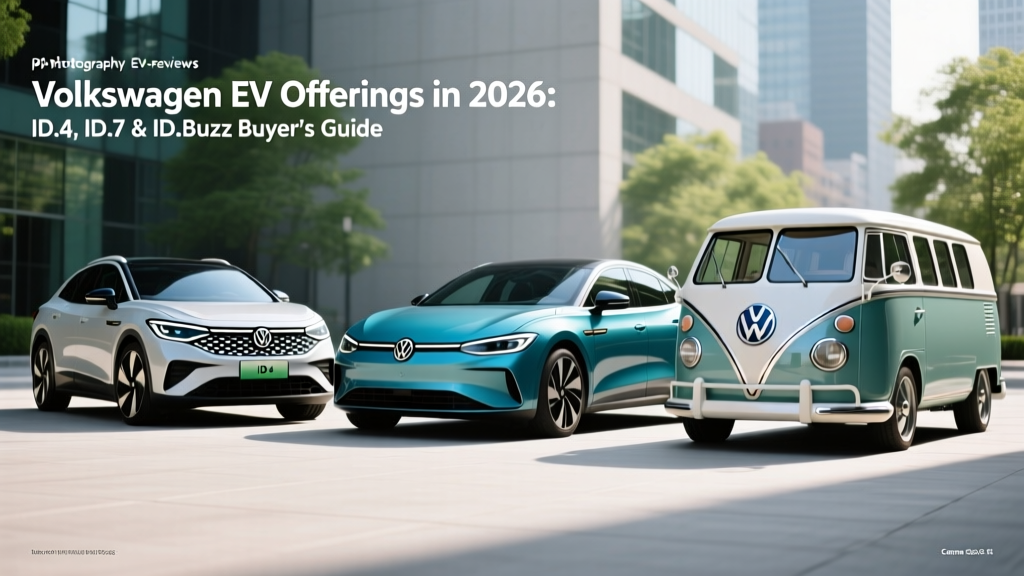
Volkswagen currently sells three battery-electric vehicles in the U.S.: the ID.4 compact SUV (starting ~$39,735, EPA range up to 291 miles), the ID.7 sedan (starting ~$49,995, EPA range up to 342 miles), and the ID.Buzz three-row minivan (starting ~$59,995, EPA range up to 234 miles). All three use VW's MEB platform with NMC battery chemistry, support DC fast charging up to 175–200 kW, and qualify for varying levels of the federal §30D tax credit depending on battery sourcing and buyer income. The ID.4 remains the volume seller and best value; the ID.7 targets sedan buyers who want max range; the ID.Buzz fills a niche with no direct electric rival.
The Full Volkswagen EV Lineup: Specs Compared
VW's U.S. electric strategy centers on three distinct body styles, all built on the modular MEB (Modularer E-Antriebs-Baukasten) platform. Here's how the numbers stack up across the 2026 model year.
| Spec | 2026 ID.4 (Pro S AWD) | 2026 ID.7 Pro S | 2026 ID.Buzz Pro S |
|---|---|---|---|
| Body Style | Compact SUV (5-seat) | Midsize Sedan | Minivan (3-row, 7-seat) |
| Battery (Usable) | 82 kWh (NMC) | 86 kWh (NMC) | 91 kWh (NMC) |
| EPA Range | 263 mi (AWD) / 291 mi (RWD) | 342 mi | 234 mi (RWD) / 231 mi (AWD) |
| MPGe (Combined) | 104 MPGe (AWD) | 122 MPGe | 87 MPGe |
| Motor Output | 295 hp (AWD) | 282 hp (RWD) | 282 hp (RWD) / 330 hp (AWD) |
| 0–60 mph | 5.4 sec (AWD) | 6.5 sec | 7.3 sec (RWD) |
| Peak DC Fast Charge | 175 kW | 200 kW | 175 kW |
| 10–80% DC Charge | ~28 min | ~26 min | ~30 min |
| Level 2 Charge Rate | 11 kW (AC) | 11 kW (AC) | 11 kW (AC) |
| Base MSRP | $39,735 (RWD) / $43,735 (AWD) | $49,995 | $59,995 |
| Battery Warranty | 8 yr / 100,000 mi | 8 yr / 100,000 mi | 8 yr / 100,000 mi |
Sources: fueleconomy.gov, Volkswagen of America press specifications.
Real-World Range: What the EPA Sticker Doesn't Tell You
EPA vs. Reality
ID.4 AWD (EPA 263 mi): Expect ~220–240 mi on highway trips at 70 mph; ~185–210 mi in freezing temperatures with cabin heat.
ID.7 Pro S (EPA 342 mi): Expect ~290–310 mi highway; ~250–275 mi in cold weather. The sedan's lower drag coefficient (Cd ~0.23) helps it hold range better at speed than the SUVs.
ID.Buzz (EPA 234 mi): Expect ~190–210 mi highway; ~165–185 mi cold. The Buzz's boxy shape and heavy curb weight (~5,500 lbs) hit efficiency hard above 65 mph.
The MEB platform's thermal management system includes a heat pump on all 2026 U.S. models, which mitigates but doesn't eliminate cold-weather range loss. In our experience with MEB vehicles in sub-30°F conditions, expect a 20–30% range reduction versus EPA figures, depending on cabin temperature settings and whether you precondition the battery. Preconditioning — warming the battery while still plugged in — is essential for achieving advertised DC fast-charge speeds in cold weather. Without it, the battery's BMS (battery management system) will throttle charge rates to protect the cells, sometimes cutting peak kW in half.
Charging Speeds and Infrastructure Reality
All three VW EVs use the CCS1 connector natively, though Volkswagen has confirmed that NACS-equipped models will begin appearing for the 2027 model year. For 2026, you'll charge on CCS at home and on the road, with access to Electrify America's network (which VW helped fund as part of its Dieselgate settlement).
| Charging Level | Power | Miles Added per Hour | Typical Use Case |
|---|---|---|---|
| Level 1 (120V) | ~1.4 kW | ~3–5 mi/hr | Overnight top-up, emergencies |
| Level 2 (240V, 48A) | ~11 kW | ~30–40 mi/hr | Home daily charging, full overnight charge |
| DC Fast Charge | 175–200 kW peak | ~600–750 mi/hr (peak) | Road trips, 10–80% in 26–30 min |
Charging curve reality check: The "175 kW" or "200 kW" peak rate is just that — a peak. VW's MEB battery sustains peak rate only between roughly 10–30% State of Charge (SoC). From 30–60%, the rate tapers to ~120–140 kW; from 60–80%, it drops further to ~70–90 kW. Above 80%, charging slows dramatically to protect cell longevity. This is why the 10–80% metric matters more than peak kW. On a road trip, plan your stops around the 10–80% window — charging from 80–100% can take as long as the 10–80% session.
For home Level 2 charging, a full 0–100% charge on the ID.4's 82 kWh battery takes roughly 8 hours at 11 kW. Most owners who plug in nightly never need a full charge — 20–30 miles of daily driving replenishes in under an hour.
Cost Breakdown: Purchase, Fueling, and Ownership
The upfront price of a VW EV is higher than a comparable gas vehicle, but the total cost of ownership (TCO) equation depends heavily on your electricity rates, driving volume, and tax-credit eligibility.
| Cost Factor | 2026 ID.4 Pro S AWD | 2026 Tiguan 2.0T SE (Gas Baseline) |
|---|---|---|
| Base MSRP | $43,735 | $32,355 |
| Fed. Tax Credit (§30D) | Up to $7,500 (see eligibility below) | $0 |
| Effective Price After Credit | ~$36,235 | $32,355 |
| Fuel/Energy Cost (15,000 mi/yr) | ~$540/yr (at $0.13/kWh) | ~$1,950/yr (at $3.25/gal, 28 MPG) |
| Annual Maintenance | ~$250/yr (no oil, fewer brakes) | ~$650/yr |
| Insurance (avg.) | ~$1,800/yr | ~$1,500/yr |
| 5-Year Total Operating Cost | ~$12,950 | ~$13,000 |
Fuel costs based on national averages; your electricity rate and gas prices will vary. Insurance premiums are estimates based on industry averages for compact SUVs. Source: fueleconomy.gov, AAA fuel-cost data.
The ID.4's higher insurance cost (~$300/yr more than the gas Tiguan) reflects the higher repair costs and parts pricing common to EVs. However, the ~$1,400/yr fuel savings and ~$400/yr maintenance savings largely offset this. Over five years, the ID.4 with a full tax credit actually costs less to own than the Tiguan, despite the higher sticker price.
Federal Tax Credit: §30D Eligibility Checklist
Not every buyer qualifies for the full $7,500. Under current IRS rules for 2026:
- Income caps: AGI must not exceed $150,000 (single), $225,000 (head of household), or $300,000 (married filing jointly).
- MSRP caps: SUVs/vans (ID.4, ID.Buzz) must be under $80,000; sedans (ID.7) under $55,000. All current VW EV trims fall under these limits.
- Battery sourcing: The $7,500 credit splits into two halves — $3,750 for critical-mineral sourcing and $3,750 for battery-component manufacturing. VW has been working to shift sourcing to FTA-partner countries, but eligibility for each half varies by model year and production batch. Check the IRS's official vehicle eligibility list before purchasing.
- Point-of-sale transfer: You can transfer the credit to the dealer at purchase to reduce your out-of-pocket cost immediately, rather than waiting for tax filing.
- VIN verification: The dealer must report the sale and your VIN to the IRS via the seller-reporting tool.
Tax rules change frequently. Consult a tax professional and verify current eligibility on irs.gov.
VW vs. Gas and Hybrid Alternatives
| Metric | ID.4 Pro S AWD (EV) | Tiguan SE (Gas) | Tucson Hybrid (HEV) |
|---|---|---|---|
| MSRP | $43,735 | $32,355 | $34,950 |
| After Fed. Credit | ~$36,235 | $32,355 | $34,950 |
| EPA Efficiency | 104 MPGe | 26 MPG combined | 38 MPG combined |
| Annual Fuel Cost | ~$540 | ~$1,950 | ~$1,340 |
| 0–60 mph | 5.4 sec | 7.5 sec | 7.1 sec |
| Cargo (behind 2nd row) | 30.3 cu ft | 33.0 cu ft | 38.7 cu ft |
| Home Charging Needed? | Yes (strongly recommended) | No | No |
The hybrid Tucson HEV is a compelling middle ground if you lack home charging access or frequently drive in rural areas with sparse DC fast-charging infrastructure. However, the ID.4's instant torque, quieter cabin, and dramatically lower fueling cost make it a better daily driver for suburban commuters with Level 2 home charging.
Common Misconceptions About VW's EVs
| Myth | Fact |
|---|---|
| "VW EVs have terrible software" | Early 2021–2022 ID.4 models did suffer from laggy infotainment. The 2026 models run VW's ID.Software 4.0, which is significantly faster and more responsive, with wireless CarPlay/Android Auto and improved voice recognition. |
| "The battery will need replacing in 5 years" | VW warranties the battery for 8 years/100,000 miles against degradation below 70% of original capacity. Real-world MEB fleet data from European taxis and U.S. owners shows ~5–8% degradation after 100,000 miles — well within warranty thresholds. |
| "You can't road-trip in an ID.4" | The Electrify America network (included free for 3 years on some trims) has over 900 DC fast-charging stations nationwide. With 10–80% charges taking ~28 minutes, a 600-mile trip requires two stops and adds ~60 minutes total. |
| "EVs are worse in winter" | Range drops 20–30% in cold weather — this is real and measurable. But EVs start instantly in cold (no cranking a frozen engine), the heat pump provides cabin warmth efficiently, and preconditioning while plugged in preserves range. Winter tires and a home Level 2 charger mitigate most cold-weather drawbacks. |
| "VW is abandoning EVs" | VW has invested over €180 billion in electrification through 2028. The ID.7 and ID.Buzz are recent additions, and the next-generation ID.2 (a sub-$30K compact) is confirmed for global markets, though U.S. availability remains unannounced. |
Decision Framework: Which VW EV Is Right for You?
Choose the ID.4 if:
- You want the most affordable entry into VW's EV lineup (~$36K after credit)
- You commute 20–50 miles daily and can charge at home
- You need an SUV but don't require three rows
- You value all-wheel drive for snow/rain climates (AWD available from $43,735)
Choose the ID.7 if:
- Range is your top priority (342 mi EPA is the longest of any VW EV)
- You prefer a sedan's driving dynamics and highway efficiency
- You take regular 200–300 mile road trips and want fewer charge stops
- You're cross-shopping the Tesla Model 3, Hyundai Ioniq 6, or BMW i4
Choose the ID.Buzz if:
- You need three rows and 7-passenger seating with zero emissions
- You want a minivan but find the Chrysler Pacifica Hybrid's 32-mile EV range insufficient
- Most of your driving is under 150 miles between charges
- You're willing to accept a range trade-off (~234 mi) for the space and versatility
Consider a hybrid instead if:
- You cannot install a Level 2 home charger (apartment, street parking, no garage)
- You regularly tow (the ID.4 is rated for only 2,700 lbs; the ID.Buzz is not rated for towing in the U.S.)
- You frequently drive 400+ mile routes through rural charging deserts
What First-Time VW EV Buyers Should Know
Home charging is non-negotiable for a good ownership experience. A Level 2 home charger (240V, 48-amp circuit) costs roughly $800–$1,500 for the hardware plus $500–$2,000 for electrician installation, depending on whether your electrical panel needs an upgrade to 200A. This is a one-time cost that pays for itself within 1–2 years of fuel savings versus gas. Without home charging, you'll rely on public Level 2 and DC fast chargers, which cost 2–4× more per kWh and add inconvenience.
VW's dealer network is still adapting. Not every VW dealer is certified to sell and service EVs. Before shopping, confirm that your local dealer has EV-trained technicians, a dedicated service bay with high-voltage safety equipment, and the ability to process §30D point-of-sale credit transfers.
Plan for insurance costs. Get insurance quotes before signing a purchase agreement. EV insurance premiums run 10–25% higher than equivalent gas vehicles due to higher repair costs, specialized parts, and battery-replacement risk. Shop multiple carriers — some insurers (like Tesla Insurance, Progressive, and State Farm) have EV-specific rating models that can be more favorable.
Maintenance is minimal but not zero. EVs eliminate oil changes, spark plugs, and transmission fluid. You'll still need tire rotations (EVs wear tires faster due to instant torque and heavier weight), cabin air filter replacement, brake fluid checks, and wiper blades. Budget ~$200–$300/yr for routine maintenance versus ~$600–$800 for a gas equivalent.
Frequently Asked Questions
Does the Volkswagen ID.4 qualify for the full $7,500 federal tax credit?
Eligibility depends on your income, the vehicle's battery sourcing at time of manufacture, and MSRP caps. The ID.4 (as an SUV) falls under the $80,000 MSRP cap. However, the critical-minerals and battery-component sourcing requirements change periodically. Check the IRS eligible vehicle list and confirm with your dealer before purchase. You can transfer the credit to the dealer at point of sale to reduce your out-of-pocket cost.
How long does it take to charge a VW ID.4 at home?
On a Level 2 charger (240V, 48A, delivering ~11 kW), a full 0–100% charge of the ID.4's 82 kWh battery takes approximately 8 hours. Most owners plug in nightly and only need to replenish 20–40% of the battery, which takes 2–3 hours. A standard 120V outlet (Level 1) adds only 3–5 miles per hour and is practical only for emergencies or very low daily mileage.
Is the ID.Buzz practical for daily use despite its low range?
With an EPA range of 234 miles (RWD), the ID.Buzz covers the average American's daily driving (37 miles) for nearly a week without charging. For families doing school runs, errands, and weekend trips under 150 miles, it's entirely practical. The limitation appears on long road trips — plan for a charge stop every ~180 miles of highway driving. If your typical trips exceed 250 miles, the ID.7 (342 mi) or a PHEV minivan like the Pacifica Hybrid may serve you better.
Will VW switch to the Tesla NACS charging connector?
Volkswagen has committed to adopting the NACS (North American Charging Standard) connector for future models, with NACS-equipped vehicles expected beginning in the 2027 model year. For 2026 models, the connector remains CCS1. VW owners can use a CCS-to-NACS adapter (sold by VW and third parties) to access Tesla Supercharger stations that support non-Tesla vehicles.
How does VW's battery warranty compare to competitors?
VW covers the high-voltage battery for 8 years or 100,000 miles against degradation below 70% of original capacity. This matches the industry standard set by Hyundai/Kia (10 yr/100,000 mi) and Tesla (8 yr/100,000–120,000 mi depending on model). If the battery falls below 70% State of Health within the warranty period, VW will repair or replace it at no cost.
What happens if I can't charge at home?
Public-only EV ownership is viable but more expensive and less convenient. Expect to pay $0.30–$0.50/kWh at public DC fast chargers versus $0.10–$0.15/kWh at home. That roughly triples your fueling cost, though it still undercuts gasoline on a per-mile basis in most states. If you lack home charging, strongly consider whether a hybrid (HEV or PHEV) better fits your situation until home or workplace charging becomes available.