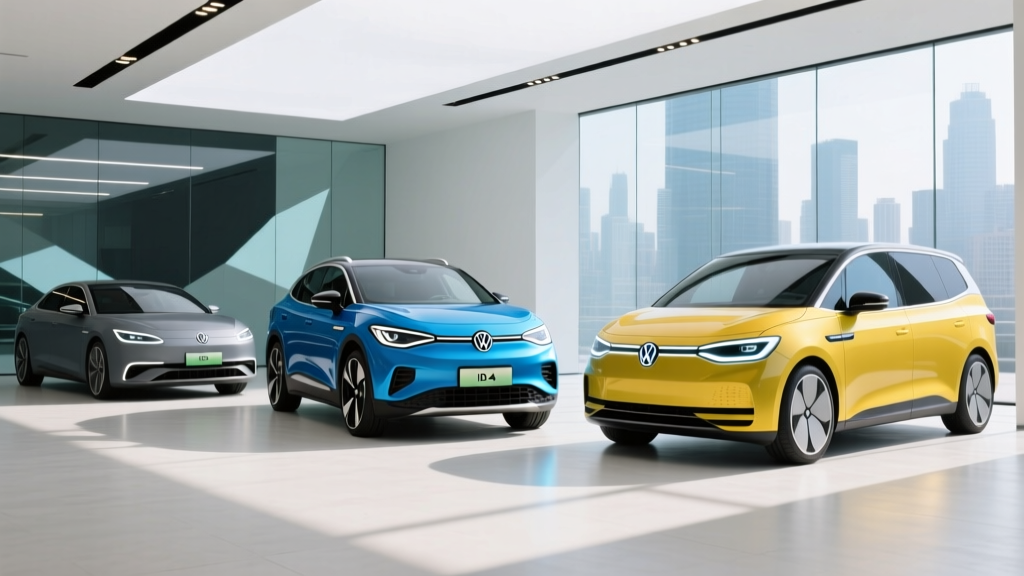
Quick Answer: Volkswagen's 2026 EV lineup centers on three models: the ID.4 compact SUV (EPA 291 mi, from ~$41,990), the ID.7 sedan (EPA 340 mi, from ~$49,990), and the ID. Buzz three-row minivan (EPA 234 mi, from ~$59,995). The ID.4 remains the volume seller and best value, especially if it qualifies for a partial or full federal tax credit under IRS §30D rules. All three use VW's MEB platform with NMC battery chemistry, support DC fast charging up to 175–200 kW depending on model, and have transitioned to the NACS connector for Tesla Supercharger access. If you need three rows and don't mind shorter range, the ID. Buzz is unique in the market. If highway range matters most, the ID.7 sedan is the strongest pick.
The 2026 Volkswagen EV Lineup at a Glance
Volkswagen has committed heavily to electrification through its ID. family, and by the 2026 model year the lineup has matured past early-production growing pains. Software stability has improved significantly over the 2021–2023 ID.4 models that drew criticism for sluggish infotainment, and the addition of the ID.7 sedan and ID. Buzz gives buyers genuine choices across body styles.
Here is how the three current-production models stack up on paper:
| Spec | 2026 ID.4 (Pro S AWD) | 2026 ID.7 (Pro S) | 2026 ID. Buzz (Pro S AWD) |
|---|---|---|---|
| EPA Range | 291 mi | 340 mi | 234 mi |
| Battery (usable) | 82 kWh (NMC) | 86 kWh (NMC) | 91 kWh (NMC) |
| Drivetrain | Dual-motor AWD, 335 hp | RWD, 282 hp | Dual-motor AWD, 335 hp |
| 0–60 mph | 5.4 sec | 6.5 sec | 5.7 sec |
| Peak DC Fast Charge | 175 kW | 200 kW | 175 kW |
| 10–80% DCFC Time | ~28 min | ~26 min | ~30 min |
| Level 2 (AC) Rate | 11 kW | 11 kW | 11 kW |
| Connector | NACS (native) | NACS (native) | NACS (native) |
| MPGe (combined) | 104 MPGe | 115 MPGe | 84 MPGe |
| Cargo (behind 2nd row) | 30.3 cu ft | 18.2 cu ft (trunk) | 75.5 cu ft (2-row config) |
| Base MSRP | $41,990 | $49,990 | $59,995 |
| Battery Warranty | 8 yr / 100,000 mi | 8 yr / 100,000 mi | 8 yr / 100,000 mi |
Sources: fueleconomy.gov, Volkswagen USA.
Real-World Range: What the EPA Sticker Doesn't Tell You
ID.4 (EPA 291 mi): Expect 240–265 mi on highway road trips at 70–75 mph. In freezing temperatures (below 32°F), plan for 195–220 mi. The ID.4's heat pump (standard on Pro S trims) helps, but cold still hits NMC batteries hard.
ID.7 (EPA 340 mi): Highway driving yields roughly 280–305 mi. Cold weather drops this to approximately 230–260 mi. The longer wheelbase and improved aero give the ID.7 a meaningful advantage over the ID.4 on long trips.
ID. Buzz (EPA 234 mi): The boxy shape and 5,000+ lb curb weight hurt efficiency. Highway range lands around 190–210 mi; cold weather can push it below 170 mi. This is a city-and-suburb vehicle, not a road-trip champion.
These real-world figures matter because EPA test cycles include low-speed urban driving and moderate climate control use. If your commute is mostly stop-and-go under 50 mph, you may actually match or exceed EPA numbers. If you drive 75 mph on I-80 in January, you will not.
The ID.4 and ID.7 both benefit from VW's updated thermal management system introduced for 2025, which includes battery preconditioning when you navigate to a DC fast charger. This matters: arriving at a charger with a cold battery can double your 10–80% charge time. Always use the built-in navigation to route to a charger, even if you know the way — it triggers the preconditioning cycle.
Charging Speed and the NACS Transition
For 2026, all Volkswagen EVs sold in the US ship with a native NACS (North American Charging Standard) port. This is a significant shift from the CCS1 connector used on 2021–2024 models, and it means direct access to Tesla's Supercharger network — over 25,000 stalls nationwide — without an adapter.
| Charging Level | Power | Speed (ID.4 approx.) | Best For |
|---|---|---|---|
| Level 1 (120V household) | ~1.4 kW | ~4 mi/hr | Overnight top-up, PHEV-style use |
| Level 2 (240V home/public) | Up to 11 kW | ~32 mi/hr | Daily home charging, full overnight fill |
| DC Fast Charge | Peak 175 kW (ID.4) | ~210 mi in 30 min (peak) | Road trips, quick top-ups |
Charging curve reality: The ID.4's 175 kW peak rate only holds between roughly 10% and 35% state of charge. From 35–60%, it tapers to around 120 kW; from 60–80%, it drops further to 70–90 kW. This is why VW quotes ~28 minutes for 10–80% rather than a simple peak-rate calculation. The ID.7, with its 200 kW peak and slightly improved curve, shaves about 2 minutes off that.
If you are upgrading from a 2022–2024 ID.4 with CCS, note that VW and third-party networks like Electrify America have deployed NACS cables at many stations. For legacy CCS chargers, VW includes a CCS-to-NACS adapter with new vehicles for 2026.
Volkswagen EV vs. Gas and Hybrid: The Cost Breakdown
How does a Volkswagen EV actually compare to a gas-powered Tiguan or a hybrid alternative over five years? Let's run the numbers using the ID.4 Pro S AWD ($41,990 MSRP) against the 2026 Tiguan SE R-Line ($36,500 MSRP) and the 2026 Toyota RAV4 Hybrid XLE ($35,500 MSRP).
| Cost Factor (5 yr / 75,000 mi) | ID.4 Pro S AWD | Tiguan SE R-Line (Gas) | RAV4 Hybrid XLE |
|---|---|---|---|
| Purchase Price (MSRP) | $41,990 | $36,500 | $35,500 |
| Est. Federal Tax Credit (§30D) | Up to $7,500* | $0 | $0 |
| Effective Purchase Price | ~$34,490 | $36,500 | $35,500 |
| Fuel / Electricity (75k mi) | ~$3,750 (home L2, $0.14/kWh avg) | ~$8,440 (28 MPG avg, $3.15/gal) | ~$5,720 (39 MPG avg, $3.15/gal) |
| Maintenance (5 yr est.) | ~$1,200 | ~$3,800 | ~$3,200 |
| Insurance (5 yr est.) | ~$9,500 | ~$7,800 | ~$7,500 |
| 5-Year Total (purchase + fuel + maint. + ins.) | ~$48,940 | ~$56,540 | ~$51,920 |
*Tax credit caveat: The §30D federal EV tax credit has strict eligibility requirements including buyer income caps ($300k joint / $150k single), MSRP caps ($80k for SUVs/vans, $55k for sedans), and battery critical-mineral and component sourcing rules that change annually. As of 2026, the ID.4 is assembled in Emden, Germany — which may affect eligibility depending on current-year sourcing thresholds. Always verify your specific eligibility on irs.gov or consult a tax professional before relying on the credit in your budget.
The ID.4 wins on total cost of ownership primarily through fuel and maintenance savings — electric motors don't need oil changes, transmission fluid, or spark plugs. However, insurance costs run 15–25% higher for EVs, which partially offsets the savings. If you cannot charge at home and must rely on public DC fast charging at $0.35–$0.50/kWh, your fuel cost jumps to roughly $6,500–$9,000 over five years, narrowing the gap considerably.
Tax Credits, Incentives, and What They Actually Mean for VW
§30D Federal EV Tax Credit Checklist (2026 rules):
- Income cap: Modified AGI ≤ $300,000 (joint) / $225,000 (head of household) / $150,000 (single)
- MSRP cap: ≤ $80,000 for SUVs and vans (ID.4, ID. Buzz) / ≤ $55,000 for sedans (ID.7)
- Battery sourcing: Critical minerals and battery components must meet escalating percentage thresholds from qualified trade partners — these thresholds increase each year through 2032
- Assembly: Final assembly must occur in North America unless the vehicle qualifies under a commercial-lease transfer provision
- Point-of-sale transfer: Eligible buyers can transfer the credit to the dealer at purchase, reducing the sale price directly rather than waiting for a tax refund
- One-time use: You can only claim the credit once per vehicle (VIN-locked), and you're limited to one new EV credit and one used EV credit per 3-year period
The ID.4's German assembly has been a recurring eligibility issue since the §30D rules took effect. Volkswagen has not announced a US-built ID.4 for 2026 (the Chattanooga, TN plant focuses on the ICE Atlas and other models). This means the ID.4's federal credit eligibility depends entirely on whether the battery sourcing requirements are met — and those requirements tighten annually. The ID.7 sedan, with its $49,990 base price, clears the $55,000 sedan MSRP cap, but faces the same assembly and sourcing hurdles.
The ID. Buzz, as a van, falls under the $80,000 MSRP cap and may have more flexibility — but again, assembly location and battery sourcing are the gatekeepers. Some buyers have used the commercial lease loophole (where the credit goes to the lessor and is passed through as a lease reduction) to capture value even when purchase eligibility is uncertain. Check current rules before committing.
Common Volkswagen EV Misconceptions
| Myth | Fact |
|---|---|
| "VW's EV software is still broken." | The ID.Software 4.0 update (rolled out through 2025–2026) significantly improved responsiveness, navigation accuracy, and over-the-air reliability. It's not Tesla-grade, but the freezing and lag complaints from 2022–2023 models are largely resolved. |
| "The ID.4 can't road-trip because of slow charging." | At 175 kW peak with NACS Supercharger access, the ID.4 adds roughly 150 miles in 20 minutes at a V3 or V4 Supercharger. That's adequate for 2–3 hour driving intervals with 20-minute breaks. |
| "EV batteries need replacing after 5 years." | VW's battery warranty guarantees ≥70% capacity retention for 8 years or 100,000 miles. Real-world degradation data from early 2021 ID.4 owners shows roughly 6–9% loss at 60,000 miles — well within warranty. NMC chemistry is proven through hundreds of thousands of MEB-platform vehicles globally. |
| "You can't charge a VW EV at a Tesla Supercharger." | 2026 models with native NACS ports charge directly at Superchargers. For 2021–2024 CCS-equipped models, VW provides a CCS-to-NACS adapter, and Tesla has enabled Supercharger access for non-Tesla NACS vehicles. |
| "The ID. Buzz has the same range as the ID.4." | Despite a larger 91 kWh battery, the ID. Buzz's boxy aerodynamics and heavy curb weight limit it to 234 mi EPA — 57 miles less than the ID.4. Physics wins. |
First-Time VW EV Buyer: What You Actually Need to Know
If you're coming from a gas Tiguan or Atlas, here are the ownership realities that no brochure will emphasize:
Home charging is the make-or-break factor. A Level 2 home charger (240V, 40–48 amp circuit) delivers a full overnight charge in 7–9 hours and costs $500–$1,500 for the unit plus $800–$2,500 for professional installation, depending on your electrical panel capacity. If your panel is 100-amp and already near capacity, a panel upgrade to 200 amps can add $1,500–$3,500. Without home charging, you'll rely on public Level 2 or DC fast charging — which costs 2–4× more per mile and adds weekly time overhead.
Regenerative braking takes a week to learn. VW's ID. models offer adjustable regen via steering-wheel paddles (D, B mode, and three regen levels). B mode enables near-one-pedal driving in city traffic, but VW's regen isn't as aggressive as Nissan Leaf or Chevrolet Bolt. You'll still use the friction brake pedal for final stops. Plan on eating through brake pads far less often — most EV owners report 80,000+ miles on original pads.
Cold weather is real, and it's measurable. If you live in the upper Midwest or Northeast, expect 25–35% range loss in sustained sub-freezing temperatures. The heat pump on Pro S trims helps cabin efficiency, but battery chemistry (NMC) inherently loses capacity and charge acceptance rate in the cold. Preconditioning while plugged in mitigates this — always schedule departure times in the VW app.
Insurance will cost more. EV insurance premiums run 15–25% higher than equivalent gas vehicles, driven by higher repair costs (specialized body shops, battery protection protocols) and higher replacement values. Get quotes from Geico, Progressive, and State Farm before signing a purchase agreement — the difference between insurers can be $400–$800/year.
Decision Framework: Which Volkswagen EV Is Right for You?
Choose the ID.4 if: You want the most affordable entry point, need a compact SUV footprint, drive under 300 miles between charges, and value access to the Supercharger network for occasional road trips.
Choose the ID.7 if: Highway range is your top priority, you prefer a sedan's driving dynamics and efficiency (115 MPGe vs. 104 MPGe), and you're willing to pay ~$8,000 more for ~50 extra miles of EPA range.
Choose the ID. Buzz if: You need three rows of seating and the sliding-door minivan convenience, your daily driving is under 150 miles, and you accept the range penalty of a heavy, boxy vehicle. There is no other electric minivan in this price class.
Look elsewhere if: You need 350+ miles of real-world highway range (consider the Hyundai Ioniq 6 or Tesla Model 3 Long Range), you want the cheapest possible EV (the Chevrolet Equinox EV starts ~$8,000 lower), or you need a truck bed (Rivian R1T or Ford F-150 Lightning).
Frequently Asked Questions
Does the 2026 Volkswagen ID.4 qualify for the $7,500 federal tax credit?
It depends on current-year §30D battery sourcing requirements and your personal income. The ID.4 is assembled in Germany, which does not automatically disqualify it (final assembly in North America is not required for all credit components), but the critical-mineral and battery-component sourcing thresholds must be met. These thresholds increase each year. Verify eligibility at irs.gov or ask your VW dealer for the latest IRS compliance letter for the specific VIN.
How long does it take to charge a VW ID.4 at home?
On a Level 2 home charger (240V, 48-amp, delivering ~11 kW to the vehicle), a full 0–100% charge takes approximately 8.5 hours. Most owners charge from 20% to 80% overnight, which takes about 4.5 hours. On a standard 120V outlet (Level 1), expect roughly 4 miles of range per hour of charging — adequate only for low-mileage drivers or PHEV-style use.
Is the Volkswagen ID. Buzz practical for families?
Yes, with caveats. The ID. Buzz offers 75.5 cu ft of cargo volume in two-row configuration and three rows of seating for up to seven passengers. The sliding doors and flat floor are excellent for child seats and gear. However, the 234-mile EPA range means frequent charging stops on road trips, and at ~$60,000 MSRP, it is significantly more expensive than a gas Chrysler Pacifica Hybrid (which offers 32 miles of electric-only range plus gas backup). If your family road-trips frequently, the range limitation is real.
How does VW's EV reliability compare to Tesla or Hyundai?
Volkswagen's MEB platform reliability has improved since the rough 2021–2022 launch years. The most common issues reported to NHTSA involve 12V battery drain (a known issue addressed via software updates) and early infotainment glitches. Mechanical reliability of the electric drivetrain itself is strong — electric motors have far fewer moving parts than internal combustion engines. In owner surveys, Hyundai/Kia's E-GMP platform and Tesla's Model Y tend to score slightly higher on initial quality, but VW has closed the gap substantially by 2026.
What happens if my VW EV battery degrades past 70%?
Volkswagen's high-voltage battery warranty covers capacity below 70% for 8 years or 100,000 miles, whichever comes first. If your battery falls below that threshold within the warranty period, VW will repair or replace it at no cost. Out of warranty, a full battery replacement for the ID.4 is estimated at $12,000–$18,000 depending on labor and parts availability. However, real-world data from early MEB vehicles suggests most batteries retain 85–92% capacity at 100,000 miles under normal use — well above the warranty floor.