The Short Answer on Volkswagen EVs in 2026
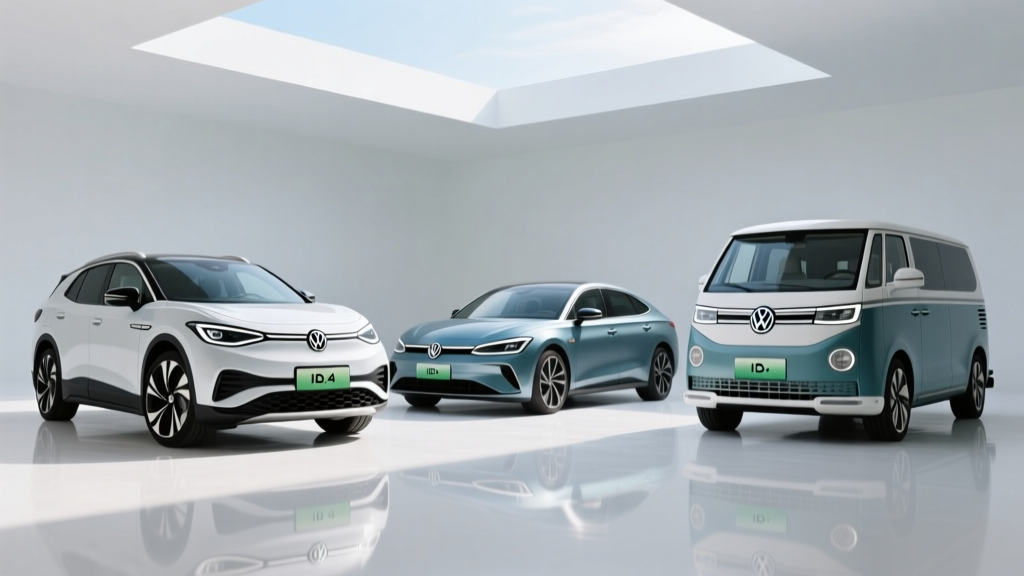
Volkswagen's current US electric lineup spans three distinct models: the ID.4 compact SUV (starting ~$39,735, EPA range up to 291 miles), the ID.7 sedan (starting ~$49,995, EPA range up to 342 miles), and the ID.Buzz three-row electric van (starting ~$59,995, EPA range up to 234 miles). All three use the MEB platform with NMC battery chemistry and now feature NACS charging ports native, granting access to Tesla Superchargers without adapters. For most buyers, the ID.4 Pro S offers the strongest value proposition — a practical family crossover with competitive range and a realistic shot at the §30D federal tax credit depending on your income and the vehicle's battery sourcing compliance for the current tax year.
Volkswagen's 2026 EV Lineup at a Glance
VW has committed heavily to electrification, but the US market gets a focused trio rather than the full European catalog. Each model targets a different buyer profile, and the specs tell very different stories.
| Spec | ID.4 Pro S (AWD) | ID.7 Pro S | ID.Buzz 1st Edition |
|---|---|---|---|
| Base MSRP | $43,735 | $49,995 | $59,995 |
| EPA Range | 263 mi | 342 mi | 234 mi |
| Battery (usable) | 82 kWh (NMC) | 86 kWh (NMC) | 91 kWh (NMC) |
| Horsepower | 335 hp | 339 hp | 330 hp (AWD) |
| 0-60 mph | 5.4 sec | 5.1 sec | 6.5 sec |
| Peak DC Fast Charge | 175 kW | 200 kW | 175 kW |
| 10-80% DC Time | ~28 min | ~26 min | ~30 min |
| Level 2 Rate | 11 kW | 11 kW | 11 kW |
| Charging Port | NACS (native) | NACS (native) | NACS (native) |
| MPGe (combined) | 104 MPGe | 115 MPGe | 81 MPGe |
| Battery Warranty | 8 yr / 100,000 mi | 8 yr / 100,000 mi | 8 yr / 100,000 mi |
Real-World Range Reality Check
EPA numbers are a starting point, not a guarantee. Here's what to actually expect from VW's MEB platform in daily driving:
- ID.4 Pro S AWD: EPA 263 mi → expect 220-240 mi on highway road trips at 70+ mph; 180-200 mi in sub-30°F winter conditions.
- ID.7 Pro S: EPA 342 mi → expect 285-310 mi highway; 240-270 mi in cold weather. The sedan's superior aerodynamics (lower drag coefficient) make a meaningful difference at highway speed.
- ID.Buzz AWD: EPA 234 mi → expect 190-210 mi highway; 160-180 mi cold. The Buzz's boxy shape and heavy curb weight punish highway efficiency.
Source: Cross-referenced with fueleconomy.gov EV testing data and real-world owner reports.
Volkswagen EV vs. Gas and Hybrid: The Cost Equation
Shopping a Volkswagen EV means cross-shopping against VW's own gas models (Tiguan, Atlas) and hybrids, as well as competitors. Let's run the numbers on the most common comparison: the ID.4 versus a similarly equipped Tiguan SEL.
| Factor | ID.4 Pro S AWD | Tiguan SEL 4Motion (Gas) |
|---|---|---|
| MSRP (approx.) | $43,735 | $39,500 |
| Federal Tax Credit (§30D) | Up to $7,500 (see eligibility) | $0 |
| Effective Purchase Price | ~$36,235 | $39,500 |
| Fuel/Energy Cost (15,000 mi/yr) | $540-$780 (home charging) | $2,100-$2,400 |
| Maintenance (annual avg.) | $200-$400 | $800-$1,200 |
| Insurance (annual avg.) | $1,800-$2,400 | $1,400-$1,900 |
| 5-Year Fuel/Energy Total | $2,700-$3,900 | $10,500-$12,000 |
| 5-Year Maintenance Total | $1,000-$2,000 | $4,000-$6,000 |
The math favors the ID.4 heavily if you qualify for the full §30D credit and charge primarily at home. Over five years and 75,000 miles, total operating cost savings can reach $8,000-$12,000 even accounting for higher EV insurance premiums. If you don't qualify for the credit (income caps, MSRP caps, or battery sourcing rules), the break-even timeline extends to roughly 6-7 years depending on local electricity rates.
Charging the Volkswagen EV Fleet: What You Need to Know
VW's 2026 models ship with native NACS ports, meaning you can plug directly into Tesla Superchargers (now open to non-Tesla EVs) as well as Electrify America, EVgo, and other networks with NACS connectors. This is a significant advantage over the CCS1 port used on 2021-2024 ID.4 models.
| Charging Level | Power | Miles Added per Hour | Best Use Case |
|---|---|---|---|
| Level 1 (120V) | 1.2-1.4 kW | 3-4 mi/hr | Emergency / overnight trickle |
| Level 2 (240V, 48A) | 11 kW | 30-37 mi/hr | Daily home charging (full overnight) |
| DC Fast (peak) | 175-200 kW | ~10 mi/min at peak | Road trips, 10-80% in 26-30 min |
Charging curve reality: VW's MEB platform peaks at its maximum kW only between roughly 10-30% State of Charge (SoC). Above 50%, the rate tapers significantly. A "28-minute" 10-80% charge assumes optimal battery preconditioning (which the ID.4/ID.7 handle automatically when you navigate to a charger). Without preconditioning — say, arriving at a charger with a cold-soaked battery — expect 35-45 minutes for the same session.
Home charging setup: All three VW EVs accept up to 11 kW on Level 2 (48 amps on a 60-amp circuit). A typical home installation runs $800-$2,500 for the charger and electrical work if your panel has capacity. If you need a panel upgrade from 100A to 200A service, add $1,500-$3,500. Consult a licensed electrician for your specific situation.
Federal Tax Credit Eligibility for VW EVs
The §30D Clean Vehicle Credit remains a moving target due to evolving battery sourcing and critical mineral requirements. Here's the current framework for 2026:
§30D Requirements Checklist
- MSRP Cap: SUVs/vans must be under $80,000; sedans under $55,000. The ID.4 and ID.Buzz qualify on price. The ID.7 sedan at $49,995 base also qualifies, but higher trims may push past the $55,000 sedan cap.
- Buyer Income Cap: AGI must not exceed $300,000 (joint), $225,000 (head of household), or $150,000 (single).
- Battery Sourcing: The credit splits into two halves — $3,750 for critical minerals and $3,750 for battery component manufacturing. VW has worked to localize its supply chain, but the exact credit amount varies by model year and production batch. Check the IRS's official list at irs.gov qualified vehicles.
- Point-of-Sale Transfer: You can transfer the credit to the dealer at purchase, reducing your out-of-pocket cost immediately rather than waiting for tax filing.
- Final Assembly: Must occur in North America. The ID.4 is built in Chattanooga, TN. The ID.7 and ID.Buzz are imported — verify current assembly location as it may affect eligibility.
Critical caveat: The ID.7 and ID.Buzz may face partial or full credit disqualification depending on battery component sourcing rules and final assembly location. Always verify on the IRS website and with your tax professional before counting on the full $7,500.
Common Volkswagen EV Misconceptions
| Myth | Fact |
|---|---|
| "The ID.4 software is still broken." | VW's ID.Software 4.0 (rolled out across the fleet) resolved the major infotainment lag and touch-slider complaints of 2021-2023 models. The 2026 system is responsive and stable. |
| "VW batteries degrade quickly." | MEB platform NMC batteries show 5-8% degradation at 100,000 miles based on European fleet data. VW warrants 70% capacity retention at 8 years/100,000 miles — a conservative floor, not an expectation. |
| "You can't road-trip a VW EV." | With native NACS and access to the Supercharger network (17,000+ stalls), road-tripping is straightforward. Plan 20-minute stops every 180-220 miles in the ID.4. |
| "EV insurance is unaffordable." | Premiums are 15-25% higher on average vs. gas equivalents, but the gap has narrowed. Shop multiple carriers — some now offer EV-specific discounts. |
| "Cold weather destroys range." | Expect 20-30% loss in sub-freezing temps. The ID.4/ID.7 have heat pumps (standard on Pro S trims), which reduce HVAC energy draw by ~30% vs. resistive heating. |
Decision Framework: Which Volkswagen EV Is Right for You?
Choose the ID.4 If:
- You need a compact family SUV with cargo space (30.3 cu ft rear, 64.2 cu ft folded)
- Your daily commute is under 80 miles round-trip
- You want the lowest entry price in VW's EV lineup
- You value US assembly (Chattanooga, TN) for potential tax credit strength
- You'll charge at home 90%+ of the time
Choose the ID.7 If:
- Range is your top priority (342 mi EPA is VW's best)
- You prefer sedan driving dynamics and efficiency (115 MPGe)
- You regularly take highway trips and want fewer charging stops
- You want the latest MEB+ platform refinements
Choose the ID.Buzz If:
- You need three rows and seating for 7
- You want a lifestyle/road-trip vehicle with massive interior volume
- Range is secondary to space and character
- Budget is flexible ($60K+ before options)
Look Elsewhere If:
- You need 350+ miles of range → consider Hyundai Ioniq 6 or Tesla Model 3 Long Range
- You need the fastest DC charging → Hyundai/Kia E-GMP platform (240+ kW peak) or Tesla Model Y (250 kW)
- You want a compact EV under $35K → VW doesn't currently compete here in the US
Ownership Costs: 5-Year Breakdown
| Cost Category | ID.4 Pro S AWD | ID.7 Pro S | ID.Buzz 1st Ed. |
|---|---|---|---|
| Purchase Price (MSRP) | $43,735 | $49,995 | $59,995 |
| Est. Tax Credit | -$3,750 to $7,500 | -$0 to $7,500 | -$0 to $7,500 |
| Home Charger Install | $1,200-$2,500 | $1,200-$2,500 | $1,200-$2,500 |
| 5-Yr Energy (home) | $2,700-$3,900 | $2,300-$3,400 | $3,500-$4,800 |
| 5-Yr Maintenance | $1,000-$2,000 | $1,000-$2,000 | $1,200-$2,200 |
| 5-Yr Insurance | $9,000-$12,000 | $9,500-$13,000 | $10,000-$14,000 |
| Est. 5-Yr Depreciation | $14,000-$18,000 | $16,000-$21,000 | $18,000-$24,000 |
| 5-Yr Total Cost | $55,000-$72,000 | $62,000-$80,000 | $74,000-$96,000 |
Depreciation remains the wildcard. VW EVs have historically depreciated more steeply than Tesla or Hyundai/Kia equivalents, though the NACS adoption and software improvements may stabilize residual values for 2025+ models. Check IIHS ratings for safety performance, which influences both insurance costs and resale value.
Frequently Asked Questions
Is the Volkswagen ID.4 a reliable EV?
Early 2021-2022 ID.4 models had software and 12V battery issues that VW addressed through recalls and OTA updates. The 2025-2026 models with ID.Software 4.0 are substantially more refined. Long-term powertrain reliability data from European fleets (where the ID.4 has sold since 2020) shows the MEB drivetrain to be durable, with motor and battery failure rates well below 1% at 100,000 miles.
Can I charge a VW EV at Tesla Superchargers?
Yes. 2025 and 2026 VW EVs come with native NACS ports, meaning direct Supercharger access without an adapter. For 2021-2024 ID.4 owners with CCS1 ports, VW and third parties offer CCS-to-NACS adapters (~$200-$250), though charge speeds may be slightly reduced.
What's the real cost to charge a VW ID.4 at home?
With a national average electricity rate of $0.16/kWh and the ID.4's 82 kWh battery, a full charge costs roughly $13.12. For 15,000 miles of annual driving at 3.0 mi/kWh efficiency, you'll use about 5,000 kWh per year, costing approximately $800 annually — versus $2,200+ for gas in a comparable Tiguan.
Does the ID.7 qualify for the $7,500 tax credit?
It depends on the trim (must stay under $55,000 MSRP for sedan classification), your income, and the specific battery sourcing of the unit you purchase. The base Pro trim at ~$49,995 is positioned to qualify, but always verify on the IRS qualified vehicle list before purchasing.
How does VW's battery warranty compare to competitors?
VW offers 8 years/100,000 miles with a 70% capacity retention guarantee. This matches Hyundai/Kia and Tesla, though some competitors guarantee 70% while others (like Rivian) guarantee 60%. The 70% threshold is the industry standard and reflects a conservative floor — most MEB batteries retain 90%+ at this mileage based on fleet data.
Should I buy a VW EV or a Hyundai Ioniq 5?
The Ioniq 5 offers faster DC charging (240 kW peak vs. 175 kW), slightly more range on equivalent battery sizes, and a more distinctive design. The ID.4 counters with a more traditional SUV driving feel, US assembly (better tax credit odds), and a slightly lower starting price. If fast road-trip charging is your priority, the Ioniq 5 wins. If you want a no-surprises family hauler with strong tax credit eligibility, the ID.4 is the safer bet.